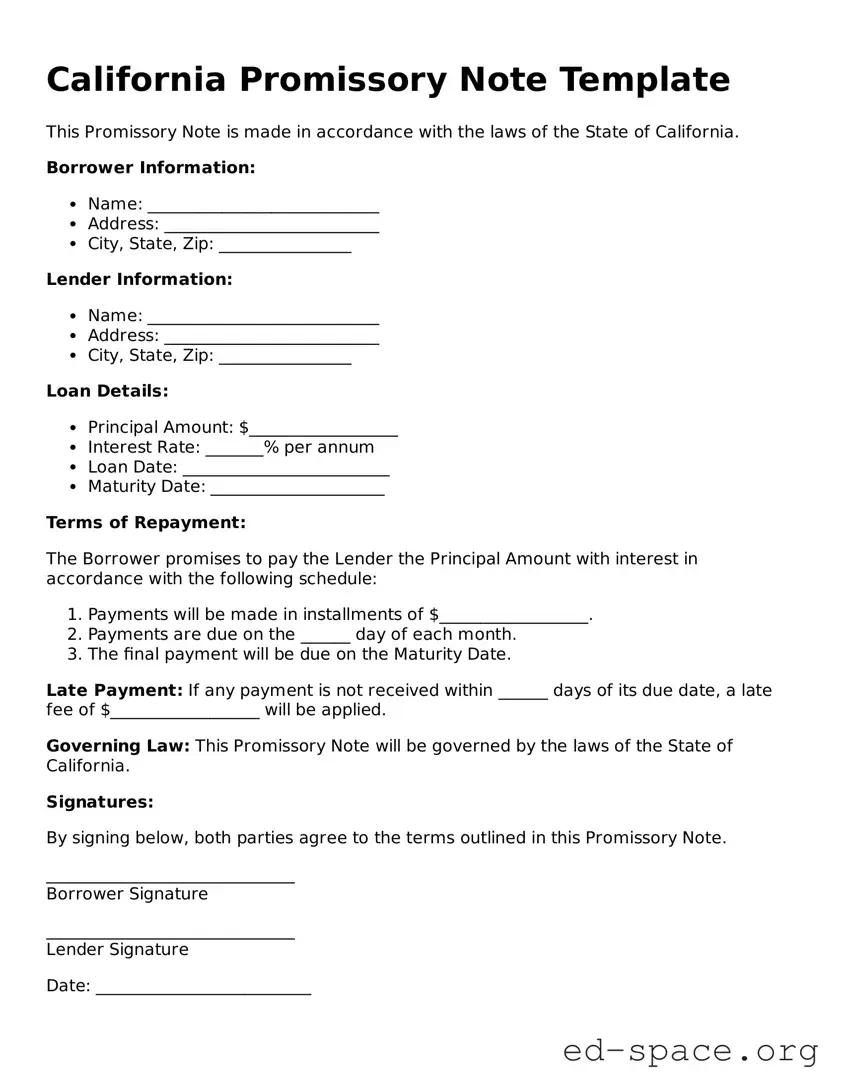
In the realm of financial transactions, a California Promissory Note serves as a crucial instrument for establishing clear terms between borrowers and lenders. This legally binding document outlines the borrower's commitment to repay a specified amount of money to the lender, detailing essential aspects such as the principal amount, interest rate, payment schedule, and the consequences of default. By articulating these terms, the Promissory Note fosters transparency and trust, ensuring that both parties understand their rights and obligations. Additionally, it may include provisions for prepayment, collateral, and governing law, providing further clarity and security for the lender. Understanding the nuances of this form is vital for anyone engaged in borrowing or lending money in California, as it not only protects the interests of the lender but also provides the borrower with a clear roadmap for repayment. As financial needs evolve, having a well-drafted Promissory Note can be a key factor in facilitating successful transactions and maintaining positive relationships between parties.
California Promissory Note Template
This Promissory Note is made in accordance with the laws of the State of California.
Borrower Information:
Lender Information:
Loan Details:
Terms of Repayment:
The Borrower promises to pay the Lender the Principal Amount with interest in accordance with the following schedule:
Late Payment: If any payment is not received within ______ days of its due date, a late fee of $__________________ will be applied.
Governing Law: This Promissory Note will be governed by the laws of the State of California.
Signatures:
By signing below, both parties agree to the terms outlined in this Promissory Note.
______________________________
Borrower Signature
______________________________
Lender Signature
Date: __________________________
| Fact Name | Description |
|---|---|
| Definition | A California Promissory Note is a written promise to pay a specified amount of money to a designated person or entity at a future date or on demand. |
| Governing Laws | The California Civil Code, particularly sections 1901-1910, governs promissory notes in the state. |
| Types | Promissory notes can be either secured or unsecured, depending on whether collateral is provided. |
| Interest Rates | California allows parties to agree on an interest rate, but it cannot exceed the maximum rate set by law, which is typically 10% per annum. |
| Enforceability | For a promissory note to be enforceable, it must be signed by the borrower and contain essential terms, such as the amount, interest rate, and payment schedule. |
| Default Consequences | If the borrower defaults, the lender may pursue legal action to recover the owed amount, including possible foreclosure on any collateral if the note is secured. |
After gathering all necessary information, you are ready to complete the California Promissory Note form. This document outlines the terms of a loan agreement between a borrower and a lender. Follow the steps below to fill out the form accurately.
Once you have completed the form, review it for accuracy. Make copies for both parties and keep the original in a safe place. This ensures that both the borrower and lender have a record of the agreement.
What is a California Promissory Note?
A California Promissory Note is a written promise to pay a specific amount of money to a designated person or entity at a specified time or on demand. This legal document outlines the terms of the loan, including the interest rate, repayment schedule, and any penalties for late payments. It serves as a record of the loan agreement between the borrower and lender, ensuring that both parties understand their rights and responsibilities.
Who can use a California Promissory Note?
Any individual or business can use a California Promissory Note as long as they are engaged in a legitimate lending agreement. This includes personal loans between friends or family members, business loans, or loans for real estate transactions. It's important for both parties to be clear about the terms of the agreement to avoid misunderstandings in the future.
What are the key components of a California Promissory Note?
A well-structured California Promissory Note should include several key components: the names and addresses of both the borrower and lender, the principal amount of the loan, the interest rate, the repayment schedule, and any late fees or penalties. Additionally, it should specify whether the loan is secured or unsecured and include any relevant terms regarding prepayment or default.
Is a California Promissory Note legally binding?
Yes, a California Promissory Note is legally binding once it is signed by both parties. This means that if the borrower fails to repay the loan according to the agreed terms, the lender has the right to take legal action to recover the owed amount. To strengthen the enforceability of the note, it is advisable to have it notarized, although this is not a legal requirement.
Can a California Promissory Note be modified after it is signed?
Yes, a California Promissory Note can be modified after it is signed, but both parties must agree to the changes. It is best practice to document any modifications in writing and have both parties sign the revised agreement. This helps to prevent disputes and ensures that everyone is on the same page regarding the new terms.
Incorrect Borrower Information: Many people fail to provide accurate details about the borrower. This includes the full name, address, and sometimes even the social security number. Missing or incorrect information can lead to confusion or legal issues later.
Not Specifying the Loan Amount: Some individuals neglect to clearly state the amount of money being borrowed. This is crucial, as it defines the obligations of the borrower. Without a specified amount, it can be difficult to enforce the terms of the loan.
Omitting the Interest Rate: Forgetting to include the interest rate is a common mistake. The interest rate affects how much the borrower will ultimately pay back. If it’s not mentioned, the loan may be considered interest-free, which is rarely the intention.
Ignoring Payment Terms: Failing to outline the payment schedule can lead to misunderstandings. It's important to specify when payments are due, how much each payment will be, and the method of payment. Clear terms help both parties understand their responsibilities.
When dealing with a California Promissory Note, several other documents may accompany it to ensure clarity and legality in the transaction. Each of these documents serves a specific purpose and can help protect the interests of both parties involved.
Utilizing these documents alongside the California Promissory Note can help ensure a smoother transaction and protect the rights of all parties involved. It’s essential to understand each document's role to navigate the lending process effectively.
When filling out the California Promissory Note form, there are important steps to follow. Here are some guidelines to help you complete the form correctly.
Following these guidelines will help ensure that your Promissory Note is completed properly. Taking the time to do it right can prevent misunderstandings in the future.
Misconceptions about the California Promissory Note form can lead to confusion. Here are five common misunderstandings:
Understanding these misconceptions can help individuals navigate the use of promissory notes more effectively.
When filling out and utilizing the California Promissory Note form, it is important to keep several key points in mind. Understanding these elements can help ensure clarity and enforceability in your agreement.
By adhering to these guidelines, both borrowers and lenders can foster a clear understanding of their financial commitments, leading to a smoother transaction process.