Homepage Free Prenuptial Agreement Form for California
Content Overview

Planning for a future together is an exciting part of any relationship, and a California prenuptial agreement can help couples navigate the complexities of marriage. This legal document outlines how assets and debts will be managed in the event of a divorce or separation. It allows partners to specify their individual rights and responsibilities, providing clarity and protection for both parties. Key aspects of the form include the identification of separate and community property, financial disclosures, and provisions for spousal support. By discussing these topics openly, couples can foster a sense of trust and understanding, ensuring that they are on the same page before tying the knot. In California, the process of creating a prenuptial agreement is straightforward, but it’s important to follow the legal requirements to ensure that the agreement is enforceable. With the right approach, a prenuptial agreement can serve as a valuable tool for a healthy and transparent marriage.

Document Preview

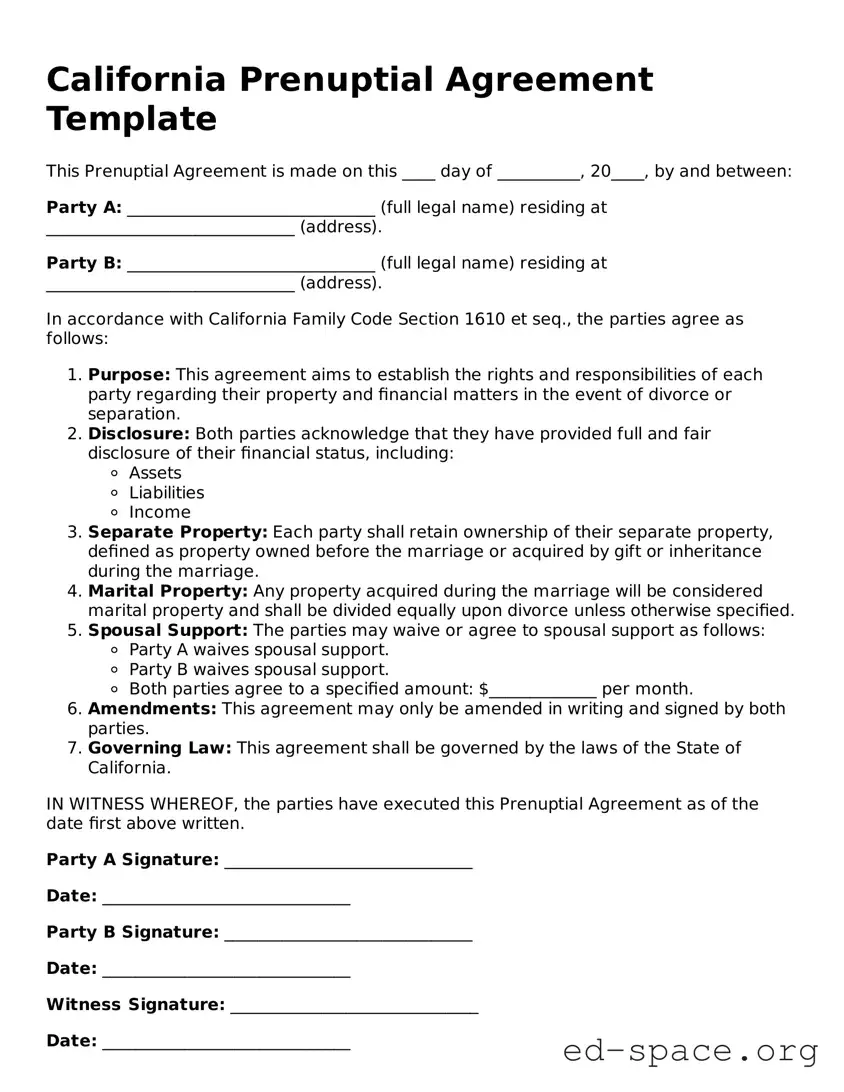
California Prenuptial Agreement Template

This Prenuptial Agreement is made on this ____ day of __________, 20____, by and between:

Party A: ______________________________ (full legal name) residing at ______________________________ (address).

Party B: ______________________________ (full legal name) residing at ______________________________ (address).

In accordance with California Family Code Section 1610 et seq., the parties agree as follows:

  1. Purpose: This agreement aims to establish the rights and responsibilities of each party regarding their property and financial matters in the event of divorce or separation.
  2. Disclosure: Both parties acknowledge that they have provided full and fair disclosure of their financial status, including:
    • Assets
    • Liabilities
    • Income
  3. Separate Property: Each party shall retain ownership of their separate property, defined as property owned before the marriage or acquired by gift or inheritance during the marriage.
  4. Marital Property: Any property acquired during the marriage will be considered marital property and shall be divided equally upon divorce unless otherwise specified.
  5. Spousal Support: The parties may waive or agree to spousal support as follows:
    • Party A waives spousal support.
    • Party B waives spousal support.
    • Both parties agree to a specified amount: $_____________ per month.
  6. Amendments: This agreement may only be amended in writing and signed by both parties.
  7. Governing Law: This agreement shall be governed by the laws of the State of California.

IN WITNESS WHEREOF, the parties have executed this Prenuptial Agreement as of the date first above written.

Party A Signature: ______________________________

Date: ______________________________

Party B Signature: ______________________________

Date: ______________________________

Witness Signature: ______________________________

Date: ______________________________

PDF Form Details

Fact Name Details
Governing Law The California Prenuptial Agreement is governed by the California Family Code, specifically Sections 1600-1617.
Purpose This agreement outlines the division of assets and responsibilities in the event of divorce or separation.
Requirements Both parties must voluntarily enter into the agreement, and it must be in writing and signed by both individuals.
Disclosure Full financial disclosure is required to ensure that both parties understand each other's financial situation before signing.

California Prenuptial Agreement: Usage Guidelines

Completing the California Prenuptial Agreement form requires careful attention to detail. This process helps ensure that both parties understand their rights and responsibilities before entering into marriage. Here are the steps to fill out the form effectively.

  1. Begin by gathering personal information for both parties. This includes full names, addresses, and contact information.
  2. Clearly state the date on which the agreement is being made.
  3. List any assets owned by each party. This includes property, bank accounts, investments, and any other significant items of value.
  4. Identify any debts that each party may have. This is important for transparency and future financial planning.
  5. Discuss and outline how assets and debts will be handled during the marriage and in the event of a divorce.
  6. Include any provisions for spousal support, if applicable. Both parties should agree on this aspect.
  7. Sign and date the agreement in the presence of a notary public. This step is crucial for the document's legal validity.
  8. Make copies of the signed agreement for both parties to keep for their records.

Once the form is completed and signed, both parties should review the document to ensure that it accurately reflects their intentions and agreements. Properly executed, this agreement can provide clarity and protection for both individuals as they enter into marriage.

Your Questions, Answered

What is a prenuptial agreement in California?

A prenuptial agreement, often referred to as a "prenup," is a legal contract created by two individuals before they get married. This agreement outlines how assets and debts will be divided in the event of divorce or separation. In California, such agreements can also address spousal support and other financial matters. It is crucial for both parties to fully disclose their financial situations and to understand the terms of the agreement to ensure it is enforceable in court.

What are the requirements for a valid prenuptial agreement in California?

For a prenuptial agreement to be considered valid in California, several key requirements must be met. First, both parties must enter into the agreement voluntarily, without any coercion. Second, the agreement must be in writing and signed by both parties. Additionally, full disclosure of assets and liabilities is necessary. Finally, the agreement should be fair and reasonable at the time of signing. If any of these conditions are not met, the agreement may be challenged in court.

Can a prenuptial agreement be modified or revoked after marriage?

Yes, a prenuptial agreement can be modified or revoked after marriage. To do this, both parties must agree to the changes, and the new terms must be documented in writing and signed by both individuals. It is advisable to consult with legal counsel during this process to ensure that the modifications are enforceable. If either party wishes to revoke the agreement entirely, they must also do so in writing, with both parties' consent.

What happens if a prenuptial agreement is not in place?

If a couple does not have a prenuptial agreement in place and they later divorce, California's community property laws will govern the division of assets and debts. This means that most property acquired during the marriage will be considered jointly owned and divided equally. Without a prenup, individuals may have less control over how their assets are distributed, which can lead to disputes and complications during the divorce process. Therefore, having a prenuptial agreement can provide clarity and protection for both parties.

Common mistakes

  1. Failing to fully disclose assets and debts. Transparency is crucial. Both parties should provide a complete picture of their financial situations.

  2. Not seeking legal advice. It’s wise to consult with a lawyer who specializes in family law. They can help navigate the complexities of the agreement.

  3. Using vague language. Specificity matters. Clear and precise terms can prevent misunderstandings later.

  4. Not considering future changes. Life circumstances can shift. Addressing how the agreement will adapt to changes is essential.

  5. Ignoring state laws. Each state has different requirements for prenuptial agreements. Familiarity with California’s laws is necessary.

  6. Failing to sign the agreement in front of a notary. Proper execution is important for the agreement to be enforceable.

  7. Not discussing the agreement openly. Open communication fosters understanding and can strengthen the relationship.

  8. Overlooking the importance of timing. Completing the agreement well in advance of the wedding can prevent last-minute stress.

  9. Neglecting to review the agreement periodically. As life evolves, so should the agreement. Regular reviews can ensure it remains relevant.

Documents used along the form

When preparing for a marriage, couples often consider a prenuptial agreement to clarify financial matters and protect individual assets. Alongside this important document, several other forms and documents may be necessary to ensure a comprehensive understanding of each party's rights and responsibilities. Below is a list of these documents, each serving a unique purpose in the context of marriage and financial planning.

  • Financial Disclosure Statement: This document requires both parties to provide a detailed account of their assets, liabilities, income, and expenses. Transparency is crucial, as it helps ensure that both individuals are fully informed before signing the prenuptial agreement.
  • Property Settlement Agreement: Often used in the event of divorce, this agreement outlines how property and debts will be divided. It can be beneficial to establish terms that may come into play if the marriage does not last.
  • Postnuptial Agreement: Similar to a prenuptial agreement, this document is created after marriage. It can address changes in circumstances or clarify financial responsibilities that may arise during the marriage.
  • Will: A will details how an individual’s assets will be distributed upon their death. Couples may want to update their wills to reflect their marital status and any shared assets.
  • Trust Documents: Trusts can be established to manage and protect assets for the benefit of one or more beneficiaries. This may be particularly relevant for couples with children from previous relationships.
  • Power of Attorney: This document allows one person to make legal and financial decisions on behalf of another if they become incapacitated. It is essential for ensuring that a spouse can manage their partner's affairs if necessary.
  • Health Care Proxy: This document designates someone to make medical decisions on behalf of another person if they are unable to do so themselves. It can be particularly important in emergencies or serious health situations.
  • Marital Settlement Agreement: If a couple decides to separate or divorce, this agreement outlines the terms of the separation, including custody, support, and property division. It can help streamline the divorce process.

Each of these documents plays a significant role in the overall financial and legal planning for couples. Understanding their importance can help individuals make informed decisions that protect their interests and foster a healthy partnership.

Similar forms

  • Postnuptial Agreement: Similar to a prenuptial agreement, a postnuptial agreement is created after marriage. It outlines the division of assets and responsibilities in case of divorce or separation.
  • Separation Agreement: This document is used when a couple decides to live apart. It details the terms of their separation, including asset division, child custody, and support obligations.
  • Divorce Settlement Agreement: This agreement is reached during divorce proceedings. It specifies how assets and debts will be divided and addresses issues such as child support and alimony.
  • Living Together Agreement: Often used by unmarried couples, this document outlines the rights and responsibilities of each partner while cohabitating, similar to a prenuptial agreement.
  • Asset Protection Trust: This legal arrangement protects assets from creditors and may be similar in intent to a prenuptial agreement, which aims to safeguard individual property in marriage.
  • Will: A will specifies how a person's assets will be distributed upon death. Like a prenuptial agreement, it addresses the management and distribution of property.
  • Power of Attorney: This document allows one person to make decisions on behalf of another. It can include financial decisions, similar to how a prenuptial agreement addresses financial matters in marriage.
  • Healthcare Proxy: A healthcare proxy designates someone to make medical decisions for another person. While it focuses on health, it shares the personal responsibility aspect found in prenuptial agreements.
  • Financial Disclosure Statement: This document requires parties to disclose their financial situation. It is often used in conjunction with prenuptial agreements to ensure transparency.
  • Marriage License Application: This document is required to legally marry. While it does not address asset division, it is an essential part of the legal marriage process, similar to the prenuptial agreement.

Dos and Don'ts

When filling out the California Prenuptial Agreement form, it's important to approach the process with care and attention. Here are some key do's and don'ts to consider:

  • Do discuss your intentions openly with your partner.
  • Do seek legal advice to understand your rights and obligations.
  • Do be transparent about your assets and debts.
  • Do ensure both parties sign the agreement voluntarily.
  • Don't rush the process; take your time to review the agreement.
  • Don't include unfair or unreasonable terms.
  • Don't forget to update the agreement if your financial situation changes.
  • Don't overlook the importance of having the agreement notarized.

Misconceptions

Many people hold misconceptions about prenuptial agreements, especially in California. Understanding these misunderstandings can clarify the purpose and function of these legal documents.

  • Prenuptial agreements are only for the wealthy. This is a common belief, but anyone can benefit from a prenuptial agreement, regardless of income. It can help clarify financial responsibilities and protect individual assets.
  • Prenuptial agreements are unromantic. While discussing finances may not seem romantic, having a clear agreement can lead to a stronger relationship by reducing future conflicts.
  • Prenuptial agreements are not enforceable. In California, prenuptial agreements are legally binding if they meet certain requirements, such as being in writing and signed by both parties.
  • Only one partner needs to hire a lawyer. It is advisable for both partners to seek independent legal counsel to ensure that their interests are protected and that the agreement is fair.
  • Prenuptial agreements can cover anything. While they can address many financial matters, they cannot include provisions that violate public policy or are illegal, such as child custody arrangements.
  • Prenuptial agreements are permanent. These agreements can be modified or revoked if both parties agree to the changes in writing.
  • Prenuptial agreements are only for divorce. They can also provide clarity during the marriage, outlining financial responsibilities and expectations.
  • Signing a prenuptial agreement means you expect to divorce. Many couples view it as a proactive step to protect both parties, not as a sign of impending separation.
  • Prenuptial agreements are only for heterosexual couples. Same-sex couples can also benefit from prenuptial agreements, as they serve the same purpose regardless of sexual orientation.
  • Once signed, a prenuptial agreement cannot be changed. As mentioned earlier, both parties can agree to amend the terms of the agreement at any time, as long as it is done in writing.

Addressing these misconceptions can help individuals and couples make informed decisions about prenuptial agreements and their implications for future relationships.

Key takeaways

When considering a prenuptial agreement in California, it is essential to understand the following key points:

  • Both Parties Must Agree: A prenuptial agreement requires the consent of both individuals entering into the marriage.
  • Full Disclosure is Crucial: Each party should provide a complete and honest disclosure of their assets and debts to ensure fairness.
  • Legal Representation is Recommended: It is advisable for each party to seek independent legal counsel to understand their rights and obligations.
  • Written and Signed: The agreement must be in writing and signed by both parties to be enforceable.
  • Review Period: Allow sufficient time for both parties to review the agreement before the wedding to avoid claims of coercion.
  • State Laws Apply: Familiarize yourself with California laws regarding prenuptial agreements, as they can impact the validity of the document.

Understanding these points can help ensure that the prenuptial agreement is valid and serves its intended purpose.