The California Preliminary Notice—Private Works form serves as a critical safeguard for those involved in construction projects, particularly subcontractors and suppliers. This legal document informs property owners that, despite having paid their general contractor, they may still face the risk of a lien against their property if the subcontractor or supplier does not receive full payment for their services or materials. It emphasizes the importance of protecting oneself by either obtaining a signed release from the party providing the notice or exploring other protective measures. The form must be served in compliance with California Civil Code, ensuring that all parties, including the property owner and direct contractor, are duly notified. Additionally, if a notice of cessation or completion is recorded, the property owner has a limited time frame to send a copy to the contractor and the notifying party, or else the deadline for a lien claim may be extended. This notice does not reflect the financial status of the contractor but rather serves to clarify the legal rights of all involved parties in the construction process.

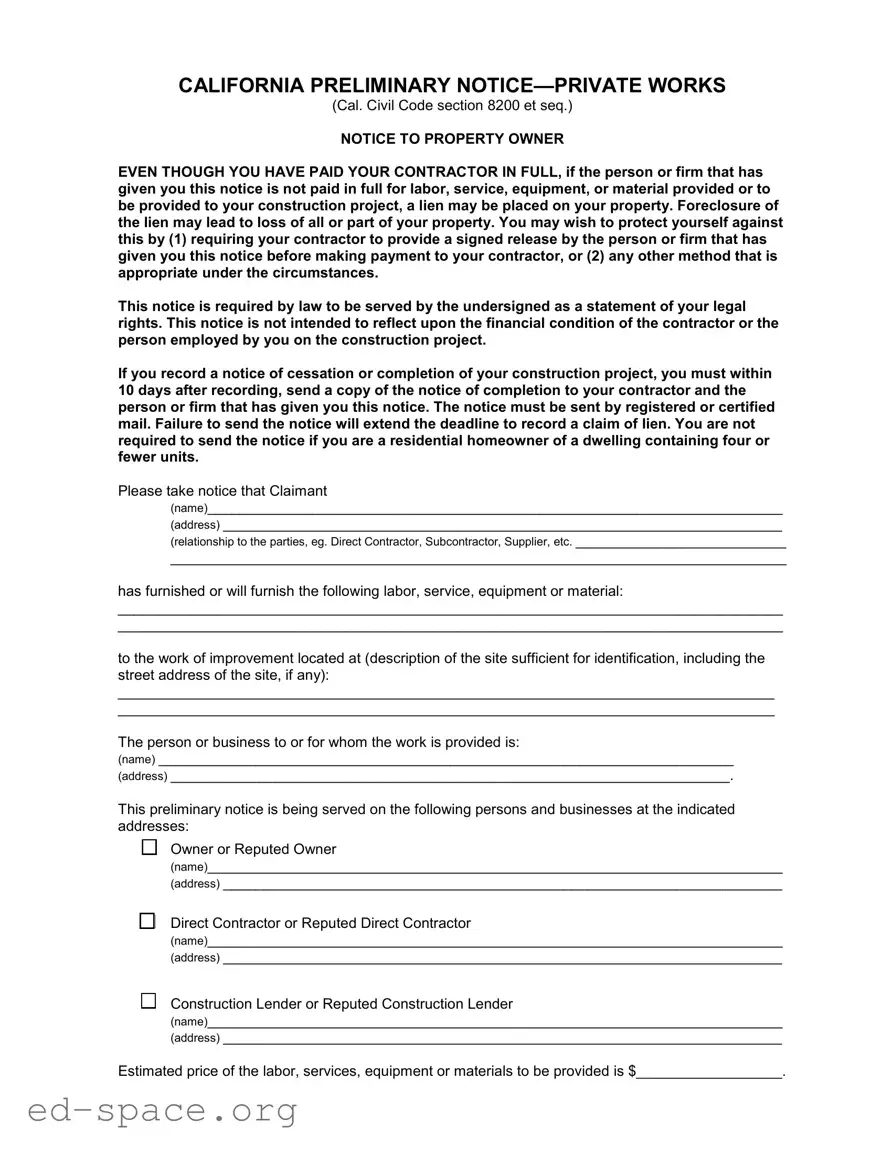
CALIFORNIA PRELIMINARY
(Cal. Civil Code section 8200 et seq.)
NOTICE TO PROPERTY OWNER
EVEN THOUGH YOU HAVE PAID YOUR CONTRACTOR IN FULL, if the person or firm that has given you this notice is not paid in full for labor, service, equipment, or material provided or to be provided to your construction project, a lien may be placed on your property. Foreclosure of the lien may lead to loss of all or part of your property. You may wish to protect yourself against this by (1) requiring your contractor to provide a signed release by the person or firm that has given you this notice before making payment to your contractor, or (2) any other method that is appropriate under the circumstances.
This notice is required by law to be served by the undersigned as a statement of your legal rights. This notice is not intended to reflect upon the financial condition of the contractor or the person employed by you on the construction project.
If you record a notice of cessation or completion of your construction project, you must within 10 days after recording, send a copy of the notice of completion to your contractor and the person or firm that has given you this notice. The notice must be sent by registered or certified mail. Failure to send the notice will extend the deadline to record a claim of lien. You are not required to send the notice if you are a residential homeowner of a dwelling containing four or fewer units.
Please take notice that Claimant (name)_______________________________________________________________________
(address) _____________________________________________________________________
(relationship to the parties, eg. Direct Contractor, Subcontractor, Supplier, etc. __________________________
____________________________________________________________________________
has furnished or will furnish the following labor, service, equipment or material:
__________________________________________________________________________________
__________________________________________________________________________________
to the work of improvement located at (description of the site sufficient for identification, including the street address of the site, if any):
_________________________________________________________________________________
_________________________________________________________________________________
The person or business to or for whom the work is provided is:
(name) _______________________________________________________________________
(address) _____________________________________________________________________.
This preliminary notice is being served on the following persons and businesses at the indicated addresses:
Owner or Reputed Owner
(name)_______________________________________________________________________
(address) _____________________________________________________________________
Direct Contractor or Reputed Direct Contractor
(name)_______________________________________________________________________
(address) _____________________________________________________________________
Construction Lender or Reputed Construction Lender
(name)_______________________________________________________________________
(address) _____________________________________________________________________
Estimated price of the labor, services, equipment or materials to be provided is $__________________.
PROOF OF SERVICE DECLARATION
(CA Civil Code §§
I, _________________________________________________ declare that I served copies of the
above California Preliminary
by personally delivering copies to _____________________________________________
(name and title of person served) at ___________________________________________
(address) on ______________________________ (date), at __________________ (time).
by
Documentation provided by the United States Postal Service showing that payment was made to mail the notice using registered or certified mail, or express mail.
Documentation provided by an express service carrier showing that payment was made to send the notice using an overnight delivery service.
A return receipt, delivery confirmation, signature confirmation, tracking record, or other proof of delivery or attempted delivery provided by the United States Postal Service, or a photocopy of the record of delivery and receipt maintained by the United States Postal Service, showing the date of delivery and to whom delivered, or in the event of nondelivery, by the returned envelope itself.
A tracking record or other documentation provided by an express service carrier showing delivery or attempted delivery of the notice.
by leaving the notice and mailing a copy in the manner provided in Section 415.20 of the Code of Civil Procedure for service of summons and complaint in a civil action, on
____________________ (date).
I declare, under penalty of perjury under the laws of the State of California, that the foregoing is true and correct.
Signature: ________________________________________________________________
Signed at _____________________________________, on _________________, 20____.
| Fact Name | Fact Description |
|---|---|
| Governing Law | The California Preliminary Notice for Private Works is governed by Cal. Civil Code section 8200 et seq. |
| Purpose of Notice | This notice informs property owners of their rights regarding unpaid contractors or suppliers. |
| Payment Warning | Even if a property owner pays their contractor in full, they may still face a lien if subcontractors or suppliers are unpaid. |
| Lien Risk | A lien could lead to foreclosure, which may result in the loss of property. |
| Release Requirement | Property owners can protect themselves by requiring a signed release from the notice sender before making payments. |
| Notice Delivery | The notice must be served by the undersigned to assert legal rights. |
| Notice of Cessation | If a notice of cessation or completion is recorded, a copy must be sent to the contractor and notice sender within 10 days. |
| Mailing Method | The notice must be sent via registered or certified mail to ensure proper delivery. |
| Residential Exemption | Homeowners of dwellings with four or fewer units are not required to send this notice. |
| Proof of Service | A declaration of service is required, detailing how the notice was delivered. |
Filling out the California Preliminary Notice Private Works form requires careful attention to detail. This document serves as a notification to property owners and other parties involved in a construction project. It is essential to provide accurate information to ensure compliance with legal requirements.
Once the form is completed, ensure that it is properly served to all relevant parties. Keep copies for your records, as they may be needed for future reference or verification.
What is the purpose of the California Preliminary Notice—Private Works form?
This form serves as a legal notice to property owners, informing them that if the contractor does not pay their subcontractors, suppliers, or laborers, a lien may be placed on the property. This means that even if the property owner has paid the contractor in full, they could still face financial consequences if the contractor fails to settle debts with those who contributed to the project.
Who is required to send this notice?
What should property owners do upon receiving this notice?
Property owners should take this notice seriously. They may want to require their contractor to provide a signed release from the person or firm that sent the notice before making any payments. This step can help protect the owner from potential liens. Additionally, if the owner records a notice of cessation or completion of the project, they must send a copy of that notice to the contractor and the sender of the preliminary notice within 10 days.
Are there any exceptions to sending this notice?
Yes, residential homeowners of dwellings containing four or fewer units are not required to send this notice. However, it is still advisable for homeowners to be aware of their rights and the implications of the notice, even if they are not legally obligated to send it.
What happens if the notice is not sent?
If the preliminary notice is not sent when required, the deadline to record a claim of lien may be extended. This can create complications for property owners and contractors alike, as it may lead to disputes over payments and the rights of those who provided labor or materials. It's crucial to follow the legal requirements to avoid potential issues down the line.
Incomplete Information: Failing to provide all required details, such as the claimant's name, address, and relationship to the parties involved, can render the notice ineffective.
Incorrect Property Description: Not including a clear and sufficient description of the work site can create confusion and may lead to disputes about the property in question.
Missing Recipient Information: Omitting the names and addresses of all parties who should receive the notice, including the property owner and contractor, can result in legal complications.
Failure to Estimate Costs: Not providing an estimated price for the labor, services, equipment, or materials can weaken the notice's effectiveness and leave parties uncertain about the financial obligations.
Improper Service Method: Using an incorrect method to serve the notice, such as failing to use registered or certified mail when required, can invalidate the notice.
Neglecting Proof of Service: Not including adequate proof of service, such as documentation from the postal service or delivery confirmation, can lead to challenges in enforcing the notice.
Ignoring Deadlines: Missing the deadlines for sending copies of the notice after recording a notice of cessation or completion can extend the time frame for filing a lien.
Inaccurate Signatures: Not signing the notice or failing to have the correct individual sign can result in the notice being deemed invalid.
Not Keeping Copies: Failing to retain copies of the notice and proof of service for personal records can complicate future legal proceedings.
The California Preliminary Notice—Private Works form serves as a crucial document for those involved in construction projects. However, it is often accompanied by several other forms and documents that help protect the rights of those providing labor, services, or materials. Below is a list of related documents commonly used in conjunction with the Preliminary Notice.
Understanding these documents can significantly aid in navigating the complexities of construction law in California. Each form plays a vital role in protecting the rights of all parties involved, ensuring that the construction process proceeds smoothly and legally.
When filling out the California Preliminary Notice Private Works form, it’s crucial to ensure that you do it correctly to protect your rights and interests. Here’s a list of things you should and shouldn’t do:
By following these guidelines, you can help ensure that your rights are protected and that you fulfill your obligations under California law. It’s always better to be thorough and precise when dealing with legal documents.
This form is not optional. Under California law, it is a required step for those providing labor or materials on private construction projects. Failing to serve this notice can jeopardize a contractor's ability to file a lien for unpaid work.
Even if a property owner pays their contractor in full, they can still face a lien if subcontractors or suppliers are not paid. This highlights the importance of the Preliminary Notice in informing property owners of potential risks.
This notice serves to protect both contractors and property owners. It informs property owners of their rights and responsibilities, helping them avoid unexpected financial liabilities.
Timeliness is crucial. The Preliminary Notice must be sent within a specific timeframe after work begins. Delays can result in losing the right to file a lien, making adherence to deadlines essential.
The form varies based on the type of project and the parties involved. Different requirements exist for residential versus commercial projects, and the notice must be tailored accordingly to comply with applicable laws.
Understanding the California Preliminary Notice for Private Works is crucial for both property owners and contractors. Here are some key takeaways regarding its use and importance:
In summary, being diligent about the California Preliminary Notice for Private Works is essential for safeguarding against potential financial liabilities in construction projects. Awareness and compliance can help ensure a smoother process for all parties involved.