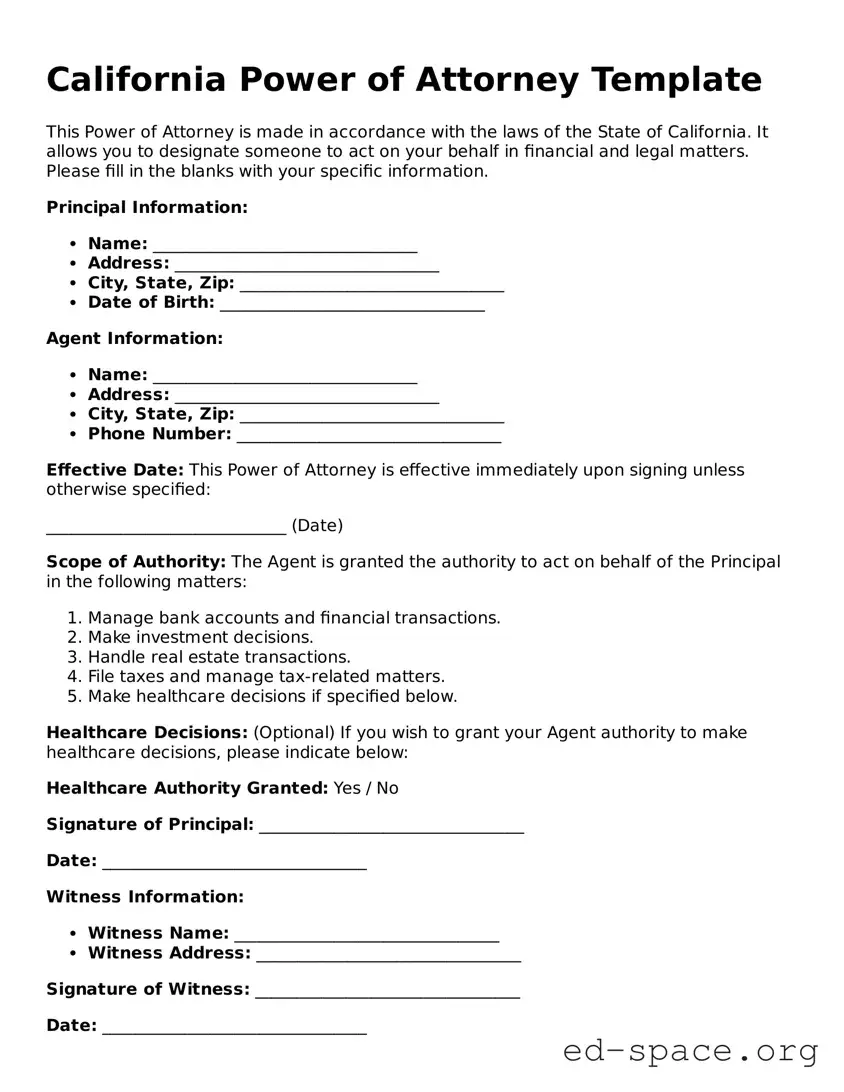
The California Power of Attorney form is a crucial legal document that grants an individual the authority to make decisions on behalf of another person. This form is particularly important for those who may become incapacitated or unable to manage their affairs due to illness, injury, or other circumstances. By designating an agent, also known as an attorney-in-fact, the principal ensures that their financial, medical, and legal matters can be handled according to their wishes. The form can be tailored to fit various needs, allowing the principal to specify the powers granted to the agent, whether they are broad or limited in scope. It also provides options for durable power of attorney, which remains effective even if the principal becomes incapacitated, and springing power of attorney, which only takes effect under certain conditions. Understanding the implications of this form is essential for anyone looking to safeguard their interests and ensure that their preferences are respected in times of need.
California Power of Attorney Template
This Power of Attorney is made in accordance with the laws of the State of California. It allows you to designate someone to act on your behalf in financial and legal matters. Please fill in the blanks with your specific information.
Principal Information:
Agent Information:
Effective Date: This Power of Attorney is effective immediately upon signing unless otherwise specified:
_____________________________ (Date)
Scope of Authority: The Agent is granted the authority to act on behalf of the Principal in the following matters:
Healthcare Decisions: (Optional) If you wish to grant your Agent authority to make healthcare decisions, please indicate below:
Healthcare Authority Granted: Yes / No
Signature of Principal: ________________________________
Date: ________________________________
Witness Information:
Signature of Witness: ________________________________
Date: ________________________________
This document must be signed in the presence of a notary public to be valid. It is advisable to consult with an attorney to ensure that your Power of Attorney meets your specific needs and complies with California law.
| Fact Name | Details |
|---|---|
| Definition | A Power of Attorney (POA) is a legal document that allows one person to act on behalf of another in legal or financial matters. |
| Governing Law | The California Power of Attorney is governed by the California Probate Code, specifically Sections 4000-4545. |
| Types of POA | California recognizes several types of POAs, including Durable, Springing, and Limited Power of Attorney. |
| Durability | A Durable Power of Attorney remains effective even if the principal becomes incapacitated. |
| Springing POA | A Springing Power of Attorney only becomes effective upon the occurrence of a specified event, such as the principal's incapacitation. |
| Agent's Authority | The agent can be granted broad or limited authority, depending on the principal's wishes outlined in the document. |
| Execution Requirements | The form must be signed by the principal and, in some cases, witnessed or notarized to be valid. |
| Revocation | The principal can revoke a Power of Attorney at any time, as long as they are mentally competent. |
Filling out a California Power of Attorney form is a straightforward process that allows you to designate someone to act on your behalf in financial or legal matters. Once completed, the form must be signed and may need to be notarized, depending on your specific needs and circumstances.
What is a Power of Attorney in California?
A Power of Attorney (POA) in California is a legal document that allows an individual, known as the principal, to designate another person, called the agent or attorney-in-fact, to make decisions on their behalf. This can include financial matters, healthcare decisions, or other specific tasks. The principal must be of sound mind when creating this document, and it can be tailored to fit the principal's needs and preferences.
What types of Power of Attorney are available in California?
California recognizes several types of Power of Attorney. The most common are the General Power of Attorney, which grants broad authority to the agent, and the Limited Power of Attorney, which restricts the agent's authority to specific tasks or timeframes. Additionally, there is a Durable Power of Attorney, which remains in effect even if the principal becomes incapacitated, and a Healthcare Power of Attorney, which specifically addresses medical decisions.
How do I create a Power of Attorney in California?
To create a Power of Attorney in California, the principal must complete the appropriate form, which can be obtained online or through legal resources. The form must be signed and dated by the principal, and it is advisable to have it notarized to enhance its validity. If the agent is to act on healthcare matters, the form should comply with California's specific requirements for healthcare directives.
Can I revoke a Power of Attorney in California?
Yes, a Power of Attorney can be revoked at any time by the principal, provided they are still mentally competent. To revoke the document, the principal should create a written revocation notice and communicate this to the agent and any relevant third parties. It is also advisable to destroy any copies of the original Power of Attorney to prevent confusion.
What happens if the principal becomes incapacitated?
If the principal becomes incapacitated and has executed a Durable Power of Attorney, the agent can continue to act on the principal's behalf without interruption. However, if a non-durable Power of Attorney was used, the agent's authority would cease upon the principal's incapacity. It is crucial for individuals to consider their long-term needs when selecting the type of Power of Attorney.
Do I need an attorney to create a Power of Attorney in California?
While it is not legally required to hire an attorney to create a Power of Attorney in California, it is often advisable. An attorney can provide guidance on the specific needs of the principal, ensure compliance with state laws, and help avoid potential pitfalls. Consulting with a legal professional can provide peace of mind and clarity in this important decision-making process.
Not specifying the powers granted. Many individuals fail to clearly outline the specific powers they wish to grant to their agent, which can lead to confusion and potential disputes.
Choosing the wrong agent. Selecting someone who may not act in your best interest or who is not trustworthy can have serious consequences.
Forgetting to date the document. A date is crucial; without it, the validity of the Power of Attorney can be questioned.
Not signing in front of a notary. In California, a Power of Attorney must be notarized to be legally binding, yet many people overlook this requirement.
Failing to inform the agent. It’s essential to communicate your wishes and the responsibilities your agent will have. Lack of communication can lead to misunderstandings.
Neglecting to revoke old Powers of Attorney. If you create a new Power of Attorney, make sure to formally revoke any previous ones to avoid confusion.
Not considering alternate agents. Life is unpredictable. Choosing a backup agent can ensure that your wishes are carried out even if your first choice is unavailable.
Ignoring state-specific requirements. Each state has its own rules regarding Power of Attorney forms. Not adhering to California’s specific requirements can invalidate the document.
Overlooking the importance of regular updates. Life changes—relationships, health, and financial situations evolve. Regularly reviewing and updating your Power of Attorney ensures it remains relevant.
Not seeking legal advice. While it’s possible to fill out the form independently, consulting with a legal professional can provide clarity and ensure that your document meets all necessary requirements.
A California Power of Attorney (POA) form is a vital document that grants someone the authority to act on your behalf in financial or legal matters. However, several other forms and documents may complement or enhance the effectiveness of a POA. Below is a list of commonly used documents that often accompany the California Power of Attorney form. Each serves a specific purpose and can help ensure that your wishes are honored and your interests are protected.
Understanding these documents and their roles can significantly impact your estate planning strategy. By utilizing a combination of these forms along with your California Power of Attorney, you can create a comprehensive plan that safeguards your interests and provides peace of mind for you and your loved ones.
When filling out the California Power of Attorney form, it's essential to approach the task with care. Here are some important do's and don'ts to keep in mind.
By following these guidelines, you can ensure that your Power of Attorney form is filled out correctly and effectively. This will help safeguard your interests and provide clarity in the future.
Many people have misunderstandings about the California Power of Attorney form. Here are four common misconceptions:
This is not true. Individuals can create a Power of Attorney without a lawyer, as long as they follow the legal requirements set by California law. However, consulting a lawyer can provide guidance and ensure the document meets all necessary criteria.
While many use it for financial decisions, a Power of Attorney can also cover health care decisions. You can specify whether your agent can make medical choices on your behalf.
This is a misconception. You can revoke a Power of Attorney at any time, as long as you are mentally competent. Revocation should be done in writing and communicated to all relevant parties.
Your agent can be anyone you trust, not just a family member. Many people choose friends, colleagues, or professionals to serve in this role.
Filling out and using a California Power of Attorney form is an important step in planning for your future. Here are some key takeaways to consider:
Being informed about the Power of Attorney process can help you make better decisions for your future and ensure your wishes are honored.