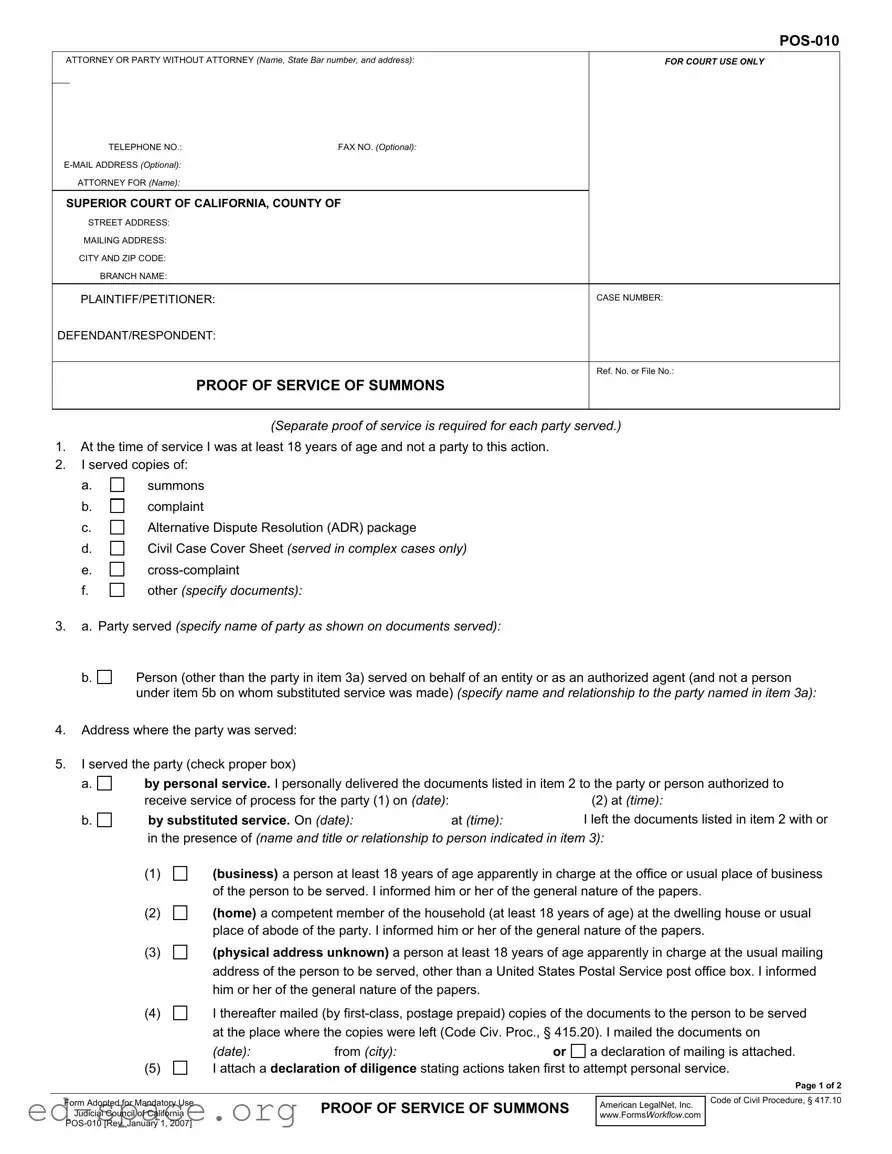
The California POS-010 form plays a crucial role in the legal process, specifically regarding the service of summons. This form is essential for documenting how legal documents are served to parties involved in a court case. It requires the name and contact information of the attorney or party serving the documents, along with the details of the case, including the names of the plaintiff and defendant, and the case number. The form outlines the methods of service, which can include personal delivery, substituted service, or mail, and mandates that a separate proof of service is submitted for each party served. Additionally, it captures important details such as the date and time of service, the address where the documents were delivered, and the identity of the person who performed the service. By ensuring that all parties are properly notified of legal actions, the POS-010 helps maintain the integrity of the judicial process. Understanding how to accurately complete and submit this form is vital for anyone involved in legal proceedings in California.
ATTORNEY OR PARTY WITHOUT ATTORNEY (Name, State Bar number, and address): |
FOR COURT USE ONLY |
TELEPHONE NO.: |
FAX NO. (Optional): |
|
|
ATTORNEY FOR (Name): |
|
SUPERIOR COURT OF CALIFORNIA, COUNTY OF
STREET ADDRESS:
MAILING ADDRESS:
CITY AND ZIP CODE:
BRANCH NAME:
PLAINTIFF/PETITIONER: |
CASE NUMBER: |
DEFENDANT/RESPONDENT:
Ref. No. or File No.:
PROOF OF SERVICE OF SUMMONS
(Separate proof of service is required for each party served.)
1.At the time of service I was at least 18 years of age and not a party to this action.
2.I served copies of:
a. summons
b. complaint
c. |
Alternative Dispute Resolution (ADR) package |
d. |
Civil Case Cover Sheet (served in complex cases only) |
e. |
|
f. |
other (specify documents): |
3.a. Party served (specify name of party as shown on documents served):
b.
Person (other than the party in item 3a) served on behalf of an entity or as an authorized agent (and not a person under item 5b on whom substituted service was made) (specify name and relationship to the party named in item 3a):
4.Address where the party was served:
5.I served the party (check proper box)
a. |
by personal service. I personally delivered the documents listed in item 2 to the party or person authorized to |
||
|
receive service of process for the party (1) on (date): |
|
(2) at (time): |
b. |
by substituted service. On (date): |
at (time): |
I left the documents listed in item 2 with or |
in the presence of (name and title or relationship to person indicated in item 3):
(1)
(2)
(3)
(4)
(5)
(business) a person at least 18 years of age apparently in charge at the office or usual place of business of the person to be served. I informed him or her of the general nature of the papers.
(home) a competent member of the household (at least 18 years of age) at the dwelling house or usual place of abode of the party. I informed him or her of the general nature of the papers.
(physical address unknown) a person at least 18 years of age apparently in charge at the usual mailing address of the person to be served, other than a United States Postal Service post office box. I informed him or her of the general nature of the papers.
I thereafter mailed (by
(date): from (city):or a declaration of mailing is attached. I attach a declaration of diligence stating actions taken first to attempt personal service.
Page 1 of 2
Form Adopted for Mandatory Use
Judicial Council of California
PROOF OF SERVICE OF SUMMONS
American LegalNet, Inc. www.FormsWorkflow.com
Code of Civil Procedure, § 417.10

PLAINTIFF/PETITIONER:
DEFENDANT/RESPONDENT:
CASE NUMBER:
5.c.
d.
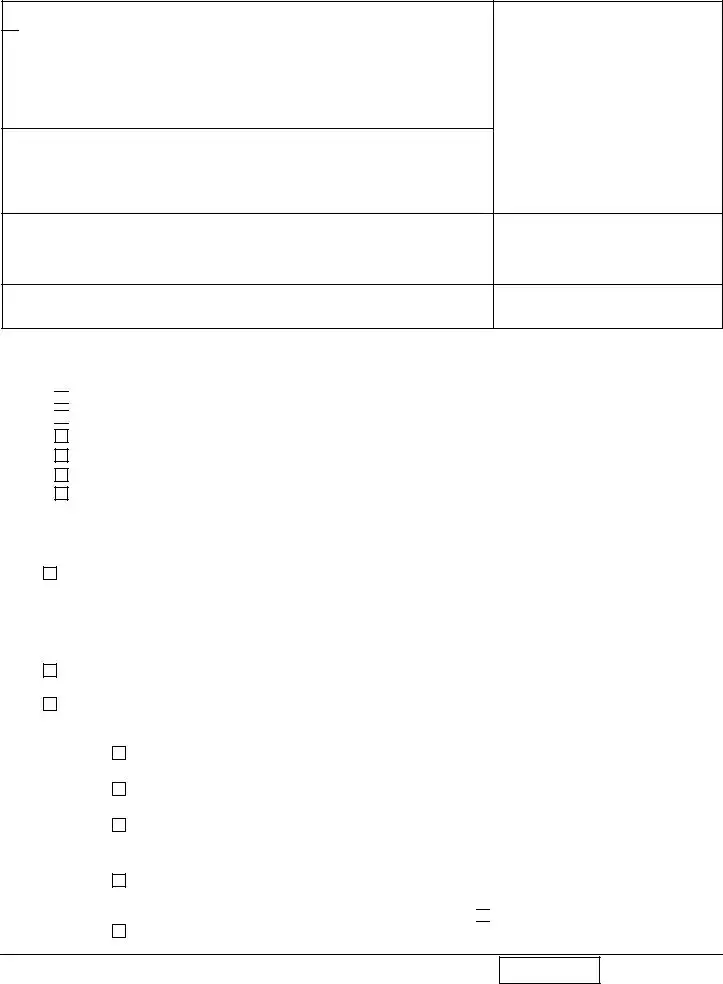
by mail and acknowledgment of receipt of service. I mailed the documents listed in item 2 to the party, to the address shown in item 4, by
(1) on (date): |
(2) from (city): |
|
(3) |
with two copies of the Notice and Acknowledgment of Receipt and a |
|
|
to me. (Attach completed Notice and Acknowledgement of Receipt.) (Code Civ. Proc., § 415.30.) |
|
(4) |
to an address outside California with return receipt requested. (Code Civ. Proc., § 415.40.) |
|
by other means (specify means of service and authorizing code section):
Additional page describing service is attached.
6. The "Notice to the Person Served" (on the summons) was completed as follows:
a. |
as an individual defendant. |
|
|
|
b. |
as the person sued under the fictitious name of (specify): |
|
|
|
c. |
as occupant. |
|
|
|
d. |
On behalf of (specify): |
|
|
|
|
under the following Code of Civil Procedure section: |
|
|
|
|
416.10 |
(corporation) |
415.95 |
(business organization, form unknown) |
|
416.20 |
(defunct corporation) |
416.60 |
(minor) |
|
416.30 |
(joint stock company/association) |
416.70 |
(ward or conservatee) |
|
416.40 |
(association or partnership) |
416.90 |
(authorized person) |
|
416.50 |
(public entity) |
415.46 |
(occupant) |
|
|
|
other: |
|
7.Person who served papers
a.Name:
b.Address:
c.Telephone number:
d.The fee for service was: $
e.I am:
(1) |
not a registered California process server. |
|
||
(2) |
exempt from registration under Business and Professions Code section 22350(b). |
|||
(3) |
a registered California process server: |
|
||
|
(i) |
owner |
employee |
independent contractor. |
(ii)Registration No.:
(iii)County:
8. |
I declare under penalty of perjury under the laws of the State of California that the foregoing is true and correct. |
|
or |
9.
Date:
I am a California sheriff or marshal and I certify that the foregoing is true and correct.
(NAME OF PERSON WHO SERVED PAPERS/SHERIFF OR MARSHAL) |
(SIGNATURE) |
PROOF OF SERVICE OF SUMMONS |
Page 2 of 2
American LegalNet, Inc. www.FormsWorkflow.com
| Fact Name | Details |
|---|---|
| Form Purpose | The POS-010 form is used to provide proof of service of summons in California civil cases. |
| Governing Law | This form is governed by the California Code of Civil Procedure, specifically sections 415.10 to 415.95. |
| Age Requirement | The server must be at least 18 years old and not a party to the case. |
| Service Methods | Service can be done through personal delivery, substituted service, mail, or other means as specified. |
| Declaration Requirement | A declaration of diligence may be required if personal service was not achieved initially. |
| Filing Requirement | The completed POS-010 form must be filed with the court to confirm service has been properly executed. |
Completing the California POS-010 form is an essential step in the legal process when you need to prove that a summons has been served. After filling out this form, you will file it with the court to demonstrate that the necessary parties have received the required documents. Here’s how to fill it out step by step.
Once you have completed the form, make sure to keep a copy for your records. Then, file the POS-010 with the court as part of your case documentation. This step is crucial to ensure that all parties are properly notified and that your case can proceed smoothly.
What is the California POS 010 form used for?
The California POS 010 form, also known as the Proof of Service of Summons, is used to document the service of legal documents, such as a summons and complaint, to the parties involved in a legal action. It ensures that all parties have been properly notified of the proceedings against them, which is a critical step in the legal process.
Who needs to fill out the POS 010 form?
The form must be completed by the individual or entity that serves the legal documents. This could be an attorney, a registered process server, or anyone who is at least 18 years old and not a party to the case. It’s essential that the person completing the form has firsthand knowledge of how the documents were served.
What information is required on the POS 010 form?
The form requires several pieces of information, including the names and addresses of the parties involved, the date and time of service, and the method of service used (personal service, substituted service, or mail). Additionally, it asks for details about the person who served the documents and their relationship to the case.
How should the documents be served?
Documents can be served in several ways. Personal service involves directly handing the documents to the party. Substituted service allows for the documents to be left with someone at the party's residence or business. Mail service requires sending the documents via first-class mail along with a Notice and Acknowledgment of Receipt. Each method has specific requirements that must be followed for proper service.
Is there a fee for service, and how is it documented?
If a fee is charged for the service of the documents, the amount must be recorded on the form. The person serving the documents should indicate whether they are a registered process server or exempt from registration. This information helps establish the credibility of the service performed.
What happens if the form is not completed correctly?
If the POS 010 form is not filled out correctly, it could lead to delays in the legal process or even dismissal of the case. Proper service is crucial, and any errors on the form may raise questions about whether the parties were adequately notified. It’s important to double-check all entries before submitting the form to the court.
Can the POS 010 form be submitted electronically?
Yes, many courts in California allow for electronic filing of the POS 010 form. However, it’s essential to check the specific rules of the court where the case is filed. If electronic filing is not available, the form must be submitted in person or by mail. Always ensure that you follow the court's guidelines for submission.
Failing to provide complete contact information for the attorney or party without an attorney. This includes missing details such as the telephone number or email address.
Not specifying the correct name of the party served. It's essential to ensure that the name matches exactly as it appears on the legal documents.
Incorrectly filling out the address where the party was served. Providing an incomplete or inaccurate address can lead to complications in the service process.
Omitting the date and time of service. This information is crucial for establishing the timeline of the legal process.
Choosing the wrong method of service without proper justification. For instance, if personal service is required but substituted service is selected, this can invalidate the service.
Not attaching the necessary documents, such as the Notice and Acknowledgment of Receipt when mailing documents. This step is vital for confirming that the party received the documents.
Failing to sign the declaration under penalty of perjury. This signature is a legal affirmation that the information provided is accurate and truthful.
The California POS-010 form, known as the Proof of Service of Summons, is an essential document in legal proceedings. It confirms that all relevant parties have been properly served with court documents. However, several other forms and documents often accompany this form to ensure that the legal process runs smoothly. Below is a list of these documents, along with a brief description of each.
Each of these documents plays a vital role in the legal process. Together, they ensure that all parties are informed and that the court has the necessary information to proceed with the case. Understanding these forms can help individuals navigate the complexities of the legal system more effectively.
The California POS-010 form, known as the Proof of Service of Summons, is essential for documenting the service of legal documents in California. Several other documents share similarities with the POS-010, particularly in their purpose and structure. Here are five such documents:
When filling out the California POS-010 form, it is crucial to be thorough and accurate. Below is a list of ten important dos and don'ts to guide you through the process.
Following these guidelines will help ensure that your form is filled out correctly, reducing the likelihood of complications in your case.
Misconceptions about the California POS-010 form can lead to confusion during legal processes. Here are five common misconceptions, along with explanations to clarify them.
When using the California POS 010 form, it’s important to follow specific guidelines to ensure proper service of documents. Here are some key takeaways: