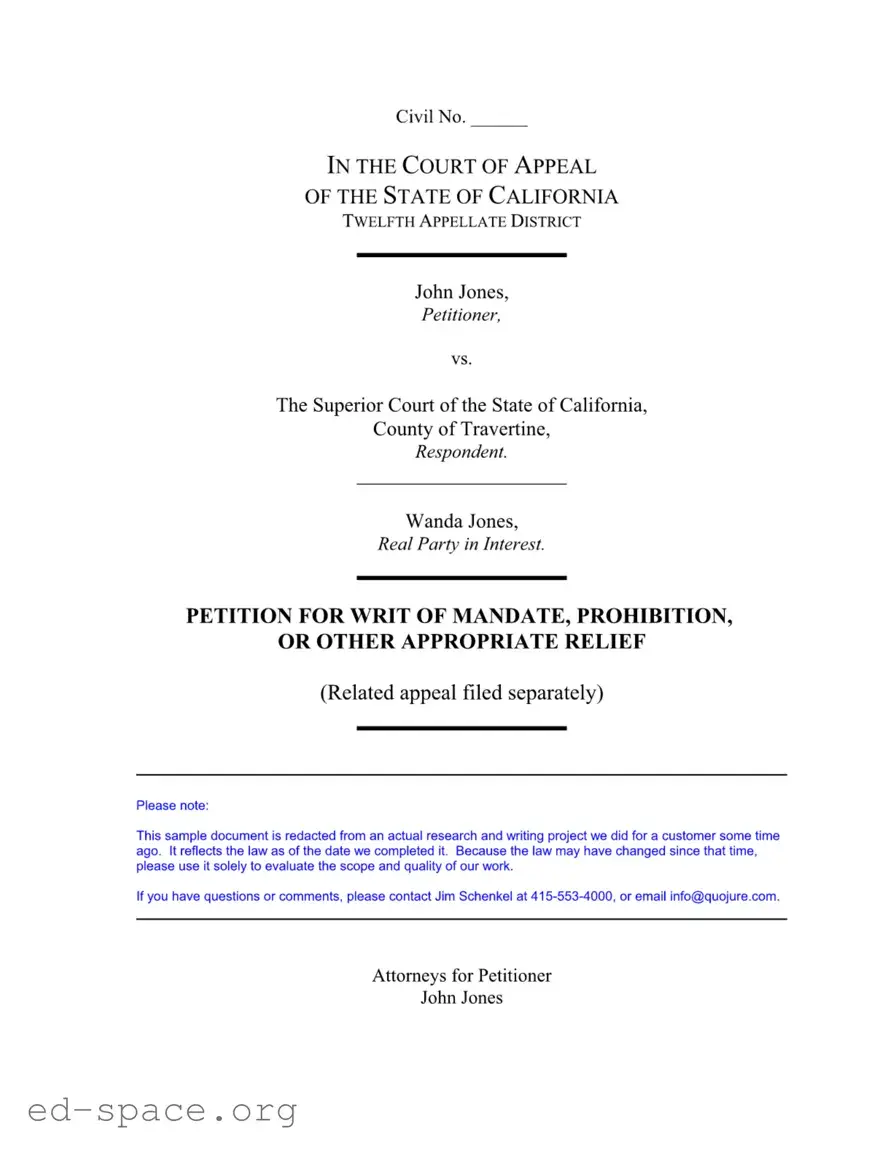
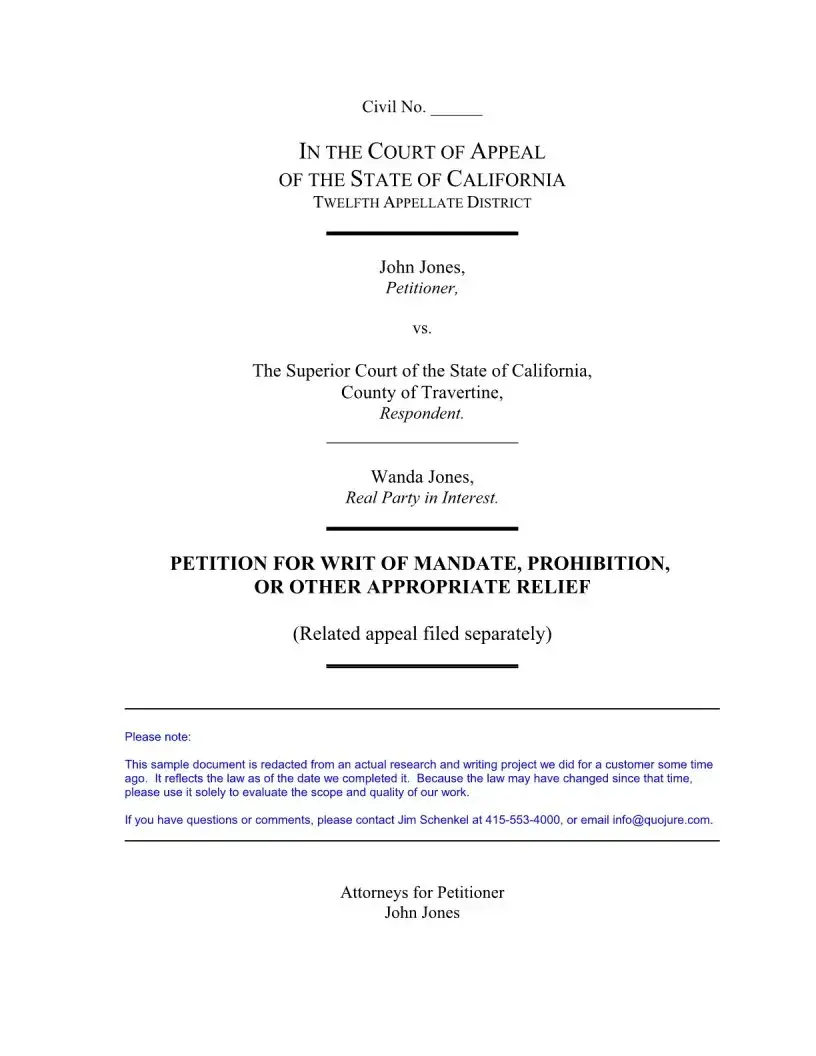
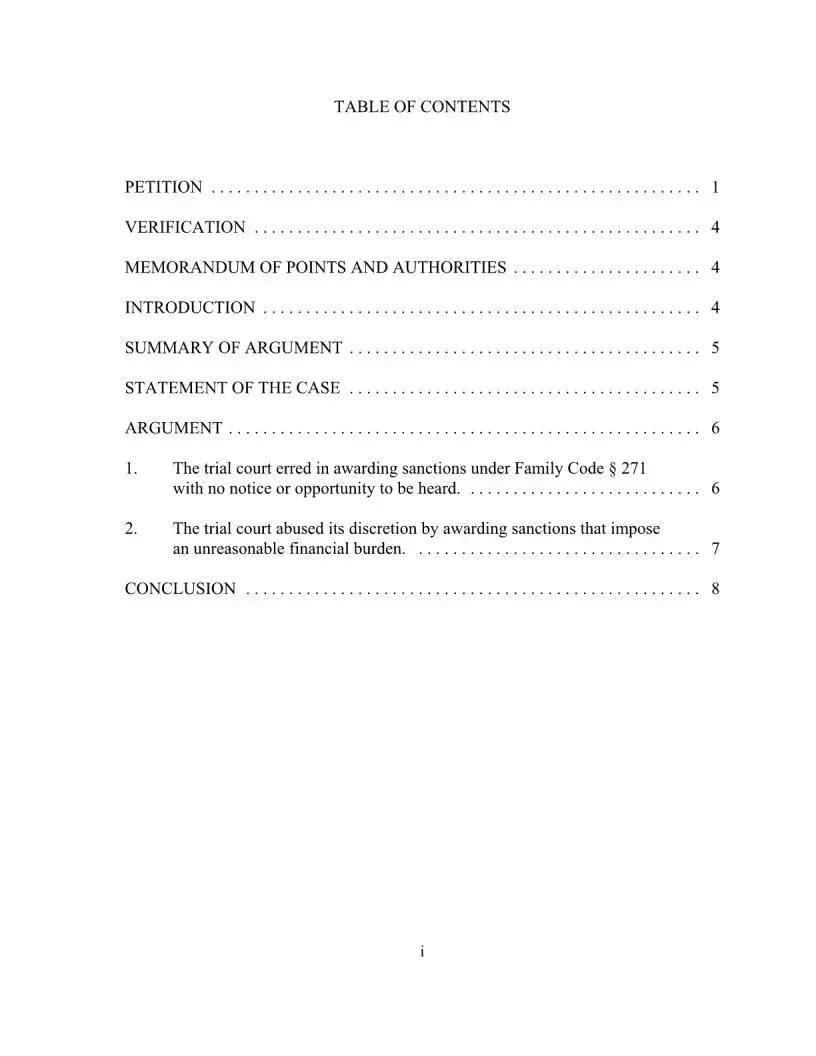
The California Petition Mandate form serves as a crucial legal tool for individuals seeking to challenge decisions made by lower courts. This form is typically used in the Court of Appeal when a petitioner believes that a trial court has made an error or acted beyond its authority. In a typical case, the petitioner, like John Jones in our example, files a petition against the Superior Court of California, highlighting specific grievances, such as improper sanctions awarded without due process. The document outlines the necessary components, including a verification section, a memorandum of points and authorities, and a detailed argument that supports the petitioner's claims. Each section plays a vital role in presenting the case clearly and effectively. The form also requires a summary of the argument, a statement of the case, and a conclusion, ensuring that all relevant information is presented in a structured manner. Understanding how to properly complete and submit this form is essential for anyone looking to navigate the appellate process in California.
| Fact Name | Description |
|---|---|
| Court Jurisdiction | The petition is filed in the Twelfth Appellate District of the California Court of Appeal. |
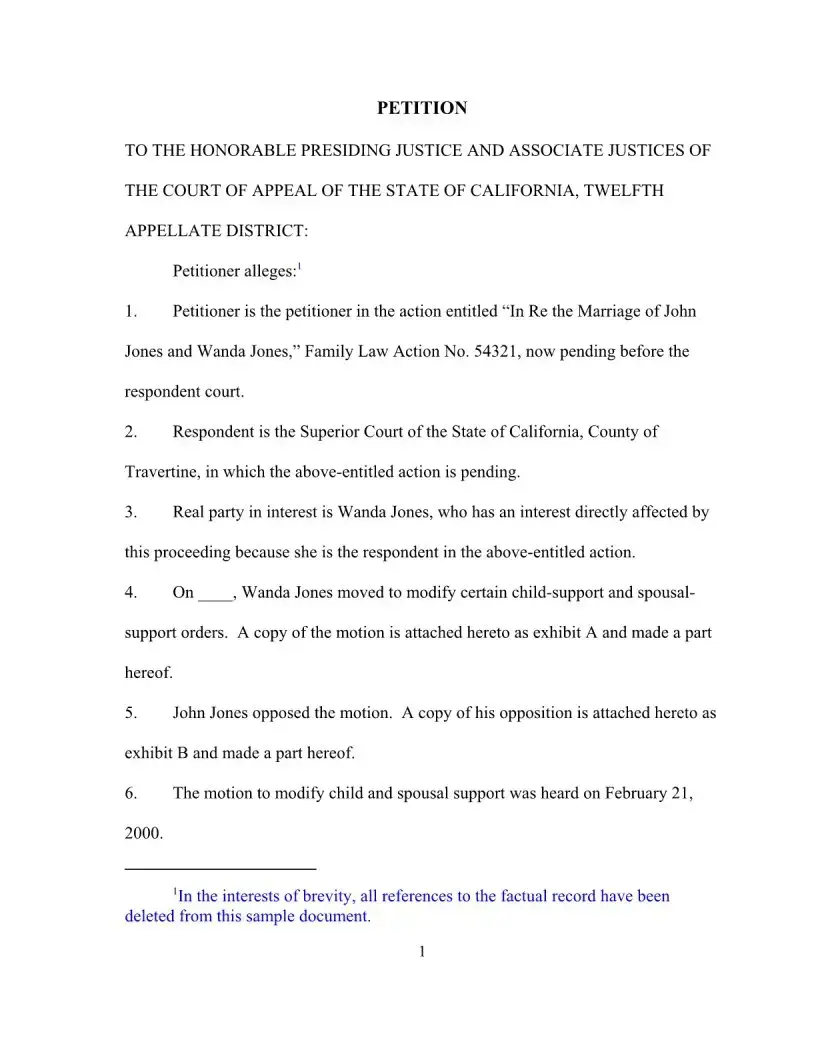
| Petitioner | John Jones is the petitioner in this matter, seeking a writ of mandate. |
| Respondent | The Superior Court of California, County of Travertine, serves as the respondent. |
| Real Party in Interest | Wanda Jones is the real party in interest, directly affected by the proceedings. |
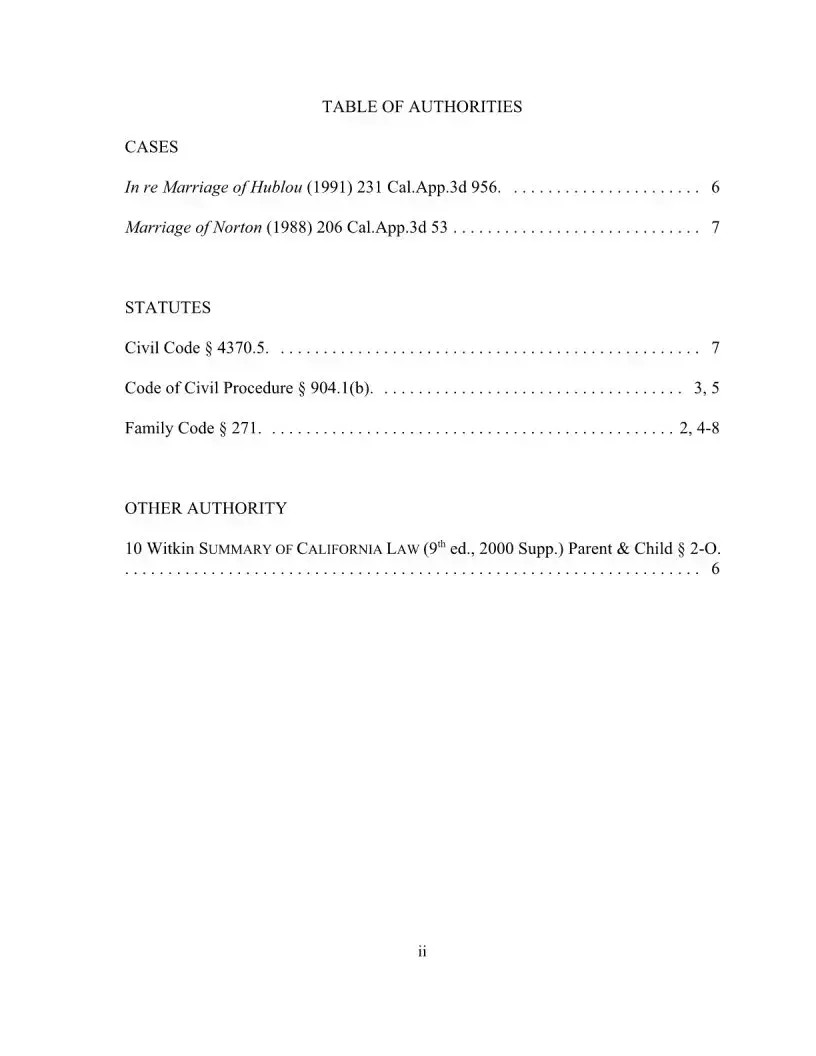
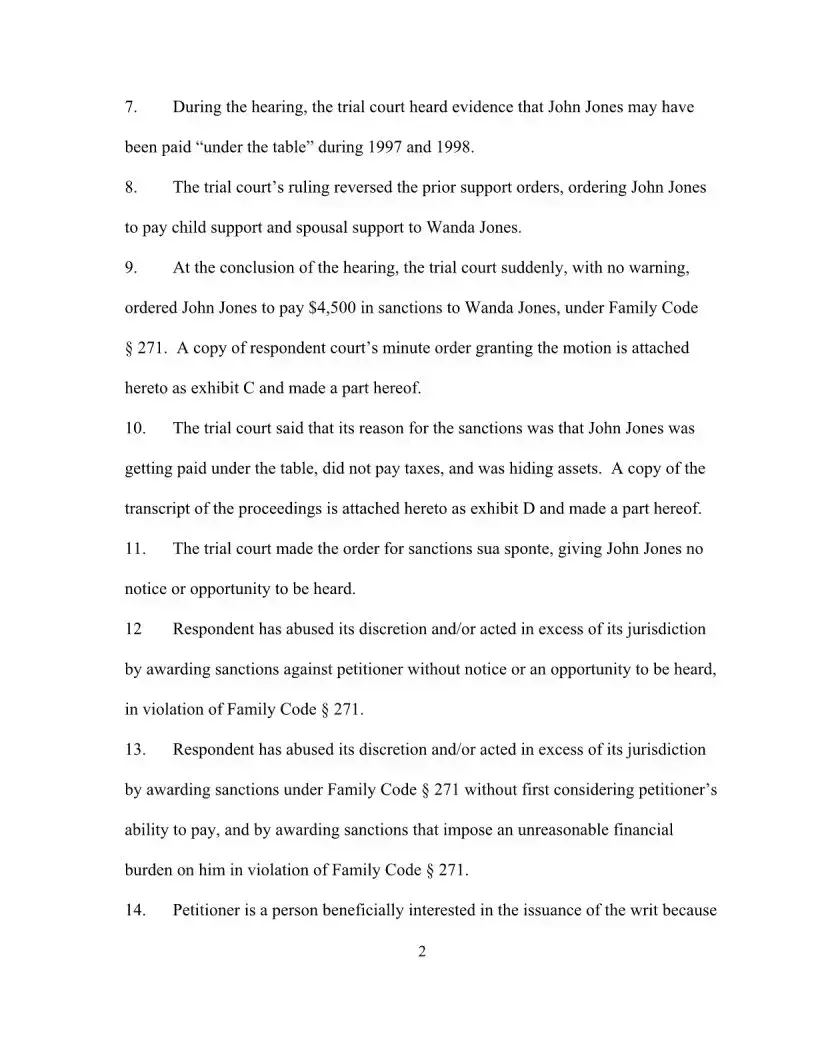
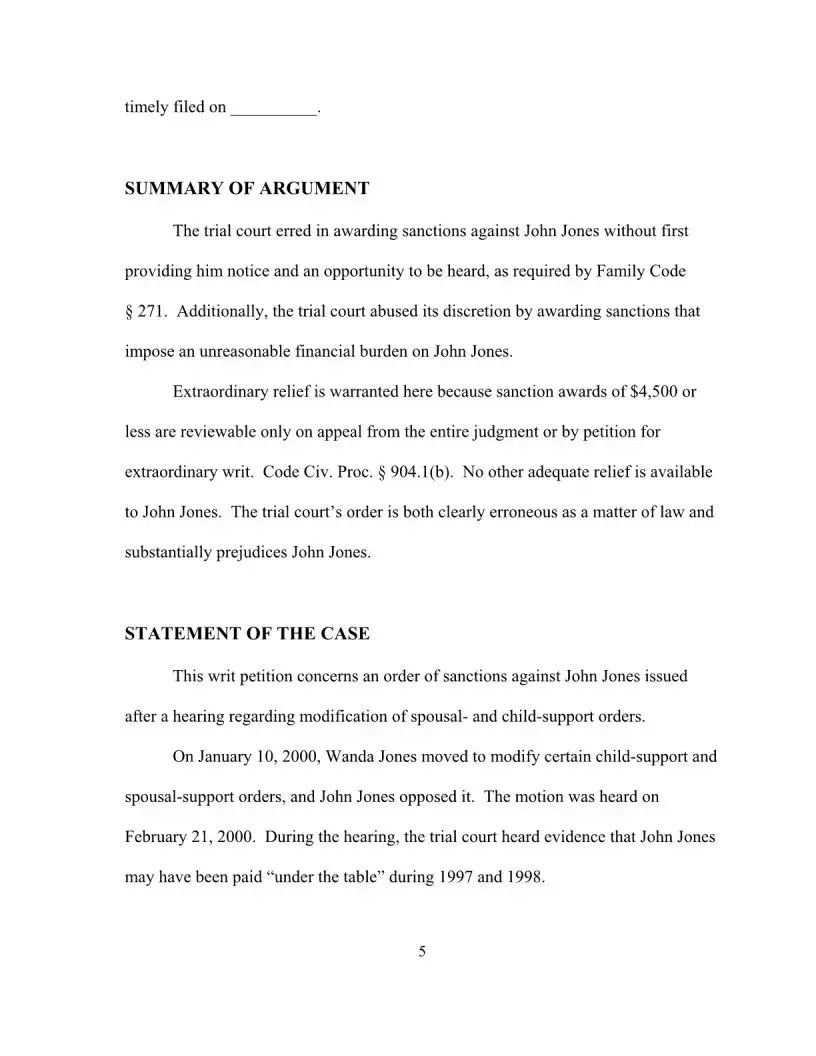
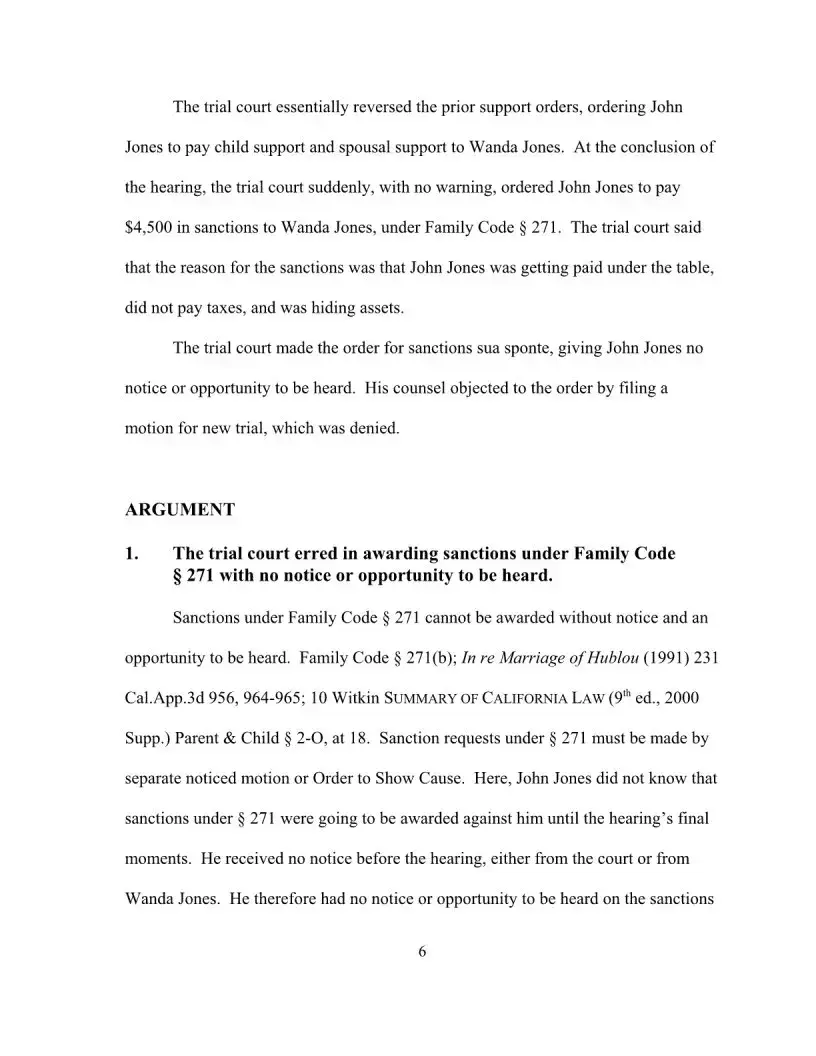
| Governing Law | Family Code § 271 governs the imposition of sanctions in family law cases. |
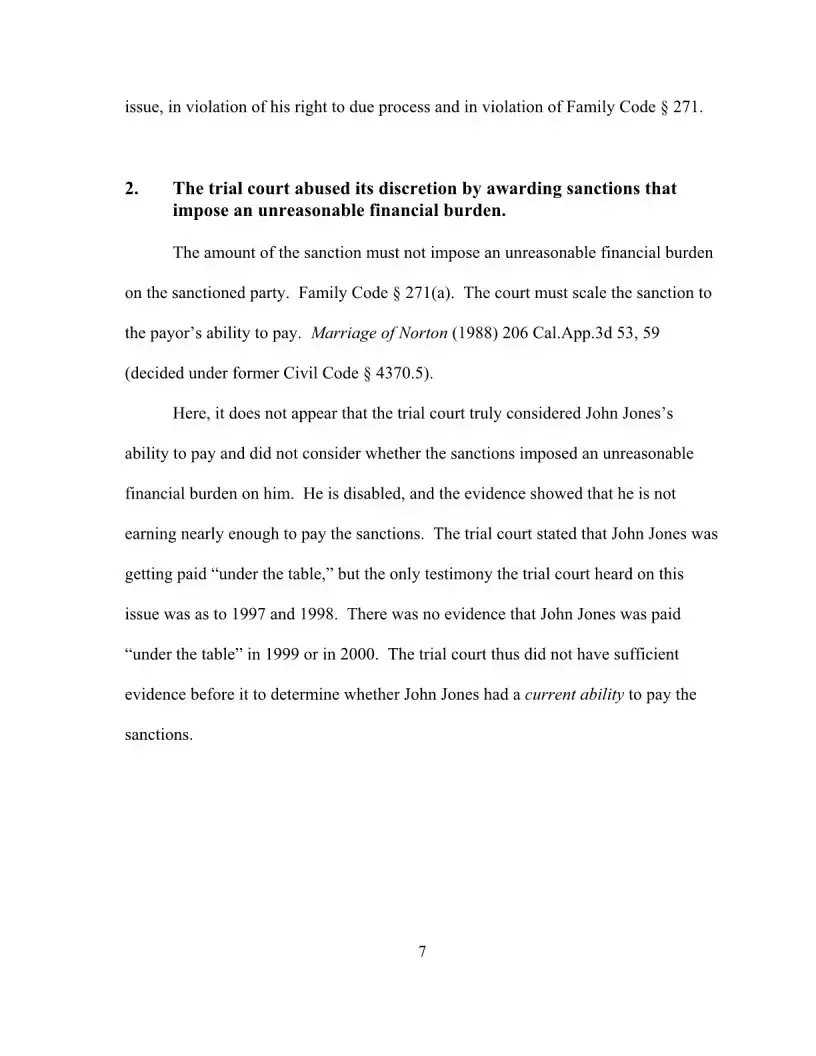
| Sanctions Issue | The trial court awarded sanctions without providing notice or an opportunity to be heard. |
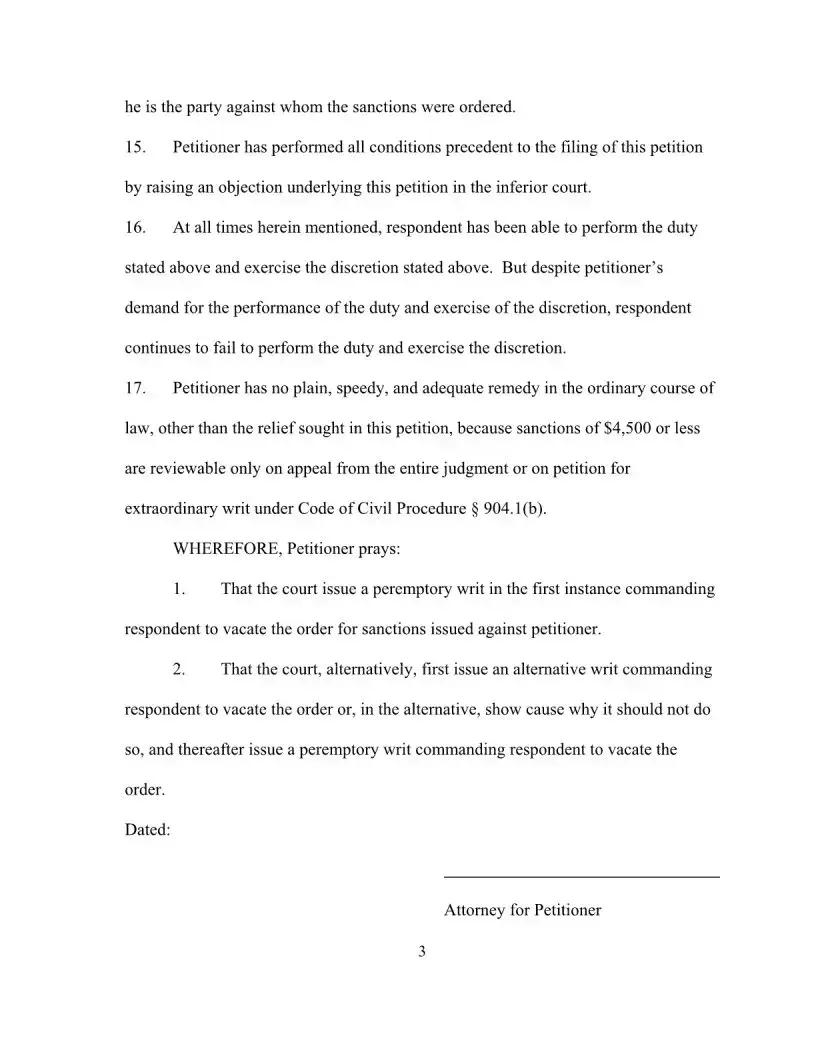
| Financial Burden | The sanctions imposed were claimed to create an unreasonable financial burden on John Jones. |
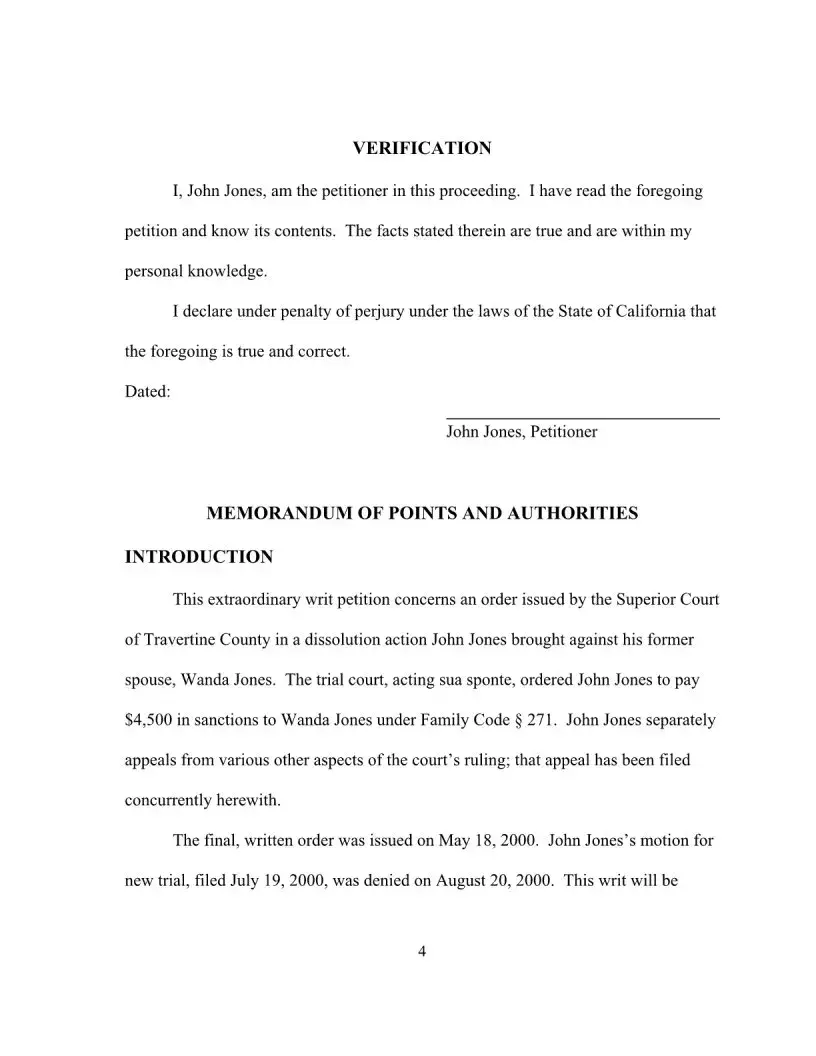
| Related Appeal | A related appeal has been filed separately, indicating ongoing legal proceedings. |
| Verification Requirement | The petition must include a verification section to confirm its authenticity. |
Filling out the California Petition Mandate form requires careful attention to detail. Once you complete the form, it will be submitted to the appropriate court for review. Make sure all information is accurate and complete to avoid delays in processing your petition.
After completing the form, review it for any errors or missing information. Once you’re satisfied, submit it to the court along with any required filing fees. Keep copies of everything for your records.
What is the purpose of the California Petition Mandate form?
The California Petition Mandate form is used to request a writ of mandate from the Court of Appeal. This writ is a court order that directs a lower court or government agency to perform a specific act that is mandated by law. In family law cases, such as those involving child support or spousal support, the petitioner may seek relief from decisions made by the superior court that they believe were made in error or without proper procedure.
Who can file a Petition for Writ of Mandate?
Any individual or entity that is affected by a decision made by a lower court can file a Petition for Writ of Mandate. In the context of family law, this often includes parties involved in divorce or custody disputes. For instance, in the sample document, John Jones, the petitioner, is challenging a ruling made by the Superior Court regarding sanctions imposed without notice.
What are the key components of the Petition for Writ of Mandate?
The key components of the Petition include a clear statement of the facts, the legal grounds for the request, and the specific relief sought. It typically consists of sections such as the introduction, summary of the argument, statement of the case, and detailed arguments supporting the petitioner's claims. Each section serves to establish the context and rationale for the petition, ensuring the court understands the basis for the request.
What happens after the Petition for Writ of Mandate is filed?
Once the Petition is filed, the court will review the document and may schedule a hearing. The respondent, in this case, the Superior Court, will be given an opportunity to respond to the petition. The court will then determine whether to grant the writ, which could result in the lower court being ordered to take specific actions or reconsider its previous decisions.
What are the potential outcomes of a Writ of Mandate petition?
The outcomes can vary. If the court grants the writ, it may order the lower court to take corrective action. This could include overturning a previous decision or requiring a new hearing with proper notice. If the writ is denied, the petitioner may have limited options for further appeal, depending on the circumstances of the case. The decision can significantly impact the parties involved, especially in family law matters where financial and custodial issues are at stake.
Missing Information: One common mistake is failing to provide all necessary information. Each section of the form must be filled out completely. Omitting details like names, dates, or case numbers can lead to delays or rejections.
Incorrect Formatting: People often overlook the required format for the petition. Using the wrong font, size, or spacing can make the document difficult to read and may not comply with court standards.
Not Following Instructions: Each petition has specific instructions that must be followed. Ignoring these guidelines can result in a petition being deemed invalid. Always read the instructions carefully before starting.
Inadequate Supporting Documents: Failing to attach necessary supporting documents is a frequent error. It's essential to include all relevant exhibits and evidence that substantiate your claims.
Neglecting to Proofread: Typos and grammatical errors can undermine the credibility of your petition. Taking the time to proofread can prevent misunderstandings and ensure clarity in your arguments.
The California Petition Mandate form is often accompanied by several other important documents that help to clarify and support the petition process. Each of these documents serves a specific purpose and is essential for the effective presentation of the case. Below is a list of forms and documents frequently used in conjunction with the California Petition Mandate form.
Understanding these documents is crucial for anyone navigating the petition process in California. Each form plays a vital role in ensuring that the petition is presented clearly and effectively, allowing the court to make an informed decision.
When filling out the California Petition Mandate form, careful attention to detail can make a significant difference in the outcome. Here are seven essential do's and don'ts to guide you through the process:
Following these guidelines can enhance the clarity and effectiveness of your petition, helping to ensure that your case is heard fairly and promptly.
This form is designed for anyone involved in a legal matter, not just seasoned attorneys. Individuals can use it to present their case effectively, even without extensive legal training.
While timeliness is important, you do not have to file the form right after a decision. There are specific deadlines, but they vary depending on the circumstances of your case.
Submitting the Petition Mandate form does not guarantee that the court will rule in your favor. The court will review the arguments and evidence before making a decision.
You can amend the petition if necessary. If new information arises or if there are errors, you may file an amended version for the court's consideration.
The court evaluates each petition based on its specific facts and legal arguments. Stronger petitions that clearly outline issues and provide supporting evidence are more likely to receive attention.
While having a lawyer can be beneficial, it is not mandatory to file the Petition Mandate. Individuals can represent themselves, though they should be aware of the legal standards and procedures involved.
When filling out and using the California Petition Mandate form, it is important to keep the following key takeaways in mind:
By keeping these points in mind, you can better navigate the process of filling out and submitting the California Petition Mandate form. It is important to approach this task with care and attention to detail.