The California Operating Agreement form is a crucial document for limited liability companies (LLCs) operating in the state. This form outlines the internal rules and regulations that govern the management and operations of the LLC. It typically includes essential elements such as the roles and responsibilities of members, the process for decision-making, and guidelines for profit distribution. Additionally, the agreement addresses procedures for adding or removing members, as well as the steps to take in the event of dissolution. By clearly defining these aspects, the Operating Agreement helps to prevent disputes among members and provides a framework for resolving conflicts. Furthermore, while California does not mandate an Operating Agreement for LLCs, having one in place is highly recommended to ensure smooth operations and legal protection for all members involved.
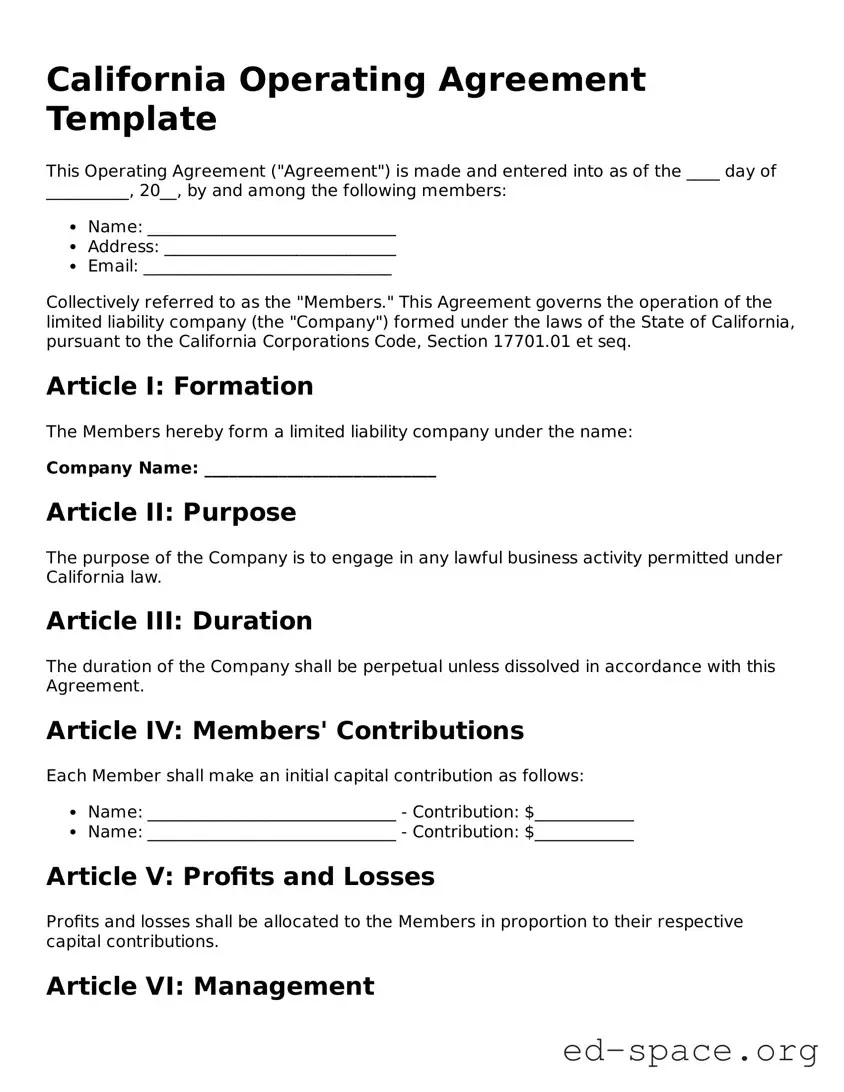
California Operating Agreement Template
This Operating Agreement ("Agreement") is made and entered into as of the ____ day of __________, 20__, by and among the following members:
Collectively referred to as the "Members." This Agreement governs the operation of the limited liability company (the "Company") formed under the laws of the State of California, pursuant to the California Corporations Code, Section 17701.01 et seq.
Article I: Formation
The Members hereby form a limited liability company under the name:
Company Name: ____________________________
Article II: Purpose
The purpose of the Company is to engage in any lawful business activity permitted under California law.
Article III: Duration
The duration of the Company shall be perpetual unless dissolved in accordance with this Agreement.
Article IV: Members' Contributions
Each Member shall make an initial capital contribution as follows:
Article V: Profits and Losses
Profits and losses shall be allocated to the Members in proportion to their respective capital contributions.
Article VI: Management
The Company shall be managed by the Members. Decisions shall be made by a majority vote of the Members, unless otherwise specified in this Agreement.
Article VII: Meetings
Meetings of the Members shall be held at least annually. Notice of the meeting shall be given at least ____ days in advance.
Article VIII: Indemnification
The Company shall indemnify each Member against any loss, liability, or expense incurred in connection with the Company, except in cases of gross negligence or willful misconduct.
Article IX: Amendments
This Agreement may be amended only by a written agreement signed by all Members.
Article X: Governing Law
This Agreement shall be governed by and construed in accordance with the laws of the State of California.
IN WITNESS WHEREOF, the Members have executed this Operating Agreement as of the date first above written.
_______________________________ _______________________________
Member Signature Member Signature
_______________________________ _______________________________
Printed Name Printed Name
| Fact Name | Description |
|---|---|
| Purpose | The California Operating Agreement outlines the management structure and operational procedures of a Limited Liability Company (LLC) in California. |
| Governing Law | This agreement is governed by the California Corporations Code, specifically sections pertaining to LLCs. |
| Member Rights | It details the rights and responsibilities of each member, ensuring clarity in decision-making and profit distribution. |
| Flexibility | California allows LLCs to customize their operating agreements, providing flexibility in how the business is run. |
Once you have the California Operating Agreement form in hand, you can proceed to fill it out. This document will require specific information about your business and its members. Follow the steps below to ensure that you complete the form accurately.
After completing the form, review it for accuracy. Ensure that all members have signed before storing it safely. This document will serve as a vital reference for the operation of your LLC.
What is a California Operating Agreement?
A California Operating Agreement is a legal document that outlines the ownership and operating procedures of a limited liability company (LLC) in California. It serves as an internal guide for members, detailing their rights, responsibilities, and the management structure of the LLC. While not required by law, having an Operating Agreement is highly recommended to avoid misunderstandings and disputes among members.
Why is an Operating Agreement important?
The Operating Agreement is important because it provides clarity on how the LLC will operate. It can help prevent conflicts by clearly defining each member's roles, decision-making processes, and profit distribution. Additionally, having a well-drafted agreement can protect the limited liability status of the LLC and ensure compliance with state regulations.
Who should draft the Operating Agreement?
What should be included in the Operating Agreement?
An effective Operating Agreement typically includes several key components. These may consist of the LLC's name, purpose, duration, and registered agent information. It should also outline the members' contributions, ownership percentages, management structure, and procedures for adding or removing members. Additionally, details regarding profit and loss distribution, voting rights, and dispute resolution methods should be included.
Can the Operating Agreement be amended?
Yes, the Operating Agreement can be amended. The process for making changes should be outlined within the document itself. Typically, amendments require the consent of a certain percentage of members. It is advisable to document any changes in writing and to keep a record of all versions of the agreement for future reference.
Is the Operating Agreement filed with the state?
No, the Operating Agreement is not filed with the state of California. It is an internal document meant for the members of the LLC. However, it is crucial to keep it in a safe place and ensure that all members have access to it, as it may be needed for reference or in case of disputes.
What happens if an LLC does not have an Operating Agreement?
If an LLC does not have an Operating Agreement, it will be governed by California's default laws regarding LLCs. These laws may not align with the members' intentions or expectations. Without a formal agreement, members may face challenges in decision-making, profit distribution, and resolving disputes. Having an Operating Agreement helps establish clear guidelines that protect the interests of all members.
Incomplete Information: Many individuals fail to provide all required details. This includes missing names, addresses, or specific roles of members. Each member's contribution should be clearly stated to avoid confusion later.
Not Specifying Management Structure: A common oversight is neglecting to outline how the company will be managed. Whether it’s member-managed or manager-managed, this decision is crucial for operational clarity.
Ignoring State Requirements: Some people overlook the specific requirements set by California law. It’s essential to ensure that the agreement complies with state regulations to avoid legal issues down the road.
Failing to Address Profit Distribution: Not detailing how profits and losses will be shared among members is a frequent mistake. Clear terms regarding financial distribution can prevent disputes in the future.
Not Updating the Agreement: Once the Operating Agreement is completed, some individuals forget to revisit it. As circumstances change, updating the document is necessary to reflect any new agreements or changes in membership.
When forming a Limited Liability Company (LLC) in California, the Operating Agreement is a crucial document. However, several other forms and documents are often used in conjunction with it to ensure proper compliance and organization. Here’s a list of these important documents.
Each of these documents plays a significant role in the formation and operation of an LLC in California. Properly preparing and maintaining these forms can help ensure compliance and facilitate smoother business operations.
When filling out the California Operating Agreement form, it's essential to follow certain guidelines to ensure accuracy and compliance. Here are five things you should and shouldn't do:
When it comes to the California Operating Agreement form, several misconceptions can lead to confusion for business owners and partners. Understanding these misunderstandings is crucial for ensuring compliance and effective management of a limited liability company (LLC). Below is a list of common misconceptions:
By addressing these misconceptions, business owners can better understand the importance of an Operating Agreement and ensure their LLC operates smoothly and in compliance with California law.
When filling out and using the California Operating Agreement form, there are several key points to keep in mind to ensure a smooth process for your business. Here are five essential takeaways:
By keeping these points in mind, you can create a solid foundation for your business that promotes clarity and cooperation among members.