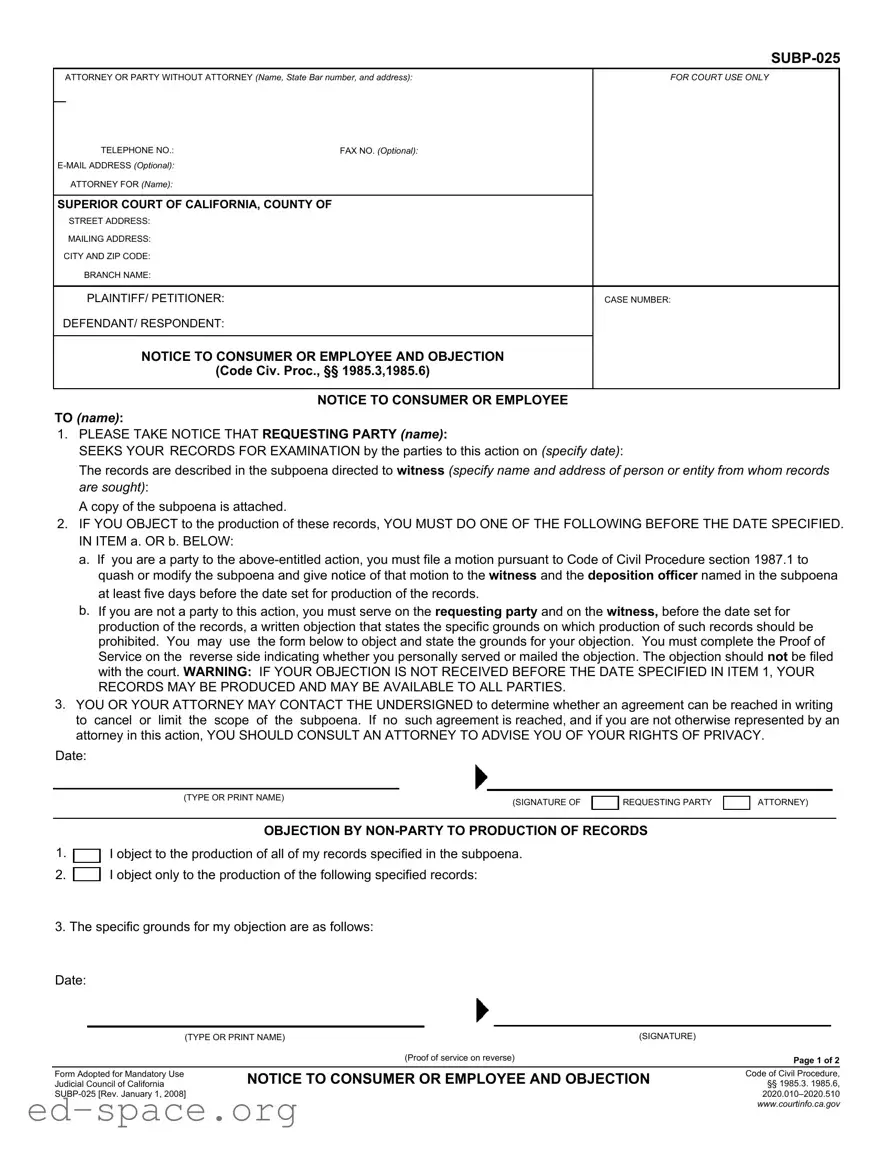
The California Notice Consumer form serves as an important legal document that informs individuals—whether they are consumers or employees—about requests for their personal records in the context of legal proceedings. This form outlines the specific details of the request, including the name of the requesting party, the records sought, and the date on which these records are expected to be produced. It also provides clear instructions for individuals who wish to object to the production of their records. Those who are parties to the action can file a motion to quash or modify the subpoena, while non-parties must submit a written objection stating their grounds for refusal. The form emphasizes the necessity of timely communication, warning that failure to object before the specified date may result in the release of their records to all parties involved in the case. Additionally, it encourages individuals to seek legal counsel if they have concerns about their privacy rights, reinforcing the importance of understanding one's legal standing in such situations.
ATTORNEY OR PARTY WITHOUT ATTORNEY (Name, State Bar number, and address): |
FOR COURT USE ONLY |
TELEPHONE NO.: |
FAX NO. (Optional): |
|
|
ATTORNEY FOR (Name): |
|
SUPERIOR COURT OF CALIFORNIA, COUNTY OF
STREET ADDRESS:
MAILING ADDRESS:
CITY AND ZIP CODE:
BRANCH NAME:
PLAINTIFF/ PETITIONER: |
CASE NUMBER: |
DEFENDANT/ RESPONDENT:
NOTICE TO CONSUMER OR EMPLOYEE AND OBJECTION
(Code Civ. Proc., §§ 1985.3,1985.6)
NOTICE TO CONSUMER OR EMPLOYEE
TO (NAME):
1.PLEASE TAKE NOTICE THAT REQUESTING PARTY (NAME):
SEEKS YOUR RECORDS FOR EXAMINATION by the parties to this action on (specify date):
The records are described in the subpoena directed to witness (specify name and address of person or entity from whom records are sought):
A copy of the subpoena is attached.
2.IF YOU OBJECT to the production of these records, YOU MUST DO ONE OF THE FOLLOWING BEFORE THE DATE SPECIFIED. IN ITEM a. OR b. BELOW:
a.If you are a party to the
b.If you are not a party to this action, you must serve on the requesting party and on the witness, before the date set for production of the records, a written objection that states the specific grounds on which production of such records should be prohibited. You may use the form below to object and state the grounds for your objection. You must complete the Proof of Service on the reverse side indicating whether you personally served or mailed the objection. The objection should not be filed with the court. WARNING: IF YOUR OBJECTION IS NOT RECEIVED BEFORE THE DATE SPECIFIED IN ITEM 1, YOUR RECORDS MAY BE PRODUCED AND MAY BE AVAILABLE TO ALL PARTIES.
3.YOU OR YOUR ATTORNEY MAY CONTACT THE UNDERSIGNED to determine whether an agreement can be reached in writing to cancel or limit the scope of the subpoena. If no such agreement is reached, and if you are not otherwise represented by an attorney in this action, YOU SHOULD CONSULT AN ATTORNEY TO ADVISE YOU OF YOUR RIGHTS OF PRIVACY.
Date:
(TYPE OR PRINT NAME)
(SIGNATURE OF
REQUESTING PARTY
ATTORNEY)
1.
2.
OBJECTION BY
I object to the production of all of my records specified in the subpoena. I object only to the production of the following specified records:
3.The specific grounds for my objection are as follows:
Date:
(TYPE OR PRINT NAME) |
(SIGNATURE) |
|
|
|
|
(Proof of service on reverse) |
Page 1 of 2 |
|
|
|
|
Form Adopted for Mandatory Use |
NOTICE TO CONSUMER OR EMPLOYEE AND OBJECTION |
Code of Civil Procedure, |
|
Judicial Council of California |
§§ 1985.3. 1985.6, |
||
|
|
||
|
|
|
www.courtinfo.ca.gov |

PLAINTIFF/PETITIONER:
DEFENDANT/RESPONDENT:
CASE NUMBER:
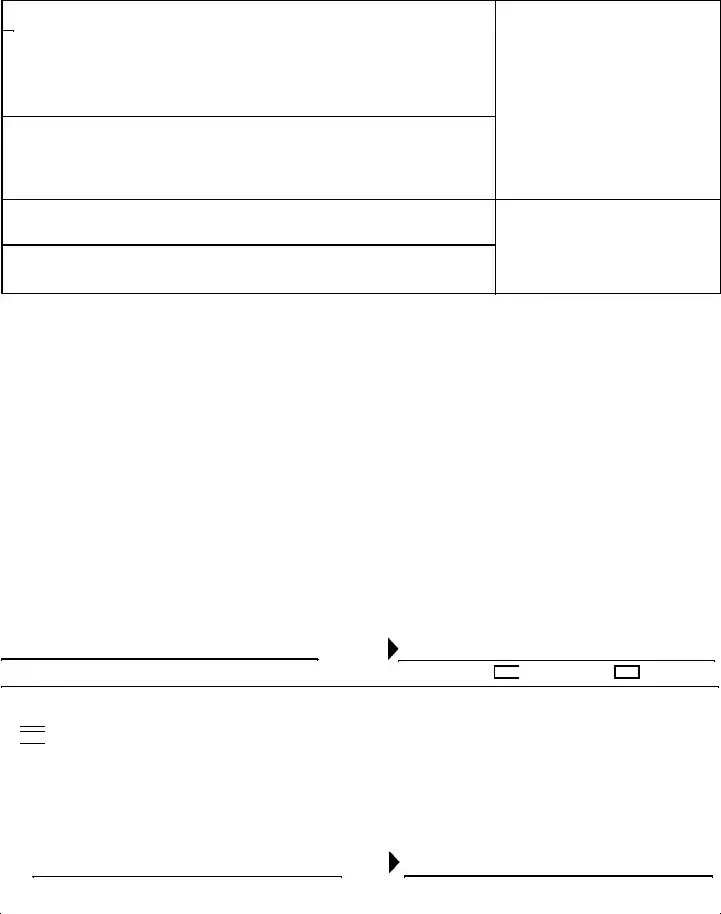
PROOF OF SERVICE OF NOTICE TO CONSUMER OR EMPLOYEE AND OBJECTION
(Code Civ. Proc., §§ 1985.3,1985.6)
Personal Service
1.At the time of service I was at least 18 years of age and not a party to this legal action.
2.I served a copy of the Notice to Consumer or Employee and Objection as follows (check either a or b):
a. |
|
Personal service. I personally delivered the Notice to Consumer or Employee and Objection as follows: |
|||
|
(1) |
Name of person served: |
(3) |
Date served: |
|
|
(2) |
Address where served: |
(4) |
Time served: |
|
b.
Mail. I deposited the Notice to Consumer or Employee and Objection in the United States mail, in a sealed envelope with postage fully prepaid. The envelope was addressed as follows:
(1) Name of person served:
(2) Address:
(5)I am a resident of or employed in the county where the Notice to Consumer or Employee and Objection was mailed.
c.My residence or business address is (specify):
d.My phone number is (specify):
I declare under penalty of perjury under the laws of the State of California that the foregoing is true and correct. Date:
(TYPE OR PRINT NAME OF PERSON WHO SERVED) |
(SIGNATURE OF PERSON WHO SERVED) |
PROOF OF SERVICE OF OBJECTION TO PRODUCTION OF RECORDS
(Code Civ. Proc., §§ 1985.3,1985.6)
Personal Service
1.At the time of service I was at least 18 years of age and not a party to this legal action.
2.I served a copy of the Objection to Production of Records as follows (complete either a or b): a. ON THE REQUESTING PARTY
(1) |
|
Personal service. I personally delivered the Objection to Production of Records as follows: |
|
|
|
(i) Name of person served: |
(iii) Date served: |
|
|
(ii) Address where served: |
(iv) Time served: |
(2)
Mail. I deposited the Objection to Production of Records in the United States mail, in a sealed envelope with postage fully prepaid. The envelope was addressed as follows:
(i) Name of person served: (ii) Address:
(v)I am a resident of or employed in the county where the Objection to Production of Records was mailed. b. ON THE WITNESS
(1) |
|
Personal service. I personally delivered the Objection to Production of Records as follows: |
|
|
|
(i) Name of person served: |
(iii) Date served: |
|
|
(ii) Address where served: |
(iv) Time served: |
(2)
Mail. I deposited the Objection to Production of Records in the United States mail, in a sealed envelope with postage fully prepaid. The envelope was addressed as follows:
(i) Name of person served: (ii) Address:
(v)I am a resident of or employed in the county where the Objection to Production of Records was mailed.
3.My residence or business address is (specify):
4.My phone number is (specify):
I declare under penalty of perjury under the laws of the State of California that the foregoing is true and correct. Date:
(TYPE OR PRINT NAME OF PERSON WHO SERVED) |
(SIGNATURE OF PERSON WHO SERVED) |
|
NOTICE TO CONSUMER OR EMPLOYEE AND OBJECTION
Page 2 of 2
| Fact Name | Description |
|---|---|
| Purpose | The California Notice to Consumer form informs individuals about a request for their records in a legal action. |
| Governing Laws | This form is governed by California Code of Civil Procedure sections 1985.3 and 1985.6. |
| Objection Process | Individuals can object to the request by either filing a motion or serving a written objection, depending on their party status in the case. |
| Deadline for Objection | Objections must be submitted before the specified date to prevent records from being produced. |
| Privacy Rights | The form advises individuals to consult an attorney to understand their privacy rights related to the subpoena. |
| Proof of Service | Individuals must complete a Proof of Service to indicate how the notice or objection was delivered. |
Completing the California Notice Consumer form requires careful attention to detail. After filling out the form, it is important to understand the next steps, particularly regarding any objections to the production of records. This ensures that the rights of all parties involved are respected and that the necessary legal procedures are followed.
What is the California Notice Consumer form?
The California Notice Consumer form is a legal document that notifies consumers or employees that their records are being requested for examination in a legal case. It outlines the rights of the individual whose records are being sought and provides instructions on how to object to the request.
Who can use the California Notice Consumer form?
This form can be used by attorneys or parties involved in a legal action who need to request records from a consumer or employee. It is designed to protect the privacy of individuals whose records are being requested.
What should I do if I receive this notice?
If you receive the notice, you have the right to object to the production of your records. You must do so before the specified date. If you are a party to the action, you can file a motion to quash or modify the subpoena. If you are not a party, you can send a written objection to the requesting party and the witness.
What happens if I do not respond to the notice?
If you do not respond by the deadline, your records may be produced and made available to all parties involved in the case. It's important to act promptly to protect your privacy.
Can I consult an attorney about this notice?
Yes, you are encouraged to consult an attorney if you have questions or concerns about your rights and privacy. An attorney can help you understand the implications of the notice and advise you on how to respond.
What information is included in the notice?
The notice includes details about the requesting party, the records being sought, and instructions on how to object. It also contains a warning about the consequences of not responding.
Is there a specific format for my objection?
Your objection should clearly state the specific grounds for your objection. You can use the form provided in the notice to outline your reasons. Make sure to complete the Proof of Service section to indicate how you delivered your objection.
What if I only want to object to certain records?
You can specify which records you object to in your response. The form allows you to indicate whether you object to all records or only certain ones, along with the reasons for your objection.
Do I need to file my objection with the court?
No, you do not need to file your objection with the court. Instead, you must serve your objection on the requesting party and the witness. Keep a copy for your records.
What is the deadline for responding to the notice?
The deadline for responding is specified in the notice itself. Make sure to pay attention to this date to ensure your rights are protected.
Failing to include all required personal information, such as name, address, and contact details.
Not specifying the correct date for the examination of records, which can lead to confusion.
Omitting the name and address of the witness from whom records are sought.
Not filing a motion to quash or modify the subpoena within the required timeframe.
Neglecting to serve the written objection on both the requesting party and the witness, which is essential for proper notification.
Using vague language in the written objection, rather than clearly stating the specific grounds for the objection.
Failing to complete the Proof of Service section on the reverse side of the form.
Not consulting an attorney if unsure about rights, which can lead to unintentional waivers of privacy.
Ignoring the warning that records may be produced if objections are not received in time.
Submitting the objection to the court instead of serving it to the requesting party and the witness, which is not required.
When dealing with the California Notice Consumer form, several other documents often come into play. Each of these forms serves a unique purpose in the legal process, ensuring that parties involved are informed and their rights are protected. Here’s a brief overview of some of the key documents you might encounter.
Understanding these documents can significantly ease the legal process. Each plays a vital role in ensuring that all parties are informed and that their rights are respected throughout the legal proceedings. Being familiar with them can help individuals navigate their legal obligations more effectively.
The California Notice Consumer form is similar to several other legal documents that serve similar purposes in protecting individual rights and privacy. Below is a list of eight documents that share similarities with the California Notice Consumer form:
When filling out the California Notice Consumer form, it's important to be careful and precise. Here are four key things to keep in mind:
Following these guidelines will help ensure that your rights are respected throughout the process.
This form is designed for both attorneys and individuals. Anyone whose records are being requested can use it to object to the production of their records.
Actually, the objection does not need to be filed with the court. Instead, it should be served to the requesting party and the witness directly.
Time is of the essence. The objection must be received before the specified date in the notice, or the records may be produced.
This notice also applies to employees. If your records are being requested in relation to your employment, you have the same rights to object.
Ignoring the notice is not an option. If you do not respond, your records may still be released to the requesting party.
In fact, you or your attorney can reach out to the requesting party to discuss limiting the scope of the subpoena or even canceling it altogether.
The form can be used for any type of records that are being requested, as long as they pertain to the individual named in the notice.
Filling out and using the California Notice Consumer form involves several important steps and considerations. Here are key takeaways to keep in mind: