Homepage Blank California Note Secured PDF Form
Article Guide

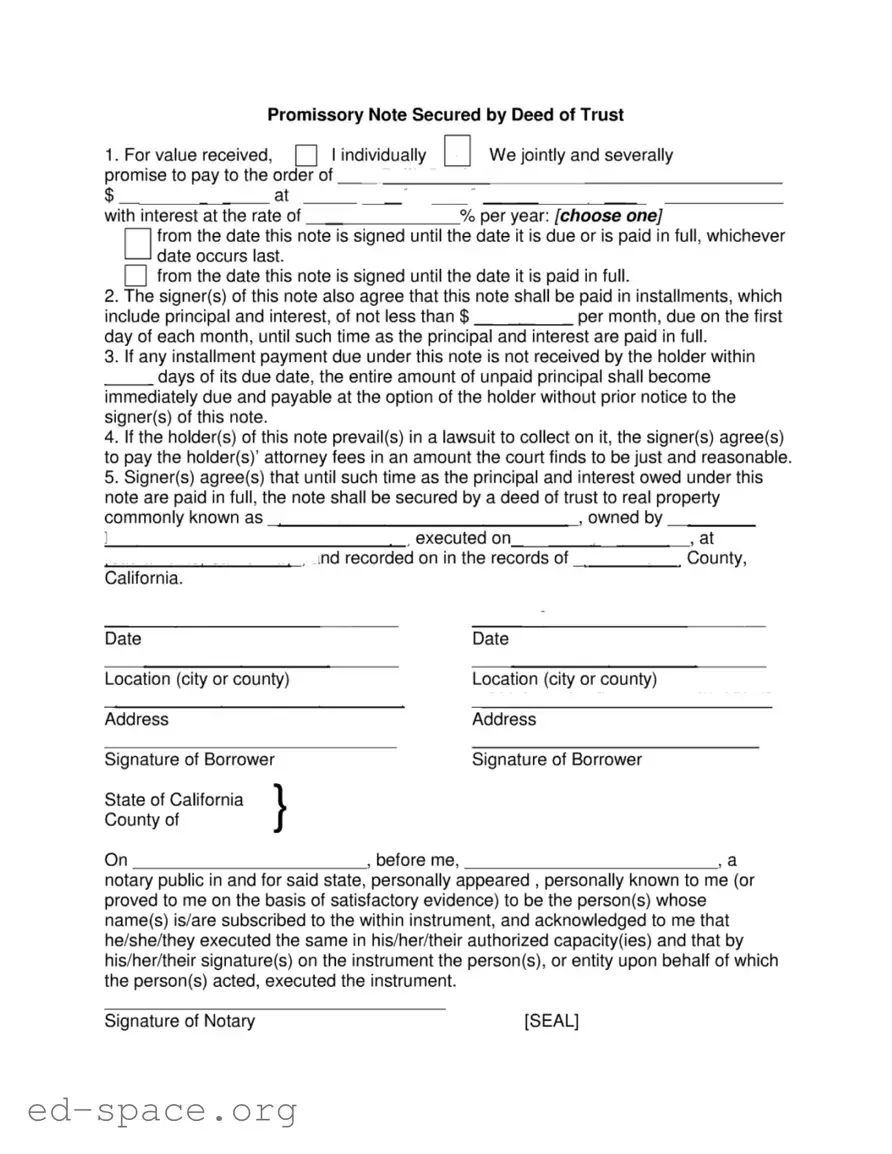
The California Note Secured form serves as a crucial document for individuals and entities entering into a loan agreement where a promissory note is backed by a deed of trust. This form outlines the borrower's commitment to repay a specified amount of money, along with interest, under agreed-upon terms. Borrowers must understand that payments are structured in installments, with specific monthly amounts due on the first day of each month until the loan is fully repaid. If a payment is missed, the lender has the right to demand the entire outstanding balance without prior notification. Additionally, should a legal dispute arise regarding the collection of the debt, the borrower is responsible for covering the lender's attorney fees, as determined by the court. The note is secured by a deed of trust on a designated property, providing the lender with a level of security in case of default. Proper execution of this form, including notarization, is essential to ensure its validity and enforceability in the state of California.
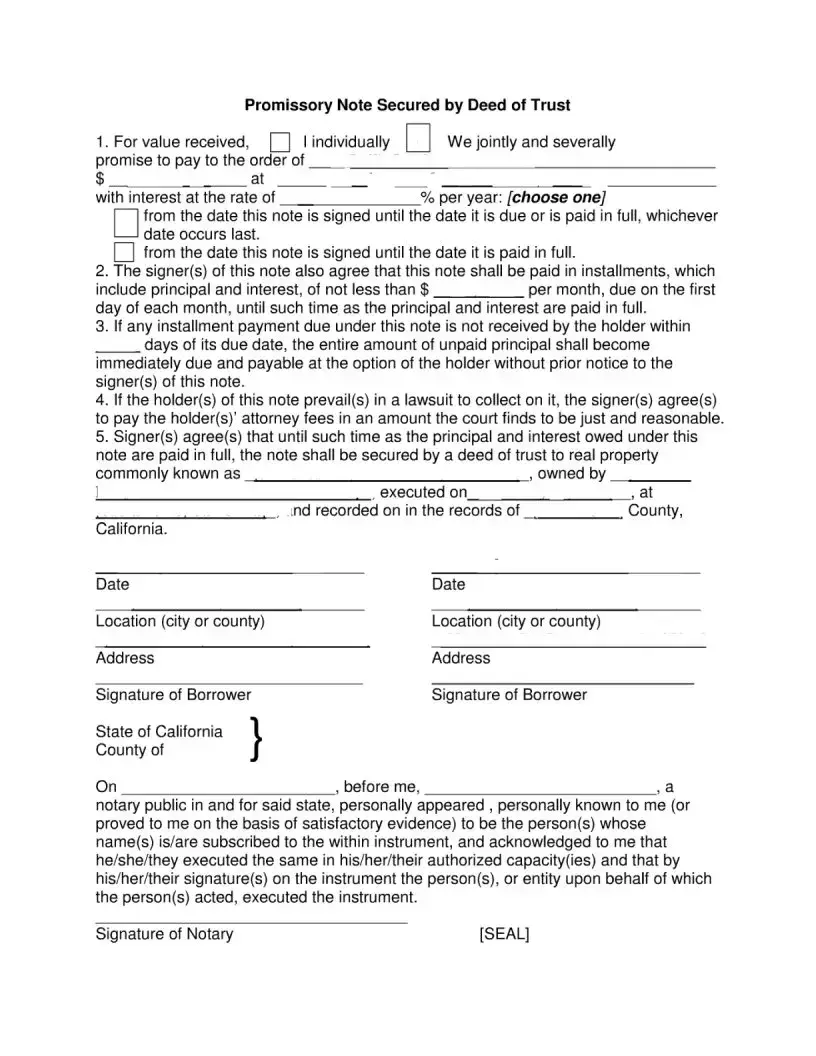
Document Preview

Form Specifications

Fact Name Description
Purpose The California Note Secured form is used to document a loan agreement secured by a deed of trust on real property.
Payment Terms Borrowers must repay the loan in installments that include both principal and interest.
Interest Rate The interest rate is specified in the note and can vary based on the agreement between the parties.
Late Payments If a payment is not received within a certain number of days, the entire unpaid amount can become due immediately.
Attorney Fees Should the lender need to pursue legal action, the borrower agrees to pay reasonable attorney fees incurred by the lender.
Security The note is secured by a deed of trust on a specific property, which serves as collateral for the loan.
Governing Law This form is governed by California law, specifically the California Civil Code.
Notarization The signatures on the note must be notarized to verify the identity of the parties involved.
Record Keeping Once executed, the deed of trust must be recorded in the county where the property is located to ensure legal enforceability.

California Note Secured: Usage Guidelines

Filling out the California Note Secured form is a straightforward process, but it requires careful attention to detail. This form is essential for documenting a loan secured by real property. Once completed, it establishes the obligations of the borrower and the rights of the lender. Follow these steps to ensure that you fill out the form correctly.

  1. Begin by entering the name of the lender in the blank space next to “to the order of.”
  2. Next, write the total amount of the loan in the space provided for “$.”
  3. Specify the location where the loan will be paid by filling in the blank next to “at.”
  4. Indicate the interest rate by entering the percentage in the space provided for “% per year.”
  5. Choose whether the interest will be calculated from the date the note is signed or until it is paid in full. Make sure to check the appropriate option.
  6. Fill in the amount of the monthly installment payment in the space provided for “not less than $.”
  7. Specify the number of days within which the holder must receive an installment payment after its due date in the blank space provided.
  8. Provide the address of the property that will secure the note in the space labeled “commonly known as.”
  9. Enter the date the deed of trust was executed in the space provided.
  10. Fill in the date the deed was recorded in the records of the county.
  11. Sign the form where indicated as the borrower.
  12. In the notary section, fill in the location (city or county) and date where the notarization will take place.
  13. Finally, the notary public will need to sign and seal the document, confirming the identities of the signers.

Your Questions, Answered

What is a California Note Secured form?

The California Note Secured form is a legal document that outlines a borrower's promise to repay a loan. This form is secured by a deed of trust, which means that the loan is backed by real property. In essence, if the borrower fails to repay the loan as agreed, the lender has the right to take possession of the property to recover the owed amount. This document details the terms of repayment, including the amount borrowed, interest rates, and payment schedule.

How does the repayment process work?

Repayment under the California Note Secured form typically occurs in monthly installments. The borrower agrees to pay a specified amount each month, which includes both principal and interest. The payments are due on the first day of each month until the loan is fully repaid. This structure helps borrowers manage their finances by spreading the repayment over time, making it more manageable.

What happens if a payment is missed?

If a borrower fails to make a payment on time, the lender has the option to declare the entire unpaid principal amount due immediately. This means that the borrower could be required to pay back the full amount of the loan without any prior notice. It is crucial for borrowers to stay on top of their payments to avoid this situation, as it can lead to serious financial consequences.

Are there any legal fees involved if the lender takes action?

Yes, if the lender needs to take legal action to collect the debt, the borrower may be responsible for the lender's attorney fees. The borrower agrees to pay these fees if the lender prevails in a lawsuit. This provision emphasizes the importance of adhering to the terms of the note, as legal proceedings can be costly and stressful for all parties involved.

What does it mean for the note to be secured by a deed of trust?

A deed of trust is a legal instrument that secures the loan with real property. This means that the property serves as collateral for the loan. If the borrower defaults on the loan, the lender can initiate foreclosure proceedings to recover the owed amount by selling the property. This arrangement provides security for the lender and can help ensure that the borrower takes their repayment obligations seriously.

What is required for the form to be legally binding?

For the California Note Secured form to be legally binding, it must be signed by the borrower(s) and may require notarization. The notary public verifies the identities of the signers and ensures that they understand the document before signing. This step adds a layer of authenticity and protection, ensuring that all parties are entering into the agreement willingly and with full understanding of their obligations.

Common mistakes

  1. Incomplete Information: Many people forget to fill in all required fields. This includes the names of the parties involved, the amount of the loan, and the interest rate. Leaving any of these blank can lead to confusion and potential legal issues.

  2. Incorrect Dates: It's common to see mistakes with dates. Ensure that the date the note is signed and any other relevant dates are accurate. An incorrect date can affect the validity of the note.

  3. Not Specifying Payment Terms: Failing to clearly outline the payment terms is a frequent error. The amount of each installment, due dates, and whether the payments include both principal and interest should be explicitly stated.

  4. Neglecting Notary Requirements: Some individuals overlook the need for notarization. If the form requires a notary, ensure that it is properly signed and stamped. This step is crucial for the document's legal enforceability.

Documents used along the form

The California Note Secured form is often accompanied by several other important documents that provide additional context and security for the transaction. Below is a list of these documents, each described briefly to clarify their purpose and relevance.

  • Deed of Trust: This document secures the promissory note by placing a lien on the property. It outlines the terms under which the lender can foreclose on the property if the borrower defaults.
  • Grant Deed: This document transfers ownership of the property from the seller to the buyer. It provides a clear record of the property’s title and any covenants related to it.
  • Title Insurance Policy: This policy protects the lender and borrower against any claims or disputes over property ownership. It ensures that the title is clear and free of encumbrances.
  • Loan Agreement: This document details the terms of the loan, including the interest rate, repayment schedule, and any fees associated with the loan. It serves as a comprehensive reference for both parties.
  • Disclosure Statements: These are required documents that inform the borrower of the loan terms, costs, and any potential risks. They promote transparency in the lending process.
  • Borrower’s Financial Statement: This document provides the lender with a snapshot of the borrower’s financial health, including income, debts, and assets, helping to assess creditworthiness.
  • Amortization Schedule: This schedule outlines the repayment plan for the loan, showing how much of each payment goes toward principal and interest over time.
  • Power of Attorney: In some cases, this document allows a designated person to act on behalf of the borrower in legal or financial matters related to the property transaction.
  • Closing Statement: This document summarizes the final costs associated with the transaction, including fees, taxes, and the total amount due at closing.

These documents work together to ensure that both the lender and borrower understand their rights and obligations, providing a framework for a secure and transparent transaction. Properly managing these forms is crucial for a successful lending process in California.

Similar forms

The California Note Secured form shares similarities with several other legal documents. Each of these documents serves a purpose related to loans, security interests, or agreements between parties. Here’s a breakdown of eight similar documents:

  • Promissory Note: Like the California Note Secured form, a promissory note outlines a borrower's promise to repay a specified amount of money, usually with interest, over a set period.
  • Deed of Trust: This document secures the promissory note by allowing the lender to take possession of the property if the borrower defaults, much like the security provided in the California Note Secured form.
  • Mortgage Agreement: Similar to the California Note Secured form, a mortgage agreement also secures a loan with real property, detailing the borrower's obligations and the lender's rights.
  • Loan Agreement: A loan agreement outlines the terms of borrowing, including the amount, interest rate, and repayment schedule, akin to the terms found in the California Note Secured form.
  • Security Agreement: This document establishes a security interest in personal property, ensuring that the lender has rights to the collateral if the borrower defaults, similar to the security provided in the California Note Secured form.
  • Installment Sale Agreement: Like the California Note Secured form, this agreement allows for the payment of a purchase price in installments, often secured by the property being sold.
  • Guaranty Agreement: This document involves a third party agreeing to be responsible for the borrower's debt if they default, similar to how the California Note Secured form outlines obligations of the signer(s).
  • Forbearance Agreement: This agreement may temporarily modify the terms of a loan, providing relief to a borrower facing difficulties, much like how the California Note Secured form addresses default and payment terms.

Dos and Don'ts

When filling out the California Note Secured form, it is essential to approach the task with care. Here are five things you should and shouldn't do:

  • Do ensure all personal information is accurate and complete. Double-check names, addresses, and other details.
  • Do specify the correct interest rate and payment terms clearly. Ambiguities can lead to misunderstandings later.
  • Do sign the document in the presence of a notary public. This adds a layer of authenticity to your agreement.
  • Do keep a copy of the signed form for your records. This can be important for future reference.
  • Do read the entire document thoroughly before signing. Understanding your obligations is crucial.
  • Don't leave any sections blank. Incomplete forms may be rejected or cause issues down the line.
  • Don't use vague language. Be specific about payment amounts and due dates to avoid confusion.
  • Don't forget to include the correct date of signing. This is important for the validity of the note.
  • Don't rush through the process. Take your time to ensure everything is filled out correctly.
  • Don't ignore the legal implications of the note. Understand that it is a binding contract with serious consequences.

Misconceptions

There are several misconceptions surrounding the California Note Secured form. Understanding these can help clarify its purpose and function.

  • It only applies to individual borrowers. Many believe that the California Note Secured form is exclusively for individual borrowers. In reality, it can be used by both individuals and businesses. Joint borrowers can also sign the note, making it a flexible option for various lending scenarios.
  • Interest rates are fixed. Some people think that the interest rate on the note is always fixed. However, the form allows for different types of interest arrangements. Borrowers can choose whether the rate is fixed or variable, depending on their agreement with the lender.
  • Payments are always due monthly. A common misconception is that payments must always be made monthly. While the form typically outlines monthly installments, the payment schedule can be customized. Borrowers and lenders can agree to different payment frequencies as needed.
  • Late payments result in immediate foreclosure. Many assume that missing a payment leads directly to foreclosure. In fact, the form states that the lender has the option to declare the entire amount due after a missed payment, but they are not required to do so immediately. This provides some flexibility for borrowers.
  • Attorney fees are always recoverable. Some people think that attorney fees are guaranteed to be awarded to the lender in all cases. The form specifies that fees will only be awarded if the lender prevails in a lawsuit. This means that the outcome of any legal action will determine whether fees are recoverable.
  • The deed of trust is unnecessary. A misconception exists that the deed of trust is an optional part of the agreement. In fact, the note is secured by a deed of trust to real property, which provides legal protection for the lender. This security is a critical component of the agreement.

Key takeaways

  • Understand the Purpose: The California Note Secured form is used to document a loan agreement where the borrower promises to repay the lender with interest, secured by real property.
  • Complete All Sections: Fill in all required fields, including the borrower's name, loan amount, interest rate, and property details. Incomplete forms can lead to confusion or disputes later.
  • Installment Payments: The note specifies that payments will be made in installments, which include both principal and interest. Ensure you know the monthly payment amount and due date.
  • Late Payments: Be aware that if a payment is not received on time, the entire unpaid amount may become due immediately at the lender's discretion.
  • Legal Fees: If the lender needs to take legal action to collect the debt, the borrower agrees to pay for reasonable attorney fees incurred by the lender.
  • Secured by Deed of Trust: The note is secured by a deed of trust on the property, meaning the property can be claimed by the lender if the borrower defaults.
  • Notary Requirement: The signatures of the borrower(s) must be notarized to validate the agreement. This adds an extra layer of security and authenticity.
  • Record Keeping: Keep a copy of the completed form for your records. This will be important for both parties in case of any disputes.
  • Consult Professionals: If you have questions or concerns about the terms of the note, consider seeking legal or financial advice to ensure you understand your obligations.