The California Notary Acknowledgement form serves as an essential tool in the realm of legal documentation, providing a means for individuals to authenticate their signatures on various types of documents. This form is particularly significant in transactions involving real estate, contracts, and other legal agreements where proof of identity and intent is crucial. When a notary public completes this form, they confirm that the signer appeared before them, verified their identity, and willingly signed the document. The form typically includes details such as the date of acknowledgment, the name of the signer, and the notary's signature and seal. It is important to note that the California Notary Acknowledgement form does not certify the content of the document itself, but rather the act of signing it. Understanding the requirements and implications of this form can help individuals navigate the complexities of legal transactions more effectively, ensuring that their documents hold the necessary weight in legal contexts.
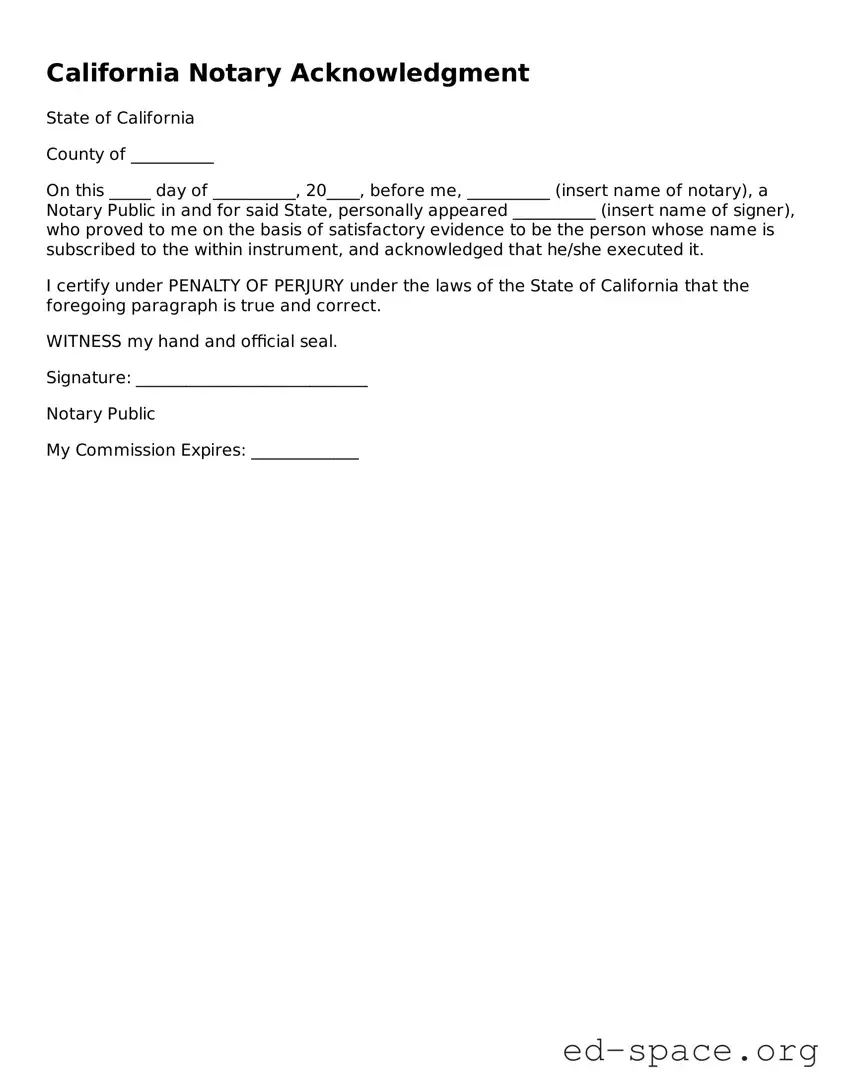
California Notary Acknowledgment
State of California
County of __________
On this _____ day of __________, 20____, before me, __________ (insert name of notary), a Notary Public in and for said State, personally appeared __________ (insert name of signer), who proved to me on the basis of satisfactory evidence to be the person whose name is subscribed to the within instrument, and acknowledged that he/she executed it.
I certify under PENALTY OF PERJURY under the laws of the State of California that the foregoing paragraph is true and correct.
WITNESS my hand and official seal.
Signature: ____________________________
Notary Public
My Commission Expires: _____________
| Fact Name | Details |
|---|---|
| Purpose | The California Notary Acknowledgement form is used to verify the identity of individuals signing a document. |
| Governing Law | California Civil Code Section 1185 governs the use of the Notary Acknowledgement form. |
| Signers | At least one signer must appear before the notary public to complete the acknowledgment. |
| Identification | Signers must provide valid identification to the notary, such as a driver's license or passport. |
| Format | The form must include specific wording as outlined in California law to be valid. |
| Notary's Role | The notary public certifies that the signer is who they claim to be and witnessed the signing. |
| Record Keeping | Notaries are required to keep a record of each acknowledgment in their journal. |
| Fees | California law allows notaries to charge a fee for performing acknowledgments, typically up to $15. |
| Expiration | The acknowledgment does not expire, but the underlying document may have its own expiration terms. |
After obtaining the California Notary Acknowledgement form, the next step involves accurately completing the document. This form is essential for verifying the identity of a signer in various legal contexts. Properly filling it out ensures that the acknowledgment is valid and can be used as intended.
What is a California Notary Acknowledgement form?
The California Notary Acknowledgement form is a legal document that verifies the identity of a signer and confirms that they willingly signed a particular document. This form is often used in real estate transactions, legal documents, and other important agreements. By completing this form, a notary public certifies that they have witnessed the signer’s signature, ensuring that the signature is authentic and that the signer was not under duress or coercion at the time of signing.
When do I need to use a Notary Acknowledgement?
A Notary Acknowledgement is typically required when you are signing documents that need to be recorded with a government office, such as property deeds, mortgages, or certain legal affidavits. It may also be necessary for documents that will be used in court. If you are unsure whether your document requires a notary acknowledgment, it is advisable to consult with a legal professional or the entity requesting the document.
What information is included in the Notary Acknowledgement form?
The Notary Acknowledgement form includes several key pieces of information. It typically contains the name and signature of the signer, the date of the acknowledgment, and the name and signature of the notary public. Additionally, it will include the notary's commission number and the expiration date of their commission. This information helps to establish the credibility of the notarization and provides essential details for record-keeping purposes.
How do I find a notary public in California?
Finding a notary public in California is relatively straightforward. You can search online for notaries in your area or check with local banks, law offices, or shipping centers, as many of these places offer notary services. Additionally, the California Secretary of State's website provides a searchable database of notaries public. It is important to ensure that the notary you choose is properly commissioned and in good standing to avoid any issues with your notarized documents.
Not including the correct date. The date should reflect when the acknowledgment is made, not when the document was signed.
Forgetting to include the signer’s name. The name must match the identification presented to the notary.
Using the wrong type of identification. The notary must verify the signer’s identity using acceptable forms of ID.
Leaving the notary’s signature blank. The notary must sign the acknowledgment to validate it.
Failing to include the notary’s seal. The seal is essential for the acknowledgment to be legally binding.
Not specifying the capacity of the signer. This is important if the signer is acting on behalf of a business or organization.
Neglecting to fill in the county and state where the acknowledgment takes place. This information is required for proper documentation.
Using an outdated form. Always ensure you have the most current version of the California Notary Acknowledgment form.
The California Notary Acknowledgment form is commonly used in various legal and financial transactions to verify the identity of the signer and the authenticity of the document. Several other forms and documents often accompany this acknowledgment to facilitate different processes. Below is a list of these related documents, each serving a specific purpose.
These documents, when used in conjunction with the California Notary Acknowledgment form, help ensure that transactions are legally sound and that all parties' rights are protected. Understanding the purpose of each document can assist individuals in navigating legal processes more effectively.
The Notary Acknowledgment form serves a specific purpose in verifying the identity of signers and the authenticity of their signatures. Several other documents share similarities in function and intent. Below is a list of seven documents that are comparable to the Notary Acknowledgment form:
When filling out the California Notary Acknowledgment form, it is important to follow specific guidelines to ensure the document is valid. Here are some things you should and shouldn't do:
Many people have misunderstandings about the California Notary Acknowledgement form. These misconceptions can lead to confusion about its purpose and use. Here are nine common misconceptions:
Many believe that a notary checks the accuracy of the information in a document. In reality, notaries only verify the identity of the signer and witness their signature.
Some think that every legal document must be notarized. However, only certain documents require a notary acknowledgment to be legally effective.
There is a misconception that notaries can offer legal guidance. Notaries are not lawyers and cannot give legal advice regarding the documents they notarize.
People often confuse acknowledgments with jurats. An acknowledgment confirms a signature, while a jurat involves the signer taking an oath about the truth of the document.
Some believe that notaries can notarize documents in any state. However, notaries are only authorized to perform notarizations in the state where they are commissioned.
It is a common belief that notaries must have a personal relationship with the signer. In fact, they only need to verify the signer's identity through proper identification.
While some notaries may offer their services for free, most charge a fee. The amount can vary based on state regulations and the notary's discretion.
Many assume that notarization guarantees the validity of a document. However, notarization does not ensure that the document is legally binding or enforceable.
Some think that all notaries maintain detailed records of every transaction. In California, notaries are required to keep a journal, but not all states have this requirement.
When filling out and using the California Notary Acknowledgement form, keep these key points in mind: