In the competitive landscape of California's business environment, protecting sensitive information is crucial for companies and individuals alike. The California Non-disclosure Agreement (NDA) serves as a vital tool in safeguarding confidential information from unauthorized disclosure. This legally binding document outlines the obligations of the parties involved, specifying what constitutes confidential information and the duration of the confidentiality obligations. It typically includes provisions regarding the permitted use of the information, the consequences of breach, and any exceptions to confidentiality. By establishing clear terms, the NDA fosters trust and encourages open communication, allowing businesses to collaborate without the fear of sensitive information falling into the wrong hands. Understanding the key elements of this form is essential for anyone looking to navigate the complexities of confidentiality in California's dynamic market.
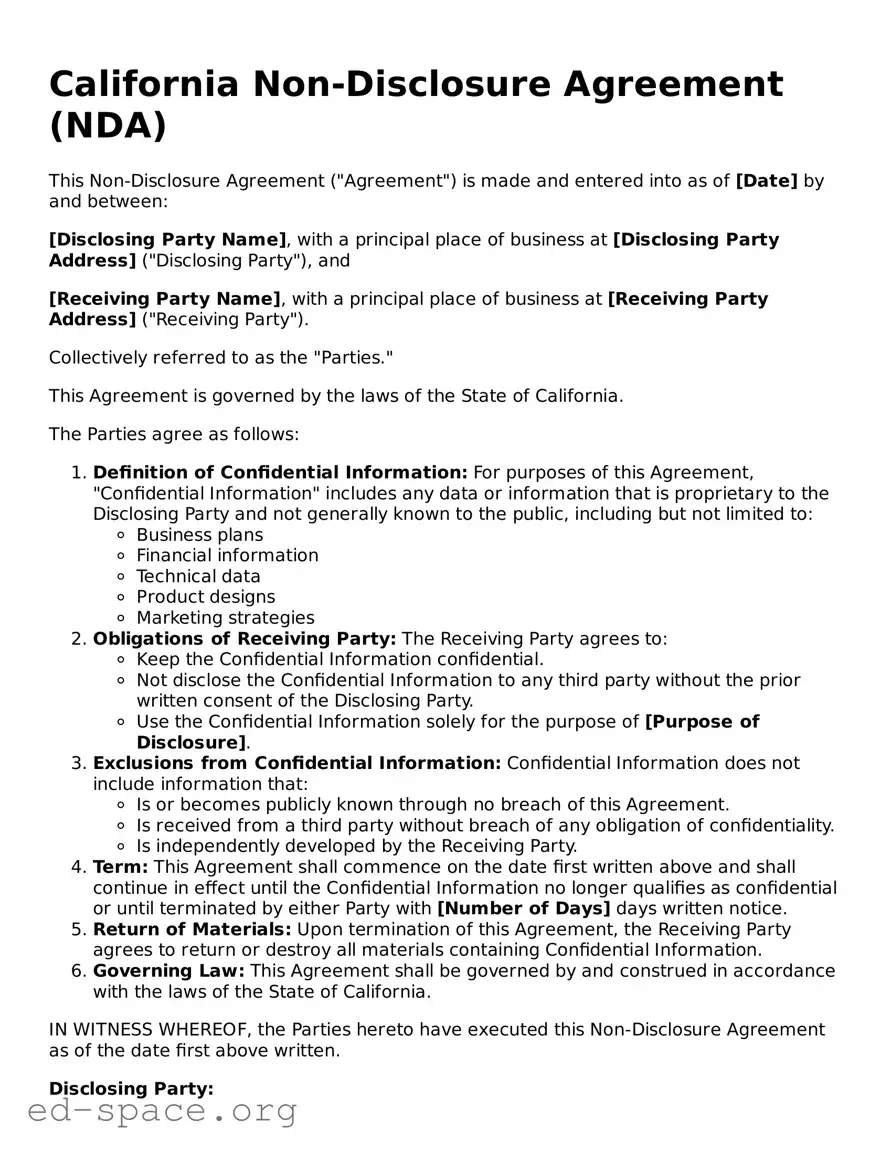
California Non-Disclosure Agreement (NDA)
This Non-Disclosure Agreement ("Agreement") is made and entered into as of [Date] by and between:
[Disclosing Party Name], with a principal place of business at [Disclosing Party Address] ("Disclosing Party"), and
[Receiving Party Name], with a principal place of business at [Receiving Party Address] ("Receiving Party").
Collectively referred to as the "Parties."
This Agreement is governed by the laws of the State of California.
The Parties agree as follows:
IN WITNESS WHEREOF, the Parties hereto have executed this Non-Disclosure Agreement as of the date first above written.
Disclosing Party:
Signature: ___________________________
Name: [Disclosing Party Name]
Title: [Title]
Receiving Party:
Signature: ___________________________
Name: [Receiving Party Name]
Title: [Title]
| Fact Name | Description |
|---|---|
| Purpose | A California Non-disclosure Agreement (NDA) protects confidential information shared between parties. |
| Parties Involved | The agreement typically involves a disclosing party and a receiving party. |
| Governing Law | California law governs the NDA, ensuring it adheres to state regulations. |
| Duration | The duration of confidentiality can vary but is often specified in the agreement. |
| Definition of Confidential Information | The NDA should clearly define what constitutes confidential information to avoid ambiguity. |
| Permitted Disclosures | Certain disclosures may be allowed, such as those required by law or court order. |
| Consequences of Breach | Breaching the NDA can lead to legal action, including potential damages. |
| Mutual vs. Unilateral | NDAs can be mutual (both parties share information) or unilateral (one party discloses). |
| Exclusions | Common exclusions include information already in the public domain or independently developed. |
| Signatures | The agreement must be signed by both parties to be legally binding. |
Once you have the California Non-disclosure Agreement form in front of you, it’s time to fill it out accurately. This process involves several straightforward steps. Follow the instructions carefully to ensure all necessary information is included.
After completing these steps, you will have a properly filled-out Non-disclosure Agreement. This document will help protect sensitive information as you move forward with your business dealings.
What is a Non-disclosure Agreement (NDA) in California?
A Non-disclosure Agreement, or NDA, is a legal contract that protects confidential information shared between parties. In California, it ensures that sensitive information, such as trade secrets, business plans, or proprietary data, remains private. By signing an NDA, both parties agree not to disclose the information to others without permission.
Why should I use a Non-disclosure Agreement?
Using an NDA is crucial when sharing sensitive information. It provides legal protection if the other party discloses your information without consent. An NDA can help maintain your competitive edge, safeguard your business interests, and build trust between parties involved in a project or partnership.
What should be included in a California NDA?
A well-drafted NDA should include the following key elements: a clear definition of what constitutes confidential information, the obligations of both parties regarding the information, the duration of confidentiality, and any exclusions (like information already in the public domain). Additionally, it should specify the governing law, which, in this case, would be California law.
How long does the confidentiality obligation last?
The duration of confidentiality can vary based on the agreement. Typically, NDAs in California specify a timeframe ranging from one to five years. However, some agreements may state that the obligation lasts indefinitely, especially for trade secrets. It's important to clearly outline this in the NDA.
Can I enforce an NDA in California?
Yes, NDAs are enforceable in California as long as they are reasonable and not overly broad. If a party breaches the agreement, the injured party can seek legal remedies, such as monetary damages or injunctive relief. However, courts may not enforce NDAs that impose unreasonable restrictions on a party’s ability to work or conduct business.
Are there any limitations on what can be protected by an NDA?
Yes, not all information can be protected by an NDA. For example, information that is already public or independently developed cannot be protected. Additionally, if the information is disclosed through legal proceedings or required by law, the NDA may not apply. It's important to understand these limitations when drafting an NDA.
Do I need a lawyer to draft an NDA?
While it's not legally required to have a lawyer draft an NDA, it is highly recommended. A lawyer can ensure that the NDA is properly structured, complies with California law, and addresses your specific needs. This can save you from potential legal issues down the road.
What happens if someone breaches the NDA?
If someone breaches the NDA, the injured party has several options. They can pursue legal action to seek damages or request a court order to stop further disclosure. The specific remedies available depend on the terms of the NDA and the nature of the breach. It's essential to act promptly to protect your rights.
Inadequate Identification of Parties: One common mistake is failing to clearly identify all parties involved in the agreement. Each party's full legal name should be included, along with any relevant business names.
Vague Definition of Confidential Information: Another frequent error is not providing a precise definition of what constitutes confidential information. A broad or unclear definition can lead to misunderstandings and disputes later on.
Omitting Duration of Confidentiality: People often neglect to specify how long the confidentiality obligations will last. Without a defined duration, it can be unclear when the obligations end, which may lead to ongoing liability.
Failure to Include Permitted Disclosures: Some individuals forget to outline the circumstances under which confidential information may be disclosed. Including exceptions is crucial to avoid potential legal complications.
Not Reviewing for Compliance with California Law: Lastly, individuals may overlook the importance of ensuring that the agreement complies with California law. Legal requirements can vary, and non-compliance may render the agreement unenforceable.
A California Non-disclosure Agreement (NDA) is an essential document for protecting sensitive information shared between parties. When entering into an NDA, several other forms and documents may be necessary to ensure comprehensive protection and clarity in the business relationship. Below is a list of commonly used documents that often accompany an NDA.
Utilizing these documents in conjunction with a California Non-disclosure Agreement can help create a solid framework for protecting sensitive information and fostering trust between parties. Each document serves a specific purpose and can address various aspects of confidentiality and business relationships.
When filling out the California Non-disclosure Agreement (NDA) form, it's crucial to approach the task with care. Here are five essential do's and don'ts to keep in mind:
By following these guidelines, you can help ensure that your NDA is effective and legally sound. Take the time to do it right.
Non-disclosure agreements (NDAs) are commonly used in California to protect sensitive information. However, several misconceptions surround these legal documents. Understanding these misconceptions can help individuals and businesses navigate the complexities of NDAs more effectively.
This is not true. While large corporations often use NDAs, small businesses and even individuals can benefit from them. Any entity that needs to protect confidential information can utilize an NDA to safeguard their interests.
This is misleading. An NDA must meet certain legal criteria to be enforceable. If the terms are overly broad or unreasonable, a court may refuse to enforce the agreement. It is essential to ensure that the NDA is clear and specific.
This misconception overlooks the fact that NDAs typically allow for certain disclosures, such as sharing information with employees or contractors who also agree to keep the information confidential. The agreement should specify who can access the information and under what circumstances.
While it is ideal to have an NDA in place before disclosing sensitive information, it can also be beneficial to have one after the fact. If you have already shared information without an NDA, you can still create one to protect future disclosures and clarify expectations moving forward.
When dealing with sensitive information in California, a Non-disclosure Agreement (NDA) can be an essential tool. Here are some key takeaways to consider when filling out and using the California NDA form: