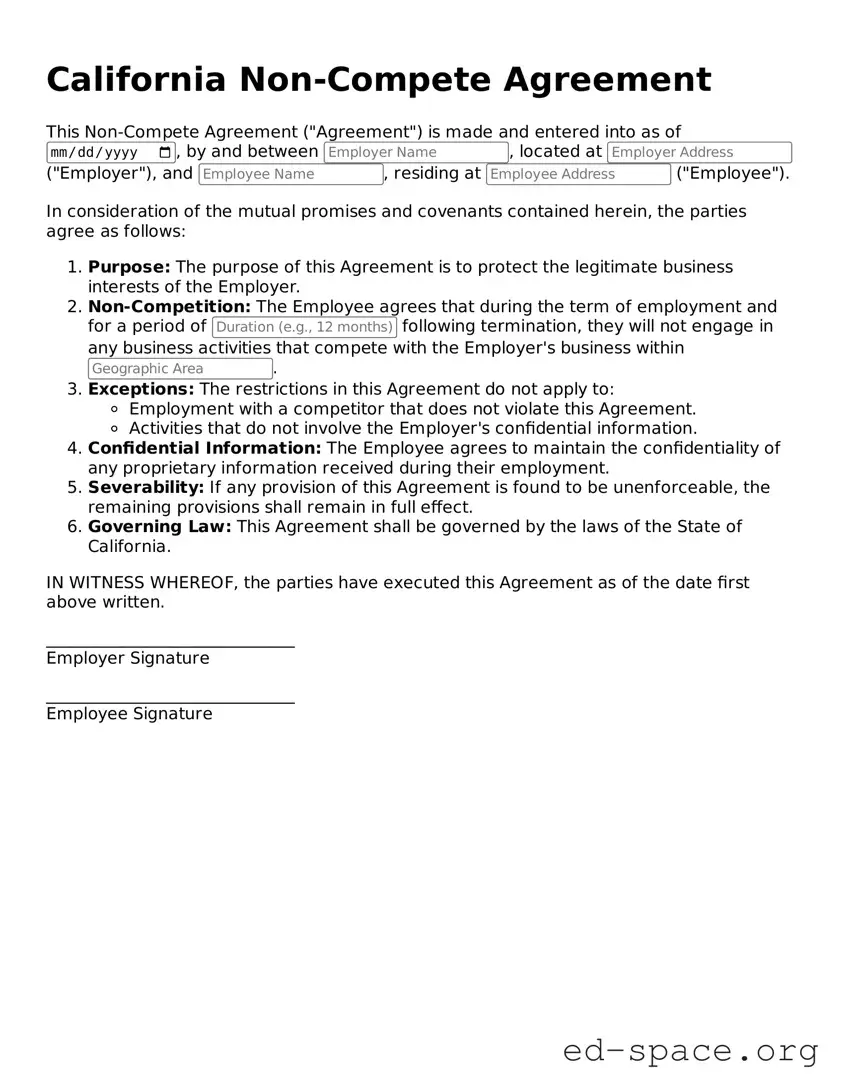
In California, the Non-compete Agreement form plays a crucial role in defining the boundaries of employment contracts and protecting business interests. This form outlines the conditions under which an employee agrees not to engage in activities that directly compete with their employer after leaving the company. It typically includes specific details such as the duration of the non-compete period, the geographical area it covers, and the types of activities restricted. While California generally disfavors non-compete clauses, certain exceptions may apply, particularly in the context of the sale of a business or the protection of trade secrets. Understanding the nuances of this form is essential for both employers and employees to navigate the legal landscape effectively. Clarity in the terms can prevent misunderstandings and potential disputes, making it vital for all parties involved to carefully review and comprehend the implications of the agreement.
California Non-Compete Agreement
This Non-Compete Agreement ("Agreement") is made and entered into as of , by and between , located at ("Employer"), and , residing at ("Employee").
In consideration of the mutual promises and covenants contained herein, the parties agree as follows:
IN WITNESS WHEREOF, the parties have executed this Agreement as of the date first above written.
______________________________
Employer Signature
______________________________
Employee Signature
| Fact Name | Description |
|---|---|
| Legality | Non-compete agreements are generally unenforceable in California, with few exceptions. |
| Governing Law | The California Business and Professions Code Section 16600 governs non-compete agreements. |
| Employee Rights | Employees in California have the right to work for competitors after leaving a job. |
| Exceptions | Non-compete agreements may be enforceable in specific cases, such as the sale of a business. |
| Impact on Employers | Employers in California cannot restrict employees from pursuing their profession or trade. |
After obtaining the California Non-compete Agreement form, it is essential to complete it accurately. Following the steps below will ensure that you provide all necessary information clearly and correctly.
Once you have completed the form, review it carefully for any errors or omissions before submitting it to the relevant party. This will help ensure that your agreement is valid and enforceable.
What is a California Non-compete Agreement?
A California Non-compete Agreement is a legal document that restricts an employee from working for a competitor or starting a similar business after leaving their current job. However, it’s important to note that California law generally does not enforce non-compete agreements, making them largely ineffective in the state.
Are non-compete agreements enforceable in California?
In most cases, non-compete agreements are not enforceable in California. The state’s strong public policy favors employee mobility and the right to work. There are some exceptions, such as when the agreement is part of the sale of a business, but these situations are limited.
What should I do if my employer asks me to sign a non-compete agreement?
If your employer asks you to sign a non-compete agreement, consider discussing your concerns with them. It may also be beneficial to seek legal advice. Understanding your rights and the potential limitations of such an agreement can help you make an informed decision.
Can a non-compete agreement affect my ability to find a new job?
While non-compete agreements are generally unenforceable in California, if you do sign one, it could create challenges when looking for a new job. Employers may be hesitant to hire you if they believe you are bound by such an agreement, even if it is not legally enforceable.
What are the alternatives to a non-compete agreement?
Employers often use non-disclosure agreements (NDAs) or non-solicitation agreements as alternatives. NDAs protect confidential information, while non-solicitation agreements prevent employees from poaching clients or coworkers. These options can provide protection without restricting an employee’s ability to work.
How long do non-compete agreements last?
In California, since non-compete agreements are typically unenforceable, there is no standard duration. However, in cases where they might be enforceable, the duration should be reasonable and not excessively long. Generally, a few months to a year is considered reasonable in other jurisdictions.
What happens if I violate a non-compete agreement?
If you violate a non-compete agreement in California, the consequences may vary. Since such agreements are often unenforceable, the employer may not have legal recourse. However, if the agreement was part of a sale of a business or another exception, you could face legal action. Always consult with a legal professional if you find yourself in this situation.
Can I negotiate the terms of a non-compete agreement?
Yes, you can negotiate the terms of a non-compete agreement before signing it. Discussing your concerns and suggesting modifications can lead to a more favorable agreement. It’s important to ensure that any terms are reasonable and do not unfairly limit your future employment opportunities.
Failing to understand the legal implications of a non-compete agreement. Many individuals do not realize that signing such an agreement can limit their future employment opportunities.
Not reviewing the terms thoroughly. It's crucial to read the entire document carefully. Skimming through can lead to missing important clauses that may affect your rights.
Omitting necessary personal information. Ensure that all required fields are filled out completely, including your full name, address, and contact information.
Neglecting to specify the duration of the non-compete clause. The agreement should clearly outline how long the restrictions will last. Without this detail, the enforceability of the agreement may be questioned.
Overlooking the geographic scope of the agreement. It is essential to define the areas where the non-compete restrictions apply. A vague description can lead to misunderstandings.
Not consulting with a legal professional. Seeking advice from an attorney can help clarify any confusing terms and ensure that your rights are protected.
Signing without considering potential consequences. Before signing, reflect on how the agreement may impact your career and future job opportunities.
When entering into a Non-compete Agreement in California, it is essential to consider various related forms and documents that can support the agreement and clarify expectations. Below is a list of commonly used documents that can accompany a Non-compete Agreement.
Understanding these documents and their roles can help ensure that both employers and employees are on the same page regarding expectations and obligations. Each document serves a specific purpose and can provide additional clarity and protection for both parties involved in a Non-compete Agreement.
When filling out a California Non-compete Agreement form, it is essential to approach the process with care. California law has specific restrictions regarding non-compete agreements, making it crucial to understand what to do and what to avoid. Here are some guidelines to consider:
Approaching the Non-compete Agreement with a clear understanding of your rights and obligations can help protect your future career prospects.
California is known for its unique approach to non-compete agreements, and many misconceptions surround this topic. Understanding these misconceptions is crucial for employees and employers alike. Here are seven common misunderstandings about non-compete agreements in California:
Non-compete agreements are always enforceable in California. This is not true. In California, non-compete agreements are generally unenforceable except in very limited circumstances, such as the sale of a business.
All employers use non-compete agreements. Many employers choose not to use them, especially in California, where the law limits their enforceability. Instead, they may rely on other protective measures, such as confidentiality agreements.
Signing a non-compete agreement means you cannot work in your field. While these agreements may restrict certain activities, they do not prevent individuals from working in their profession altogether. Employees can often find ways to work in similar roles without violating the agreement.
Non-compete agreements are the same as non-disclosure agreements. These two types of agreements serve different purposes. Non-disclosure agreements protect confidential information, while non-compete agreements restrict employment opportunities.
Employers can enforce non-compete agreements regardless of the situation. California courts often look at the reasonableness of the restrictions imposed. If the agreement is deemed overly broad or unreasonable, it may not be enforced.
All non-compete agreements are invalid in California. While most are unenforceable, certain situations, such as the sale of a business, may allow for a non-compete agreement to be valid.
Once you sign a non-compete agreement, you have no options. Employees can challenge the enforceability of these agreements in court, especially if they believe the restrictions are unreasonable or not in line with California law.
By understanding these misconceptions, individuals can better navigate the complexities of employment agreements in California. Knowledge empowers employees to protect their rights while allowing employers to craft agreements that are both fair and enforceable.
When considering a Non-compete Agreement in California, it is essential to understand its implications and requirements. Here are four key takeaways to keep in mind: