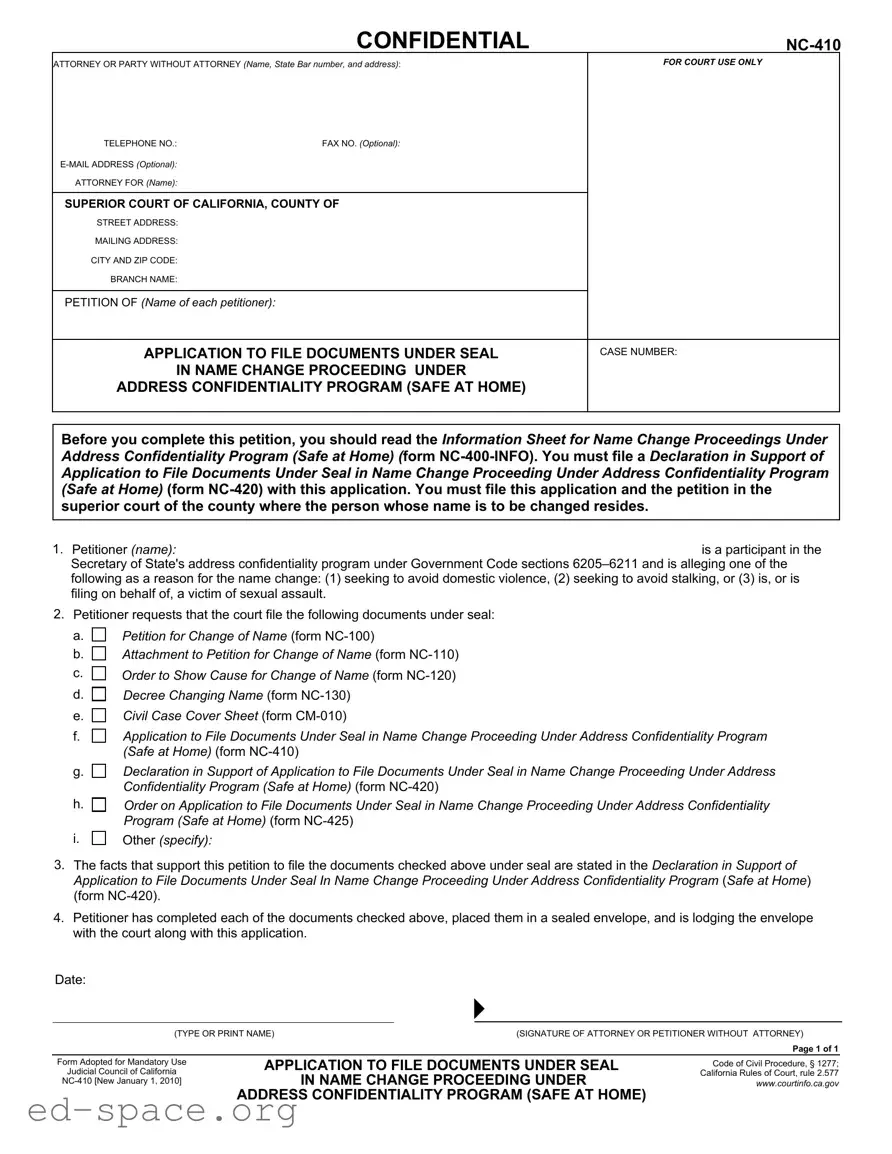
The California NC 410 form plays a crucial role in protecting the privacy of individuals undergoing name changes, particularly those participating in the Address Confidentiality Program (Safe at Home). This form is designed for petitioners who may be facing domestic violence, stalking, or are victims of sexual assault, allowing them to file their documents under seal to ensure their safety and confidentiality. The process begins with the petitioner completing this application, which must be filed in the superior court of the county where they reside. Alongside the NC 410, it is essential to submit a Declaration in Support of Application to File Documents Under Seal, using form NC-420. This declaration outlines the reasons for seeking confidentiality and details the specific documents that will be filed under seal, such as the Petition for Change of Name and the Order to Show Cause. By lodging these documents in a sealed envelope with the court, petitioners can safeguard their sensitive information while navigating the legal system. Understanding the requirements and implications of the NC 410 form is vital for anyone seeking to change their name under these protective measures.

CONFIDENTIAL
ATTORNEY OR PARTY WITHOUT ATTORNEY (Name, State Bar number, and address): |
FOR COURT USE ONLY |
|
|
||
TELEPHONE NO.: |
FAX NO. (Optional): |
|
|
|
|
ATTORNEY FOR (Name): |
|
|
|
|
|
SUPERIOR COURT OF CALIFORNIA, COUNTY OF |
|
|
STREET ADDRESS: |
|
|
MAILING ADDRESS: |
|
|
CITY AND ZIP CODE: |
|
|
BRANCH NAME: |
|
|
|
|
|
PETITION OF (Name of each petitioner): |
|
|
|
|
|
APPLICATION TO FILE DOCUMENTS UNDER SEAL |
CASE NUMBER: |
|
IN NAME CHANGE PROCEEDING UNDER |
|
|
ADDRESS CONFIDENTIALITY PROGRAM (SAFE AT HOME) |
|
|
|
|
|
|
|
|
Before you complete this petition, you should read the Information Sheet for Name Change Proceedings Under Address Confidentiality Program (Safe at Home) (form
1. Petitioner (name):is a participant in the Secretary of State's address confidentiality program under Government Code sections
2. Petitioner requests that the court file the following documents under seal:
a.
b.
c.
d.
e.
f.
g.
h.
i.
Petition for Change of Name (form
Attachment to Petition for Change of Name (form
Order to Show Cause for Change of Name (form
Decree Changing Name (form
Civil Case Cover Sheet (form
Application to File Documents Under Seal in Name Change Proceeding Under Address Confidentiality Program (Safe at Home) (form
Declaration in Support of Application to File Documents Under Seal in Name Change Proceeding Under Address Confidentiality Program (Safe at Home) (form
Order on Application to File Documents Under Seal in Name Change Proceeding Under Address Confidentiality Program (Safe at Home) (form
Other (specify):
3.The facts that support this petition to file the documents checked above under seal are stated in the Declaration in Support of Application to File Documents Under Seal In Name Change Proceeding Under Address Confidentiality Program (Safe at Home) (form
4.Petitioner has completed each of the documents checked above, placed them in a sealed envelope, and is lodging the envelope with the court along with this application.
Date:
(TYPE OR PRINT NAME) |
(SIGNATURE OF ATTORNEY OR PETITIONER WITHOUT ATTORNEY) |
|||
|
|
|
Page 1 of 1 |
|
Form Adopted for Mandatory Use |
APPLICATION TO FILE DOCUMENTS UNDER SEAL |
Code of Civil Procedure, § 1277; |
||
Judicial Council of California |
California Rules of Court, rule 2.577 |
|||
|
IN NAME CHANGE PROCEEDING UNDER |
|||
|
www.courtinfo.ca.gov |
|||
ADDRESS CONFIDENTIALITY PROGRAM (SAFE AT HOME)
| Fact Name | Details |
|---|---|
| Form Title | California NC 410 is the Application to File Documents Under Seal in Name Change Proceeding Under Address Confidentiality Program (Safe at Home). |
| Governing Laws | This form is governed by the California Code of Civil Procedure, § 1277, and the California Rules of Court, rule 2.577. |
| Purpose | The NC 410 form is designed for petitioners who wish to keep their name change documents confidential due to safety concerns. |
| Eligibility | Petitioners must be participants in the Secretary of State's address confidentiality program and may cite reasons such as domestic violence, stalking, or sexual assault. |
| Required Supporting Documents | Along with the NC 410, petitioners must file the Declaration in Support of Application to File Documents Under Seal (form NC-420). |
| Filing Location | The application and petition must be filed in the superior court of the county where the petitioner resides. |
| Document Sealing | Petitioners request that specific documents related to their name change be filed under seal for confidentiality. |
| Form Adoption Date | The NC 410 form was adopted for mandatory use on January 1, 2010. |
Filling out the California NC-410 form is an important step in the name change process under the Address Confidentiality Program (Safe at Home). This form allows you to request that specific documents be filed under seal to protect your privacy. Follow the steps below to complete the form accurately.
Once you have completed the NC-410 form, gather all necessary documents and submit them to the court. This will help ensure that your name change request is handled appropriately and confidentially.
What is the purpose of the California NC-410 form?
The California NC-410 form is an application to file documents under seal in name change proceedings, specifically for participants in the Address Confidentiality Program (Safe at Home). This form helps protect the privacy of individuals seeking a name change due to safety concerns, such as domestic violence, stalking, or sexual assault.
Who can use the NC-410 form?
Individuals who are participants in the Secretary of State's Address Confidentiality Program can use the NC-410 form. This includes those who are seeking to change their name to avoid threats to their safety. Eligibility requires meeting specific criteria related to domestic violence, stalking, or being a victim of sexual assault.
What documents must accompany the NC-410 form?
When submitting the NC-410 form, you must also file a Declaration in Support of Application to File Documents Under Seal (form NC-420). Additionally, you need to include the Petition for Change of Name (form NC-100) and any other related documents you wish to file under seal.
Where should the NC-410 form be filed?
The NC-410 form must be filed in the superior court of the county where the individual whose name is being changed resides. Ensure you check the specific court requirements and procedures for filing.
What happens after submitting the NC-410 form?
Once the NC-410 form is submitted, the court will review your application. If approved, the documents specified in your application will be filed under seal, meaning they will not be publicly accessible. This helps protect your privacy throughout the name change process.
Is there a fee associated with filing the NC-410 form?
Filing fees may apply when submitting the NC-410 form, along with any accompanying documents. It's advisable to check with the specific court for the current fee schedule and any potential fee waivers available for those in the Address Confidentiality Program.
Can I file the NC-410 form without an attorney?
Yes, you can file the NC-410 form without an attorney. However, it is recommended to seek legal advice to ensure that all requirements are met and to help navigate the process effectively, especially given the sensitive nature of the circumstances.
What information is required on the NC-410 form?
The NC-410 form requires basic information such as the petitioner's name, contact details, and the reason for the name change. You will also need to specify which documents you wish to file under seal and provide supporting facts in the accompanying declaration.
How long does it take to process the NC-410 application?
The processing time for the NC-410 application can vary by court. Typically, it may take several weeks to receive a decision. It's important to follow up with the court if you have not received a response within a reasonable timeframe.
What should I do if my NC-410 application is denied?
If your NC-410 application is denied, you may have the option to appeal the decision or refile with additional supporting information. Consulting with an attorney can provide guidance on the best course of action in such cases.
Neglecting to read the information sheet: Before starting the application, it is crucial to review the Information Sheet for Name Change Proceedings Under Address Confidentiality Program (Safe at Home) (form NC-400-INFO). Skipping this step can lead to misunderstandings about the process and requirements.
Incomplete petitioner information: Ensure that all required details about the petitioner, including name and participation in the address confidentiality program, are fully provided. Missing information can delay the application process.
Forgetting to file the necessary declarations: Along with the NC-410 form, a Declaration in Support of Application to File Documents Under Seal (form NC-420) must also be submitted. Failing to include this declaration will result in an incomplete application.
Incorrectly identifying the court: The application must be filed in the superior court of the county where the petitioner resides. Filing in the wrong court can lead to automatic rejection of the application.
Not sealing documents properly: Petitioner must complete and place all relevant documents in a sealed envelope before lodging them with the court. Neglecting this step can cause significant issues with confidentiality.
Omitting supporting facts: The petition must include facts that justify the request to file documents under seal. If these facts are not clearly stated in the declaration, the court may deny the application.
Failing to sign the form: A common mistake is submitting the NC-410 form without the required signature of the petitioner or their attorney. Remember, a signature validates the application.
Missing deadlines: Each step in the name change process has specific deadlines. Delaying the submission of the application can lead to complications or the need to restart the process.
The California NC-410 form is part of the process for individuals seeking to change their name while maintaining confidentiality for safety reasons. Along with this form, several other documents are typically required to ensure the application is complete and meets the court's standards. Below is a list of these essential forms and a brief description of each.
Each of these forms plays a critical role in the name change process under the Address Confidentiality Program in California. Properly completing and submitting these documents helps protect the petitioner's safety while ensuring compliance with legal requirements.
The California NC-410 form is part of a process that helps individuals change their names while keeping their personal information confidential. Several other documents serve similar purposes in legal proceedings. Here’s a list of five documents that share similarities with the NC-410 form:
Each of these forms plays a vital role in the name change process, ensuring that the petitioner’s rights and safety are prioritized while following legal procedures.
When filling out the California NC-410 form, it is important to follow specific guidelines to ensure the application is completed correctly. Below is a list of things to do and not to do during this process.
Understanding the California NC 410 form is essential for anyone considering a name change under the Address Confidentiality Program. However, several misconceptions often arise regarding this form and its use. Here are seven common misconceptions:
By addressing these misconceptions, individuals can better navigate the name change process and understand the significance of the NC 410 form within the Address Confidentiality Program.
When filling out and using the California NC-410 form, consider the following key takeaways: