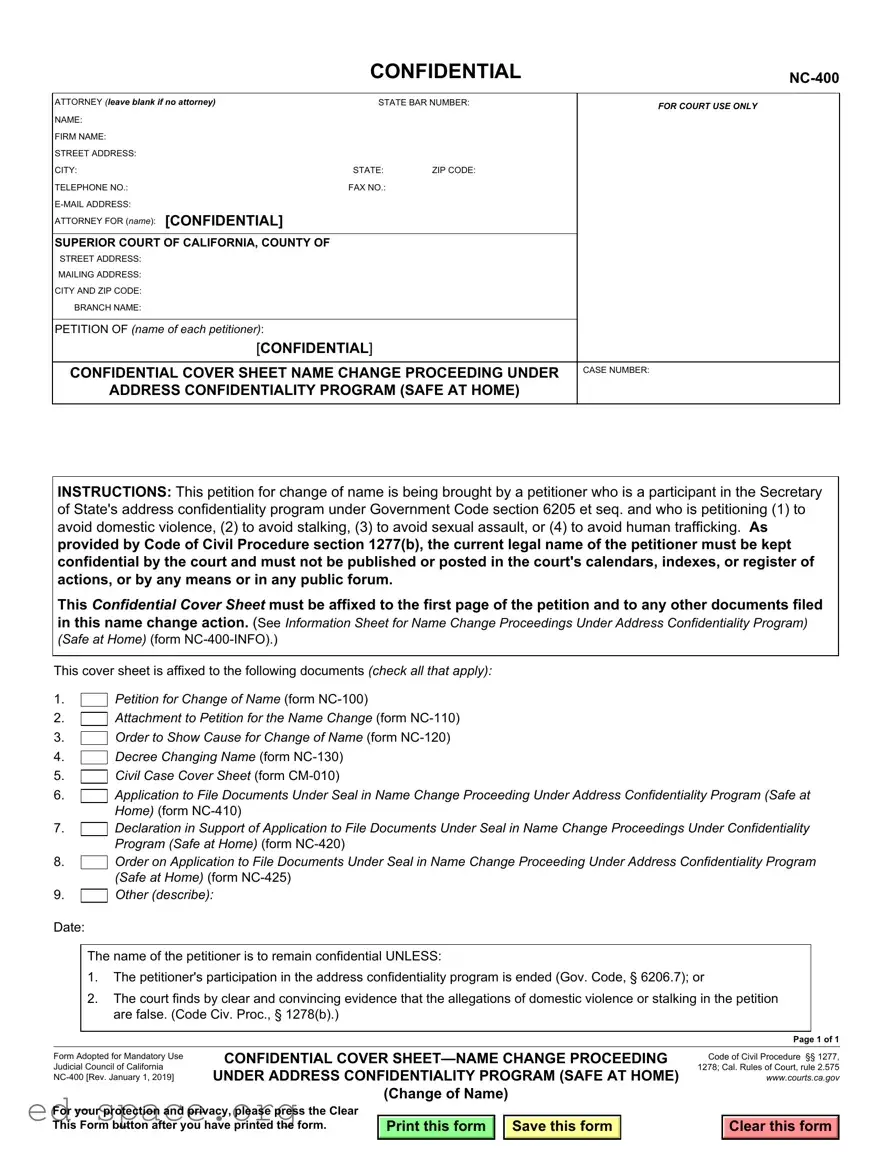
The California NC 400 form serves as a critical tool for individuals seeking to change their names while ensuring their safety and privacy. This form is specifically designed for participants in the Secretary of State's Address Confidentiality Program, which is intended to protect individuals from domestic violence, stalking, sexual assault, or human trafficking. By utilizing this form, petitioners can maintain confidentiality regarding their current legal names, as mandated by California law. The NC 400 must be attached to various documents related to the name change process, including the petition itself and any supporting declarations. It is essential that the information on this form remains confidential, safeguarding the petitioner's identity from public disclosure. The form outlines specific instructions and requirements for its use, emphasizing the importance of protecting sensitive information throughout the legal proceedings. Furthermore, it details the circumstances under which a petitioner's confidentiality may be compromised, ensuring that individuals are aware of their rights and protections under the law.

CONFIDENTIAL
ATTORNEY (leave blank if no attorney) |
STATE BAR NUMBER: |
FOR COURT USE ONLY |
|
|
|
|
|
NAME: |
|
|
|
FIRM NAME: |
|
|
|
STREET ADDRESS: |
|
|
|
CITY: |
STATE: |
ZIP CODE: |
|
TELEPHONE NO.: |
FAX NO.: |
|
|
|
|
|
|
ATTORNEY FOR (name): [CONFIDENTIAL] |
|
|
|
|
|
|
|
SUPERIOR COURT OF CALIFORNIA, COUNTY OF |
|
|
|
STREET ADDRESS: |
|
|
|
MAILING ADDRESS: |
|
|
|
CITY AND ZIP CODE: |
|
|
|
BRANCH NAME: |
|
|
|
|
|
|
|
PETITION OF (name of each petitioner): |
|
|
|
[CONFIDENTIAL] |
|
|
|
|
|
|
|
CONFIDENTIAL COVER SHEET NAME CHANGE PROCEEDING UNDER |
CASE NUMBER: |
||
|
|||
ADDRESS CONFIDENTIALITY PROGRAM (SAFE AT HOME) |
|
||
|
|
|
|
INSTRUCTIONS: This petition for change of name is being brought by a petitioner who is a participant in the Secretary of State's address confidentiality program under Government Code section 6205 et seq. and who is petitioning (1) to avoid domestic violence, (2) to avoid stalking, (3) to avoid sexual assault, or (4) to avoid human trafficking. As provided by Code of Civil Procedure section 1277(b), the current legal name of the petitioner must be kept confidential by the court and must not be published or posted in the court's calendars, indexes, or register of actions, or by any means or in any public forum.
This Confidential Cover Sheet must be affixed to the first page of the petition and to any other documents filed in this name change action. (See Information Sheet for Name Change Proceedings Under Address Confidentiality Program) (Safe at Home) (form
This cover sheet is affixed to the following documents (check all that apply):
1. |
|
Petition for Change of Name (form |
2. |
|
Attachment to Petition for the Name Change (form |
|
||
3. |
|
Order to Show Cause for Change of Name (form |
|
||
4. |
|
Decree Changing Name (form |
|
||
5. |
|
Civil Case Cover Sheet (form |
|
||
6. |
|
Application to File Documents Under Seal in Name Change Proceeding Under Address Confidentiality Program (Safe at |
|
||
|
|
Home) (form |
7. |
|
Declaration in Support of Application to File Documents Under Seal in Name Change Proceedings Under Confidentiality |
|
||
|
|
Program (Safe at Home) (form |
8. |
|
Order on Application to File Documents Under Seal in Name Change Proceeding Under Address Confidentiality Program |
|
||
|
|
(Safe at Home) (form |
9. |
|
Other (describe): |
|
Date:
The name of the petitioner is to remain confidential UNLESS:
1.The petitioner's participation in the address confidentiality program is ended (Gov. Code, § 6206.7); or
2.The court finds by clear and convincing evidence that the allegations of domestic violence or stalking in the petition are false. (Code Civ. Proc., § 1278(b).)
|
|
Page 1 of 1 |
|
|
|
|
|
Form Adopted for Mandatory Use |
CONFIDENTIAL COVER |
Code of Civil Procedure §§ 1277, |
|
Judicial Council of California |
1278; Cal. Rules of Court, rule 2.575 |
||
UNDER ADDRESS CONFIDENTIALITY PROGRAM (SAFE AT HOME) |
|||
www.courts.ca.gov |
|||
|
(Change of Name) |
|
For your protection and privacy, please press the Clear This Form button after you have printed the form.
Print this form Save this form
Clear this form
| Fact Name | Description |
|---|---|
| Form Purpose | The NC-400 form is a confidential cover sheet used in name change proceedings for individuals participating in the Address Confidentiality Program in California. |
| Governing Law | This form is governed by California Government Code section 6205 et seq. and Code of Civil Procedure sections 1277 and 1278. |
| Confidentiality | The petitioner's current legal name must remain confidential and not be disclosed in public forums, including court calendars and indexes. |
| Petitioner's Reasons | Participants may petition for a name change to avoid domestic violence, stalking, sexual assault, or human trafficking. |
| Affix Requirement | The NC-400 form must be affixed to the first page of the name change petition and any other related documents filed in the case. |
| Form Adoption | This form has been adopted for mandatory use by the Judicial Council of California as of January 1, 2019. |
| Clear Evidence Clause | The confidentiality of the petitioner's name may be lifted if the court finds clear and convincing evidence that allegations of domestic violence or stalking are false. |
| Form Revision | The NC-400 form was last revised in January 2019, ensuring it remains up-to-date with current laws and procedures. |
| Related Forms | Several forms are associated with the NC-400, including the Petition for Change of Name (NC-100) and the Order to Show Cause for Change of Name (NC-120). |
Filling out the California NC 400 form is an essential step in initiating a name change proceeding under the Address Confidentiality Program. This program is designed to protect individuals who may be at risk of domestic violence, stalking, sexual assault, or human trafficking. After completing the form, it will need to be submitted along with other relevant documents to the court.
What is the purpose of the California NC 400 form?
The California NC 400 form is a Confidential Cover Sheet used in name change proceedings for individuals participating in the Address Confidentiality Program (Safe at Home). This program is designed to protect individuals from domestic violence, stalking, sexual assault, or human trafficking. The form ensures that the petitioner's current legal name remains confidential and is not disclosed in public court records.
Who should use the NC 400 form?
This form should be used by petitioners who are enrolled in the Address Confidentiality Program and wish to change their name for safety reasons. It is specifically for those who have valid concerns about their safety due to domestic violence, stalking, sexual assault, or human trafficking.
What documents must the NC 400 form be attached to?
The NC 400 form must be affixed to several documents related to the name change action. These include the Petition for Change of Name (form NC-100), Attachment to Petition for the Name Change (form NC-110), Order to Show Cause for Change of Name (form NC-120), and others as listed on the form. This ensures that all relevant documents maintain the confidentiality of the petitioner's name.
How does the confidentiality of the petitioner's name work?
The name of the petitioner remains confidential unless certain conditions are met. These conditions include the end of the petitioner's participation in the Address Confidentiality Program or a court finding that the allegations of domestic violence or stalking are false. This protection is crucial for maintaining the safety of individuals in vulnerable situations.
What should I do after completing the NC 400 form?
After completing the NC 400 form, it should be printed and affixed to the first page of your petition and any other related documents. Ensure that you keep a copy for your records. Additionally, remember to press the "Clear This Form" button to protect your privacy before sharing or submitting the form.
Where can I find more information about the Address Confidentiality Program?
More information about the Address Confidentiality Program and the NC 400 form can be found on the California courts website. The site provides resources and guidelines for individuals seeking to understand their rights and the procedures involved in name change proceedings under this program.
Omitting Attorney Information: If you have an attorney, ensure that their name and State Bar number are filled out. Leaving this section blank can delay processing.
Incorrect Mailing Address: Double-check that the mailing address is accurate. An incorrect address can lead to missed notifications or documents.
Not Checking All Applicable Documents: Make sure to check all documents that the Confidential Cover Sheet applies to. Failing to do so can result in incomplete submissions.
Missing Signature: Ensure that the petitioner's signature is included. A missing signature can render the form invalid.
Incorrect Case Number: Verify that the case number is correctly entered. An incorrect case number can complicate tracking and processing.
Failure to Affix Cover Sheet: The Confidential Cover Sheet must be attached to the first page of the petition. Not doing so may lead to rejection of the documents.
Neglecting Confidentiality: Remember that the petitioner's current legal name must remain confidential. Do not include it in any public forums or documents.
Not Following Instructions: Review the instructions carefully. Ignoring specific guidelines can lead to errors and delays.
Incomplete Contact Information: Ensure that all contact information, including telephone number and email address, is complete and accurate. This is crucial for communication.
Ignoring the Clear This Form Button: After printing, be sure to press the "Clear This Form" button. This protects your privacy by ensuring that sensitive information is not stored.
When navigating the process of changing your name in California, especially under the Address Confidentiality Program, several key forms accompany the NC 400. Each document plays a specific role in ensuring the process is smooth and compliant with legal requirements. Here’s a brief overview of those forms.
Understanding these forms will help you navigate the name change process more effectively. Each document serves a specific purpose, ensuring your rights and privacy are protected throughout the proceedings.
The California NC 400 form is a crucial document used in name change proceedings, particularly for individuals participating in the Address Confidentiality Program. Several other forms serve similar purposes in terms of confidentiality and legal processes. Here are seven documents that share similarities with the NC 400 form:
Each of these documents plays a vital role in protecting the privacy of individuals undergoing name changes, particularly those in vulnerable situations.
When filling out the California NC 400 form, it is important to keep certain guidelines in mind. Here are five things you should and shouldn't do:
Misconceptions about the California NC 400 form can lead to confusion regarding its purpose and requirements. Below are ten common misconceptions along with clarifications.
Filling out the California NC-400 form is a crucial step for individuals seeking to change their name under the Address Confidentiality Program (Safe at Home). Here are some key takeaways to consider:
By keeping these points in mind, you can navigate the name change process more effectively and ensure your privacy and safety are prioritized.