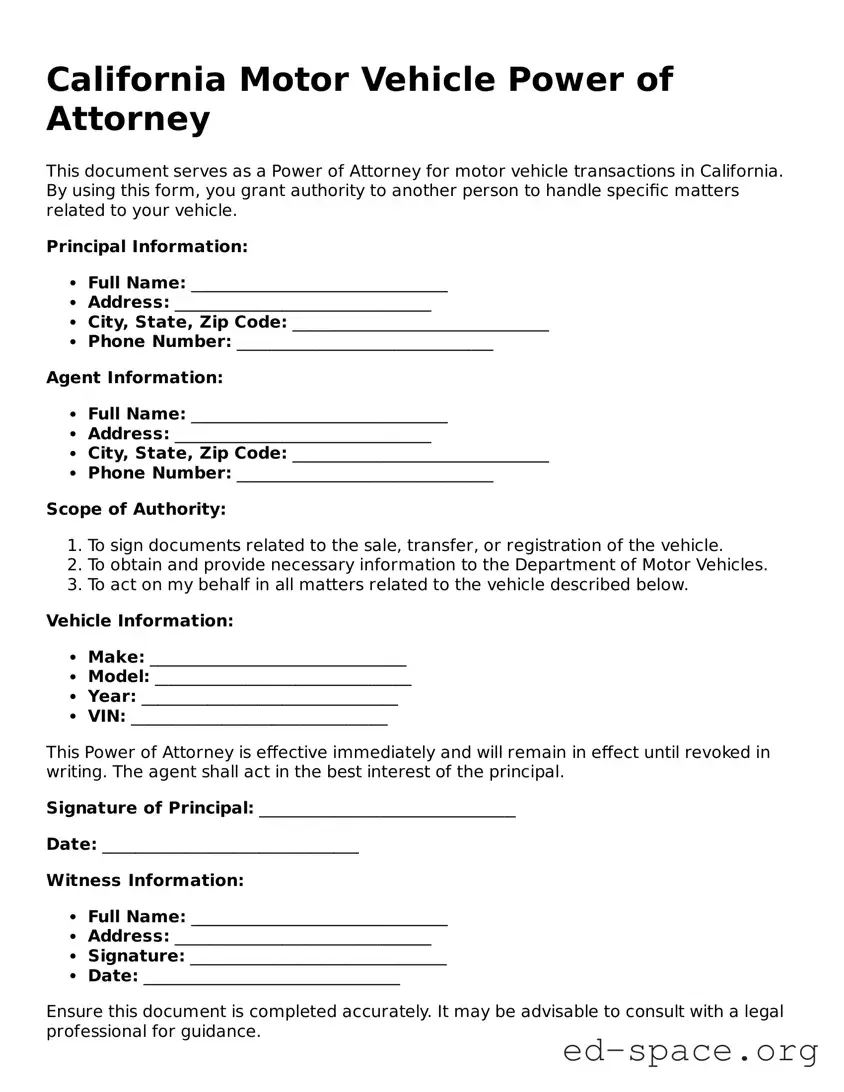
The California Motor Vehicle Power of Attorney form is a crucial document for anyone needing to delegate authority regarding their vehicle. This form allows an individual, known as the principal, to appoint another person, the agent, to act on their behalf in matters related to the ownership and operation of a motor vehicle. Key aspects of this form include the ability to transfer title, register the vehicle, and handle other important transactions with the Department of Motor Vehicles (DMV). The form requires specific information, such as the names and addresses of both the principal and agent, as well as details about the vehicle in question. By completing this form, individuals can ensure that their interests are protected while providing a trusted person with the necessary authority to manage vehicle-related tasks efficiently. Understanding the implications and requirements of this form is essential for anyone looking to navigate the complexities of vehicle ownership in California.
California Motor Vehicle Power of Attorney
This document serves as a Power of Attorney for motor vehicle transactions in California. By using this form, you grant authority to another person to handle specific matters related to your vehicle.
Principal Information:
Agent Information:
Scope of Authority:
Vehicle Information:
This Power of Attorney is effective immediately and will remain in effect until revoked in writing. The agent shall act in the best interest of the principal.
Signature of Principal: _______________________________
Date: _______________________________
Witness Information:
Ensure this document is completed accurately. It may be advisable to consult with a legal professional for guidance.
| Fact Name | Details |
|---|---|
| Purpose | The California Motor Vehicle Power of Attorney form allows an individual to authorize another person to act on their behalf regarding vehicle-related matters. |
| Governing Law | This form is governed by California Vehicle Code Section 5600. |
| Who Can Use It | Any vehicle owner in California can use this form to designate an agent for vehicle transactions. |
| Agent Responsibilities | The agent can perform tasks like signing documents, transferring titles, and registering vehicles. |
| Revocation | The principal can revoke the power of attorney at any time, as long as they provide written notice to the agent. |
| Duration | This power of attorney remains in effect until revoked or the principal dies. |
| Signature Requirement | The form must be signed by the principal and may require notarization for certain transactions. |
| Use Cases | Common uses include selling a vehicle, handling registration, or dealing with insurance matters. |
Filling out the California Motor Vehicle Power of Attorney form is a straightforward process. This document allows you to appoint someone to act on your behalf regarding motor vehicle transactions. Here are the steps to complete the form correctly.
After completing these steps, ensure that your agent understands their responsibilities. Keep a copy of the form for your records and confirm that the DMV has processed it if submitted directly.
What is a California Motor Vehicle Power of Attorney form?
The California Motor Vehicle Power of Attorney form is a legal document that allows an individual (the principal) to designate another person (the agent) to act on their behalf in matters related to motor vehicles. This includes tasks such as transferring ownership, registering vehicles, and handling other related transactions with the California Department of Motor Vehicles (DMV).
Who can be appointed as an agent in this form?
Any competent adult can be appointed as an agent. This includes family members, friends, or professionals such as attorneys or notaries. It is essential that the person you choose is trustworthy and capable of handling the responsibilities assigned to them.
How do I complete the California Motor Vehicle Power of Attorney form?
To complete the form, fill in your name, the name of the agent, and the specific powers you are granting. Be sure to sign and date the document. It may also require a witness or notary signature, depending on the specific requirements at the time of signing. Always double-check for accuracy before submission.
Is there a fee associated with the Motor Vehicle Power of Attorney?
There is no fee for completing the Motor Vehicle Power of Attorney form itself. However, if the agent needs to perform transactions at the DMV, such as transferring ownership or registering a vehicle, standard DMV fees will apply. These fees vary based on the specific services requested.
How long is the Power of Attorney valid?
The California Motor Vehicle Power of Attorney remains valid until it is revoked by the principal or until the specified task is completed. It is advisable to keep a record of the revocation if you choose to terminate the authority granted to your agent.
Can I revoke the Power of Attorney once it is granted?
Yes, you can revoke the Power of Attorney at any time, as long as you are mentally competent. To do so, you must complete a revocation form and notify your agent and any relevant parties, such as the DMV, of the change. This ensures that your agent no longer has the authority to act on your behalf.
Where should I submit the completed form?
The completed California Motor Vehicle Power of Attorney form should be submitted to the DMV when your agent is conducting transactions on your behalf. It is advisable to keep a copy for your records. If any additional documentation is required for specific transactions, ensure that your agent has those as well.
Not providing complete information. Failing to fill in all required fields can lead to delays or rejection of the form. Ensure that names, addresses, and vehicle details are accurate and complete.
Using incorrect signatures. The form must be signed by the principal (the person granting power) and may also require a witness or notary. Incomplete or mismatched signatures can invalidate the document.
Overlooking the expiration date. Some individuals forget to specify an expiration date for the power of attorney. Without this, the authority may remain in effect longer than intended.
Failing to provide a clear description of the powers granted. It's important to clearly outline what the agent can do. Vague language can lead to misunderstandings or misuse of authority.
Not keeping a copy of the completed form. After filling out the form, individuals should retain a copy for their records. This helps in case any disputes or questions arise in the future.
The California Motor Vehicle Power of Attorney form is a crucial document that allows an individual to authorize another person to act on their behalf regarding vehicle-related matters. In addition to this form, there are several other documents that are commonly used to facilitate various transactions and legal processes related to motor vehicles. Below is a list of these documents, each serving a specific purpose.
Understanding these forms and documents can help individuals navigate the often complex processes associated with vehicle ownership and transfer in California. Each document plays a vital role in ensuring that transactions are conducted legally and that all parties are protected.
When filling out the California Motor Vehicle Power of Attorney form, it is essential to follow certain guidelines to ensure the process goes smoothly. Below is a list of things you should and shouldn't do.
Many people have misunderstandings about the California Motor Vehicle Power of Attorney form. These misconceptions can lead to confusion and even legal issues. Here are four common misconceptions:
Understanding these misconceptions is crucial. They can impact how individuals manage their vehicle-related affairs in California.
When filling out and using the California Motor Vehicle Power of Attorney form, it is essential to understand several key aspects to ensure proper execution and compliance. Below are the main takeaways: