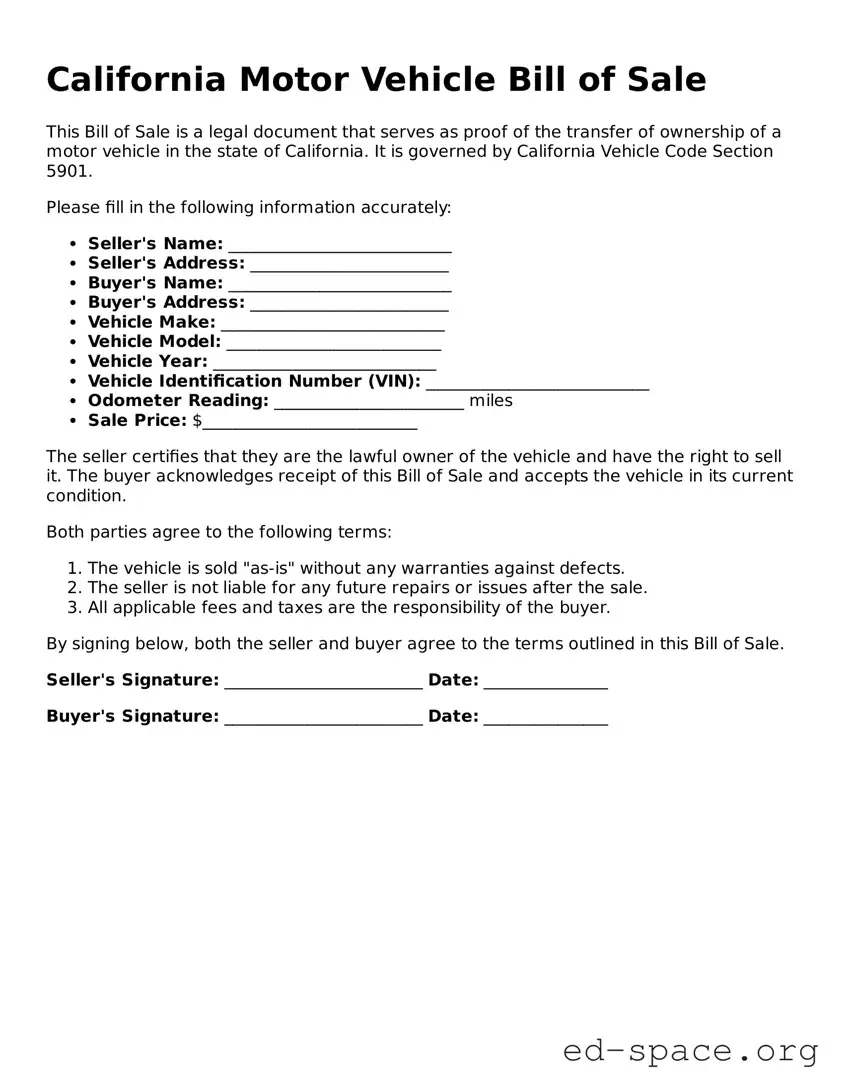
The California Motor Vehicle Bill of Sale form serves as an essential document in the transfer of ownership for motor vehicles within the state. This form captures critical information such as the vehicle's make, model, year, and identification number, which helps establish the vehicle's identity and history. Both the seller and the buyer must provide their names and addresses, ensuring that all parties involved are clearly identified. Additionally, the form includes spaces for the sale price and the date of the transaction, which are vital for tax purposes and record-keeping. By signing this document, the seller affirms that they are the rightful owner and have the authority to sell the vehicle, while the buyer acknowledges their acceptance of the vehicle in its current condition. This straightforward yet important form not only facilitates a smooth transaction but also protects the interests of both parties, providing a clear record of the sale that can be referenced in the future.
California Motor Vehicle Bill of Sale
This Bill of Sale is a legal document that serves as proof of the transfer of ownership of a motor vehicle in the state of California. It is governed by California Vehicle Code Section 5901.
Please fill in the following information accurately:
The seller certifies that they are the lawful owner of the vehicle and have the right to sell it. The buyer acknowledges receipt of this Bill of Sale and accepts the vehicle in its current condition.
Both parties agree to the following terms:
By signing below, both the seller and buyer agree to the terms outlined in this Bill of Sale.
Seller's Signature: ________________________ Date: _______________
Buyer's Signature: ________________________ Date: _______________
| Fact Name | Details |
|---|---|
| Purpose | The California Motor Vehicle Bill of Sale form is used to document the sale of a vehicle between a buyer and a seller. |
| Governing Law | This form is governed by California Vehicle Code Section 5901. |
| Required Information | It typically requires details such as the vehicle identification number (VIN), make, model, year, and sale price. |
| Signatures | Both the buyer and seller must sign the form to validate the transaction. |
| Notarization | Notarization is not required for the Bill of Sale in California, but it can add an extra layer of authenticity. |
| Use in Registration | The completed Bill of Sale is often needed when registering the vehicle with the Department of Motor Vehicles (DMV). |
| Tax Implications | Sales tax may be applicable based on the sale price documented in the Bill of Sale. |
| Record Keeping | Both parties should keep a copy of the Bill of Sale for their records. |
| Transfer of Ownership | The Bill of Sale serves as proof of ownership transfer from the seller to the buyer. |
| Availability | The form can be obtained online or at local DMV offices. |
Once you have the California Motor Vehicle Bill of Sale form, you can begin filling it out. This document is essential for transferring ownership of a vehicle, and it helps ensure that both the buyer and seller are protected during the transaction. Follow these steps to complete the form accurately.
After completing the form, make copies for both the buyer and seller. This ensures that each party has a record of the transaction. The buyer will need to take the completed Bill of Sale to the DMV when registering the vehicle.
What is a California Motor Vehicle Bill of Sale?
A California Motor Vehicle Bill of Sale is a legal document that records the sale of a vehicle. It serves as proof of the transaction between the seller and the buyer. This form includes essential details such as the vehicle's make, model, year, VIN (Vehicle Identification Number), sale price, and the names and addresses of both parties involved.
Is a Bill of Sale required in California when selling a vehicle?
While a Bill of Sale is not legally required in California, it is highly recommended. Having this document protects both the seller and the buyer by providing a record of the transaction. It can also be useful for tax purposes and when registering the vehicle with the Department of Motor Vehicles (DMV).
What information is needed to complete the Bill of Sale?
To complete the Bill of Sale, you will need the following information: the full names and addresses of both the seller and the buyer, the vehicle's make, model, year, and VIN, the sale price, and the date of the transaction. It is also helpful to include the odometer reading at the time of sale.
How do I obtain a California Motor Vehicle Bill of Sale form?
You can obtain a California Motor Vehicle Bill of Sale form from various sources. The DMV website offers a downloadable version. Additionally, many legal form websites provide templates that you can fill out. Ensure that the form you use complies with California state requirements.
Do I need to notarize the Bill of Sale?
Notarization is not a requirement for a Bill of Sale in California. However, having the document notarized can add an extra layer of authenticity and may be beneficial in certain situations, especially if there are disputes in the future.
What should I do with the Bill of Sale after the sale?
After the sale, both the seller and the buyer should keep a copy of the Bill of Sale for their records. The seller should also notify the DMV of the sale to ensure that the vehicle is no longer registered in their name. The buyer will need the Bill of Sale to register the vehicle in their name.
Can I use a Bill of Sale for a vehicle that is a gift?
Yes, a Bill of Sale can be used for a vehicle that is given as a gift. In this case, the sale price can be listed as $0. It is still important to document the transaction to avoid any future complications regarding ownership or taxes.
What happens if the vehicle has a lien on it?
If the vehicle has a lien, the seller must ensure that the lien is satisfied before selling the vehicle. The Bill of Sale should indicate that the seller has the legal right to sell the vehicle. It is advisable for the buyer to verify that there are no outstanding liens before completing the purchase.
Is there a fee associated with filing the Bill of Sale?
There is no fee to create or file a Bill of Sale in California. However, there may be fees associated with registering the vehicle with the DMV after the sale. It is important to check the current fee schedule on the DMV website or contact them directly for more information.
What if I lose my Bill of Sale?
If you lose your Bill of Sale, it is advisable to recreate the document as soon as possible. Both the seller and the buyer should have copies for their records. If necessary, you can also obtain a duplicate from the DMV, especially if the vehicle registration is affected.
Incomplete Information: Many individuals fail to provide all necessary details. This includes missing the vehicle identification number (VIN), which is crucial for identification.
Incorrect Mileage: Entering inaccurate mileage can lead to disputes. It's essential to double-check the odometer reading before filling out the form.
Omitting Signatures: Both the seller and buyer must sign the document. Neglecting to obtain the appropriate signatures invalidates the sale.
Not Including the Date: Failing to write the date of the transaction can create confusion. It is important to document when the sale occurred.
Ignoring Local Regulations: Each county may have specific requirements. Not checking local regulations can result in additional complications.
Using Incorrect Form: Some individuals may mistakenly use an outdated version of the form. Always ensure you are using the most current version of the California Motor Vehicle Bill of Sale.
When you're buying or selling a vehicle in California, the Motor Vehicle Bill of Sale form is essential. However, several other documents can help facilitate a smooth transaction. Here’s a list of some key forms you might encounter in the process.
By familiarizing yourself with these additional documents, you can ensure that your vehicle transaction is not only legal but also smooth and efficient. Being prepared with the right paperwork will save you time and potential headaches down the road.
When filling out the California Motor Vehicle Bill of Sale form, it is crucial to pay attention to detail. Properly completing this form can help ensure a smooth transaction and avoid potential issues down the line. Here are some important dos and don’ts to keep in mind:
By following these guidelines, you can help ensure that your transaction is clear and legally sound. Taking the time to complete the form properly will provide peace of mind for both the buyer and the seller.
The California Motor Vehicle Bill of Sale form is an important document for anyone buying or selling a vehicle in the state. However, several misconceptions surround its use and requirements. Here are seven common misunderstandings:
Many people believe that a Bill of Sale is optional for private sales. In California, while it is not legally required, having one is highly recommended for both the buyer and seller to document the transaction.
Some assume that only the seller's signature is needed on the Bill of Sale. In reality, both the buyer and seller should sign the document to ensure mutual agreement on the terms of the sale.
There is a misconception that the Bill of Sale requires notarization. This is not true; notarization is not a requirement for the form to be valid in California.
Some individuals think they can fill out the Bill of Sale after the transaction has occurred. It is best practice to complete the form at the time of sale to ensure all details are accurate and agreed upon.
Many confuse the Bill of Sale with the vehicle title transfer. The Bill of Sale serves as a record of the transaction, while the title transfer is a separate process that officially changes ownership with the DMV.
Some people think that general information is sufficient. However, the Bill of Sale should include specific details about the vehicle, such as the make, model, year, VIN, and odometer reading.
A common belief is that the Bill of Sale applies only to cars. In fact, it can be used for various types of vehicles, including motorcycles, boats, and trailers.
Understanding these misconceptions can help individuals navigate the process of buying or selling a vehicle more effectively. Always ensure that all necessary documentation is completed accurately to avoid potential issues in the future.
The California Motor Vehicle Bill of Sale form is an important document for anyone buying or selling a vehicle in the state. Here are some key takeaways to consider when filling out and using this form:
Understanding these key points can help ensure a smooth transaction when buying or selling a vehicle in California.