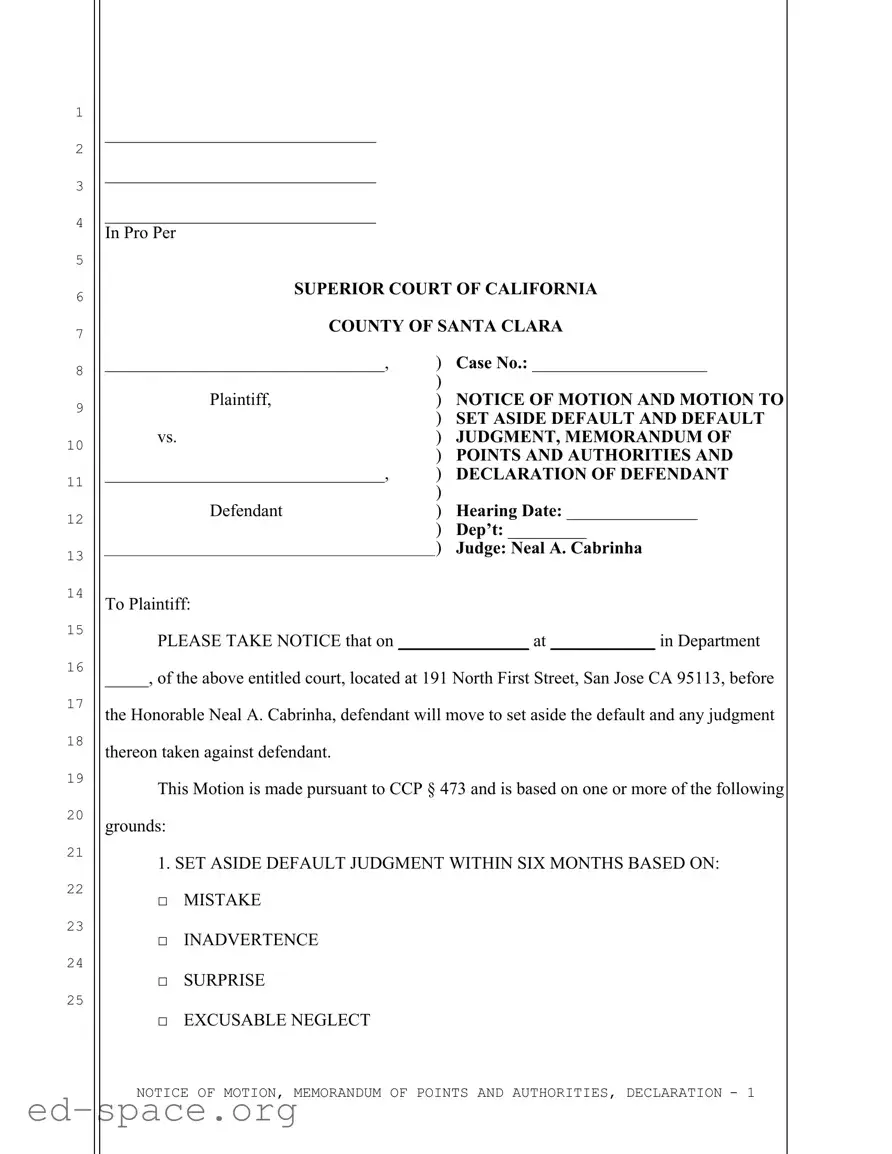
The California Motion Set Aside form is a vital tool for individuals seeking to challenge a default judgment that has been entered against them. This form allows a defendant to request that the court set aside a default judgment, which can occur when a party fails to respond to a complaint in a timely manner. The motion must be filed within six months of the judgment and can be based on several grounds, including mistake, inadvertence, surprise, or excusable neglect. When completing the form, the defendant must provide a declaration explaining the reasons for the failure to respond, as well as a proposed answer or pleading they wish to file. This process emphasizes the legal principle that cases should be decided on their merits, rather than allowing one party to benefit from the other's oversight. The form also requires the defendant to specify the hearing date and provide relevant details about the court's location and the presiding judge. Understanding the nuances of this form can empower individuals to navigate the legal system more effectively and ensure that their rights are protected.

1
2
3
4
5
6
7
8
9
10
11
12
13
14
15
16
17
18
19
20
21
22
23
24
25
_______________________________
_______________________________
_______________________________
In Pro Per
SUPERIOR COURT OF CALIFORNIA
COUNTY OF SANTA CLARA
________________________________, |
) |
Case No.: ____________________ |
|
) |
|
Plaintiff, |
) |
NOTICE OF MOTION AND MOTION TO |
|
) SET ASIDE DEFAULT AND DEFAULT |
|
vs. |
) |
JUDGMENT, MEMORANDUM OF |
|
) POINTS AND AUTHORITIES AND |
|
________________________________, |
) |
DECLARATION OF DEFENDANT |
|
) |
|
Defendant |
) |
Hearing Date: _______________ |
|
) |
Dep’t: _________ |
|
) Judge: Neal A. Cabrinha |
|
To Plaintiff:
PLEASE TAKE NOTICE that on _______________ at ____________ in Department
_____, of the above entitled court, located at 191 North First Street, San Jose CA 95113, before
the Honorable Neal A. Cabrinha, defendant will move to set aside the default and any judgment thereon taken against defendant.
This Motion is made pursuant to CCP § 473 and is based on one or more of the following grounds:
1. SET ASIDE DEFAULT JUDGMENT WITHIN SIX MONTHS BASED ON:
□MISTAKE
□INADVERTENCE
□SURPRISE
□EXCUSABLE NEGLECT
NOTICE OF MOTION, MEMORANDUM OF POINTS AND AUTHORITIES, DECLARATION - 1

1
2
3
4
5
6
7
8
9
10
11
12
13
14
15
16
17
18
19
20
21
22
23
24
25
This Motion is based on the Memorandum of Points and Authorities and the Declaration of
________________________ which follow, and on all of the pleadings, records, and files in this
action.
Dated:
By:
In Pro Per
MEMORANDUM OF POINTS AND AUTHORITIES
Code of Civil Procedure Section 473 (b) states in relevant part:
The court may, upon any terms as may be just, relieve a party of his or her legal representative from a judgment, dismissal, order, or other proceeding taken against him taken against him or her through his or her mistake, inadvertence, surprise or excusable neglect. Application for this relief shall be accompanied by a copy of the answer or other pleading proposed to be filed therein, . . .
and shall be made within a reasonable time, in no case exceeding six months, after the judgment, order or proceeding was taken.
In the present case, defendant did not file a timely response to the complaint for the
reasons stated in the attached declaration. The policy of the law is to have every case tried on its
merits and that policy views with disfavor a party who, regardless of the merits, attempts to take
advantage of the mistake, inadvertence, or neglect of his adversary. This policy is so strong that
“any doubts in applying section 473 must be resolved in favor of the party seeking relief from
default.” Elston v. City of Turlock (1985) 38 Cal.3d 227, 233; Slusher v. Durrer (1977) 69 Cal.
App. 3d 747, 753.
For the reasons stated in this Memorandum and in the attached Declaration, the
court should set aside the default and any judgment thereon taken against defendant.
NOTICE OF MOTION, MEMORANDUM OF POINTS AND AUTHORITIES, DECLARATION - 2

1
2
3
4
5
6
7
8
9
10
11
12
13
14
15
16
17
18
19
20
21
22
23
24
25
DECLARATION OF DEFENDANT
I, _______________________________, declare:
I am the Defendant in this action. I have personal knowledge of the matters discussed below and, if called as a witness, I could competently testify to them. I did not file a timely response to
the complaint in this action for the following reason(s):
______________________________________________________________________________
______________________________________________________________________________
______________________________________________________________________________
______________________________________________________________________________
______________________________________________________________________________
______________________________________________________________________________
______________________________________________________________________________
______________________________________________________________________________
______________________________________________________________________________
______________________________________________________________________________
______________________________________________________________________________
______________________________________________________________________________
I declare under penalty of perjury under the laws of the State of California that the foregoing is true and correct.
Dated:By:
In Pro Per
NOTICE OF MOTION, MEMORANDUM OF POINTS AND AUTHORITIES, DECLARATION - 3
| Fact Name | Description |
|---|---|
| Governing Law | The California Motion Set Aside form is governed by California Code of Civil Procedure Section 473. |
| Purpose | This form allows a defendant to request that the court set aside a default judgment against them. |
| Time Limit | A motion to set aside must be filed within six months of the default judgment being entered. |
| Grounds for Motion | The motion can be based on mistake, inadvertence, surprise, or excusable neglect. |
| Personal Declaration | The defendant must provide a personal declaration explaining the reasons for not responding to the complaint in a timely manner. |
| Filing Location | The motion is filed in the Superior Court of California, County of Santa Clara. |
| Hearing Requirement | A hearing date must be set for the motion to be considered by the court. |
| Judicial Discretion | The court has discretion to grant or deny the motion based on the circumstances presented. |
| Policy Favoring Trials | The law generally favors having cases decided on their merits rather than on technicalities. |
Completing the California Motion Set Aside form requires careful attention to detail. Each section of the form serves a specific purpose and must be filled out accurately to ensure the court processes your request. After submitting the form, you will await a hearing where you can present your case for having the default judgment set aside.
What is the California Motion Set Aside form?
The California Motion Set Aside form is a legal document that allows a defendant to request the court to cancel a default judgment. This form is typically used when a defendant did not respond to a lawsuit in time due to reasons such as mistake, inadvertence, surprise, or excusable neglect.
Who can file a Motion to Set Aside?
Any defendant who has had a default judgment entered against them can file a Motion to Set Aside. This includes individuals who may have missed deadlines due to unforeseen circumstances or misunderstandings regarding the legal process.
What are the grounds for setting aside a default judgment?
The main grounds for filing a Motion to Set Aside include mistake, inadvertence, surprise, or excusable neglect. The defendant must provide a valid reason for not responding to the complaint in a timely manner.
How long do I have to file a Motion to Set Aside?
You must file the Motion to Set Aside within six months of the default judgment being entered. It is crucial to act promptly to ensure your request is considered by the court.
What documents do I need to include with my Motion?
Along with the Motion to Set Aside, you must include a copy of the answer or other pleading you propose to file. This demonstrates your intent to contest the original complaint and provides context for your request.
Where do I file the Motion to Set Aside?
The Motion should be filed in the same court where the original judgment was entered. For example, if your case is in the Superior Court of California, County of Santa Clara, you will file it there.
What happens after I file the Motion?
After filing the Motion, a hearing will be scheduled. You will need to attend this hearing to present your case. The judge will review your reasons for the Motion and any evidence you provide before making a decision.
Can I represent myself in this process?
Yes, you can represent yourself in this process, which is referred to as "In Pro Per." However, it is advisable to seek legal advice or assistance if you are unsure about any aspect of the process.
What should I do if my Motion is denied?
If your Motion to Set Aside is denied, you may have limited options. You can consider appealing the decision, but this process can be complex. Consulting with a legal professional may help you understand your next steps.
Failing to provide a clear reason for the request. It's important to explain why the default should be set aside, such as mistake, inadvertence, surprise, or excusable neglect.
Not submitting the motion within the required six-month period. Timeliness is crucial, as the court may deny the request if it is late.
Neglecting to include necessary documents. A proposed answer or other pleading should accompany the motion.
Providing incomplete or unclear information in the declaration. The declaration should clearly state the reasons for not responding to the complaint.
Using legal jargon or complex language. The motion should be straightforward and easy to understand for the court.
Failing to follow proper formatting rules. Adhering to court requirements for document formatting is essential for acceptance.
The California Motion Set Aside form is an important document used by individuals seeking to reverse a default judgment in court. When navigating this process, several other forms and documents may also be necessary to support your motion. Below is a list of commonly used forms that can accompany the Motion Set Aside.
Understanding these additional documents can significantly aid in the process of filing a Motion Set Aside in California. Each form plays a vital role in presenting your case effectively and ensuring that your voice is heard in court.
When filling out the California Motion Set Aside form, it is important to follow specific guidelines to ensure your submission is correct and effective. Here’s a list of things you should and shouldn’t do:
Below is a list of common misconceptions regarding the California Motion Set Aside form, along with explanations for each.
The Motion Set Aside must be filed within six months of the default judgment. Failing to do so will likely result in denial of the motion.
Individuals can represent themselves in court, known as appearing "in pro per." The form is designed for both attorneys and self-represented individuals.
Filing the motion does not ensure that the court will grant it. The court will consider the reasons provided and may deny the request.
The motion must include a declaration explaining the reasons for not responding to the complaint in a timely manner. This is a critical part of the process.
The case will not be reopened until the court grants the motion. A hearing may be scheduled to determine the outcome.
The grounds for setting aside a default judgment are limited to mistake, inadvertence, surprise, or excusable neglect as outlined in the Code of Civil Procedure.
In addition to filing the motion, a copy of the proposed answer or other pleading must accompany it. This demonstrates the intent to contest the case.
The motion should be supported by a memorandum of points and authorities and a declaration. These documents provide the necessary context for the court.
Some defaults may have specific restrictions or conditions that must be met. The court has discretion in deciding whether to grant the motion.
While the form may seem simple, the process can involve hearings and additional documentation. It is important to be prepared for potential complexities.
Filling out and using the California Motion Set Aside form can be a critical step for defendants seeking to challenge a default judgment. Here are key takeaways to consider: