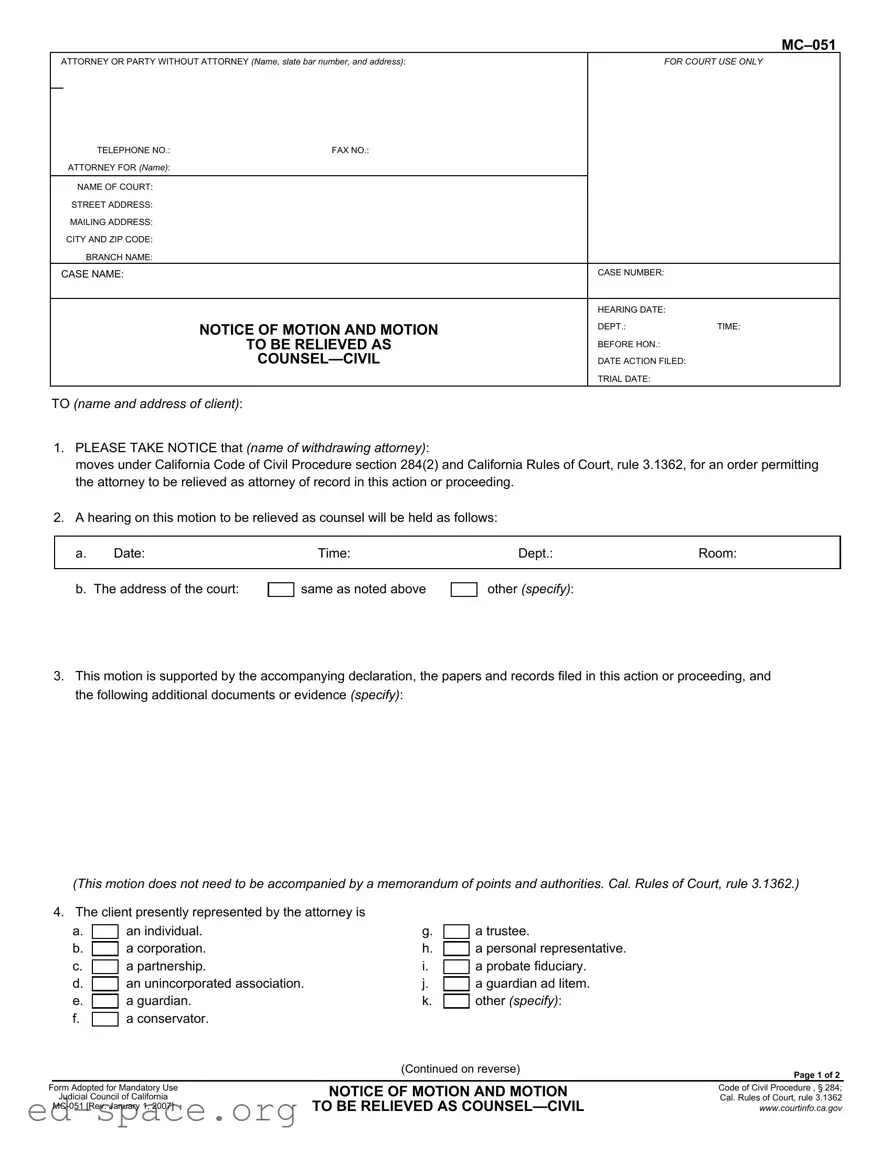
The California Motion form, designated as MC-051, serves a crucial role in the legal process for attorneys wishing to withdraw from representing a client in civil cases. This form is essential for ensuring that the withdrawal is handled appropriately and in accordance with California law. It outlines the necessary details, including the attorney's name, contact information, and the specifics of the case, such as the court name, case number, and hearing date. The form also includes important notifications for clients, alerting them to the implications of their attorney's withdrawal. For instance, if the motion is granted, clients must understand that they may need to seek new legal representation, especially if they belong to certain categories like guardians or corporations. The form emphasizes the responsibility of clients to keep the court updated with their current contact information, ensuring they receive all relevant notices. By following the guidelines set forth in this form, attorneys can facilitate a smooth transition while protecting the interests of their clients.

ATTORNEY OR PARTY WITHOUT ATTORNEY (Name, slate bar number, and address): |
FOR COURT USE ONLY |
TELEPHONE NO.: |
FAX NO.: |
|
|
ATTORNEY FOR (Name): |
|
|
|
|
|
|
|
NAME OF COURT: |
|
|
|
STREET ADDRESS: |
|
|
|
MAILING ADDRESS: |
|
|
|
CITY AND ZIP CODE: |
|
|
|
BRANCH NAME: |
|
|
|
CASE NAME: |
|
CASE NUMBER: |
|
|
|
|
|
|
|
HEARING DATE: |
|
|
NOTICE OF MOTION AND MOTION |
DEPT.: |
TIME: |
|
|
|
|
|
TO BE RELIEVED AS |
BEFORE HON.: |
|
|
DATE ACTION FILED: |
|
|
|
|
TRIAL DATE: |
|
|
|
|
|
TO (name and address of client):
1.PLEASE TAKE NOTICE that (name of withdrawing attorney):
moves under California Code of Civil Procedure section 284(2) and California Rules of Court, rule 3.1362, for an order permitting the attorney to be relieved as attorney of record in this action or proceeding.
2.A hearing on this motion to be relieved as counsel will be held as follows:
a. |
Date: |
Time: |
Dept.: |
Room: |
|
|
|
|
|
b. The address of the court:
same as noted above
other (specify):
3.This motion is supported by the accompanying declaration, the papers and records filed in this action or proceeding, and the following additional documents or evidence (specify):
(This motion does not need to be accompanied by a memorandum of points and authorities. Cal. Rules of Court, rule 3.1362.)
4. The client presently represented by the attorney is |
|
||
a. |
|
an individual. |
g. |
|
|||
|
|
|
h. |
b. |
|
a corporation. |
|
|
|
|
|
c. |
|
a partnership. |
i. |
|
|
|
|
d. |
|
an unincorporated association. |
j. |
|
|
|
|
e. |
|
a guardian. |
k. |
|
|
a conservator. |
|
f. |
|
|
|
a trustee.
a personal representative. a probate fiduciary.
a guardian ad litem.
other (specify):
|
|
(Continued on reverse) |
Page 1 of 2 |
|
|
|
|
Form Adopted for Mandatory Use |
NOTICE OF MOTION AND MOTION |
Code of Civil Procedure , § 284; |
|
|
Judicial Council of California |
Cal. Rules of Court, rule 3.1362 |
|
|
TO BE RELIEVED AS |
||
|
www.courtinfo.ca.gov |
||
CASE NAME:
CASE NUMBER:
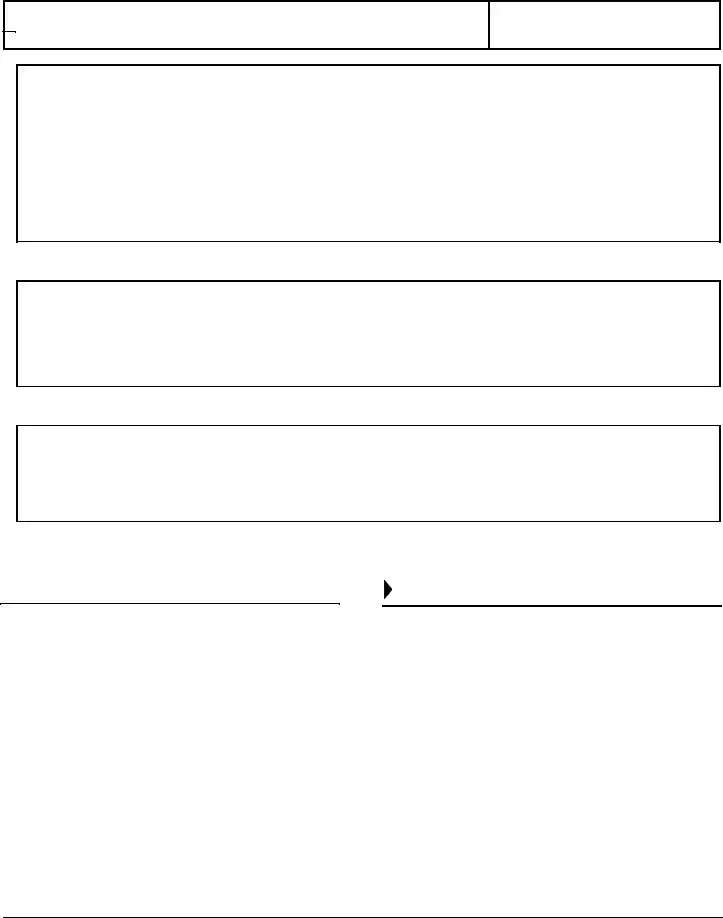
NOTICE TO CLIENT
If this motion to be relieved as counsel is granted, your present attorney will no longer be representing you. You may not in most cases represent yourself if you are one of the parties on the following list:
• A guardian |
• A personal representative |
• A guardian ad litem |
• A conservator |
• A probate fiduciary |
• An unincorporated association |
• A trustee |
• A corporation |
|
If you are one of these parties, YOU SHOULD IMMEDIATELY SEEK LEGAL ADVICE REGARDING LEGAL REPRESENTATION. Failure to retain an attorney may lead to an order striking the pleadings or to the entry of a default judgment.
5. If this motion is granted and a client is representing himself or herself, the client will be solely responsible for the case.
NOTICE TO CLIENT WHO WILL BE UNREPRESENTED
If this motion to be relieved as counsel is granted, you will not have an attorney representing you. You may wish to seek legal assistance. If you do not have a new attorney to represent you in this action or proceeding, and you are legally permitted to do so, you will be representing yourself. It will be your responsibility to comply with all court rules and applicable laws. If you fail to do so, or fail to appear at hearings, action may be taken against you. You may lose your case.
6. If this motion is granted, the client must keep the court informed of the client's current address.
NOTICE TO CLIENT WHO WILL BE UNREPRESENTED
If this motion to be relieved as counsel is granted, the court needs to know how to contact you. If you do not keep the court and other parties informed of your current address and telephone number, they will not be able to send you notices of actions that may affect you, including actions that may adversely affect your interests or result in your losing the case.
Date:
(TYPE OR PRINT NAME)
(SIGNATURE OF ATTORNEY)
Attorney for (name):
NOTICE OF MOTION AND MOTION
TO BE RELIEVED AS
Page 2 of 2
| Fact Name | Details |
|---|---|
| Governing Laws | The California Motion form is governed by California Code of Civil Procedure section 284(2) and California Rules of Court, rule 3.1362. |
| Purpose of the Form | This form is used by an attorney to formally request permission to withdraw from representing a client in a civil case. |
| Client Notification | The form includes a notice to the client, informing them of the potential consequences of being unrepresented. |
| Hearing Requirement | A hearing must be scheduled where the motion will be considered by the court. |
| Client Types | The form identifies various types of clients, including individuals, corporations, and guardians, who may be affected by the withdrawal. |
| Address Notification | If the motion is granted, the client must keep the court updated with their current contact information. |
Filling out the California Motion form can seem daunting, but by following a clear set of steps, the process becomes manageable. This form is essential for attorneys wishing to withdraw from a case, and completing it accurately ensures that the court receives all necessary information. Below are the steps to fill out the form properly.
After completing the form, make sure to review it for accuracy. Once finalized, the motion will be filed with the court, and the client will be notified of the changes in representation. It is crucial to keep all parties informed to avoid any complications during the legal process.
What is the purpose of the California Motion form MC-051?
The California Motion form MC-051 is used by attorneys who wish to withdraw from representing a client in a civil case. This form notifies the court and the client about the attorney's intention to step down from their role. It is essential for ensuring that the client is aware of their legal representation status and the implications of the withdrawal.
Who can use the MC-051 form?
This form can be used by any attorney who is officially representing a client in a civil case in California. It is specifically designed for attorneys seeking to be relieved as counsel, following the guidelines set forth in the California Code of Civil Procedure and California Rules of Court.
What happens if the motion to withdraw is granted?
If the court grants the motion to withdraw, the attorney will no longer represent the client. This means that the client must either find new legal representation or, if permitted, represent themselves in the ongoing case. Clients should be aware that representing themselves may lead to complications, especially if they belong to certain categories such as guardians or corporations.
What should clients do if they receive notice of this motion?
Clients receiving notice of this motion should take it seriously. They should consider seeking new legal representation immediately, especially if they fall into categories that restrict their ability to represent themselves. Failure to do so could result in negative outcomes, including the possibility of losing the case or having their pleadings struck.
Is a memorandum of points and authorities required with this motion?
No, a memorandum of points and authorities is not required to accompany the MC-051 form. The motion can be supported by the accompanying declaration and any additional documents or evidence the attorney wishes to provide. This simplifies the process for attorneys seeking to withdraw from a case.
What responsibilities does a client have if they become unrepresented?
Once the motion to withdraw is granted, the client becomes responsible for managing their case. This includes adhering to all court rules and laws, attending hearings, and keeping the court informed of their current address. Failure to comply with these responsibilities can lead to adverse actions, including the potential loss of the case.
How can clients ensure they receive important notices after their attorney withdraws?
Clients must keep the court informed of their current address and contact information after their attorney withdraws. This is crucial for receiving notices regarding actions that may affect their case. If clients do not provide updated information, they risk missing critical communications, which could negatively impact their legal standing.
Incomplete Information: Many individuals forget to fill in all required fields. Missing details such as the attorney’s name, case number, or hearing date can lead to delays or rejection of the motion.
Incorrect Party Designation: Some people mistakenly identify the party involved in the case. It is crucial to clearly state whether the client is an individual, corporation, or another type of entity.
Failure to Provide Supporting Documents: Omitting necessary supporting documents can weaken the motion. Ensure that any required declarations or additional evidence are included with the form.
Not Notifying the Client: It is essential to inform the client about the implications of the motion. Failing to do so can lead to misunderstandings about representation and responsibilities.
Ignoring the Court’s Address: Some individuals neglect to confirm the correct address of the court. Always verify that the court’s address matches the one provided in the motion to avoid complications.
When filing a California Motion form, several other documents may be necessary to support your case. These forms help clarify the motion's purpose, provide evidence, and ensure compliance with court procedures. Below is a list of commonly used forms that accompany the California Motion form.
Using these forms in conjunction with the California Motion form helps ensure that all procedural requirements are met. Proper documentation can lead to a more efficient process and better outcomes in legal proceedings.
The California Motion form, specifically MC-051, shares similarities with several other legal documents. Each of these documents serves a specific purpose in legal proceedings and often follows a similar structure. Here are five documents that are comparable to the California Motion form:
When filling out the California Motion form, it’s essential to follow specific guidelines to ensure accuracy and compliance. Here’s a list of things you should and shouldn’t do:
By following these guidelines, you can help ensure that your motion is processed smoothly and effectively.
Misconception 1: The motion form is only for attorneys.
In reality, while the form is designed for attorneys to request permission to withdraw from a case, it also involves the client's awareness. Clients must be informed of the motion and its implications, ensuring they understand their legal standing and representation status.
Misconception 2: Filing the motion guarantees immediate relief from representation.
This is not true. The motion must be granted by the court during a scheduled hearing. Until the court approves the request, the attorney remains responsible for the case, and the client should not assume they are unrepresented.
Misconception 3: Clients can represent themselves without any restrictions.
This is misleading. Certain parties, such as corporations or guardians, are prohibited from self-representation. They must seek new legal representation immediately to avoid negative consequences in their case.
Misconception 4: The motion does not require any supporting documents.
While the motion does not need a memorandum of points and authorities, it must be accompanied by a declaration and any relevant documents. This ensures the court has all necessary information to make an informed decision.
When filling out and using the California Motion form (MC-051), it is essential to follow specific guidelines to ensure the process goes smoothly. Here are some key takeaways to keep in mind:
Following these takeaways will help ensure that the motion process is handled properly and that all parties are informed of their rights and responsibilities.