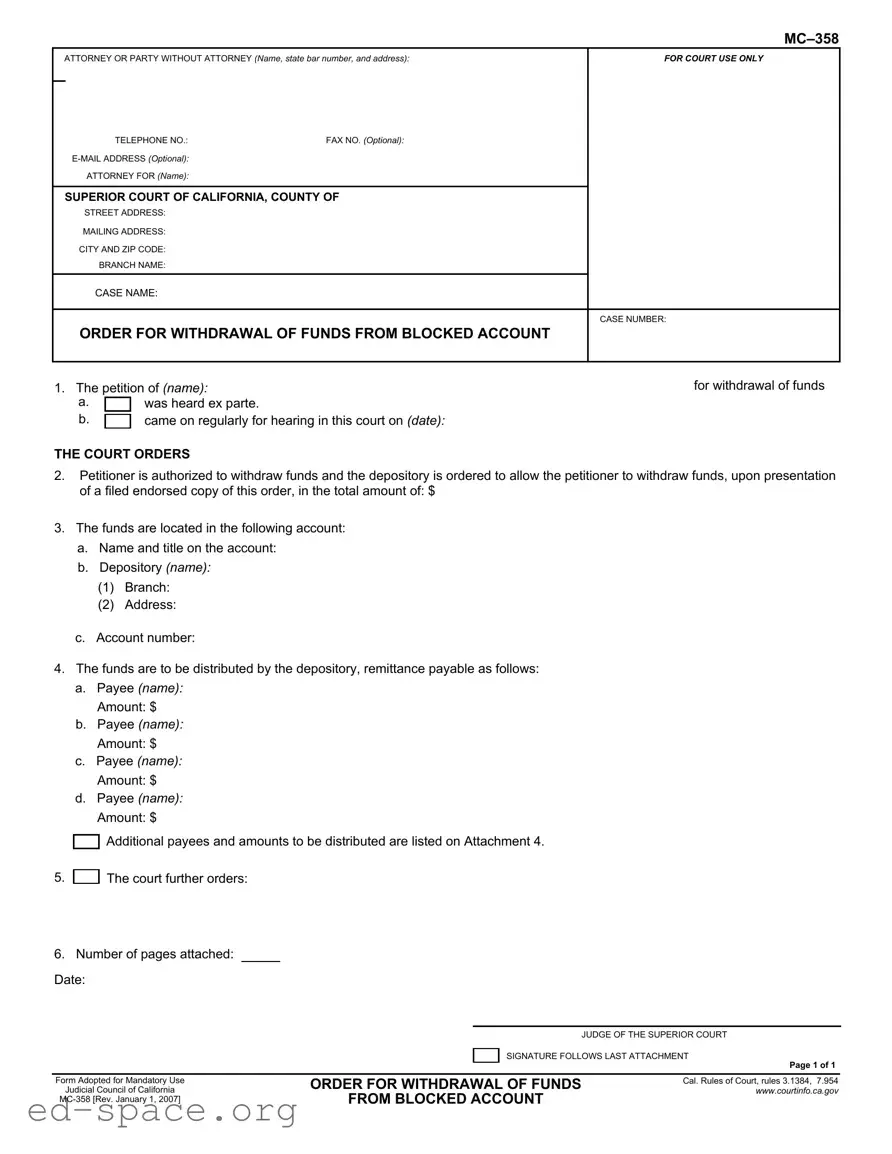
The California MC 358 form is an essential document used in the legal process for withdrawing funds from a blocked account. This form is particularly relevant when a party needs to access funds that have been restricted by a court order. It includes several key components, such as the identification of the attorney or party filing the request, the details of the case, and specific instructions for the depository holding the funds. The form captures crucial information like the total amount to be withdrawn, the account details, and how the funds should be distributed among various payees. Additionally, it outlines whether the petition was heard ex parte or during a regular court session. By completing the MC 358, petitioners can formally request the court's permission to release funds, ensuring compliance with legal requirements and facilitating the proper handling of financial matters. Understanding the structure and purpose of this form is vital for anyone involved in cases that necessitate access to blocked funds.
ATTORNEY OR PARTY WITHOUT ATTORNEY (Name, state bar number, and address): |
FOR COURT USE ONLY |
TELEPHONE NO.: |
FAX NO. (Optional): |
|
|
ATTORNEY FOR (Name): |
|
SUPERIOR COURT OF CALIFORNIA, COUNTY OF
STREET ADDRESS:
MAILING ADDRESS:
CITY AND ZIP CODE:
BRANCH NAME:
CASE NAME:
|
|
|
CASE NUMBER: |
ORDER FOR WITHDRAWAL OF FUNDS FROM BLOCKED ACCOUNT |
|
||
|
|
|
|
1. The petition of (name): |
for withdrawal of funds |
||
a. |
|
was heard ex parte. |
|
b. |
|
came on regularly for hearing in this court on (date): |
|
|
|
||
THE COURT ORDERS
2.Petitioner is authorized to withdraw funds and the depository is ordered to allow the petitioner to withdraw funds, upon presentation of a filed endorsed copy of this order, in the total amount of: $
3.The funds are located in the following account:
a.Name and title on the account:
b.Depository (name):
(1)Branch:
(2)Address:
c.Account number:
4.The funds are to be distributed by the depository, remittance payable as follows:
a.Payee (name): Amount: $
b.Payee (name): Amount: $
c.Payee (name): Amount: $
d.Payee (name): Amount: $
Additional payees and amounts to be distributed are listed on Attachment 4.
5. The court further orders:
6.Number of pages attached: Date:
JUDGE OF THE SUPERIOR COURT
SIGNATURE FOLLOWS LAST ATTACHMENT
Page 1 of 1
Form Adopted for Mandatory Use
Judicial Council of California
ORDER FOR WITHDRAWAL OF FUNDS
FROM BLOCKED ACCOUNT
Cal. Rules of Court, rules 3.1384, 7.954 www.courtinfo.ca.gov
| Fact Name | Details |
|---|---|
| Form Title | MC-358 is officially titled "Order for Withdrawal of Funds from Blocked Account." |
| Governing Law | This form is governed by California Rules of Court, specifically rules 3.1384 and 7.954. |
| Purpose | The form is used to request the withdrawal of funds that are held in a blocked account. |
| Petitioner Requirements | The petitioner must provide their name and other identifying information to facilitate the withdrawal. |
| Hearing Type | The petition may be heard ex parte, meaning it can be considered without the other party being present. |
| Depository Information | The form requires details about the depository, including its name, branch, and address. |
| Distribution of Funds | The form allows for multiple payees to receive specified amounts from the withdrawn funds. |
| Form Adoption | MC-358 has been adopted for mandatory use by the Judicial Council of California. |
Once you have gathered all necessary information, you can begin filling out the California MC 358 form. This form is essential for requesting the withdrawal of funds from a blocked account. Ensure that all information is accurate and complete to avoid delays in processing.
What is the purpose of the California MC 358 form?
The California MC 358 form is used to request the withdrawal of funds from a blocked account. This form is typically necessary in legal situations where funds have been placed in a blocked account by court order, and a party needs to access those funds for specific reasons, such as paying expenses or fulfilling obligations.
Who can file the MC 358 form?
The form can be filed by an attorney or a party representing themselves in court. The individual filing must provide their name, state bar number (if applicable), and contact information. It is essential that the petitioner has the legal authority to request the withdrawal of funds.
What information is required on the MC 358 form?
The form requires detailed information including the petitioner's name, the case name, case number, and details about the blocked account. This includes the name and title on the account, the depository name, branch, address, and account number. Additionally, the form specifies how the funds should be distributed among payees.
What does "ex parte" mean in the context of the MC 358 form?
"Ex parte" refers to a legal proceeding where one party appears before the court without the other party being present. In the context of the MC 358 form, if the petition was heard ex parte, it means that the petitioner sought the withdrawal of funds without notifying the other parties involved in the case, often due to the urgency of the situation.
What happens after the MC 358 form is submitted?
Once the form is submitted, the court will review the petition. If approved, the court will issue an order allowing the petitioner to withdraw the specified amount from the blocked account. The depository will then be required to comply with this order upon presentation of a filed endorsed copy of the court's order.
Are there any fees associated with filing the MC 358 form?
Filing fees may apply when submitting the MC 358 form, as with most court filings. The exact amount can vary by county and the specifics of the case. It is advisable to check with the local court for detailed fee information and any potential waivers that may be available.
How should the funds be distributed according to the MC 358 form?
The form requires the petitioner to list all payees and the corresponding amounts to be distributed. Each payee's name and the amount they are to receive must be clearly indicated. If there are additional payees, they should be listed on an attachment to the form.
What should I do if my request for withdrawal is denied?
If the court denies the request for withdrawal of funds, the petitioner may have the option to file a motion for reconsideration or appeal the decision, depending on the circumstances. It is important to consult with legal counsel to explore available options and understand the implications of the court's decision.
Where can I find the California MC 358 form?
The California MC 358 form can be obtained from the California Judicial Council's website or directly from the local court's clerk office. It is essential to ensure that you are using the most current version of the form, as updates may occur.
Failing to provide complete contact information. This includes missing the telephone number, fax number, or email address for the attorney or party without an attorney.
Not specifying the correct case name and case number. Inaccurate or incomplete information can lead to delays in processing.
Omitting details about the depository. It is essential to include the name, branch, and address of the financial institution holding the funds.
Incorrectly listing the account number. Double-check this information to ensure it matches the records of the depository.
Not detailing the distribution of funds clearly. Each payee's name and the corresponding amount must be accurately listed to avoid confusion.
Forgetting to sign the form. The judge's signature is crucial for the order to be valid, so ensure it is included at the end of the document.
The California MC-358 form serves as an essential document for petitioning the court for the withdrawal of funds from a blocked account. This process often requires additional forms and documents to ensure compliance with legal requirements. Below is a list of other commonly used documents associated with the MC-358 form.
Each of these documents plays a crucial role in the process of withdrawing funds from a blocked account in California. Together, they ensure that the court has all necessary information to make an informed decision while adhering to legal protocols.
The California MC 358 form is used for the withdrawal of funds from a blocked account. Several other documents serve similar purposes in different contexts. Here’s a look at five of them:
When filling out the California MC-358 form, it is essential to follow specific guidelines to ensure accuracy and compliance. Here are nine important dos and don’ts:
Understanding the California MC 358 form is essential for anyone involved in legal proceedings regarding the withdrawal of funds from a blocked account. Here are some common misconceptions:
When filling out and using the California MC-358 form, keep the following key takeaways in mind:
By adhering to these guidelines, individuals can navigate the process of using the MC-358 form more effectively.