When couples in California decide to separate, a Marital Separation Agreement can play a crucial role in outlining the terms of their separation. This legally binding document addresses key aspects such as the division of property, custody arrangements for children, and the handling of debts. It serves as a roadmap for both parties, detailing how assets will be divided and responsibilities assigned. Importantly, the agreement can also cover spousal support, ensuring that both partners are protected during the transition. By clearly defining expectations and responsibilities, the Marital Separation Agreement helps minimize disputes and provides a sense of security for both individuals involved. Understanding this form is essential for anyone navigating the complexities of separation in California, as it lays the groundwork for a more amicable and organized process.
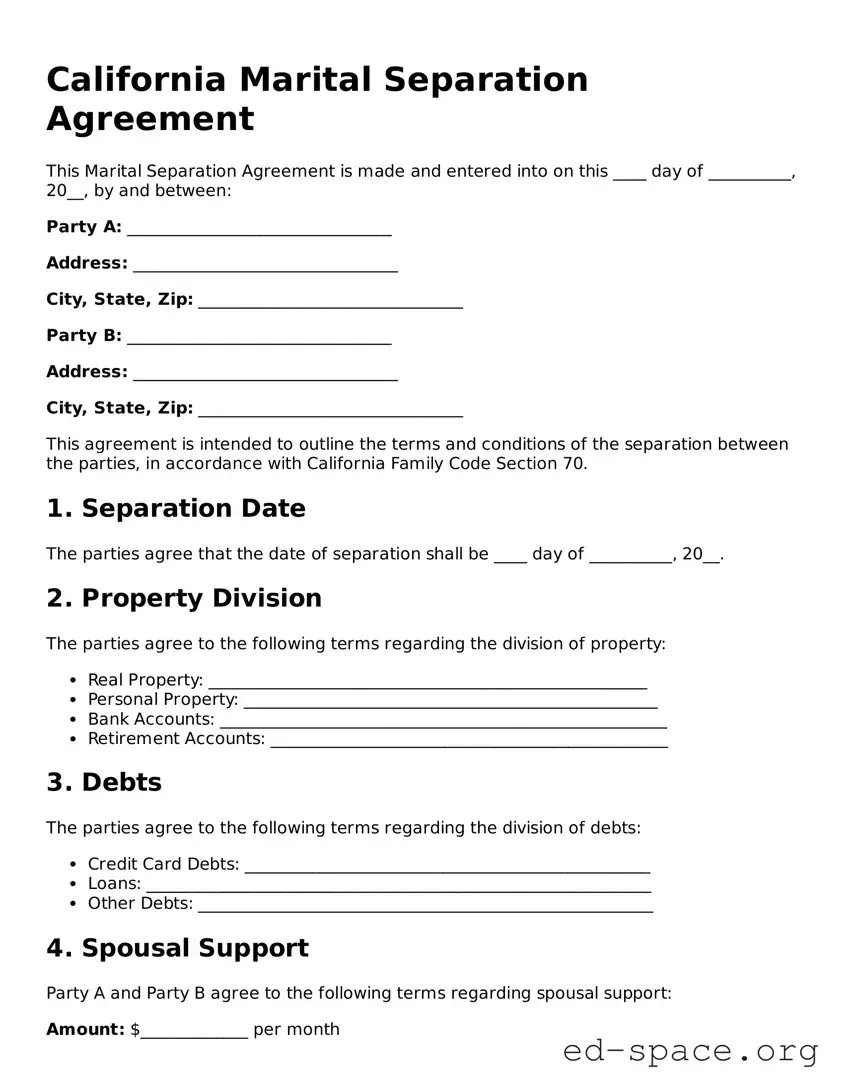
California Marital Separation Agreement
This Marital Separation Agreement is made and entered into on this ____ day of __________, 20__, by and between:
Party A: ________________________________
Address: ________________________________
City, State, Zip: ________________________________
Party B: ________________________________
Address: ________________________________
City, State, Zip: ________________________________
This agreement is intended to outline the terms and conditions of the separation between the parties, in accordance with California Family Code Section 70.
1. Separation Date
The parties agree that the date of separation shall be ____ day of __________, 20__.
2. Property Division
The parties agree to the following terms regarding the division of property:
3. Debts
The parties agree to the following terms regarding the division of debts:
4. Spousal Support
Party A and Party B agree to the following terms regarding spousal support:
Amount: $_____________ per month
Duration: _______________ months
5. Child Custody and Support
In the case of minor children, the parties agree to the following terms:
6. Miscellaneous Provisions
The parties agree to the following additional provisions:
IN WITNESS WHEREOF, the parties hereto have executed this Marital Separation Agreement as of the day and year first above written.
Party A Signature: ________________________________
Date: ________________________________
Party B Signature: ________________________________
Date: ________________________________
| Fact Name | Details |
|---|---|
| Definition | A California Marital Separation Agreement is a legal document that outlines the terms of separation between spouses, including division of assets, debts, and responsibilities for children. |
| Governing Law | This agreement is governed by California Family Code, which provides the legal framework for marital separation and divorce proceedings. |
| Voluntary Nature | The agreement is entered into voluntarily by both parties, ensuring that both spouses agree to the terms without coercion. |
| Enforceability | Once signed, the agreement can be enforced in court, provided it meets the legal requirements and both parties have disclosed their financial information. |
| Modification | Changes to the agreement can be made if both parties consent to the modifications in writing, allowing flexibility as circumstances change. |
After completing the California Marital Separation Agreement form, you will need to review it carefully for accuracy. Once finalized, you can proceed with filing the document with the appropriate court and notifying your spouse, if required. This step is crucial to ensure that the agreement is legally binding and recognized.
What is a California Marital Separation Agreement?
A California Marital Separation Agreement is a legal document that outlines the terms of separation between spouses. It addresses various aspects such as property division, child custody, support obligations, and other relevant issues. This agreement helps both parties understand their rights and responsibilities during the separation period.
Is a Marital Separation Agreement legally binding?
Yes, once both parties sign the agreement, it becomes legally binding. This means that both spouses must adhere to the terms outlined in the document. If either party fails to comply, the other may seek enforcement through the court.
Do I need an attorney to create a Marital Separation Agreement?
While it is not legally required to have an attorney, it is highly recommended. An attorney can provide valuable guidance, ensure that the agreement complies with California law, and help protect your interests. Having legal representation can also prevent future disputes.
What should be included in a Marital Separation Agreement?
The agreement should include details about property division, debt allocation, child custody arrangements, visitation schedules, and spousal support. It may also address health insurance and tax considerations. Comprehensive agreements reduce the likelihood of misunderstandings later on.
Can a Marital Separation Agreement be modified?
Yes, a Marital Separation Agreement can be modified if both parties agree to the changes. It is important to document any modifications in writing and have both parties sign the updated agreement. This ensures that the new terms are enforceable.
How does a Marital Separation Agreement affect divorce proceedings?
A Marital Separation Agreement can simplify the divorce process by addressing key issues upfront. Courts often look favorably on agreements that have been mutually agreed upon, which can lead to a smoother and faster divorce process. However, it is important to note that the agreement does not automatically finalize the divorce.
What happens if we cannot agree on the terms of the separation?
If spouses cannot reach an agreement, they may need to seek mediation or legal assistance to resolve disputes. Mediation involves a neutral third party who helps facilitate discussions and negotiations. If mediation fails, the matter may need to be resolved in court.
How long does it take to finalize a Marital Separation Agreement?
The time it takes to finalize a Marital Separation Agreement varies based on the complexity of the issues and the willingness of both parties to negotiate. Simple agreements may take a few days, while more complex situations could take weeks or even months. Open communication can help expedite the process.
Can a Marital Separation Agreement affect child custody arrangements?
Yes, a Marital Separation Agreement can have a significant impact on child custody arrangements. It allows parents to outline their desired custody and visitation schedules. Courts generally favor agreements that are in the best interest of the child, so it is important to consider the child's needs when drafting the agreement.
What should I do if my spouse does not comply with the agreement?
If your spouse fails to comply with the terms of the Marital Separation Agreement, you may need to take legal action. This could involve filing a motion with the court to enforce the agreement. It is advisable to consult with an attorney to understand your options and the best course of action.
Failing to include all necessary personal information. This includes full names, addresses, and the date of marriage. Missing details can delay the process.
Not specifying the date of separation. This date is crucial for determining the division of assets and debts.
Overlooking the division of property. Both parties should clearly outline how they plan to divide their assets and liabilities.
Ignoring child custody and support arrangements. It is essential to address these issues in detail to avoid future conflicts.
Failing to consider tax implications. Understanding how separation affects taxes can prevent financial surprises later.
Not having a witness or notary present when signing the agreement. This can lead to disputes about the validity of the document.
Leaving out provisions for spousal support. Clearly defining any support obligations can help both parties plan for the future.
Using vague language. Being specific about terms can prevent misunderstandings and disputes down the line.
Neglecting to review the agreement with a legal professional. Having an attorney review the document can provide valuable insights and ensure all legal requirements are met.
A California Marital Separation Agreement is an important document that outlines the terms of a couple's separation. It addresses various aspects such as property division, child custody, and support obligations. Along with this agreement, several other forms and documents may be necessary to ensure that all legal requirements are met. Below is a list of some commonly used forms that may accompany the Marital Separation Agreement.
Understanding these documents can help individuals navigate the separation process more effectively. Each form plays a specific role in ensuring that all legal aspects are addressed, ultimately leading to a smoother transition during a challenging time.
Separation Agreement: This document outlines the terms under which a couple agrees to live apart while remaining legally married. Similar to a Marital Separation Agreement, it addresses issues such as asset division, child custody, and support obligations.
Divorce Settlement Agreement: When couples decide to end their marriage, this agreement details the terms of the divorce, including property division and financial support. Like the Marital Separation Agreement, it seeks to clarify the responsibilities of each party.
Child Custody Agreement: This document specifically focuses on the arrangements for children following a separation or divorce. It shares similarities with the Marital Separation Agreement by addressing parenting plans and visitation rights.
Property Settlement Agreement: This type of agreement outlines how marital property will be divided upon separation or divorce. It parallels the Marital Separation Agreement in its focus on the equitable distribution of assets.
Spousal Support Agreement: This document specifies the financial support one spouse will provide to the other after separation. It is akin to the Marital Separation Agreement in that it addresses financial responsibilities post-separation.
Postnuptial Agreement: Similar to a Marital Separation Agreement, this document is created during the marriage to outline how assets and responsibilities will be handled in the event of a separation or divorce.
Memorandum of Understanding: Often used in various legal contexts, this document outlines the intentions and agreements between parties. It resembles the Marital Separation Agreement in that it serves to clarify the expectations and responsibilities of each party during a separation.
When filling out the California Marital Separation Agreement form, it is crucial to approach the process with care and attention. The following list outlines important dos and don’ts to guide you through this essential task.
By following these guidelines, you can help ensure that your separation agreement is completed properly and meets all necessary legal requirements.
Understanding the California Marital Separation Agreement form is crucial for couples navigating separation. However, several misconceptions can lead to confusion. Here are eight common misconceptions:
A marital separation agreement is not a divorce. It outlines the terms of separation but does not terminate the marriage.
While the agreement is a legal document, it may require court approval to enforce certain terms, especially regarding child custody and support.
Both spouses must agree to and sign the marital separation agreement for it to be valid.
The agreement focuses on separation terms, but additional legal processes may be necessary for a complete divorce settlement.
Couples without children can also benefit from a marital separation agreement to clarify asset division and other matters.
Changes can be made to the agreement if both parties consent and sign a new document reflecting those changes.
While not mandatory, having legal representation is advisable to ensure that both parties understand their rights and obligations.
Creating a marital separation agreement can be complex and may take time to negotiate terms that are fair to both parties.
Being informed about these misconceptions can help couples approach their separation with clarity and confidence.
When filling out and using the California Marital Separation Agreement form, keep these key takeaways in mind: