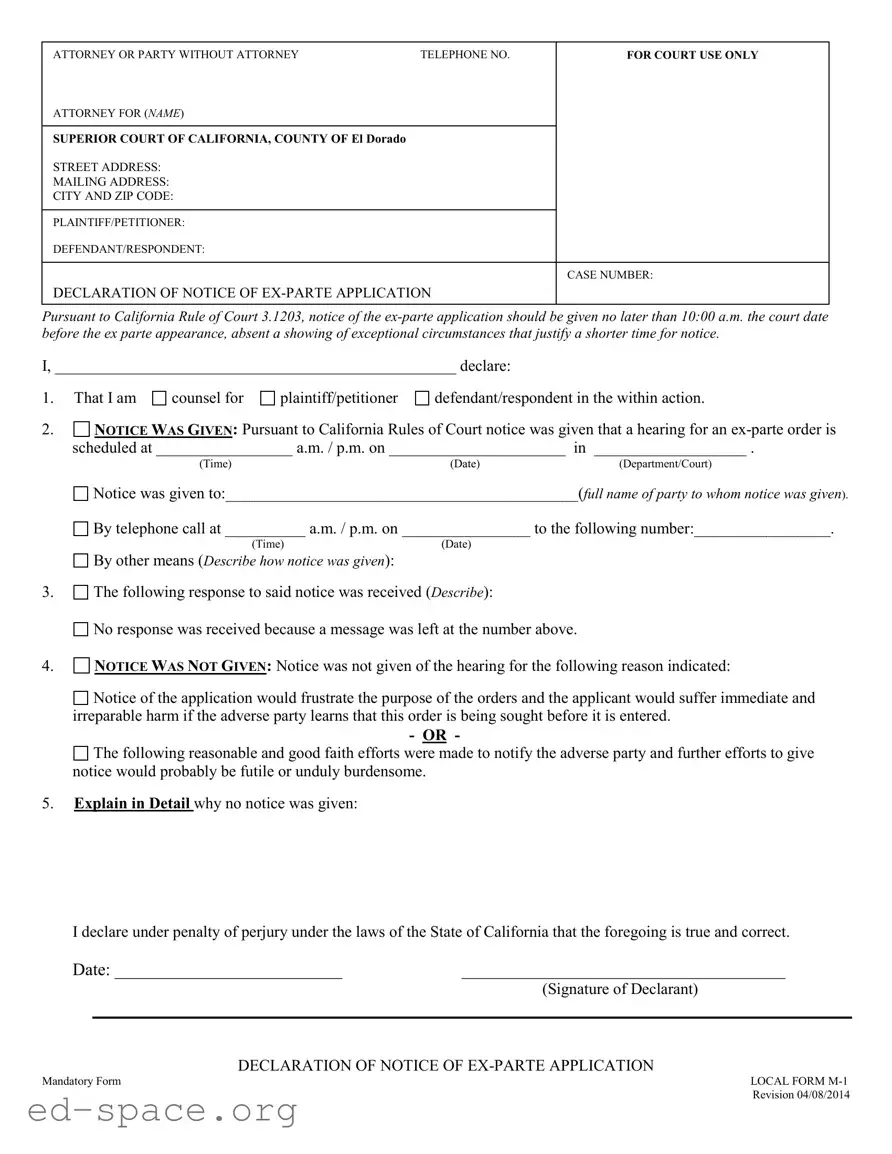
The California Local M 1 form is an essential document used in the Superior Court of California, specifically within El Dorado County, to facilitate ex-parte applications. Designed for attorneys or parties without legal representation, this form outlines the necessary steps for notifying involved parties about an upcoming ex-parte hearing. It requires the declarant to provide their contact information, the details of the parties involved in the case, and the specific case number. The form emphasizes the importance of timely notification, stating that notice must be given by 10:00 a.m. on the court date unless there are exceptional circumstances justifying a shorter notice period. It includes sections for the declarant to detail how notice was provided, whether a response was received, and if notice was not given, to explain the reasons why. This clarity helps ensure that all parties are informed and that the court can proceed fairly and justly. The Local M 1 form is not just a procedural requirement; it plays a crucial role in upholding the rights of all parties involved in legal proceedings.
ATTORNEY OR PARTY WITHOUT ATTORNEY |
TELEPHONE NO. |
FOR COURT USE ONLY |
ATTORNEY FOR (NAME)
SUPERIOR COURT OF CALIFORNIA, COUNTY OF El Dorado
STREET ADDRESS:
MAILING ADDRESS:
CITY AND ZIP CODE:
PLAINTIFF/PETITIONER:
DEFENDANT/RESPONDENT:
CASE NUMBER:
DECLARATION OF NOTICE OF
Pursuant to California Rule of Court 3.1203, notice of the
I, __________________________________________________ declare:
1.That I am
counsel for
plaintiff/petitioner
defendant/respondent in the within action.
2. |
NOTICE WAS GIVEN: Pursuant to California Rules of Court notice was given that a hearing for an |
||
|
scheduled at _________________ a.m. / p.m. on ______________________ in ___________________ . |
||
|
(Time) |
(Date) |
(Department/Court) |
Notice was given to:____________________________________________(full name of party to whom notice was given).
By telephone call at __________ a.m. / p.m. on ________________ to the following number:_________________.
|
(Time) |
(Date) |
|
By other means (Describe how notice was given): |
|
3. |
The following response to said notice was received (Describe): |
|
|
No response was received because a message was left at the number above. |
|
4. |
NOTICE WAS NOT GIVEN: Notice was not given of the hearing for the following reason indicated: |
|
|
Notice of the application would frustrate the purpose of the orders and the applicant would suffer immediate and |
|
|
irreparable harm if the adverse party learns that this order is being sought before it is entered. |
|
|
- |
OR - |
|
The following reasonable and good faith efforts were made to notify the adverse party and further efforts to give |
|
|
notice would probably be futile or unduly burdensome. |
|
5.Explain in Detail why no notice was given:
I declare under penalty of perjury under the laws of the State of California that the foregoing is true and correct.
Date: __________________________ |
_____________________________________ |
|
|
|
(Signature of Declarant) |
|
|
|
DECLARATION OF NOTICE OF
Mandatory Form |
LOCAL FORM |
|
Revision 04/08/2014 |
| Fact Name | Description |
|---|---|
| Governing Law | The California Local M 1 form is governed by California Rule of Court 3.1203. |
| Purpose | This form is used to declare notice of an ex-parte application in the Superior Court of California. |
| Notice Requirement | Notice must be given no later than 10:00 a.m. on the court date before the ex-parte appearance, unless exceptional circumstances exist. |
| Signature Requirement | The declarant must sign the form, affirming the truth of the statements under penalty of perjury. |
Completing the California Local M 1 form is an essential step in the process of filing an ex-parte application. This form requires specific information about the parties involved and the notice given regarding the application. Follow the steps below to fill out the form accurately.
After completing the form, it is important to review all entries for accuracy. Make sure to keep a copy for your records before submitting it to the court. This ensures that all parties are informed appropriately regarding the ex-parte application.
What is the California Local M 1 form used for?
The California Local M 1 form is primarily used to declare notice of an ex-parte application in court. This form is essential for informing the court and the opposing party about a request for an urgent court order. It ensures that the necessary parties are aware of the hearing and the reasons behind the request, promoting transparency in the legal process.
Who needs to fill out the Local M 1 form?
Typically, attorneys representing either the plaintiff or defendant in a case will complete the Local M 1 form. If a party is self-represented, they can also fill it out. It’s crucial that the person completing the form has a clear understanding of the case and the specifics of the ex-parte application they are seeking.
What information is required on the Local M 1 form?
The form requires several key pieces of information. You must provide the names of the parties involved, the case number, and the court details. Additionally, you will need to specify how notice of the ex-parte application was given or why it was not given. This includes the time and date of the notice and any responses received from the opposing party.
What happens if notice is not given?
If notice is not given, the form must clearly explain the reasons. This could be due to concerns that notifying the other party might cause immediate harm or that further attempts to notify would be impractical. The court will consider these reasons when deciding whether to grant the ex-parte application.
Is there a deadline for submitting the Local M 1 form?
Yes, there is a deadline. According to California Rule of Court 3.1203, notice of the ex-parte application must be given no later than 10:00 a.m. on the court date before the ex-parte appearance. However, if there are exceptional circumstances, a shorter notice period may be justified. It’s essential to adhere to these timelines to ensure your application is considered by the court.
Incomplete Information: One common mistake is failing to fill out all required fields. Each section of the form must be completed, including the names of the parties involved, the case number, and the court details. Missing information can lead to delays in processing your application.
Incorrect Time and Date: It is crucial to accurately state the time and date of the hearing. Errors in this section can cause confusion and may result in the court not being able to schedule the ex-parte appearance properly.
Improper Notification: Not providing proper notice to the other party is a significant mistake. The form requires you to detail how notice was given. Omitting this information or failing to notify the other party as required by law can jeopardize your application.
Insufficient Explanation for Lack of Notice: If notice was not given, it is essential to provide a clear and detailed explanation. Simply stating that notice would frustrate the purpose of the order is often not enough. Courts look for specific reasons why notice could not be provided.
Failure to Sign the Declaration: Not signing the form can invalidate your application. The signature is a declaration that the information provided is true and correct, and without it, the form may be rejected.
Not Keeping a Copy: After submitting the form, individuals often forget to keep a copy for their records. Retaining a copy is vital for future reference and can help clarify any issues that may arise later in the process.
When filing the California Local M 1 form, several other forms and documents may be necessary to support your case. Each document serves a specific purpose in the legal process and can help ensure that all procedural requirements are met. Below is a list of commonly used forms that accompany the Local M 1 form.
Utilizing these forms correctly is crucial for the success of your application. Each document plays a role in ensuring that the court has all the necessary information to make an informed decision. Properly completing and submitting these forms can help facilitate a smoother legal process.
The California Local M 1 form serves a specific purpose in legal proceedings, particularly regarding ex-parte applications. Several other documents share similarities with the Local M 1 form in terms of their function, structure, or requirements. Below are six such documents:
When filling out the California Local M 1 form, it is essential to approach the task with care and attention to detail. Here are five important guidelines to consider, including what you should and shouldn't do.
By following these guidelines, you can navigate the process of completing the California Local M 1 form more effectively. Attention to detail and clarity will serve you well in ensuring your application is processed smoothly.
Understanding the California Local M 1 form can be challenging, and several misconceptions often arise. Here are nine common misunderstandings about this important legal document:
While many attorneys use the form, it is also available for self-represented parties. Anyone involved in a legal matter can utilize it to provide necessary notice for ex-parte applications.
Notice is typically required, but exceptions exist. If notifying the opposing party would cause immediate harm, the applicant may request a waiver of notice.
The Local M 1 form is mandatory when filing an ex-parte application in California. Failure to use the form could result in delays or rejection of the application.
Notice must be provided by 10:00 a.m. on the court date unless there are exceptional circumstances. This strict timeline is crucial for the application to be considered.
Completing the form requires detailed information about the notice given or reasons for not giving notice. Incomplete forms may be rejected by the court.
While ex-parte applications often involve urgent issues, the Local M 1 form can be used for various situations that require expedited court consideration.
Filing the form is just one step. Parties must still attend the hearing and be prepared to present their case to the judge.
The Local M 1 form must be completed and submitted before the hearing. Filing it afterward does not fulfill the notice requirement.
While the Local M 1 form follows state guidelines, specific counties may have variations or additional requirements. It is essential to check local rules before filing.
Understand the purpose of the California Local M 1 form. This form is used to declare notice of an ex-parte application in court.
Fill in your contact information accurately. Include your name, phone number, and the court's details to ensure proper communication.
Provide the required notice details. Clearly state when and where the ex-parte hearing is scheduled, along with the time and department.
Document how notice was given. Specify whether it was done via phone or another method, and include the name of the party notified.
Explain any lack of notice if applicable. If notice was not given, detail the reasons and the efforts made to inform the other party.
Sign and date the form. Your signature confirms that the information provided is true and correct under penalty of perjury.