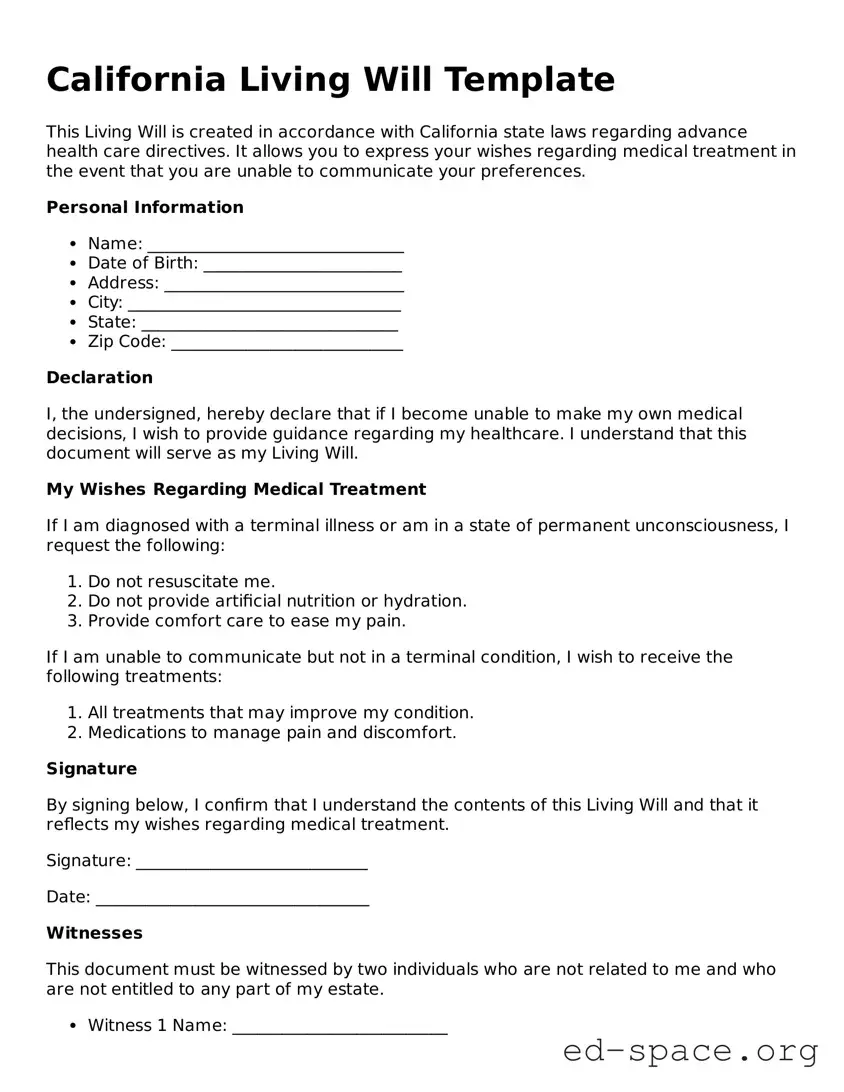
In the realm of healthcare planning, the California Living Will form serves as a crucial tool for individuals wishing to articulate their preferences regarding medical treatment in the event they become unable to communicate their wishes. This document empowers people to express their desires about life-sustaining measures, such as resuscitation efforts and artificial nutrition, ensuring that their values and choices are respected even when they cannot voice them. By filling out this form, individuals can designate specific medical interventions they wish to receive or refuse, providing clarity for family members and healthcare providers during emotionally challenging times. The form also emphasizes the importance of appointing a healthcare proxy, a trusted person who can make decisions on behalf of the individual if they are incapacitated. Understanding the nuances of this document is essential, as it not only reflects personal beliefs but also alleviates potential conflicts among loved ones, fostering peace of mind for both the individual and their family.
California Living Will Template
This Living Will is created in accordance with California state laws regarding advance health care directives. It allows you to express your wishes regarding medical treatment in the event that you are unable to communicate your preferences.
Personal Information
Declaration
I, the undersigned, hereby declare that if I become unable to make my own medical decisions, I wish to provide guidance regarding my healthcare. I understand that this document will serve as my Living Will.
My Wishes Regarding Medical Treatment
If I am diagnosed with a terminal illness or am in a state of permanent unconsciousness, I request the following:
If I am unable to communicate but not in a terminal condition, I wish to receive the following treatments:
Signature
By signing below, I confirm that I understand the contents of this Living Will and that it reflects my wishes regarding medical treatment.
Signature: ____________________________
Date: _________________________________
Witnesses
This document must be witnessed by two individuals who are not related to me and who are not entitled to any part of my estate.
Thank you for taking the time to complete this important document. Your wishes regarding medical treatment are now clearly stated.
| Fact Name | Description |
|---|---|
| Definition | A California Living Will is a legal document that allows individuals to outline their preferences for medical treatment in case they become unable to communicate their wishes. |
| Governing Laws | The California Living Will is governed by the California Probate Code, specifically sections 4600-4806. |
| Durable Power of Attorney | This form can be combined with a Durable Power of Attorney for Health Care, allowing individuals to designate someone to make medical decisions on their behalf. |
| Requirements | To be valid, the Living Will must be signed by the individual and witnessed by two adults or notarized. |
| Types of Treatments | Individuals can specify preferences regarding life-sustaining treatments, such as resuscitation and mechanical ventilation. |
| Revocation | A Living Will can be revoked at any time by the individual, as long as they are mentally competent. |
| Storage | It's advisable to keep the Living Will in a safe place and share copies with family members and healthcare providers. |
| Legal Aid | Individuals are encouraged to seek legal advice when creating a Living Will to ensure it meets all legal requirements and accurately reflects their wishes. |
Completing the California Living Will form is an important step in expressing your healthcare preferences. After filling out the form, you will need to ensure it is signed and witnessed properly to make it legally binding. Here are the steps to guide you through the process of filling out the form.
What is a California Living Will?
A California Living Will is a legal document that allows individuals to outline their wishes regarding medical treatment in the event they become unable to communicate those wishes themselves. This document specifically addresses end-of-life care and can guide healthcare providers and family members in making decisions that align with the individual's preferences. It is an important tool for ensuring that your values and desires are respected during critical medical situations.
How do I create a Living Will in California?
Creating a Living Will in California involves several straightforward steps. First, you should consider your preferences for medical treatment and end-of-life care. Next, you can either use a standard form provided by the state or consult with an attorney to draft a customized document. After completing the form, sign it in the presence of two witnesses or a notary public to ensure its validity. Make sure to provide copies to your healthcare providers and loved ones to ensure they are aware of your wishes.
Can I change or revoke my Living Will?
Yes, you can change or revoke your Living Will at any time as long as you are mentally competent. To make changes, simply create a new Living Will that reflects your updated wishes. Ensure that you properly sign and witness the new document. If you wish to revoke your existing Living Will, you can do so by destroying the document or by stating your intention to revoke it in writing. Inform your healthcare providers and family members about the change to avoid any confusion.
What happens if I do not have a Living Will?
If you do not have a Living Will, medical decisions may fall to your family members or legal representatives. This can lead to uncertainty and potential disagreements among loved ones about your care preferences. Without clear guidance, healthcare providers may be forced to rely on state laws and default protocols, which may not align with your personal values. Having a Living Will provides clarity and ensures that your wishes are known and respected.
Is a Living Will the same as a Durable Power of Attorney for Health Care?
No, a Living Will and a Durable Power of Attorney for Health Care are not the same, although they can work together. A Living Will focuses specifically on your wishes regarding medical treatment, particularly at the end of life. In contrast, a Durable Power of Attorney for Health Care designates a person to make medical decisions on your behalf if you are unable to do so. You can have both documents to ensure comprehensive coverage of your healthcare preferences.
Not understanding the purpose of a Living Will. Many individuals fill out the form without fully grasping its significance in expressing their healthcare wishes.
Failing to specify treatment preferences. It's crucial to clearly outline which medical treatments you do or do not want in specific situations.
Neglecting to discuss wishes with family. Open conversations with loved ones can prevent confusion and ensure everyone is on the same page.
Not updating the document regularly. Life circumstances change, and so do healthcare preferences. Regularly review and revise the Living Will as necessary.
Forgetting to sign and date the form. A Living Will is not valid unless it is properly signed and dated by the individual making the declaration.
Overlooking witness requirements. California law requires the presence of witnesses when signing the Living Will. Failing to meet these requirements can invalidate the document.
Using vague language. Clear and specific instructions are essential. Avoid ambiguous terms that could lead to misinterpretation of your wishes.
Not considering appointing a healthcare proxy. A Living Will is powerful, but having someone to advocate for your wishes can provide additional support.
Ignoring state-specific laws. Each state has its own regulations regarding Living Wills. Familiarize yourself with California's specific requirements.
Failing to keep copies in accessible locations. Store the completed Living Will in a safe but accessible place, and provide copies to your healthcare provider and family members.
A California Living Will is an essential document for individuals who wish to express their healthcare preferences in the event they become unable to communicate. However, several other forms and documents often accompany the Living Will to ensure comprehensive planning for medical care and decision-making. Here are seven important documents to consider:
These documents work together to create a comprehensive plan for your healthcare and personal wishes. By considering each one, you can ensure that your preferences are clearly communicated and respected in any medical situation.
A Living Will is an important document that outlines a person's wishes regarding medical treatment in case they become unable to communicate those wishes themselves. There are several other documents that serve similar purposes in terms of healthcare decisions and end-of-life planning. Here are ten documents that share similarities with a Living Will:
When filling out the California Living Will form, it’s important to approach the task with care. This document outlines your preferences for medical treatment in case you become unable to communicate your wishes. Here are ten essential dos and don’ts to keep in mind:
By following these guidelines, you can ensure that your Living Will accurately reflects your desires and provides clear instructions for your healthcare team. This proactive approach can help alleviate stress for your loved ones during difficult times.
Living wills are important documents that help individuals express their wishes regarding medical treatment in case they become unable to communicate. However, there are several misconceptions surrounding the California Living Will form that can lead to confusion. Here are nine common misconceptions:
Understanding these misconceptions can help you make informed decisions about creating a living will that reflects your wishes and ensures your voice is heard when it matters most.
When considering a California Living Will, it's essential to understand its purpose and how to complete it properly. Here are some key takeaways: