Creating a Last Will and Testament is a crucial step in ensuring that your wishes are honored after your passing. In California, this legal document serves as a roadmap for distributing your assets, appointing guardians for minor children, and designating an executor to manage your estate. The form is designed to reflect your specific desires regarding the allocation of your property, whether it be real estate, personal belongings, or financial accounts. Additionally, it allows you to express your preferences for funeral arrangements and other final wishes. Understanding the essential components of the California Last Will and Testament form can empower you to make informed decisions that align with your values and priorities. By taking the time to complete this form accurately, you can help alleviate the potential for disputes among family members and ensure that your legacy is carried out as you intended.
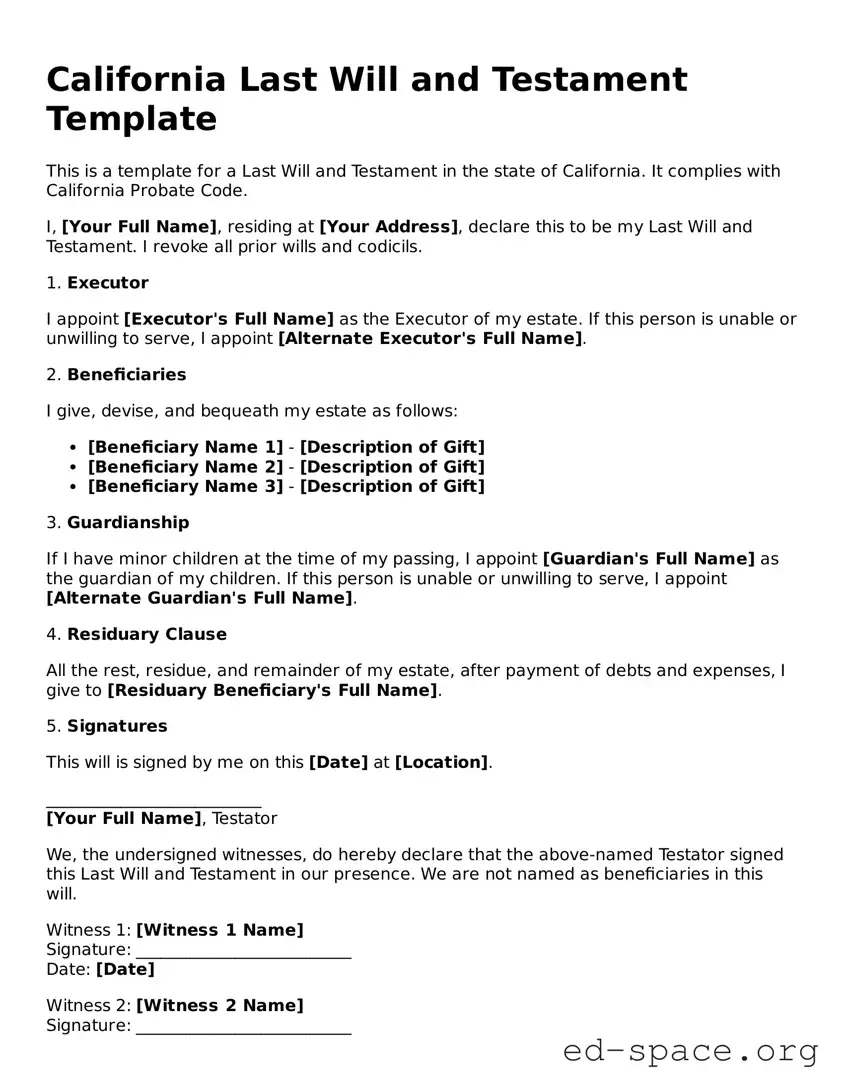
California Last Will and Testament Template
This is a template for a Last Will and Testament in the state of California. It complies with California Probate Code.
I, [Your Full Name], residing at [Your Address], declare this to be my Last Will and Testament. I revoke all prior wills and codicils.
1. Executor
I appoint [Executor's Full Name] as the Executor of my estate. If this person is unable or unwilling to serve, I appoint [Alternate Executor's Full Name].
2. Beneficiaries
I give, devise, and bequeath my estate as follows:
3. Guardianship
If I have minor children at the time of my passing, I appoint [Guardian's Full Name] as the guardian of my children. If this person is unable or unwilling to serve, I appoint [Alternate Guardian's Full Name].
4. Residuary Clause
All the rest, residue, and remainder of my estate, after payment of debts and expenses, I give to [Residuary Beneficiary's Full Name].
5. Signatures
This will is signed by me on this [Date] at [Location].
__________________________
[Your Full Name], Testator
We, the undersigned witnesses, do hereby declare that the above-named Testator signed this Last Will and Testament in our presence. We are not named as beneficiaries in this will.
Witness 1: [Witness 1 Name]
Signature: __________________________
Date: [Date]
Witness 2: [Witness 2 Name]
Signature: __________________________
Date: [Date]
6. Notarization
State of California
County of [County Name]
On this [Date], before me, a Notary Public, personally appeared [Your Full Name], known to me to be the person whose name is subscribed to this document.
__________________________
Notary Public Signature
| Fact Name | Description |
|---|---|
| Governing Law | The California Last Will and Testament is governed by the California Probate Code, specifically Sections 6100-6324. |
| Requirements | To be valid, the will must be in writing, signed by the testator, and witnessed by at least two individuals. |
| Age Requirement | The testator must be at least 18 years old to create a valid will in California. |
| Revocation | A will can be revoked by creating a new will or by physically destroying the original document. |
| Holographic Wills | California recognizes holographic wills, which are handwritten and do not require witnesses if the signature and material provisions are in the testator's handwriting. |
| Probate Process | Once the testator passes away, the will must go through probate, a legal process to validate the will and distribute assets. |
After you have gathered all the necessary information, you are ready to fill out the California Last Will and Testament form. This document will help you express your wishes regarding the distribution of your assets and the care of any dependents after your passing. Follow these steps carefully to ensure that your will is completed correctly.
Once you have completed the form, keep it in a safe place. You may also want to inform your executor and loved ones where it is located. This ensures that your wishes will be honored when the time comes.
What is a Last Will and Testament in California?
A Last Will and Testament is a legal document that outlines how an individual wants their assets distributed after their death. It allows the person, known as the testator, to specify beneficiaries, appoint an executor, and make arrangements for any dependents. In California, having a valid will can help ensure that your wishes are honored and can simplify the probate process for your loved ones.
Who can create a Last Will and Testament in California?
In California, any person who is at least 18 years old and of sound mind can create a Last Will and Testament. This means they must understand the nature of the document and the implications of their decisions. It is important for the testator to be free from any undue influence when drafting their will.
What are the requirements for a valid Last Will and Testament in California?
To be considered valid, a Last Will and Testament in California must be in writing and signed by the testator. Additionally, it should be witnessed by at least two individuals who are not beneficiaries. These witnesses must also sign the will, affirming that they observed the testator sign the document. If these requirements are not met, the will may be deemed invalid.
Can I change or revoke my Last Will and Testament?
Yes, a testator can change or revoke their Last Will and Testament at any time, as long as they are of sound mind. Changes can be made by creating a new will or by adding a codicil, which is an amendment to the existing will. To revoke a will, the testator can destroy the document or explicitly state their intention to revoke it. It is advisable to inform all relevant parties of any changes made.
What happens if I die without a Last Will and Testament in California?
If a person dies without a will, they are said to have died "intestate." In such cases, California law dictates how the deceased's assets will be distributed. Typically, assets will be distributed to surviving relatives according to a predetermined hierarchy. This process can be lengthy and may not align with the deceased's wishes, making a will an essential part of estate planning.
Can I write my Last Will and Testament by hand?
Yes, California recognizes holographic wills, which are handwritten wills that do not require witnesses. However, for a holographic will to be valid, it must be signed by the testator and the material provisions must be in the testator's handwriting. While this option is available, it is generally recommended to use a formal will to ensure clarity and compliance with legal standards.
What is the role of an executor in a Last Will and Testament?
The executor is the person appointed in the will to manage the deceased's estate. Their responsibilities include gathering assets, paying debts and taxes, and distributing the remaining assets to the beneficiaries according to the will. It is crucial for the testator to choose someone trustworthy and capable of handling these duties, as the executor plays a significant role in the probate process.
How does the probate process work in California?
Probate is the legal process through which a deceased person's estate is administered. In California, it involves validating the will, inventorying assets, paying debts and taxes, and distributing the remaining assets to beneficiaries. The process can take several months to years, depending on the complexity of the estate. Having a clear and valid will can streamline this process and minimize disputes among heirs.
Can I include funeral arrangements in my Last Will and Testament?
Yes, a testator can include specific instructions for funeral arrangements in their will. However, it is important to note that these instructions may not be legally binding, as the will may not be read until after the funeral. It is advisable to communicate your wishes to family members or a trusted friend to ensure they are honored.
Not clearly identifying beneficiaries. It's crucial to name beneficiaries specifically. Vague terms can lead to confusion and disputes.
Failing to sign the will properly. In California, you must sign your will. Not doing so can render it invalid.
Not having witnesses. California requires at least two witnesses to sign the will. Without them, the will may not be legally binding.
Forgetting to update the will. Life changes, like marriage or the birth of a child, may necessitate updates. Failing to do so can lead to unintended consequences.
Using outdated forms. Laws can change, and using an old form might lead to problems. Always ensure you have the latest version.
Not including a residuary clause. This clause addresses any assets not specifically mentioned in the will. Omitting it can create confusion about what happens to those assets.
Overlooking the need for a self-proving affidavit. While not required, this can simplify the probate process. Including it can save time and hassle for your loved ones.
When preparing a Last Will and Testament in California, several other forms and documents may be needed to ensure that all aspects of estate planning are covered. Each document serves a specific purpose and can help streamline the process of managing an estate. Below is a list of commonly used forms that complement the Last Will and Testament.
Each of these documents plays a vital role in estate planning. By understanding their purposes, individuals can better prepare for the future and ensure their wishes are honored. It's essential to consult with a qualified professional to determine which documents are most appropriate for your specific situation.
The Last Will and Testament is an important legal document that outlines how a person's assets and affairs should be handled after their death. Several other documents serve similar purposes in estate planning and can complement or substitute for a will. Below are four documents that share similarities with a Last Will and Testament:
When preparing your California Last Will and Testament, it is essential to approach the process with care and attention to detail. Here are ten important do's and don'ts to consider.
By following these guidelines, you can create a clear and effective Last Will and Testament that reflects your wishes and provides peace of mind for you and your loved ones.
Understanding the California Last Will and Testament form is essential for anyone planning their estate. However, several misconceptions often arise. Here are eight common misunderstandings:
This is not true. Anyone can benefit from having a will, regardless of their financial status. A will helps ensure that your wishes are honored after your death.
Many young adults also have assets or dependents. Creating a will early can provide peace of mind and clarity for loved ones.
In California, a will must be in writing to be legally valid. Oral wills are not recognized, so it's important to document your wishes properly.
This is a misconception. You can update or revoke your will at any time as your circumstances or wishes change.
A will does not eliminate the probate process. However, it can simplify the process and provide guidance on how to distribute your assets.
While a spouse may inherit a significant portion of your estate, not all assets automatically transfer to them. A will can specify different distributions.
In California, a will must be signed by at least two witnesses to be valid. This requirement helps ensure the authenticity of the document.
While online templates can be a starting point, they may not address specific state laws or individual circumstances. Consulting with a legal professional is advisable.
Clearing up these misconceptions can help individuals make informed decisions about their estate planning.
When preparing a Last Will and Testament in California, it is essential to understand the key aspects of the process. Here are some important takeaways to consider:
Understanding these elements can help you navigate the process of creating a will that accurately reflects your wishes and meets California's legal requirements.