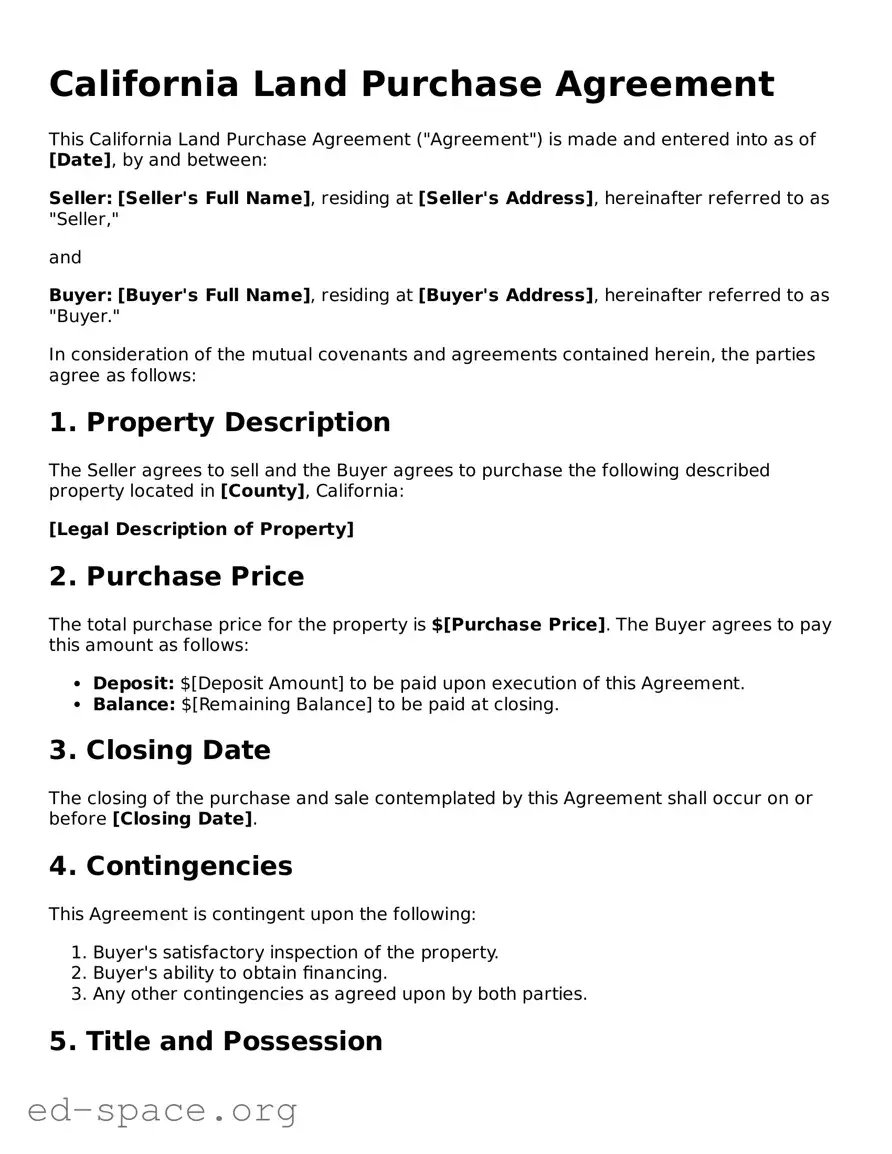
The California Land Purchase Agreement form serves as a crucial document in real estate transactions, outlining the terms and conditions under which a buyer agrees to purchase property from a seller. This agreement typically includes essential details such as the purchase price, financing arrangements, and contingencies that must be satisfied before the sale can be finalized. Additionally, it delineates the responsibilities of both parties, covering aspects such as inspections, disclosures, and the timeline for closing the deal. Notably, the form also addresses potential issues such as title defects and the allocation of costs associated with the transaction, ensuring that both buyers and sellers have a clear understanding of their rights and obligations. By establishing a legally binding framework, the California Land Purchase Agreement not only facilitates smoother negotiations but also helps prevent disputes that may arise during the property transfer process. Understanding this form is vital for anyone looking to navigate the complexities of real estate in California.
California Land Purchase Agreement
This California Land Purchase Agreement ("Agreement") is made and entered into as of [Date], by and between:
Seller: [Seller's Full Name], residing at [Seller's Address], hereinafter referred to as "Seller,"
and
Buyer: [Buyer's Full Name], residing at [Buyer's Address], hereinafter referred to as "Buyer."
In consideration of the mutual covenants and agreements contained herein, the parties agree as follows:
1. Property Description
The Seller agrees to sell and the Buyer agrees to purchase the following described property located in [County], California:
[Legal Description of Property]
2. Purchase Price
The total purchase price for the property is $[Purchase Price]. The Buyer agrees to pay this amount as follows:
3. Closing Date
The closing of the purchase and sale contemplated by this Agreement shall occur on or before [Closing Date].
4. Contingencies
This Agreement is contingent upon the following:
5. Title and Possession
The Seller shall convey good and marketable title to the property to the Buyer at closing. Possession of the property shall be delivered to the Buyer upon closing.
6. Governing Law
This Agreement shall be governed by and construed in accordance with the laws of the State of California.
7. Signatures
IN WITNESS WHEREOF, the parties hereto have executed this Agreement as of the date first above written.
Seller's Signature: ____________________________ Date: _______________
Buyer's Signature: ____________________________ Date: _______________
| Fact Name | Details |
|---|---|
| Purpose | The California Land Purchase Agreement form is used to outline the terms and conditions of a land sale between a buyer and a seller. |
| Governing Law | This agreement is governed by the laws of the State of California. |
| Parties Involved | The form identifies the buyer and the seller, ensuring both parties are clearly named. |
| Property Description | A detailed description of the property being sold is included, which may encompass boundaries and any structures on the land. |
| Purchase Price | The agreement specifies the total purchase price for the property, along with payment terms. |
| Contingencies | Buyers may include contingencies, such as financing or inspection, which must be satisfied before the sale is finalized. |
| Closing Date | The form sets a closing date, which is when the ownership of the property is officially transferred. |
| Disclosures | California law requires certain disclosures to be made regarding the property’s condition and any known issues. |
| Signatures | The agreement must be signed by both parties to be legally binding, indicating their acceptance of the terms. |
After obtaining the California Land Purchase Agreement form, you will need to carefully fill it out to ensure all necessary details are included. This process will help clarify the terms of the land purchase and protect both parties involved.
Once the form is completed, ensure that both parties retain a copy for their records. It is advisable to review the agreement with a legal professional before proceeding with the transaction.
What is a California Land Purchase Agreement?
A California Land Purchase Agreement is a legal document that outlines the terms and conditions under which one party agrees to buy and another party agrees to sell a piece of land in California. This agreement typically includes details such as the purchase price, payment terms, and any contingencies that must be met before the sale can be finalized. It serves to protect the interests of both the buyer and the seller, ensuring that all parties are clear on their obligations and rights throughout the transaction.
What are the essential components of this agreement?
Several key elements must be included in a California Land Purchase Agreement. These components typically encompass the legal description of the property, the purchase price, the closing date, and any contingencies such as financing or inspections. Additionally, the agreement should specify how the property will be conveyed, any warranties or representations made by the seller, and the responsibilities of each party regarding taxes, utilities, and maintenance during the escrow period.
How does the escrow process work in a land purchase?
Once the California Land Purchase Agreement is signed, the escrow process begins. An impartial third party, known as the escrow agent, holds the funds and documents involved in the transaction until all conditions of the agreement are met. The buyer typically deposits earnest money into escrow, which shows their commitment to the purchase. The escrow agent then coordinates the necessary steps, such as title searches and inspections, and ensures that all parties fulfill their obligations before the property is officially transferred to the buyer.
Can I modify the California Land Purchase Agreement?
Yes, modifications can be made to the California Land Purchase Agreement, but both parties must agree to any changes. It is crucial to document these modifications in writing and have both parties sign the amended agreement. Oral changes are generally not enforceable, so written documentation ensures clarity and protects the interests of everyone involved in the transaction.
What happens if one party breaches the agreement?
If one party fails to uphold their end of the California Land Purchase Agreement, it is considered a breach. The non-breaching party has several options, which may include seeking damages, enforcing the agreement through specific performance, or terminating the contract. It is advisable to consult with a legal professional to understand the best course of action based on the specific circumstances surrounding the breach.
Incomplete Information: Many people fail to fill out all required fields. Missing details can delay the process or lead to misunderstandings.
Incorrect Property Description: It’s crucial to provide an accurate description of the property. Errors in the address or legal description can create legal issues.
Ignoring Contingencies: Buyers often overlook important contingencies, such as financing or inspection. These can protect buyers from unexpected issues.
Not Understanding Terms: Some individuals don’t fully grasp the terms of the agreement. This can lead to confusion about obligations and rights.
Forgetting Signatures: A common mistake is failing to sign the agreement. An unsigned contract is not legally binding.
Missing Dates: Dates are essential in a purchase agreement. Omitting them can cause complications in the timeline of the transaction.
Overlooking Earnest Money: Buyers sometimes neglect to specify the amount of earnest money. This can affect the seriousness of the offer.
Not Consulting Professionals: Some buyers try to navigate the process without legal or real estate advice. This can lead to costly mistakes.
Failing to Review the Agreement: Rushing through the agreement without a thorough review can result in overlooking critical clauses or terms.
When engaging in a land purchase in California, several forms and documents complement the California Land Purchase Agreement. Each of these documents plays a vital role in ensuring that the transaction proceeds smoothly and legally. Below is a brief overview of four essential documents often associated with this agreement.
Understanding these documents is essential for anyone involved in a land purchase. Each one serves a specific purpose, contributing to the overall integrity and legality of the transaction. Familiarity with these forms can help ensure a smoother buying process and protect the interests of all parties involved.
The Land Purchase Agreement is a crucial document in real estate transactions. Several other documents share similarities with it, serving various purposes in the buying and selling process. Here are six documents that are comparable to the Land Purchase Agreement:
When filling out the California Land Purchase Agreement form, it is essential to approach the process with care and attention to detail. Below are ten important guidelines to consider, divided into things you should do and things you should avoid.
Things You Should Do:
Things You Shouldn't Do:
Understanding the California Land Purchase Agreement form is essential for both buyers and sellers involved in real estate transactions. However, several misconceptions often arise regarding this important document. Below are eight common misconceptions, along with clarifications.
While most real estate transactions benefit from a formal agreement, not every transaction mandates a Land Purchase Agreement. Informal agreements may suffice in certain situations, although they can lead to misunderstandings.
A purchase offer is typically an initial proposal made by a buyer to a seller, while the Land Purchase Agreement is a more comprehensive document that outlines the terms and conditions once the offer is accepted.
Parties can negotiate changes to the agreement before closing the transaction. Amendments can be made if both parties agree to the new terms.
The Land Purchase Agreement applies to both residential and commercial properties. It is a versatile document used across various types of real estate transactions.
While real estate agents often assist in completing the form, buyers and sellers can also fill it out themselves. However, they should ensure they understand all terms and conditions.
Signing the agreement indicates intent to proceed, but it does not guarantee the sale. Conditions such as financing and inspections can still affect the final outcome.
This misconception overlooks the fact that the agreement is designed to protect the interests of both parties. It outlines the rights and responsibilities of each party involved in the transaction.
While the agreement is legally binding, certain circumstances, such as fraud or misrepresentation, may allow a party to void the contract. Legal advice is recommended in such cases.
When filling out and using the California Land Purchase Agreement form, there are several important points to keep in mind:
By keeping these key takeaways in mind, you can navigate the California Land Purchase Agreement with greater confidence and clarity.