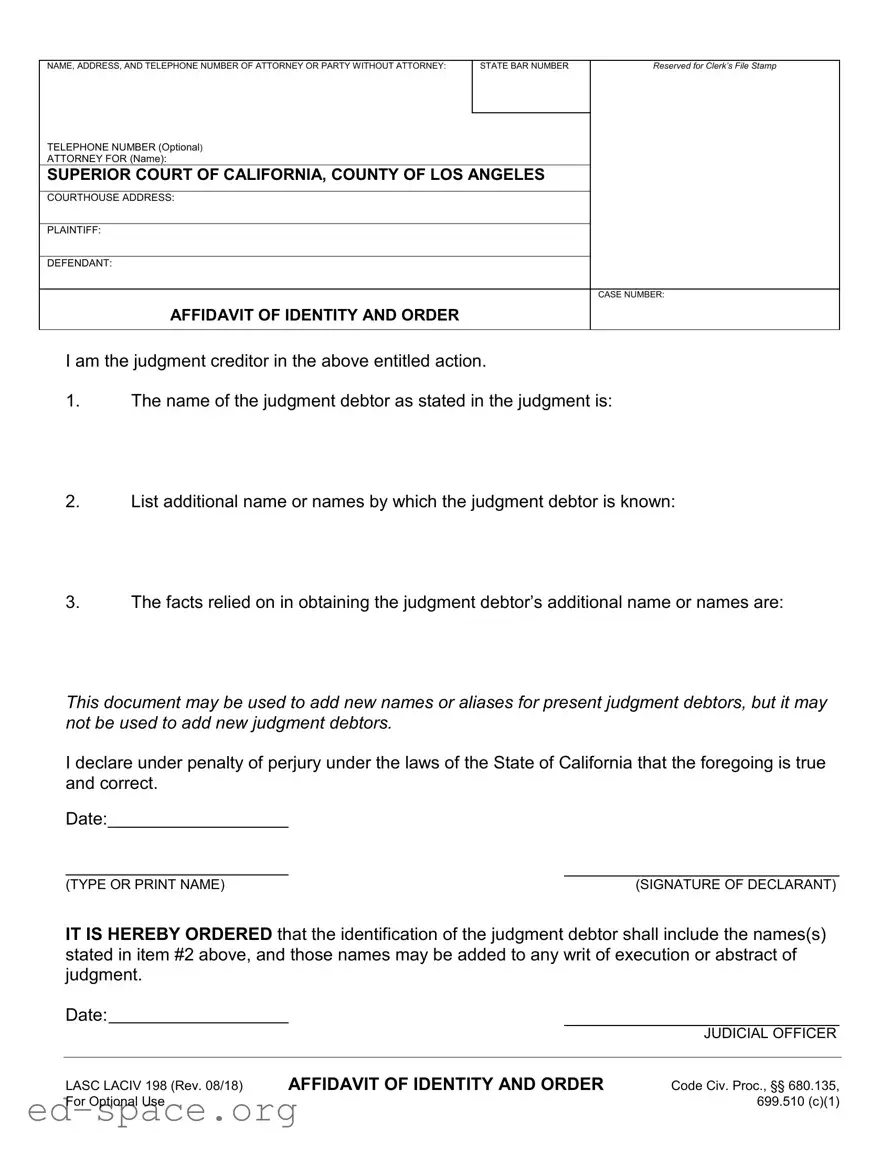
The California Laciv 198 form plays a crucial role in the legal process concerning judgment debtors. This document is primarily utilized by judgment creditors to officially identify and add any additional names or aliases associated with a judgment debtor. It is important to note that while this form allows creditors to clarify the identity of a debtor, it does not permit the addition of new judgment debtors. The form requires the creditor to provide their name, address, and contact information, as well as the details of the case, including the names of the plaintiff and defendant, along with the case number. Additionally, it includes sections for the creditor to declare under penalty of perjury the accuracy of the information provided. The judicial officer then reviews the affidavit and issues an order to include the additional names in any existing writ of execution or abstract of judgment. This process helps ensure that all known aliases of a judgment debtor are recognized in legal proceedings, thereby facilitating the enforcement of judgments.

NAME, ADDRESS, AND TELEPHONE NUMBER OF ATTORNEY OR PARTY WITHOUT ATTORNEY: |
STATE BAR NUMBER |
Reserved for Clerk’s File Stamp |
|
|
|
TELEPHONE NUMBER (Optional)
ATTORNEY FOR (Name):
SUPERIOR COURT OF CALIFORNIA, COUNTY OF LOS ANGELES
COURTHOUSE ADDRESS:
PLAINTIFF:
DEFENDANT:
CASE NUMBER:
AFFIDAVIT OF IDENTITY AND ORDER
I am the judgment creditor in the above entitled action.
1.The name of the judgment debtor as stated in the judgment is:
2.List additional name or names by which the judgment debtor is known:
3.The facts relied on in obtaining the judgment debtor’s additional name or names are:
This document may be used to add new names or aliases for present judgment debtors, but it may not be used to add new judgment debtors.
I declare under penalty of perjury under the laws of the State of California that the foregoing is true and correct.
Date:
(TYPE OR PRINT NAME) |
(SIGNATURE OF DECLARANT) |
IT IS HEREBY ORDERED that the identification of the judgment debtor shall include the names(s) stated in item #2 above, and those names may be added to any writ of execution or abstract of judgment.
Date:
JUDICIAL OFFICER
LASC LACIV 198 (Rev. 08/18) For Optional Use
AFFIDAVIT OF IDENTITY AND ORDER
Code Civ. Proc., §§ 680.135, 699.510 (c)(1)
| Fact Name | Details |
|---|---|
| Form Title | LACIV 198 - Affidavit of Identity and Order |
| Purpose | This form is used to add new names or aliases for existing judgment debtors. |
| Limitations | It cannot be used to add new judgment debtors. |
| Governing Laws | California Code of Civil Procedure, Sections 680.135 and 699.510 (c)(1). |
| Judgment Creditor | The individual or entity that holds the judgment against the debtor. |
| Signature Requirement | The declarant must sign the form under penalty of perjury. |
| Clerk's File Stamp | A reserved space for the court clerk's stamp is included on the form. |
Filling out the California Laciv 198 form is a straightforward process. This form allows you to identify additional names or aliases of a judgment debtor. Follow these steps carefully to ensure that all necessary information is accurately provided.
What is the purpose of the California Laciv 198 form?
The California Laciv 198 form, also known as the Affidavit of Identity and Order, is used primarily by judgment creditors. Its main purpose is to allow creditors to add additional names or aliases of a judgment debtor to the official court records. This is important because sometimes debtors may use different names, and having these names recorded can help ensure that the creditor can collect what they are owed. However, it’s crucial to note that this form cannot be used to add new judgment debtors; it is strictly for updating the names associated with an existing judgment.
Who needs to fill out the Laciv 198 form?
This form is intended for judgment creditors who have obtained a judgment against a debtor. If you are a creditor and you know that the debtor has been using other names or aliases, you should consider filling out this form. It helps clarify the identity of the debtor in court documents, which can facilitate the collection process. If you are unsure whether you qualify, consulting with a legal professional can provide clarity.
What information is required on the Laciv 198 form?
When filling out the Laciv 198 form, you will need to provide several key pieces of information. First, you must include your name, address, and contact information as the attorney or party without an attorney. Next, you will identify the judgment debtor by name as stated in the original judgment. Additionally, you should list any other names or aliases that the judgment debtor is known by. Finally, you will need to provide the facts that support why these additional names are associated with the debtor. This information is crucial for the court to understand the request clearly.
What happens after I submit the Laciv 198 form?
Once you submit the Laciv 198 form to the court, it will be reviewed by a judicial officer. If the officer approves the request, an order will be issued that includes the additional names you provided. This order will then be added to any writ of execution or abstract of judgment related to your case. It’s important to keep a copy of the order for your records, as it serves as proof that the additional names have been officially recognized by the court.
Is there a penalty for providing false information on the Laciv 198 form?
Yes, there is a significant penalty for providing false information on the Laciv 198 form. When you sign the form, you are declaring under penalty of perjury that the information you have provided is true and correct. If it is found that you have knowingly submitted false information, you could face legal consequences, including fines or other penalties. Therefore, it is essential to ensure that all information on the form is accurate and truthful before submission.
Failing to provide complete information. Many individuals do not fill in all required fields, such as the judgment debtor's name or the case number. Omitting these details can lead to delays or rejection of the form.
Incorrectly listing additional names. Some people mistakenly add names that are not legally associated with the judgment debtor. This can create confusion and may result in the form being deemed invalid.
Not signing the form. A common oversight is neglecting to provide a signature. Without a signature, the declaration cannot be accepted, and the process will be stalled.
Misunderstanding the purpose of the form. Some individuals attempt to add new judgment debtors instead of just aliases. This misuse can lead to legal complications and must be avoided.
The California Laciv 198 form is an important document used in legal proceedings, particularly for judgment creditors seeking to clarify the identity of a judgment debtor. Alongside this form, several other documents are commonly utilized to support legal actions and ensure proper processing within the court system. Below is a list of these documents, each serving a distinct purpose.
Each of these documents plays a crucial role in the legal process surrounding judgments and debt collection in California. Understanding their functions can help both creditors and debtors navigate the complexities of the judicial system more effectively.
Affidavit of Identity: Similar to the California Laciv 198 form, this document serves to affirm the identity of a party involved in a legal matter. It is often used in various court proceedings to clarify the identity of individuals when multiple names or aliases are present.
Judgment Creditor's Claim: This form allows a judgment creditor to assert their rights to collect a debt. Like the Laciv 198, it identifies the creditor and debtor, focusing on the relationship established by the judgment.
Writ of Execution: This document is issued by the court to enforce a judgment. It requires the identification of the debtor, similar to how the Laciv 198 form adds names to a judgment debtor's identity.
Abstract of Judgment: This document summarizes the judgment and can include multiple names for the debtor. The Laciv 198 form allows for the addition of such names to ensure comprehensive identification.
Notice of Judgment Lien: This form is used to establish a lien on a debtor's property. Just as the Laciv 198 identifies names associated with a judgment debtor, this document ensures that all relevant names are linked to the lien.
Substitution of Attorney: This document allows a party to change their legal representation. While it serves a different purpose, it similarly involves the identification of parties and may require clarity on names.
Request for Default Judgment: This form is used when a defendant fails to respond to a lawsuit. Like the Laciv 198, it requires accurate identification of the parties involved to proceed with the judgment.
Petition for Change of Name: This document allows an individual to legally change their name. It emphasizes the importance of identity, akin to the Laciv 198 form's function in clarifying a judgment debtor's identity.
Declaration of Service: This form confirms that legal documents have been properly served to the parties involved. Accurate identification is crucial, similar to how the Laciv 198 ensures correct identification of judgment debtors.
Request for Judicial Notice: This document asks the court to recognize certain facts or documents. It often involves identifying parties or relevant documents, paralleling the identification focus of the Laciv 198 form.
When filling out the California Laciv 198 form, it is essential to adhere to specific guidelines to ensure accuracy and compliance. Below is a list of things you should and shouldn't do.
Understanding the California Laciv 198 form is essential for anyone involved in legal proceedings related to judgments. However, several misconceptions often arise. Here are seven common misunderstandings:
Clarifying these misconceptions can help individuals navigate the legal landscape more effectively and ensure compliance with the necessary procedures.
When dealing with the California Laciv 198 form, understanding its purpose and proper usage is crucial. This form is primarily an affidavit of identity that allows for the inclusion of additional names or aliases of a judgment debtor. Here are some key takeaways regarding its completion and application:
Understanding these aspects can significantly enhance the effectiveness of the California Laciv 198 form in legal proceedings.