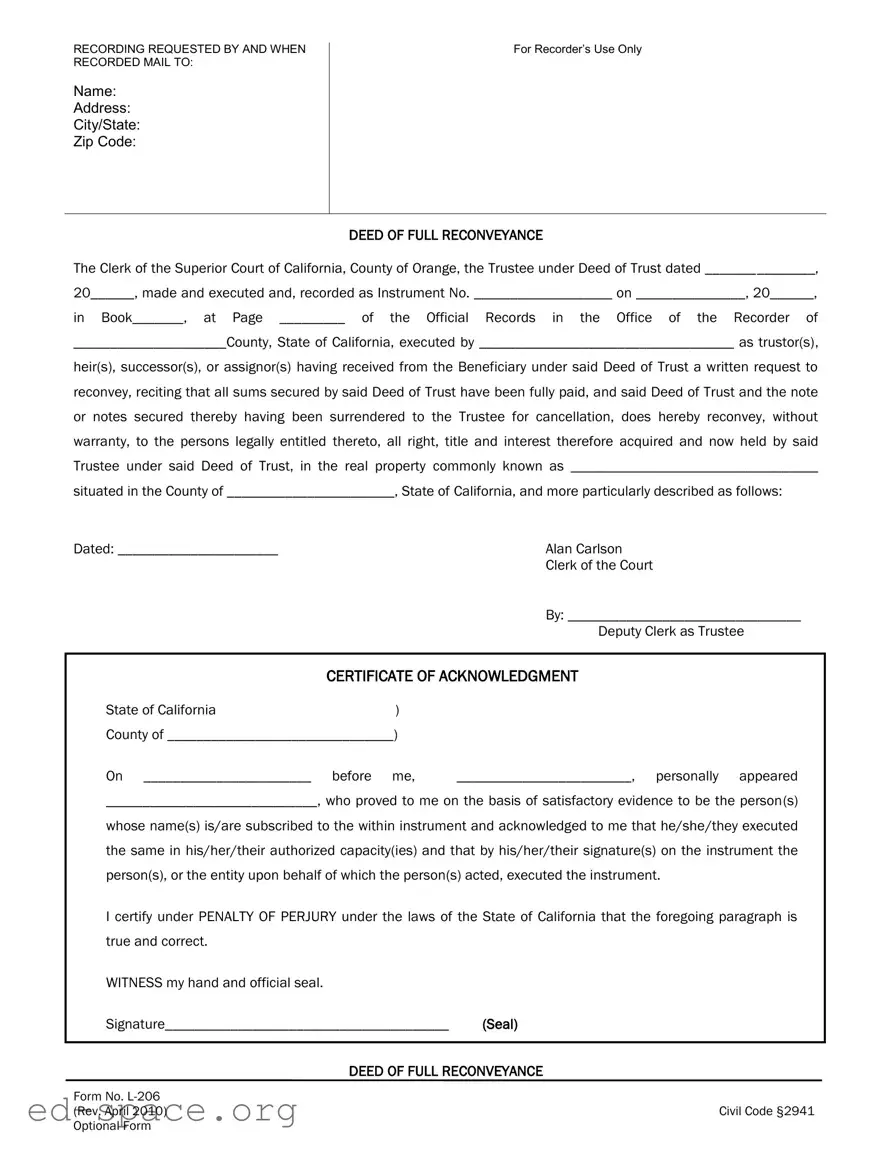
The California L 206 form is a crucial document for individuals navigating the complexities of real estate transactions, particularly those involving a Deed of Trust. This form serves as a Deed of Full Reconveyance, which essentially signifies that a borrower has fulfilled their obligations under a loan secured by real property. When all payments have been made, the Trustee, acting on behalf of the Beneficiary, issues this form to officially return the property rights back to the trustor or their heirs. It includes essential details such as the names of the parties involved, the recording information, and a description of the property in question. Additionally, the form requires a certificate of acknowledgment to verify the identity of the individuals involved, ensuring that the process is both secure and legitimate. By understanding the significance and components of the L 206 form, individuals can better protect their rights and interests in real estate matters within California.

RECORDING REQUESTED BY AND WHEN RECORDED MAIL TO:
Name:
Address:
City/State:
Zip Code:
For Recorder’s Use Only
DEED OF FULL RECONVEYANCE
The Clerk of the Superior Court of California, County of Orange, the Trustee under Deed of Trust dated _______________,
20______, made and executed and, recorded as Instrument No. ___________________ on _______________, 20______,
in Book_______, at Page _________ of the Official Records in the Office of the Recorder of
_____________________County, State of California, executed by ___________________________________ as trustor(s),
heir(s), successor(s), or assignor(s) having received from the Beneficiary under said Deed of Trust a written request to reconvey, reciting that all sums secured by said Deed of Trust have been fully paid, and said Deed of Trust and the note or notes secured thereby having been surrendered to the Trustee for cancellation, does hereby reconvey, without warranty, to the persons legally entitled thereto, all right, title and interest therefore acquired and now held by said Trustee under said Deed of Trust, in the real property commonly known as __________________________________
situated in the County of _______________________, State of California, and more particularly described as follows:
Dated: ______________________ |
|
Alan Carlson |
|
|
Clerk of the Court |
|
|
By: ________________________________ |
|
|
Deputy Clerk as Trustee |
|
|
|
|
CERTIFICATE OF ACKNOWLEDGMENT |
|
State of California |
) |
|
County of _______________________________) |
|
|
On _______________________ |
before me, |
________________________, personally appeared |
_____________________________, who proved to me on the basis of satisfactory evidence to be the person(s)
whose name(s) is/are subscribed to the within instrument and acknowledged to me that he/she/they executed the same in his/her/their authorized capacity(ies) and that by his/her/their signature(s) on the instrument the person(s), or the entity upon behalf of which the person(s) acted, executed the instrument.
I certify under PENALTY OF PERJURY under the laws of the State of California that the foregoing paragraph is true and correct.
WITNESS my hand and official seal.
Signature_______________________________________ (Seal)
DEED OF FULL RECONVEYANCE
Form No.
(Rev. April 2010)Civil Code §2941
Optional Form
| Fact Name | Description |
|---|---|
| Form Purpose | The California L 206 form is used for the Deed of Full Reconveyance, which indicates that a borrower has fully paid off their mortgage. |
| Governing Law | This form is governed by California Civil Code §2941, which outlines the requirements for reconveyance of a deed of trust. |
| Execution Date | The form must include the date when the Deed of Trust was executed, which is crucial for record-keeping. |
| Trustee Role | The Trustee, often a title company or attorney, must sign the form to confirm the reconveyance of the property. |
| Beneficiary Request | A written request from the Beneficiary is necessary, stating that all sums secured by the Deed of Trust have been paid. |
| Property Description | The form requires a clear description of the property being reconveyed, including its common name and legal description. |
| Certificate of Acknowledgment | An acknowledgment section is included, where a notary public verifies the identity of the signers. |
| Optional Form | The L 206 form is considered optional but is commonly used to ensure proper legal documentation of reconveyance. |
| Seal Requirement | A notary's seal is required on the Certificate of Acknowledgment to validate the document. |
Completing the California L 206 form requires careful attention to detail. This form is essential for the reconveyance of a deed of trust, signifying that the obligations have been fulfilled. Follow these steps to ensure accurate completion.
After completing these steps, review the form for accuracy before submitting it for recording. Ensure that all required signatures and information are included to avoid delays in processing.
What is the California L 206 form?
The California L 206 form is known as the Deed of Full Reconveyance. This form is used when a borrower has paid off their mortgage or deed of trust. It serves as a legal document that officially transfers the property title back to the borrower, indicating that they have fulfilled their obligations under the loan agreement. The form needs to be properly filled out and recorded to ensure that the borrower’s rights to the property are clear and undisputed.
Who needs to fill out the L 206 form?
The L 206 form must be filled out by the Trustee, who is the entity that held the deed of trust. This typically happens after the borrower has fully paid off their loan. The Trustee will need to confirm that all payments have been made and that the deed of trust can be canceled. The borrower or their representative may also need to provide information, such as their name and the property details, to ensure the form is accurate.
How do I record the L 206 form?
To record the L 206 form, you will need to take the completed document to the County Recorder’s Office where the property is located. It is essential to ensure that all required fields are filled out correctly. There may be a small fee for recording the document. Once recorded, the form becomes part of the public record, which protects your ownership rights and shows that the mortgage has been fully paid.
What happens if I don’t file the L 206 form after paying off my mortgage?
If you do not file the L 206 form after paying off your mortgage, the deed of trust may still appear as a lien against your property. This could create confusion regarding your ownership and may complicate future transactions involving the property, such as selling or refinancing. Filing the L 206 form is crucial to ensure that your property title is clear and free of any claims related to the paid-off loan.
Missing Information: Many people forget to fill in all required fields, such as the name and address of the requester. Leaving these blank can delay processing.
Incorrect Dates: It's crucial to ensure that the dates entered are accurate. Mistakes in the date of the deed of trust or the date of recording can lead to complications.
Improper Signatures: All necessary parties must sign the form. Failing to obtain the required signatures can invalidate the document.
Not Acknowledging the Document: The certificate of acknowledgment must be completed properly. Without it, the form may not be accepted by the Recorder's Office.
Missing or Incorrect Instrument Number: This number is essential for tracking the deed of trust. Ensure it is entered correctly to avoid confusion.
Inaccurate Property Description: The property must be described clearly and accurately. Any discrepancies can lead to legal issues down the line.
Failure to Include the Correct County: The county where the property is located must be specified. Omitting this detail can result in processing delays.
Not Keeping Copies: Always retain copies of the filled-out form for your records. This can be helpful for future reference or if any issues arise.
Ignoring the Instructions: Each form comes with specific instructions. Not following these can lead to mistakes that are easily avoidable.
The California L 206 form, known as the Deed of Full Reconveyance, is an important document used in real estate transactions. It signifies that a borrower has fully repaid their loan, allowing the trustee to transfer the property back to the borrower. There are several other forms and documents commonly used alongside this form. Below is a list of these documents, each accompanied by a brief description.
These documents play a vital role in the process of property ownership and financing. Understanding them can help individuals navigate real estate transactions more effectively and ensure that their rights are protected.
The California L 206 form, known as the Deed of Full Reconveyance, serves a specific purpose in the realm of real estate transactions. It is important to understand that there are other documents that share similarities with this form. Below are four such documents, each with a brief explanation of how they relate to the L 206 form.
Understanding these documents can help clarify the processes involved in real estate transactions and ensure that all parties are aware of their rights and responsibilities.
When filling out the California L 206 form, it is essential to follow specific guidelines to ensure accuracy and compliance. Here are four important dos and don’ts:
Misconceptions about the California L 206 form can lead to confusion for those involved in real estate transactions. Here are four common misconceptions:
Here are key takeaways regarding the California L 206 form, which is used for the Deed of Full Reconveyance: