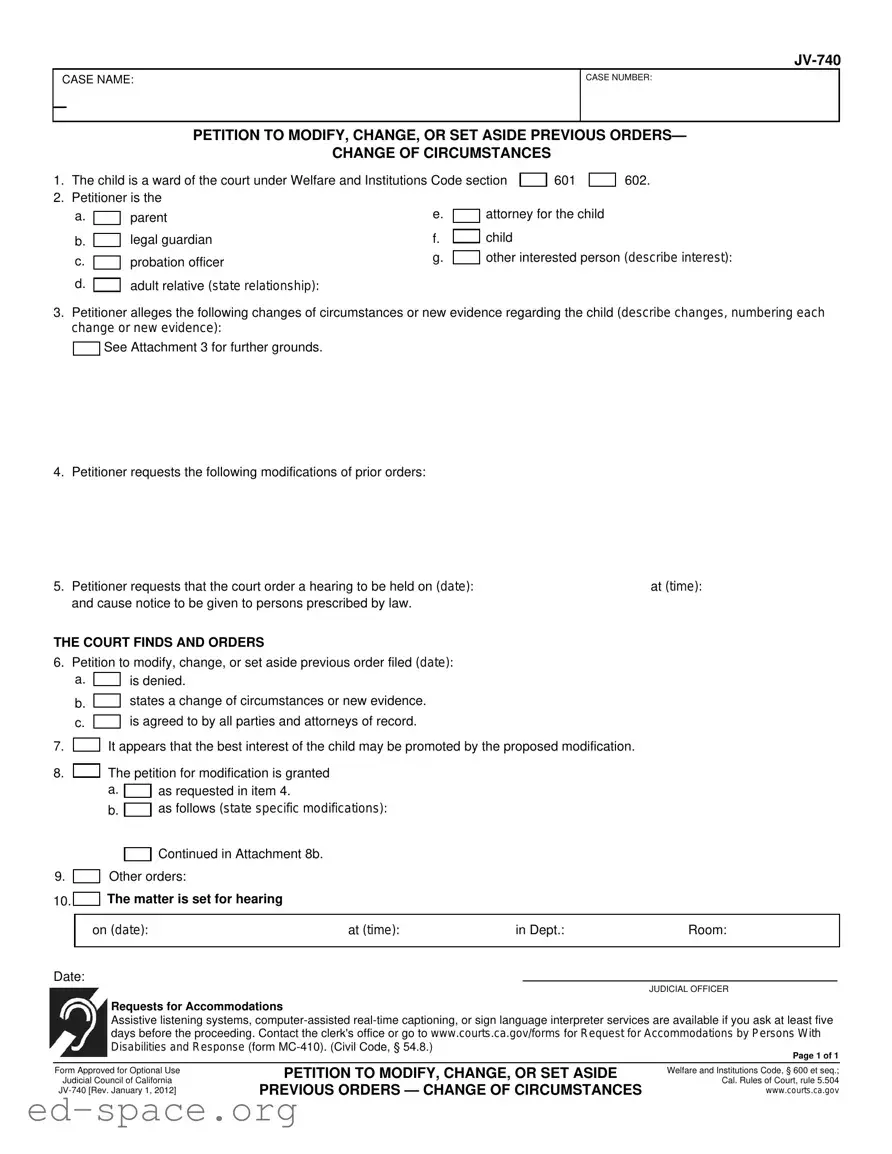
The California JV 740 form serves as a crucial legal document in the juvenile court system, particularly for individuals seeking to modify, change, or set aside previous court orders related to a child who is a ward of the court. This form is utilized when there are changes in circumstances or new evidence that may affect the child's welfare, as outlined under the Welfare and Institutions Code sections 601 and 602. The petitioner, who may be a parent, legal guardian, attorney for the child, probation officer, or other interested parties, must clearly articulate the changes or new evidence in a numbered format. Additionally, the form allows the petitioner to request specific modifications to prior orders and to schedule a hearing for the court to consider these requests. The court will assess whether the proposed modifications align with the best interests of the child, which is the primary concern in such cases. Furthermore, the JV 740 includes provisions for accommodations for individuals with disabilities, ensuring that all parties have access to the legal process. This form is essential for navigating the complexities of juvenile law and ensuring that the child's needs are adequately addressed in court proceedings.
CASE NAME:
CASE NUMBER:
PETITION TO MODIFY, CHANGE, OR SET ASIDE PREVIOUS ORDERS—
CHANGE OF CIRCUMSTANCES
1. |
The child is a ward of the court under Welfare and Institutions Code section |
|
601 |
|
602. |
|||||
2. |
Petitioner is the |
|
|
|
|
|
|
|
||
|
a. |
|
parent |
e. |
|
attorney for the child |
|
|||
|
|
|
|
|||||||
|
|
|
||||||||
|
|
|
legal guardian |
f. |
|
child |
|
|
|
|
|
|
|
|
|
|
|
|
|||
|
b. |
|
|
|
|
|
|
|||
|
|
|
|
|
|
|||||
|
|
|
|
|
|
|
||||
|
|
|
|
|
|
other interested person (describe interest): |
||||
|
c. |
|
probation officer |
g. |
|
|||||
|
|
|||||||||
|
|
|
|
|
|
|
|
|
||
|
|
|
adult relative (state relationship): |
|
|
|
|
|
|
|
|
d. |
|
|
|
|
|
|
|
|
|
3.Petitioner alleges the following changes of circumstances or new evidence regarding the child (describe changes, numbering each change or new evidence):
See Attachment 3 for further grounds.
4. Petitioner requests the following modifications of prior orders:
5. |
Petitioner requests that the court order a hearing to be held on (date): |
at (time): |
||
|
and cause notice to be given to persons prescribed by law. |
|
||
THE COURT FINDS AND ORDERS |
|
|||
6. |
Petition to modify, change, or set aside previous order filed (date): |
|
||
|
a. |
|
is denied. |
|
|
|
|
||
|
|
|
states a change of circumstances or new evidence. |
|
|
b. |
|
|
|
|
|
|
||
|
|
|
is agreed to by all parties and attorneys of record. |
|
|
c. |
|
|
|
7. It appears that the best interest of the child may be promoted by the proposed modification.
8. The petition for modification is granted
|
|
a. |
|
as requested in item 4. |
|
|
|
|
b. |
|
as follows (state specific modifications): |
|
|
|
|
|
|
|
||
|
|
|
|
Continued in Attachment 8b. |
|
|
|
|
|
|
|
|
|
9. |
|
Other orders: |
|
|
||
|
|
|
||||
10. |
|
The matter is set for hearing |
|
|
||
|
|
|
||||
|
|
|
|
|
||
|
on (date): |
at (time): |
in Dept.: |
Room: |
||
|
|
|
|
|
|
|
Date:
JUDICIAL OFFICER
Requests for Accommodations
Assistive listening systems,
Page 1 of 1
Form Approved for Optional Use
Judicial Council of California
PETITION TO MODIFY, CHANGE, OR SET ASIDE
PREVIOUS ORDERS — CHANGE OF CIRCUMSTANCES
Welfare and Institutions Code, § 600 et seq.; Cal. Rules of Court, rule 5.504 www.courts.ca.gov
| Fact Name | Description |
|---|---|
| Purpose | The JV-740 form is used to petition the court to modify, change, or set aside previous orders regarding a child. |
| Governing Laws | This form is governed by the Welfare and Institutions Code, specifically sections 600 et seq., and California Rules of Court, rule 5.504. |
| Eligibility | Petitioners can include parents, legal guardians, probation officers, attorneys for the child, or other interested persons. |
| Change of Circumstances | Petitioners must describe any changes of circumstances or new evidence that justify the request for modification. |
| Hearing Request | The form allows petitioners to request a hearing date and time, ensuring proper notice is given to relevant parties. |
After gathering the necessary information, you can proceed to fill out the California JV-740 form. This form is used to request modifications to previous court orders based on changes in circumstances. Ensure that all sections are completed accurately to facilitate the review process.
What is the purpose of the California JV-740 form?
The California JV-740 form is used to request changes to previous court orders regarding a child who is a ward of the court. This form allows petitioners to present new evidence or changes in circumstances that may affect the child's situation.
Who can file a JV-740 form?
Any interested party can file this form. This includes parents, legal guardians, attorneys for the child, probation officers, adult relatives, or other individuals with a specific interest in the child's welfare. Each petitioner must describe their relationship or interest in the child's case.
What information is needed to complete the JV-740 form?
Petitioners need to provide the case name, case number, and details about the changes in circumstances or new evidence. Additionally, they must specify the modifications they are requesting and suggest a date and time for a court hearing.
What should I include when describing changes of circumstances?
When detailing changes of circumstances, it's important to be clear and specific. Number each change or piece of new evidence. This could include changes in the child's living situation, health, education, or behavior that may impact the child's welfare.
What happens after I submit the JV-740 form?
After submission, the court will review the petition. The court may deny the request, agree to it, or set a hearing to discuss the proposed changes. If a hearing is scheduled, notice will be given to the relevant parties as required by law.
How does the court determine if the modification is in the best interest of the child?
The court considers various factors, including the child's safety, emotional well-being, and stability. The proposed changes must demonstrate that they will promote the child's best interests. This evaluation is crucial in deciding whether to grant the petition.
What accommodations are available for individuals with disabilities?
Individuals with disabilities can request accommodations such as assistive listening systems, real-time captioning, or sign language interpreter services. These requests should be made at least five days before the court proceeding. Contact the clerk's office or visit the court's website for more information on how to request these services.
Where can I find more information about the JV-740 form?
For additional details and resources, you can visit the California courts website at www.courts.ca.gov/forms. This site provides access to various forms and information related to court procedures.
Incomplete Information: One of the most common mistakes is failing to provide all required information. Each section of the JV-740 form must be filled out completely. Missing details, such as the case name or number, can lead to delays in processing.
Incorrect Petitioner Identification: It is crucial to accurately identify who the petitioner is. Misclassifying oneself, such as selecting "other interested person" when you are actually the child's parent or legal guardian, can create confusion and complicate the case.
Vague Descriptions of Changes: When describing changes of circumstances or new evidence, specificity is key. General statements without clear details do not adequately support the petition and may result in a denial.
Failure to Request a Hearing: Some individuals overlook the importance of explicitly requesting a hearing date and time. Without this request, the court may not schedule a hearing, leaving the petition unresolved.
Neglecting Attachments: If additional grounds or modifications are referenced, it is essential to attach the relevant documents. Forgetting to include these attachments can undermine the petition's validity and lead to dismissal.
The California JV-740 form is a crucial document used in juvenile court proceedings to request modifications to previous orders regarding a child who is a ward of the court. Along with this form, several other documents may be necessary to support the petition or to fulfill legal requirements. Below is a list of forms that are commonly used in conjunction with the JV-740.
Each of these forms plays a vital role in the juvenile court process, ensuring that all parties are informed and that the court has the necessary information to make informed decisions regarding the welfare of the child involved. Understanding these documents can help individuals navigate the complexities of the legal system more effectively.
The California JV-740 form is used to petition for modifications to previous court orders regarding a child who is a ward of the court. Several other legal documents serve similar purposes in different contexts. Below is a list of these documents and how they relate to the JV-740 form:
Each of these documents plays a vital role in the legal process, ensuring that the needs and best interests of children are carefully considered and addressed in court. Understanding their similarities can help individuals navigate the complexities of family law more effectively.
When filling out the California JV-740 form, it's important to follow certain guidelines to ensure accuracy and clarity. Here’s a list of things you should and shouldn’t do:
Following these guidelines can help ensure that your petition is processed smoothly. Always remember that clarity and completeness are key.
Understanding the California JV-740 form can be challenging, and several misconceptions often arise. Here are eight common misunderstandings about this important legal document:
By clarifying these misconceptions, individuals can better navigate the complexities of the JV-740 form and understand its role in advocating for the best interests of the child involved.
When filling out and using the California JV-740 form, keep these key takeaways in mind: