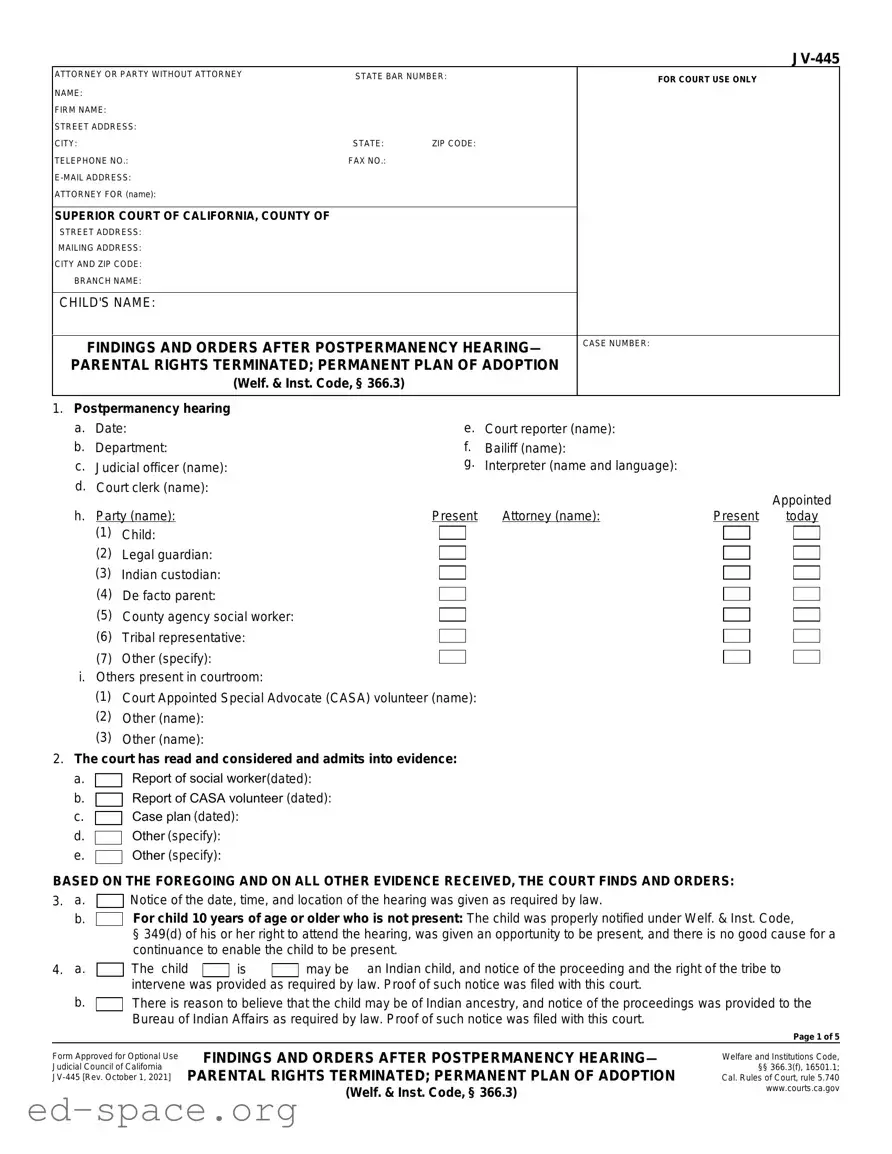
The California JV 445 form plays a crucial role in the post-permanency hearing process, particularly when a child's parental rights have been terminated and the focus shifts to a permanent plan of adoption. This form is designed to document the findings and orders made by the court during these hearings, ensuring that all relevant parties are informed and that the child's best interests remain at the forefront. It includes essential details such as the child's name, case number, and the names of involved parties, including attorneys, social workers, and any advocates present. The form captures vital information about the child's current placement, whether it is deemed appropriate, and outlines the efforts made by the county agency to secure a suitable living situation. Additionally, it addresses the child's educational and health needs, ensuring that they receive adequate support. The JV 445 also emphasizes the importance of including the child in the case plan development, particularly for those aged 12 and older, and mandates that the county agency actively involve them in discussions about their future. Through this comprehensive approach, the JV 445 form serves as a key tool in safeguarding the welfare of children in the foster care system as they transition towards a stable and loving permanent home.
ATTORNEY OR PARTY WITHOUT ATTORNEY |
STATE BAR NUMBER: |
FOR COURT USE ONLY |
|
|
|
|
|
NAME: |
|
|
|
FIRM NAME: |
|
|
|
STREET ADDRESS: |
|
|
|
CITY: |
STATE: |
ZIP CODE: |
|
TELEPHONE NO.: |
FAX NO.: |
|
|
|
|
|
|
ATTORNEY FOR (name): |
|
|
|
SUPERIOR COURT OF CALIFORNIA, COUNTY OF
STREET ADDRESS:
MAILING ADDRESS:
CITY AND ZIP CODE:
BRANCH NAME:
CHILD'S NAME:
FINDINGS AND ORDERS AFTER POSTPERMANENCY HEARING— |
CASE NUMBER: |
|
|
PARENTAL RIGHTS TERMINATED; PERMANENT PLAN OF ADOPTION |
|
(Welf. & Inst. Code, § 366.3) |
|
1.Postpermanency hearing
a. |
Date: |
|
e. |
Court reporter (name): |
|
|
|
|
|
|
||
b. |
Department: |
|
f. |
Bailiff (name): |
|
|
|
|
|
|
||
c. |
Judicial officer (name): |
|
g. |
Interpreter (name and language): |
|
|
|
|
|
|
||
d. |
Court clerk (name): |
|
|
|
|
|
|
|
Appointed |
|||
|
|
|
|
|
|
|
|
|
|
|||
h. |
Party (name): |
Present |
Attorney (name): |
Present |
today |
|||||||
|
(1) |
Child: |
|
|
|
|
|
|
|
|
|
|
|
(2) |
Legal guardian: |
|
|
|
|
|
|
|
|
|
|
|
|
|
|
|
|
|
|
|
|
|
||
|
(3) |
Indian custodian: |
|
|
|
|
|
|
|
|
|
|
|
|
|
|
|
|
|
|
|
|
|
||
|
(4) |
De facto parent: |
|
|
|
|
|
|
|
|
|
|
|
|
|
|
|
|
|
|
|
|
|
||
|
(5) |
County agency social worker: |
|
|
|
|
|
|
|
|
|
|
|
|
|
|
|
|
|
|
|
|
|
||
|
(6) |
Tribal representative: |
|
|
|
|
|
|
|
|
|
|
|
|
|
|
|
|
|
|
|
|
|
||
|
(7) |
Other (specify): |
|
|
|
|
|
|
|
|
|
|
|
|
|
|
|
|
|
|
|
|
|
||
i.Others present in courtroom:
(1)Court Appointed Special Advocate (CASA) volunteer (name):
(2)Other (name):
(3)Other (name):
2.The court has read and considered and admits into evidence:
a. Report of social worker(dated):
b. Report of CASA volunteer (dated):
c. Case plan (dated):
d. Other (specify):
e. Other (specify):
BASED ON THE FOREGOING AND ON ALL OTHER EVIDENCE RECEIVED, THE COURT FINDS AND ORDERS:
3.a.
b.
Notice of the date, time, and location of the hearing was given as required by law.
For child 10 years of age or older who is not present: The child was properly notified under Welf. & Inst. Code,
§349(d) of his or her right to attend the hearing, was given an opportunity to be present, and there is no good cause for a continuance to enable the child to be present.
4. a.
The child |
|
is |
|
may be an Indian child, and notice of the proceeding and the right of the tribe to |
|
|
|||
intervene was |
provided as required by law. Proof of such notice was filed with this court. |
|||
b.
There is reason to believe that the child may be of Indian ancestry, and notice of the proceedings was provided to the Bureau of Indian Affairs as required by law. Proof of such notice was filed with this court.
|
|
Page 1 of 5 |
Form Approved for Optional Use |
FINDINGS AND ORDERS AFTER POSTPERMANENCY HEARING— |
Welfare and Institutions Code, |
Judicial Council of California |
PARENTAL RIGHTS TERMINATED; PERMANENT PLAN OF ADOPTION |
§§ 366.3(f), 16501.1; |
Cal. Rules of Court, rule 5.740 |
(Welf. & Inst. Code, § 366.3) |
www.courts.ca.gov |
|

CHILD'S NAME:
CASE NUMBER:
5.
A Court Appointed Special Advocate is appointed for the child.
Placement
6.The child's
7. The child's current placement is appropriate.
8.
For a child placed in a
9.
a.
The child's current placement is not appropriate. The county agency must locate an appropriate placement for the child.
The matter is continued to the date and time indicated in item 32 for a |
|
written |
|
oral |
report by the county |
|
|
||||
agency on the progress made in locating an appropriate placement. |
|
|
|
|
|
b. Other(specify):
10. The child is placed outside the state of California and that
a. continues to be the most appropriate placement for the child and is in the best interest of the child.
b.does not continue to be the most appropriate placement for the child and is not in the best interest of the child. The
matter is continued to the date and time indicated in item 32 for a |
|
written |
|
oral |
report by the county |
|
|
||||
agency on the progress made toward |
|
|
|
|
|
(1) returning the child to California and locating an appropriate placement within California.
(2)locating an
(3)
Other(specify):
Case plan development
11.a.
b.
(1)
(2)
The child was actively involved in the case plan development, including the child's plan for permanent placement.
The child was not actively involved in the case plan development, including the child's plan for permanent placement, and
the county agency is ordered to actively involve the child in the case plan development, including the plan for permanent placement, and to submit to the court an updated case plan within 30 days of the date of this hearing.
the county agency is not required to actively involve the child because the child is unable, unavailable, or unwilling to participate.
12. Child 12 years of age or older:
a. The child was given the opportunity to review the case plan, sign it, and receive a copy.
b. The child was not given the opportunity to review the case plan, sign it, and receive a copy, and
(1)the county agency is ordered to provide the child with the opportunity to review the case plan, sign it, and receive a copy. The county agency is further ordered to submit to the court within 30 days of the date of this hearing written confirmation that the child was provided with this opportunity.
(2)
Efforts
the county agency is not required to actively involve the child because the child is unable, unavailable, or unwilling to participate.
13.The county agency
a.
b.
has has not
complied with the case plan by making reasonable efforts, including whatever steps are necessary to make and to finalize the permanent placement of the child.
14. The child is 16 years of age or older and the agency |
|
has |
|
has not |
made the following ongoing and intensive |
|
|
||||
efforts to return the child to a safe home or finalize the |
permanent plan: |
|
|
||
FINDINGS AND ORDERS AFTER POSTPERMANENCY HEARING— PARENTAL RIGHTS TERMINATED; PERMANENT PLAN OF ADOPTION
(Welf. & Inst. Code, § 366.3)
Page 2 of 5

CHILD'S NAME:
CASE NUMBER:
15. Child not yet placed with prospective adoptive parent or a guardian
a. The county agency |
|
has |
|
has not exercised due diligence to locate an appropriate relative with whom the child |
|||||
|
|
||||||||
could be placed. Each |
|
|
|
|
|
has |
|
has not |
been |
relative whose name has been submitted to the department |
|
|
|||||||
evaluated.
b. The child has identified the following as an individual important to him or her:
(1)(name):
(2)(name):
c.The county agency has with the child's best interest.
has not |
made efforts to identify individuals who are important to the child, consistent |
d. The county agency |
|
has |
|
has not |
made efforts to maintain the child's relationships with the individuals who |
|
|
||||
are important to the |
child, |
consistent |
with the child's best interest. |
||
e.The county agency for the child.
has
has not |
made efforts to identify a prospective adoptive parent or a legal guardian |
f.
(1)
(2)
g.
(1)
(2)
To identify individuals who are important to the child and to maintain the child's relationships with those individuals, the county agency must provide the services
as stated on the record. as follows:
To identify a prospective adoptive parent or a legal guardian for the child, the county agency must provide the service
as stated on the record. as follows:
16. The services provided to the child have been
a.
b.
adequate. not adequate.
Health and education
17. a. The child's educational needs b. The child's physical needs
c. The child's mental health needs d. The child's developmental needs
18. The child |
|
does |
|
does not |
|
|
|||
psychotropic |
medication order is on (date): |
|||
are |
|
are not |
being met. |
|
|||
are |
|
are not |
being met. |
|
|||
are |
|
are not |
being met. |
|
|||
are |
|
are not |
being met. |
|
have an order authorizing psychotropic medication. The next hearing to review the
.
19. The additional services, assessments, and/or evaluations the child requires to meet the unmet needs specified in item 17 or other concerns are:
a. stated in the social worker's report.
b. specified here:
20. The following persons are ordered to take the steps necessary for the child to begin receiving the services, assessments, and/or evaluations identified in item 19:
a. Social worker.
b. Surrogate parent (name):
c. Educational representative (name):
d. Other (name):
FINDINGS AND ORDERS AFTER POSTPERMANENCY HEARING— PARENTAL RIGHTS TERMINATED; PERMANENT PLAN OF ADOPTION
(Welf. & Inst. Code, § 366.3)
Page 3 of 5

CHILD'S NAME:
CASE NUMBER:
21. The child's education placement has changed since the last review hearing.
a. The child's educational records, including any evaluation regarding a disability, were requested by the child's new school within two business days of the request to enroll and those records were provided by the child's former school to the child's new school within two business days of the receipt of the educational records request.
b. The child is enrolled in school.
c. The child is attending school.
22. Child 14 years of age or older:
a. |
|
The services stated in the case plan include those needed to assist the child in making the transition from foster care to |
|
||
|
|
successful adulthood. |
b.
The services stated in the case plan do not include those needed to assist the child in making the transition from foster care to successful adulthood.
c.
(1)
(2)
To assist the child in making the transition to successful adulthood, the county agency must add to the case plan and provide the services
stated on the record. as follows:
Siblings
23. The child does not have siblings under the court's jurisdiction.
24. |
|
The child has siblings under the court's jurisdiction. Sibling Attachment: Contact and Placement (form |
|||||
|
|||||||
|
|
attached and incorporated by reference. |
|
|
|
|
|
25. |
|
The child has siblings. A postadoption sibling contact agreement |
|
has |
|
has not |
been developed. If not, |
|
|
|
|||||
the court has inquired into the status of the development of a voluntary postadoption sibling contact agreement.
Permanent plan
26. a. The permanent plan of adoption is appropriate and is ordered to continue as the permanent plan.
b.The likely date by which the child's adoption will be finalized is (specify date):
27. a. The permanent plan of tribal customary adoption is appropriate and is ordered to continue as the permanent plan.
b.The likely date by which the child's tribal customary adoption will be finalized is (specify date):
28. a. The child's permanent plan of adoption may or may not be appropriate, and the matter is ordered set for a hearing under Welf. & Inst. Code, § 366.26 to select the most appropriate permanent plan for the child. The county agency and the licensed county adoption agency or the California Department of Social Services, acting as an adoption agency, will prepare and serve an assessment report as described in Welf. & Inst. Code, § 366.22(b).
b.The likely date by which the child may be placed for adoption, tribal customary adoption, legal guardianship, or with a fit and willing relative (specify date):
29. Contact with the child is ordered as follows (check appropriate box and attach indicated form):
a. Visitation Attachment: Parent, Legal Guardian, Indian Custodian, Other Important Person (form
b. Visitation Attachment: Sibling (form
c. Visitation Attachment: Grandparent (form
30.All prior orders not in conflict with this order remain in full force and effect.
FINDINGS AND ORDERS AFTER POSTPERMANENCY HEARING— PARENTAL RIGHTS TERMINATED; PERMANENT PLAN OF ADOPTION
(Welf. & Inst. Code, § 366.3)
Page 4 of 5

CHILD'S NAME:
CASE NUMBER:
31. Other findings and orders:
a. See attached.
b. (Specify):
32. The next hearing is scheduled as follows:
Hearing date: |
Time: |
Dept: |
Room: |
a.
b.
c.
Postpermanency hearing (Welf. & Inst. Code, § 366.3)
Selection and implementation hearing (Welf. & Inst. Code, § 366.26) Other (specify):
33.Number of pages attached:
Date:
JUDGE
JUDGE PRO TEMPORE
COMMISSIONER
REFEREE
FINDINGS AND ORDERS AFTER POSTPERMANENCY HEARING— |
||||||
|
PARENTAL RIGHTS TERMINATED; PERMANENT PLAN OF ADOPTION |
|||||
|
|
(Welf. & Inst. Code, § 366.3) |
||||
|
|
|
|
|
|
|
For your protection and privacy, please press the Clear |
|
|
|
|
|
|
This Form button after you have printed the form. |
|
Print this form |
|
Save this form |
|
|
|
|
|
|
|
|
|
Page 5 of 5
Clear this form
| Fact Name | Details |
|---|---|
| Form Purpose | The JV-445 form is used to document findings and orders after a post-permanency hearing regarding a child’s adoption. |
| Governing Law | This form is governed by the California Welfare and Institutions Code, specifically section 366.3. |
| Form Approval | The JV-445 form is approved for optional use by the Judicial Council of California. |
| Last Revision Date | The most recent revision of the JV-445 form occurred on October 1, 2021. |
| Who Uses This Form? | Attorneys or parties without attorneys involved in child adoption cases utilize this form. |
| Contents Overview | The form includes sections for court findings, orders, and information about the child's placement and needs. |
| Hearing Notification | The form confirms that notice of the hearing date, time, and location was provided as required by law. |
| Child's Rights | It ensures that children aged 10 years or older are informed of their right to attend the hearing. |
| Evidence Consideration | The court considers various reports and documentation, such as social worker reports and case plans, before making orders. |
Filling out the California JV-445 form involves providing detailed information about a child's case in the context of post-permanency hearings. This form is crucial for documenting findings and orders regarding the child's adoption and welfare. Below are the steps to complete the form accurately.
What is the purpose of the California JV-445 form?
The California JV-445 form is used to document the findings and orders made by the court after a post-permanency hearing. This hearing typically occurs after parental rights have been terminated, and it focuses on the permanent plan for the child, such as adoption. The form ensures that all necessary information regarding the child's placement, needs, and the involvement of relevant parties is recorded and considered by the court.
Who needs to fill out the JV-445 form?
The JV-445 form is usually completed by the attorney representing the child or the county agency involved in the case. It may also be filled out by a party without an attorney. The form requires details about the child, the court hearing, and the findings made during the hearing.
What information is included in the JV-445 form?
The form includes sections for the child's name, case number, details about the court hearing, and findings related to the child's placement and needs. It also documents the involvement of various parties, such as social workers, legal guardians, and advocates. Additionally, it addresses the child's educational and health needs, as well as any plans for adoption or guardianship.
How does the court determine the child's placement?
The court evaluates whether the child's current out-of-home placement is appropriate. If not, the county agency is tasked with finding a suitable placement. Factors considered include the child's best interests, the appropriateness of the current placement, and any ongoing efforts to locate a more suitable option.
What happens if the child is not present at the hearing?
If the child is 10 years of age or older and is not present, the court must ensure that the child was properly notified of the hearing. The court also assesses whether there is good cause for the child's absence. If the child was not given the opportunity to attend, the court may require the county agency to take further action to involve the child in future hearings.
What role does the Court Appointed Special Advocate (CASA) play?
A CASA is appointed to advocate for the child's best interests in court. They provide independent recommendations based on their observations and understanding of the child's needs. Their reports are often considered by the court when making decisions regarding the child's permanent plan.
What are the next steps after completing the JV-445 form?
After the JV-445 form is completed and submitted, the court will review the findings and orders outlined in the form. The court may schedule a follow-up hearing to further assess the child's situation and ensure that the necessary services and placements are being provided. Dates and details for future hearings will be specified in the form.
Failing to include the name of the child on the form. This is essential for identifying the case.
Not providing the case number. The case number is crucial for court records and tracking.
Leaving out the date of the postpermanency hearing. This information is necessary for proper documentation.
Incorrectly filling out the judicial officer's name. Ensure that the correct name is provided to avoid confusion.
Omitting the court reporter's name if applicable. This is important for maintaining accurate records of the hearing.
Not specifying the court clerk's name. This detail is required for administrative purposes.
Failing to indicate whether the child was present at the hearing. This affects the legal proceedings.
Neglecting to provide the names of all parties present in the courtroom. This ensures that all relevant individuals are documented.
Not including the date of any reports submitted. This is important for referencing the most current information.
The California JV-445 form is utilized in post-permanency hearings, primarily concerning cases where parental rights have been terminated and a permanent plan of adoption is being established. Several other forms and documents are often associated with this process. Each serves a specific purpose in ensuring the child's needs and legal rights are addressed throughout the proceedings.
Each of these documents plays a crucial role in the legal proceedings surrounding adoption and child welfare, ensuring that the best interests of the child are prioritized and that all relevant parties are included in the process.
When completing the California JV-445 form, it is essential to adhere to certain guidelines to ensure accuracy and compliance. Below is a list of things to do and avoid.
The California JV-445 form is often misunderstood. Here are nine common misconceptions about it, along with clarifications to help you understand its purpose and function.
This form can be used by both attorneys and parties without attorneys. It is designed to facilitate communication between the court and all parties involved in a child’s case.
The JV-445 form is utilized during postpermanency hearings, which occur even if parental rights have not yet been terminated. It addresses the child’s current status and future plans.
The form is a tool for the court to gather information. While it informs decisions, the final outcome depends on various factors, including the child’s best interests and the evidence presented.
In many cases, the child’s involvement is essential. For children aged 12 and older, the form includes provisions for them to review and sign the case plan.
The JV-445 form applies to all children under the court's jurisdiction, including those in various types of placements, not just foster care.
A hearing is typically scheduled to review the findings and orders outlined in the form. This ensures that all parties have an opportunity to discuss the child’s situation.
The JV-445 form also considers long-term plans for the child, including adoption and other permanent placements, ensuring a comprehensive approach to the child's welfare.
The form specifically addresses the child’s educational needs, ensuring that they are met as part of the overall case plan.
This form may need to be completed multiple times throughout a child’s case, especially during different hearings as circumstances change.
The California JV-445 form is used to document findings and orders after a post-permanency hearing, particularly when parental rights have been terminated and the permanent plan is adoption.
Before filling out the form, gather all relevant information, such as the child's name, case number, and details about the hearing, including the date and the names of those present.
Ensure that all required parties, such as the child’s legal guardian and social worker, are listed in the appropriate sections. Their presence and input are crucial for the court's findings.
Be aware that the court must consider various reports, including those from social workers and Court Appointed Special Advocates (CASA), before making any decisions.
After completing the form, submit it to the court along with any required attachments, and remember to keep a copy for your records.