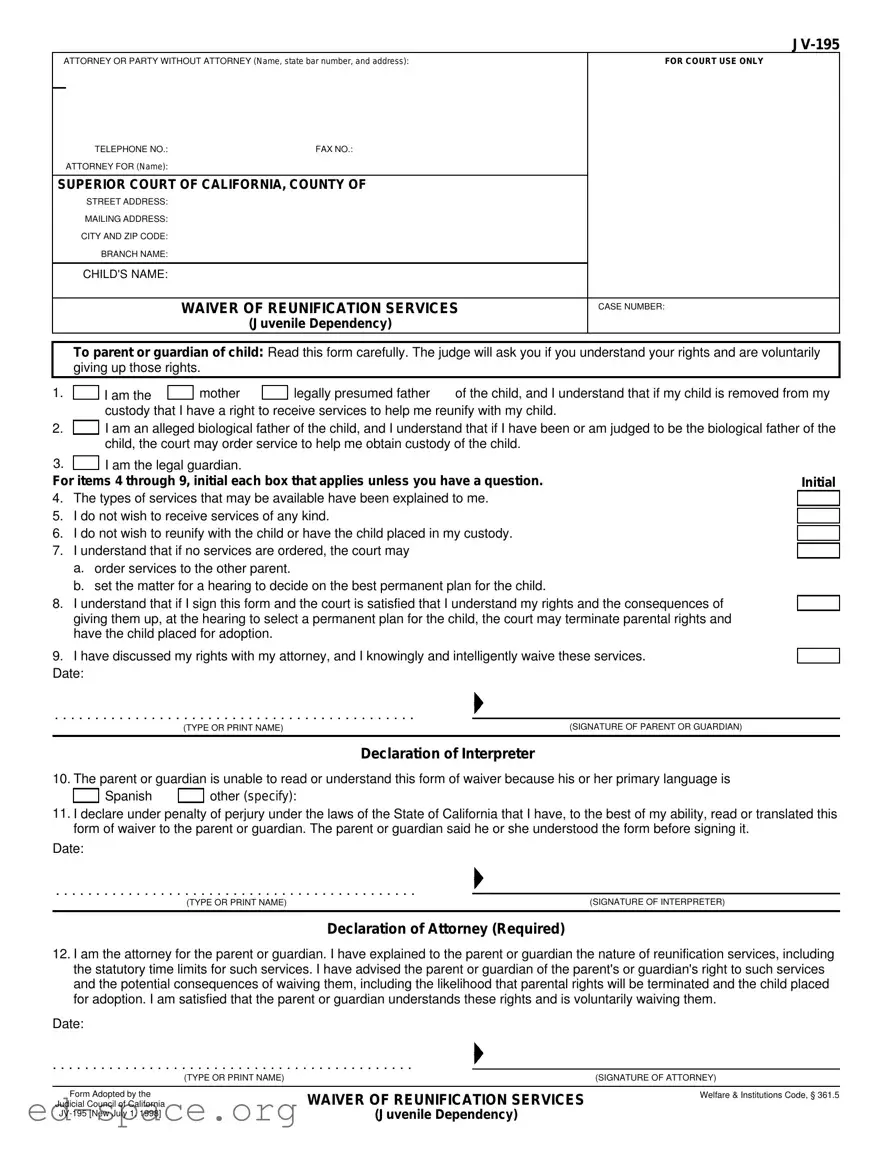
In the realm of juvenile dependency cases in California, the JV-195 form plays a crucial role for parents and guardians navigating the complex legal landscape. This form, known as the Waiver of Reunification Services, is designed to inform individuals about their rights regarding reunification services when a child is removed from their custody. It outlines the rights of the mother, presumed father, alleged biological father, and legal guardian, ensuring that each party understands the implications of waiving these services. Notably, the form requires individuals to acknowledge their understanding of the types of services that may be available and to indicate whether they wish to pursue or decline these options. By signing the JV-195, parents and guardians may be making a significant decision that could lead to the termination of their parental rights and the possibility of adoption for their child. Furthermore, the form includes sections for declarations from interpreters and attorneys, emphasizing the importance of clear communication and informed consent throughout this sensitive process. Understanding the JV-195 form is essential for anyone involved in juvenile dependency cases, as it directly impacts the future of both the child and the parent or guardian.
|
ATTORNEY OR PARTY WITHOUT ATTORNEY (Name, state bar number, and address): |
|
FOR COURT USE ONLY |
||||||||
|
|
|
TELEPHONE NO.: |
|
|
|
|
FAX NO.: |
|
|
|
|
|
|
|
|
|
|
|
|
|||
|
ATTORNEY FOR (Name): |
|
|
|
|
|
|
|
|||
|
|
|
|||||||||
SUPERIOR COURT OF CALIFORNIA, COUNTY OF |
|
|
|||||||||
|
|
|
STREET ADDRESS: |
|
|
|
|
|
|
|
|
|
|
|
MAILING ADDRESS: |
|
|
|
|
|
|
|
|
|
|
|
CITY AND ZIP CODE: |
|
|
|
|
|
|
|
|
|
|
|
|
BRANCH NAME: |
|
|
|
|
|
|
|
|
|
|
|
|
|
|
|
|
|
|
|
|
|
|
CHILD'S NAME: |
|
|
|
|
|
|
|
|
|
|
|
|
|
|
|
|
|
|
|
|
|
|
|
|
|
WAIVER OF REUNIFICATION SERVICES |
CASE NUMBER: |
|||||
|
|
|
|
|
|
||||||
|
|
|
|
|
|
|
(Juvenile Dependency) |
|
|
||
|
|
|
|
|
|
|
|
|
|
|
|
|
|
|
To parent or guardian of child: Read this form carefully. The judge will ask you if you understand your rights and are voluntarily |
||||||||
|
|
|
giving up those rights. |
|
|
|
|
|
|||
1. |
|
|
|
I am the |
|
mother |
|
|
legally presumed father |
of the child, and I understand that if my child is removed from my |
|
|
|
|
|
|
|
||||||
|
|
|
|
|
|||||||
|
|
|
|
custody that I have a right to receive services to help me reunify with my child. |
|
||||||
2.
I am an alleged biological father of the child, and I understand that if I have been or am judged to be the biological father of the child, the court may order service to help me obtain custody of the child.
3. |
|
I am the legal guardian. |
For items 4 through 9, initial each box that applies unless you have a question.
4.The types of services that may be available have been explained to me.
5.I do not wish to receive services of any kind.
6.I do not wish to reunify with the child or have the child placed in my custody.
7.I understand that if no services are ordered, the court may
a.order services to the other parent.
b.set the matter for a hearing to decide on the best permanent plan for the child.
8.I understand that if I sign this form and the court is satisfied that I understand my rights and the consequences of giving them up, at the hearing to select a permanent plan for the child, the court may terminate parental rights and have the child placed for adoption.
9.I have discussed my rights with my attorney, and I knowingly and intelligently waive these services.
Date:
Initial
. . . . . . . . . . . . . . . . . . . . . . . . . . . . . . . . . . . . . . . . . . . . .
(TYPE OR PRINT NAME) |
(SIGNATURE OF PARENT OR GUARDIAN) |
Declaration of Interpreter
10. The parent or guardian is unable to read or understand this form of waiver because his or her primary language is
Spanish
other (specify):
11.I declare under penalty of perjury under the laws of the State of California that I have, to the best of my ability, read or translated this form of waiver to the parent or guardian. The parent or guardian said he or she understood the form before signing it.
Date:
. . . . . . . . . . . . . . . . . . . . . . . . . . . . . . . . . . . . . . . . . . . . .
(TYPE OR PRINT NAME) |
(SIGNATURE OF INTERPRETER) |
|
|
Declaration of Attorney (Required)
12.I am the attorney for the parent or guardian. I have explained to the parent or guardian the nature of reunification services, including the statutory time limits for such services. I have advised the parent or guardian of the parent's or guardian's right to such services and the potential consequences of waiving them, including the likelihood that parental rights will be terminated and the child placed for adoption. I am satisfied that the parent or guardian understands these rights and is voluntarily waiving them.
Date:
. . . . . . . . . . . . . . . . . . . . . . . . . . . . . . . . . . . . . . . . . . . . .
(TYPE OR PRINT NAME) |
(SIGNATURE OF ATTORNEY) |
Form Adopted by the
Judicial Council of California
WAIVER OF REUNIFICATION SERVICES
(Juvenile Dependency)
Welfare & Institutions Code, § 361.5
| Fact Name | Description |
|---|---|
| Form Purpose | The JV-195 form is used in California for parents or guardians to waive their rights to reunification services in juvenile dependency cases. |
| Governing Law | This form is governed by the Welfare and Institutions Code, specifically § 361.5. |
| Voluntary Waiver | Parents or guardians must voluntarily waive their rights after understanding the implications of their decision. |
| Understanding Rights | The judge will inquire if the parent or guardian understands their rights before allowing the waiver. |
| Types of Services | The form includes a section where parents can acknowledge that types of reunification services have been explained to them. |
| Consequences of Waiver | By signing the form, parents may face the termination of parental rights and the possibility of the child being placed for adoption. |
| Interpreter Declaration | If the parent or guardian cannot understand the form due to language barriers, an interpreter must declare their assistance. |
| Attorney Involvement | It is required that an attorney explains the nature of reunification services and the consequences of waiving them to the parent or guardian. |
| Initialing Boxes | Parents or guardians must initial specific boxes on the form to indicate their understanding and agreement with various statements. |
| Form Adoption Date | The JV-195 form was adopted by the Judicial Council of California on July 1, 1998. |
Filling out the California JV-195 form is an essential step in the juvenile dependency process. After completing this form, it will be submitted to the court, where a judge will review it during a hearing. The judge will ensure that the parent or guardian understands their rights and the implications of waiving reunification services.
What is the purpose of the California JV-195 form?
The California JV-195 form is used to document a parent's or guardian's decision to waive their right to reunification services in juvenile dependency cases. This form ensures that individuals understand their rights regarding the potential reunification with their child and the implications of waiving those rights.
Who needs to sign the JV-195 form?
The form must be signed by the parent or guardian of the child involved in the juvenile dependency case. This includes the mother, legally presumed father, alleged biological father, or legal guardian who is making the decision regarding reunification services.
What rights does a parent or guardian give up by signing the JV-195 form?
By signing the JV-195 form, a parent or guardian waives their right to receive services aimed at helping them reunify with their child. This includes the understanding that the court may terminate parental rights and place the child for adoption if no services are ordered.
What happens if a parent or guardian does not wish to reunify with the child?
If a parent or guardian indicates that they do not wish to reunify with the child, they must acknowledge this on the form. The court may then proceed to determine the best permanent plan for the child, which could involve placing the child for adoption or offering services to the other parent.
Is legal representation required when signing the JV-195 form?
What should a parent or guardian do if they do not understand the JV-195 form?
If a parent or guardian has difficulty understanding the JV-195 form, they should seek assistance. The form includes a declaration for an interpreter, indicating that if the individual’s primary language is not English, they may require translation to fully understand their rights and the implications of the waiver.
What are the potential consequences of waiving reunification services?
Waiving reunification services can lead to serious consequences, including the termination of parental rights. If the court is satisfied that the parent or guardian understands their rights and the implications of their decision, it may proceed to finalize a permanent plan for the child, which may involve adoption.
How does the court verify understanding of the JV-195 form?
The court verifies understanding through a series of questions posed to the parent or guardian. The judge will confirm that the individual comprehends their rights and the consequences of waiving them before accepting the signed form. This process is designed to ensure informed consent.
When is the JV-195 form typically used in the court process?
The JV-195 form is typically used during juvenile dependency proceedings when a child has been removed from their home. It is part of the legal process that assesses the possibility of reunification services and the future custody of the child. Timing is crucial, as decisions made at this stage can have lasting implications for all parties involved.
Incorrectly identifying the relationship to the child: It is crucial to accurately state whether you are the mother, legally presumed father, alleged biological father, or legal guardian. Misrepresenting your relationship can lead to significant legal complications.
Failing to initial all applicable boxes: Items 4 through 9 require you to initial each box that applies to your situation. Omitting initials can result in misunderstandings about your choices and rights.
Not understanding the implications of waiving services: Many individuals do not fully grasp the consequences of giving up reunification services. It is essential to discuss these implications with an attorney before signing the form.
Neglecting to confirm language comprehension: If the parent or guardian's primary language is not English, it is vital to ensure that they understand the form. An interpreter should be utilized if necessary, and this must be documented appropriately.
Skipping the attorney's declaration: The attorney must declare that they have explained the nature of reunification services and the potential consequences of waiving them. This step is not just formal; it protects the rights of the parent or guardian.
The California JV-195 form is a critical document in juvenile dependency cases, specifically addressing the waiver of reunification services. Several other forms and documents are often used in conjunction with this form to ensure that all legal requirements are met and that the rights of the parties involved are upheld. Below is a list of these documents, along with brief descriptions of their purposes.
Understanding these additional forms is essential for navigating the juvenile dependency process. Each document serves a specific function that contributes to the overall legal framework surrounding child custody and parental rights. Proper completion and submission of these forms can significantly impact the outcomes for children and families involved in such cases.
The California JV-195 form, which is a waiver of reunification services in juvenile dependency cases, shares similarities with several other legal documents. Here’s a look at five of them:
Each of these documents emphasizes the importance of informed consent and understanding the potential consequences of relinquishing parental rights or services. They serve as critical tools in ensuring that parents are aware of their legal standing and the implications of their decisions.
When filling out the California JV-195 form, it’s important to follow certain guidelines to ensure that the process goes smoothly. Below is a list of things you should and shouldn’t do.
Following these guidelines can help ensure that your rights are protected and that the process is as clear as possible.
Understanding the California JV-195 form is crucial for parents or guardians involved in juvenile dependency cases. However, several misconceptions can lead to confusion. Here’s a breakdown of seven common myths about this important document:
By debunking these misconceptions, parents and guardians can approach the JV-195 form with greater confidence and clarity. Understanding the nuances of this document is key to navigating the juvenile dependency system effectively.
The California JV-195 form is a legal document used in juvenile dependency cases. It serves as a waiver of reunification services for parents or guardians of a child. Here are key takeaways regarding its use and completion:
Completion of the JV-195 form is a significant step in the juvenile dependency process. Individuals should ensure they fully understand the implications of their decisions.