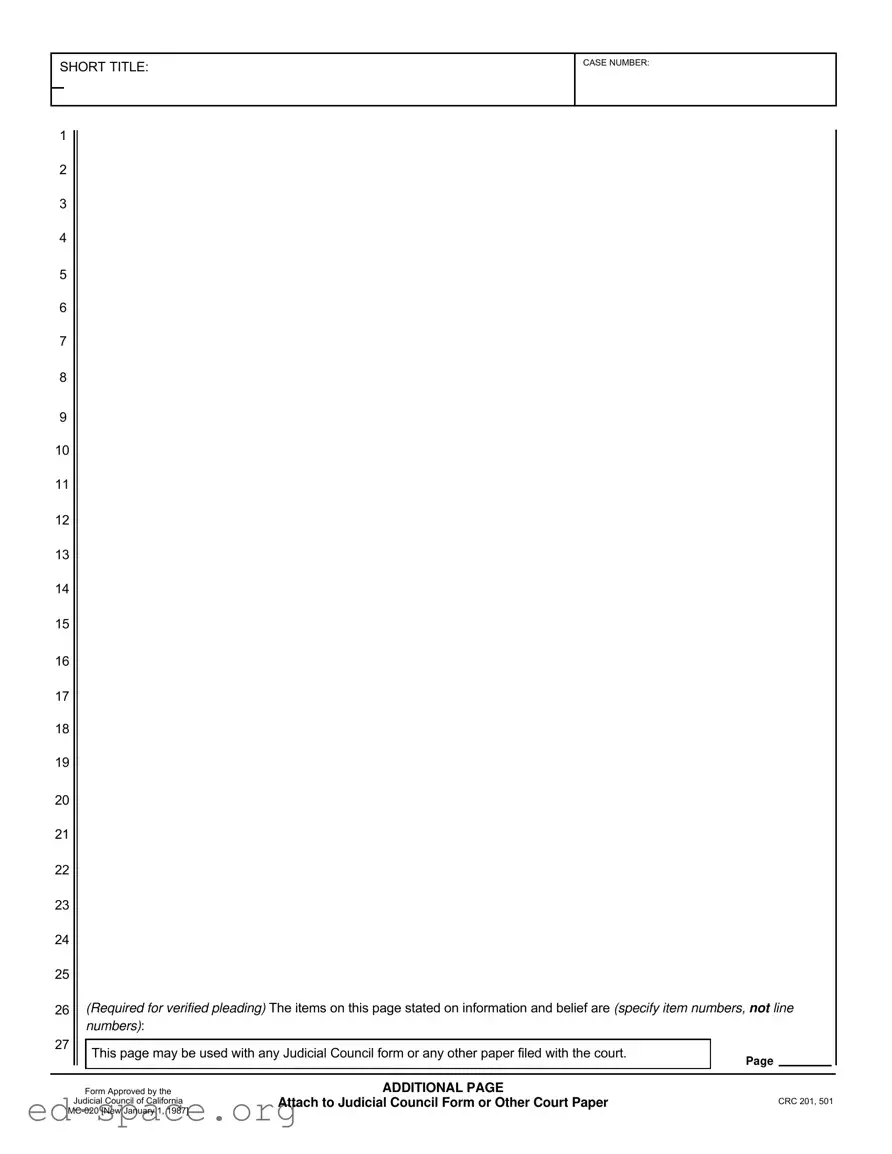
The California Judicial Council form serves as a crucial tool in the legal process, providing a standardized format that streamlines court filings and ensures consistency across various cases. This form includes essential elements such as a short title and case number, which help identify the specific legal matter at hand. Additionally, it allows users to specify item numbers, enabling them to present information clearly and effectively. The form is designed to be versatile, as it can be used in conjunction with any Judicial Council form or other court documents, ensuring that individuals can easily attach additional pages as needed. Approved by the Judicial Council of California, this form has been in use since January 1, 1987, reflecting a long-standing commitment to improving access to justice. Understanding how to properly utilize this form can significantly enhance the clarity and organization of legal submissions, making it an indispensable resource for anyone navigating the California court system.

SHORT TITLE:
CASE NUMBER:
1
2
3
4
5
6
7
8
9
10
11
12
13
14
15
16
17
18
19
20
21
22
23
24
25
26
27
(Required for verified pleading) The items on this page stated on information and belief are (specify item numbers, NOT line
numbers):
This page may be used with any Judicial Council form or any other paper filed with the court. |
Page |
|
Form Approved by the
Judicial Council of California
ADDITIONAL PAGE
Attach to Judicial Council Form or Other Court Paper
CRC 201, 501
| Fact Name | Description |
|---|---|
| Short Title | This form includes a section for the short title of the case, which helps identify the legal matter at hand. |
| Case Number | A designated area is provided for the case number, essential for tracking and referencing the case in court. |
| Verification Requirement | The form states that it is required for verified pleadings, ensuring that the information presented is truthful and accurate. |
| Usage Flexibility | This page can be attached to any Judicial Council form or other court documents, providing versatility in legal filings. |
| Governing Laws | The form is governed by California Rules of Court, specifically CRC 201 and 501, which outline procedural requirements. |
After you have gathered the necessary information, you can begin filling out the California Judicial Council form. It’s important to provide accurate details, as this will help ensure that your submission is processed smoothly.
Once you have filled out the form, you will be ready to file it with the court. Make sure to keep copies for your records. Submitting your form accurately will help facilitate the next steps in your legal process.
What is the California Judicial Council form?
The California Judicial Council form is a standardized document used in California courts. It helps streamline the legal process by providing a consistent format for various types of filings. This form can be used in conjunction with other court papers, ensuring that all necessary information is presented clearly and uniformly.
When should I use this form?
You should use the California Judicial Council form whenever you need to submit additional information or details related to a case. It is particularly useful when filing verified pleadings, as it allows you to specify item numbers based on your case requirements.
What information do I need to provide on the form?
The form requires a short title for your case and a case number. Additionally, you must specify item numbers based on the information you are providing. This information should be stated on the form based on your knowledge and belief regarding the case.
Can I attach this form to other documents?
Yes, you can attach the California Judicial Council form to any Judicial Council form or other court papers you are filing. This flexibility allows you to provide supplementary information in a structured manner, which can be beneficial for clarity and organization.
Is there a specific date when this form was approved?
The California Judicial Council form was approved for use on January 1, 1987. While it has been in use for many years, it is still relevant today for various legal proceedings in California courts.
What does "required for verified pleading" mean?
This phrase indicates that the form is necessary when submitting a verified pleading. A verified pleading is a legal document that includes a declaration or affirmation that the information contained within it is true to the best of the filer’s knowledge. The Judicial Council form helps ensure that this verification is properly documented.
What does “items stated on information and belief” refer to?
This phrase refers to the items you are providing based on your understanding or belief about the case. It allows you to present information that you may not have direct evidence for but believe to be true. This is common in legal proceedings where certain facts are based on personal knowledge or reasonable assumptions.
Are there any rules regarding the format of this form?
Yes, the form must comply with California Rules of Court, specifically rules 201 and 501. These rules outline the formatting and content requirements for court documents, ensuring that they are presented in a clear and professional manner.
How do I obtain this form?
You can obtain the California Judicial Council form from the California Judicial Council's website or your local court's website. Many courts also provide physical copies of the form in their clerk's offices, making it accessible for individuals filing documents in person.
Is there a fee associated with filing this form?
Generally, there is no fee specifically for filing the California Judicial Council form itself. However, if you are submitting it as part of a larger filing, there may be associated fees based on the type of case or documents being submitted. It's always a good idea to check with the court for any applicable fees.
Failing to include a short title for the case. This is essential for identifying your case in court documents.
Not providing the correct case number. Double-check this number to avoid confusion and ensure your documents are processed correctly.
Leaving item numbers blank. Each item must be specified clearly. Items should be numbered correctly, not referenced by line numbers.
Using the form without attaching an additional page when necessary. If you need more space, ensure that you attach the additional page properly.
Ignoring the requirement for a verified pleading. Make sure you understand what this entails, as it is crucial for the validity of your submission.
Not following the proper format as outlined by the Judicial Council of California. Adhering to the format ensures your documents are accepted without delays.
When navigating the legal process in California, it is often necessary to accompany the California Judicial Council form with additional documents. Each of these forms serves a specific purpose and can help clarify or support your case. Below is a list of commonly used forms that may be relevant.
Each of these documents plays an important role in the legal process. Understanding their purpose and how they relate to the California Judicial Council form can help ensure that your case is presented clearly and effectively in court.
The California Judicial Council form MC-020 serves as a crucial document in legal proceedings. Several other documents share similarities with this form in terms of purpose and structure. Below is a list of six such documents:
When filling out the California Judicial Council form, it is important to approach the task with care and attention to detail. Here are some key dos and don'ts to keep in mind:
By following these guidelines, you can help ensure that your form is completed correctly and efficiently. Taking the time to do it right will save you from potential setbacks in your case.
Here are five misconceptions about the California Judicial Council form:
When dealing with the California Judicial Council form, it’s essential to be thorough and accurate. Here are some key takeaways to keep in mind:
Filling out the California Judicial Council form correctly can significantly impact your case. Stay organized, be diligent, and ensure you meet all requirements.