In California, the Independent Contractor Agreement form plays a crucial role in defining the working relationship between businesses and independent contractors. This document outlines the terms and conditions under which services will be provided, ensuring that both parties have a clear understanding of their rights and responsibilities. Key components of the form include the scope of work, payment terms, and deadlines, which help to establish expectations and accountability. Additionally, it addresses issues such as confidentiality, intellectual property rights, and termination clauses, providing legal protection to both the contractor and the hiring entity. By clarifying the nature of the engagement, this agreement helps to mitigate disputes and fosters a professional environment. As California continues to evolve its labor laws, particularly with the introduction of AB 5, understanding the nuances of this form becomes increasingly important for both businesses and independent contractors navigating the gig economy.
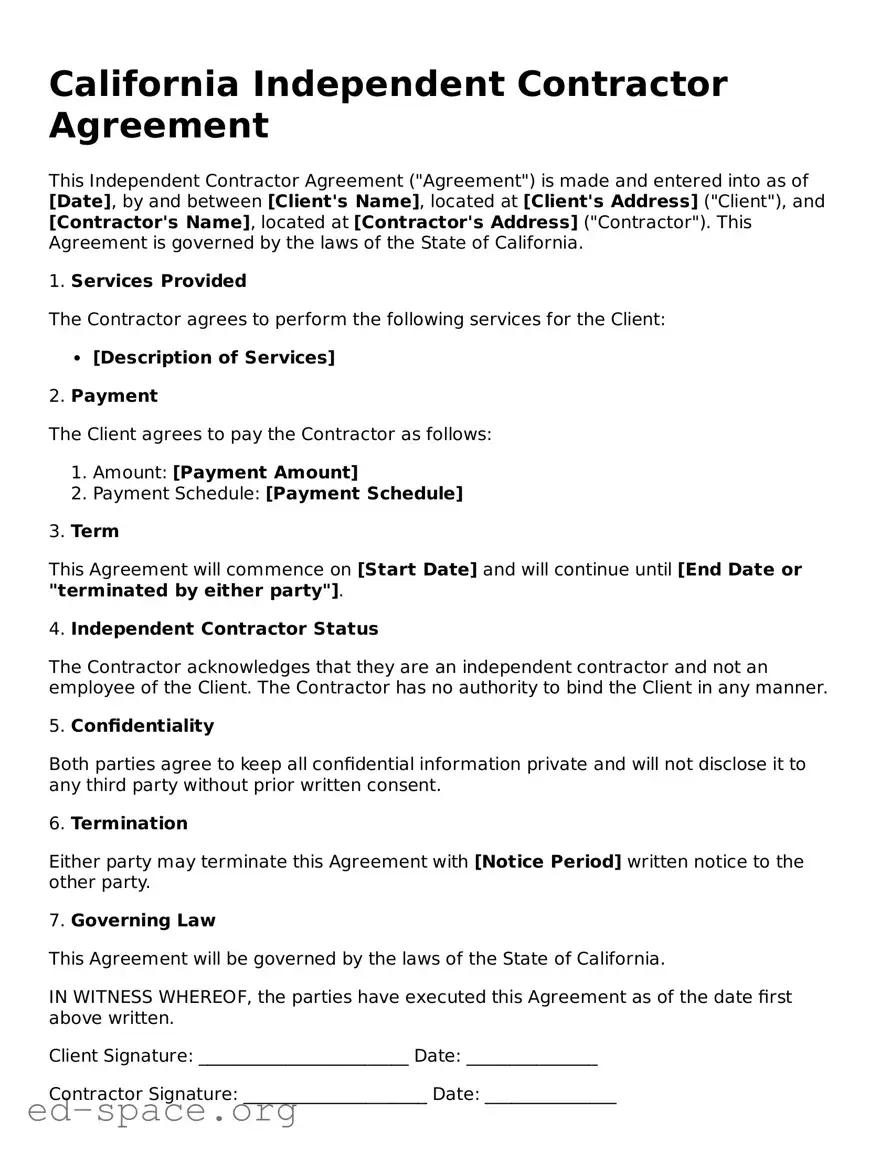
California Independent Contractor Agreement
This Independent Contractor Agreement ("Agreement") is made and entered into as of [Date], by and between [Client's Name], located at [Client's Address] ("Client"), and [Contractor's Name], located at [Contractor's Address] ("Contractor"). This Agreement is governed by the laws of the State of California.
1. Services Provided
The Contractor agrees to perform the following services for the Client:
2. Payment
The Client agrees to pay the Contractor as follows:
3. Term
This Agreement will commence on [Start Date] and will continue until [End Date or "terminated by either party"].
4. Independent Contractor Status
The Contractor acknowledges that they are an independent contractor and not an employee of the Client. The Contractor has no authority to bind the Client in any manner.
5. Confidentiality
Both parties agree to keep all confidential information private and will not disclose it to any third party without prior written consent.
6. Termination
Either party may terminate this Agreement with [Notice Period] written notice to the other party.
7. Governing Law
This Agreement will be governed by the laws of the State of California.
IN WITNESS WHEREOF, the parties have executed this Agreement as of the date first above written.
Client Signature: ________________________ Date: _______________
Contractor Signature: _____________________ Date: _______________
| Fact Name | Description |
|---|---|
| Definition | The California Independent Contractor Agreement outlines the terms between a business and an independent contractor, specifying the nature of the work and payment terms. |
| Governing Law | This agreement is governed by California state law, particularly under the California Labor Code and relevant case law. |
| Key Components | Essential elements include the scope of work, payment details, confidentiality clauses, and termination conditions. |
| Importance | Having a clear agreement helps protect both parties, ensuring that expectations are set and legal rights are maintained. |
Completing the California Independent Contractor Agreement form is a straightforward process that requires careful attention to detail. Once you have gathered the necessary information, you will be ready to proceed with filling out the form accurately.
With these steps completed, you will have filled out the California Independent Contractor Agreement form correctly. Make sure to keep a copy for your records and provide one to the contractor or hiring entity as needed.
What is a California Independent Contractor Agreement?
A California Independent Contractor Agreement is a legal document that outlines the terms of the working relationship between a business and an independent contractor. This agreement clarifies the scope of work, payment terms, and the responsibilities of both parties. It helps protect the interests of both the contractor and the hiring entity by setting clear expectations and reducing the risk of misunderstandings.
Why is it important to have an Independent Contractor Agreement in California?
Having an Independent Contractor Agreement is crucial in California due to the state's specific laws regarding employment classification. Without a formal agreement, there may be confusion over whether a worker is classified as an independent contractor or an employee. Misclassification can lead to legal issues, including penalties and back taxes. A well-drafted agreement helps ensure compliance with state laws and protects both parties from potential disputes.
What should be included in a California Independent Contractor Agreement?
Key components of a California Independent Contractor Agreement include the names of both parties, a detailed description of the services to be provided, payment terms, deadlines, and confidentiality clauses. Additionally, it should address intellectual property rights, termination conditions, and any required licenses or permits. Including these elements creates a comprehensive framework for the working relationship and minimizes potential conflicts.
Can an Independent Contractor Agreement be modified after it is signed?
Yes, an Independent Contractor Agreement can be modified after it is signed, but both parties must agree to the changes. It's important to document any amendments in writing to avoid confusion in the future. Verbal agreements or informal changes may not hold up in court if a dispute arises. Always ensure that modifications are clear and mutually accepted to maintain a professional relationship.
Neglecting to Specify Services: One common mistake is failing to clearly outline the specific services the contractor will provide. This lack of detail can lead to misunderstandings and disputes later on.
Incorrect Classification: Misclassifying a worker as an independent contractor instead of an employee can have serious legal and financial consequences. It's essential to understand the criteria that distinguish the two roles.
Omitting Payment Terms: Not including clear payment terms can create confusion. It’s important to specify how much the contractor will be paid, when payments will be made, and the method of payment.
Ignoring Tax Obligations: Failing to address tax responsibilities is a frequent oversight. Both parties should understand their tax obligations, including whether the contractor is responsible for self-employment taxes.
Not Defining the Duration of the Agreement: Leaving out the start and end dates of the agreement can lead to uncertainty. Clearly stating the duration helps both parties understand the timeline of the work.
Overlooking Confidentiality Clauses: Some individuals forget to include confidentiality provisions. If sensitive information will be shared, it’s crucial to protect that information through appropriate clauses.
Failing to Include Termination Conditions: Not specifying how either party can terminate the agreement can lead to complications. Clear termination conditions provide a way to end the agreement amicably if needed.
Not Seeking Legal Review: Many people skip having the agreement reviewed by a legal professional. A legal review can help identify potential issues and ensure compliance with applicable laws.
When engaging independent contractors in California, several key documents often accompany the Independent Contractor Agreement. These documents help clarify the relationship, outline responsibilities, and ensure compliance with legal standards. Below is a list of commonly used forms and documents.
Utilizing these documents alongside the Independent Contractor Agreement can help establish a clear and professional relationship between the contractor and the business. Each document plays a vital role in ensuring that both parties understand their rights and responsibilities, ultimately contributing to a smoother collaboration.
When filling out the California Independent Contractor Agreement form, it's essential to approach the task with care. Here’s a helpful list of things to do and avoid to ensure a smooth process.
By following these guidelines, you can help create a clear and effective Independent Contractor Agreement that protects both parties involved.
Understanding the California Independent Contractor Agreement form is essential for both businesses and independent contractors. However, several misconceptions often arise. Here are ten common misunderstandings about this form:
Being aware of these misconceptions can help both businesses and independent contractors navigate their relationships more effectively. Clarity in understanding the terms and conditions of the agreement is crucial for a successful partnership.
Filling out and using the California Independent Contractor Agreement form is an important step for both businesses and independent contractors. Here are some key takeaways to keep in mind: