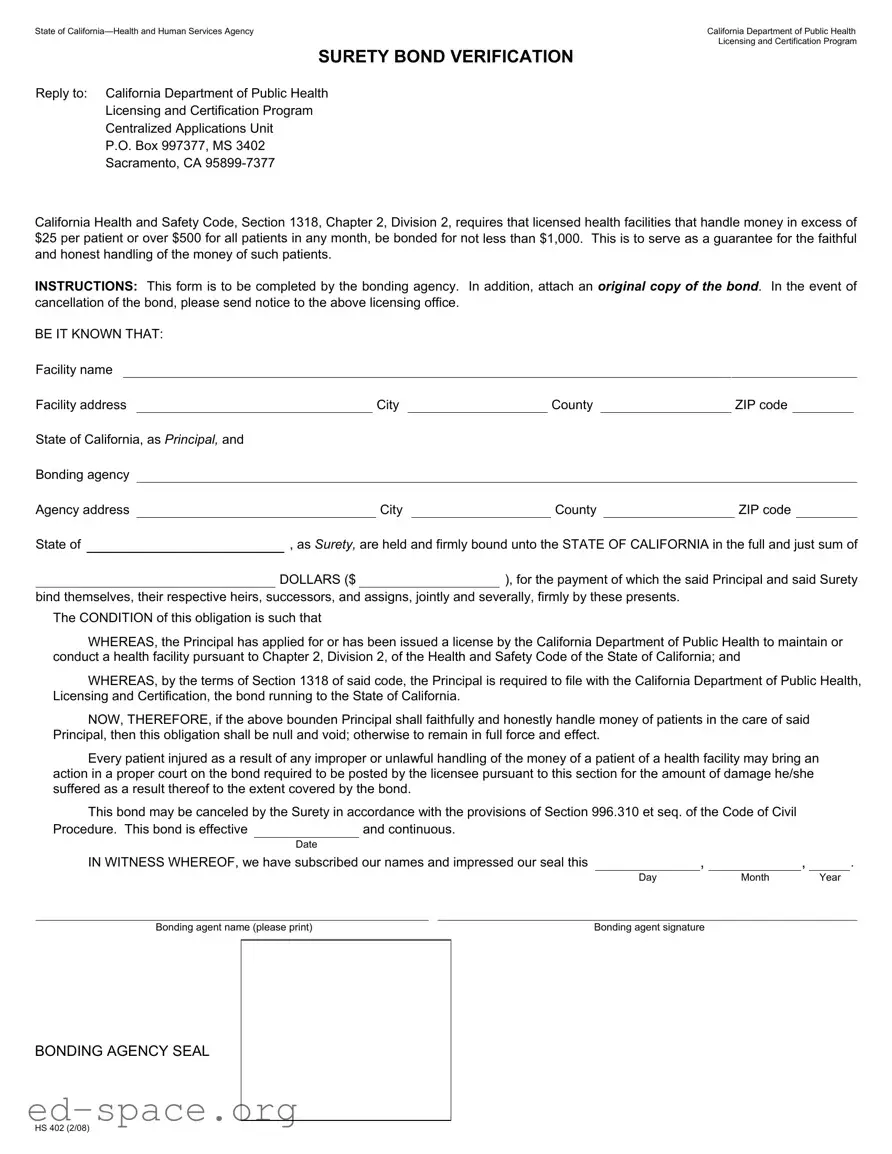
The California HS 402 form plays a crucial role in the regulatory framework governing health facilities within the state. Designed for licensed health facilities that manage significant amounts of patient funds, this form ensures compliance with the California Health and Safety Code, specifically Section 1318. Facilities that handle more than $25 per patient or exceed $500 in total patient funds within a month must secure a surety bond of at least $1,000. This bond acts as a financial guarantee, safeguarding the proper handling of patient money. The form must be filled out by the bonding agency and requires the attachment of an original copy of the bond. In the event that the bond is canceled, it is essential for the bonding agency to notify the California Department of Public Health's Licensing and Certification Program. The HS 402 form includes critical information such as the facility's name and address, the bonding agency's details, and the specific amount of the bond. It also outlines the conditions under which the bond remains in effect, emphasizing the obligation of the facility to manage patient funds honestly and responsibly. If a patient suffers financial harm due to improper handling of their money, they have the right to seek compensation through legal action against the bond. This form is not just a bureaucratic requirement; it serves as a protective measure for patients, ensuring that their funds are managed with integrity and accountability.

State of |
California Department of Public Health |
|
Licensing and Certification Program |
SURETY BOND VERIFICATION
Reply to: California Department of Public Health
Licensing and Certification Program
Centralized Applications Unit
P.O. Box 997377, MS 3402
Sacramento, CA
California Health and Safety Code, Section 1318, Chapter 2, Division 2, requires that licensed health facilities that handle money in excess of $25 per patient or over $500 for all patients in any month, be bonded for not less than $1,000. This is to serve as a guarantee for the faithful and honest handling of the money of such patients.
INSTRUCTIONS: This form is to be completed by the bonding agency. In addition, attach an original copy of the bond. In the event of cancellation of the bond, please send notice to the above licensing office.
BE IT KNOWN THAT:
Facility name
Facility address |
|
|
|
|
|
City |
|
|
|
|
County |
|
|
ZIP code |
|
|
|||
State of California, as Principal, and |
|
|
|
|
|
|
|
|
|
|
|
|
|
|
|
|
|
||
Bonding agency |
|
|
|
|
|
|
|
|
|
|
|
|
|
|
|
|
|
|
|
Agency address |
|
|
|
|
|
City |
|
|
|
|
County |
|
|
ZIP code |
|
||||
State of |
|
|
, as Surety, are held and firmly bound unto the STATE OF CALIFORNIA in the full and just sum of |
||||||||||||||||
|
|
|
DOLLARS ($ |
|
|
|
), for the payment of which the said Principal and said Surety |
||||||||||||
bind themselves, their respective heirs, successors, and assigns, jointly and severally, firmly by these presents. |
|
|
|
|
|
||||||||||||||
The CONDITION of this obligation is such that |
|
|
|
|
|
|
|
|
|
|
|
|
|||||||
WHEREAS, the Principal has applied for or has been issued a license by the California Department of Public Health to maintain or conduct a health facility pursuant to Chapter 2, Division 2, of the Health and Safety Code of the State of California; and
WHEREAS, by the terms of Section 1318 of said code, the Principal is required to file with the California Department of Public Health, Licensing and Certification, the bond running to the State of California.
NOW, THEREFORE, if the above bounden Principal shall faithfully and honestly handle money of patients in the care of said Principal, then this obligation shall be null and void; otherwise to remain in full force and effect.
Every patient injured as a result of any improper or unlawful handling of the money of a patient of a health facility may bring an action in a proper court on the bond required to be posted by the licensee pursuant to this section for the amount of damage he/she suffered as a result thereof to the extent covered by the bond.
This bond may be canceled by the Surety in accordance with the provisions of Section 996.310 et seq. of the Code of Civil |
|
|
|
|||||||
Procedure. This bond is effective |
and continuous. |
|
|
|
|
|
|
|||
|
Date |
|
|
|
|
|
|
|
|
|
IN WITNESS WHEREOF, we have subscribed our names and impressed our seal this |
|
, |
|
, |
|
. |
||||
|
|
|
|
|
Day |
Month |
|
Year |
||
|
|
|
|
|
|
|
|
|
||
Bonding agent name (please print) |
|
|
|
Bonding agent signature |
|
|
|
|
||
BONDING AGENCY SEAL
HS 402 (2/08)
| Fact Name | Details |
|---|---|
| Purpose of the Form | The California HS 402 form is used for surety bond verification for licensed health facilities that handle significant amounts of patient money. |
| Legal Requirement | According to the California Health and Safety Code, Section 1318, health facilities must be bonded for at least $1,000 if they handle more than $25 per patient or over $500 total in a month. |
| Bonding Agency's Role | The bonding agency must complete the form and attach an original copy of the bond, ensuring compliance with the state's regulations. |
| Cancellation Notice | If the bond is canceled, the bonding agency is required to notify the California Department of Public Health Licensing and Certification Program. |
Completing the California HS 402 form is essential for health facilities that manage patient funds. This process requires careful attention to detail to ensure compliance with state regulations. Below are the steps to fill out the form accurately.
Once the form is completed, attach an original copy of the bond and send the entire package to the California Department of Public Health Licensing and Certification Program. Ensure that any changes, such as bond cancellation, are communicated to the licensing office promptly.
What is the purpose of the California HS 402 form?
The California HS 402 form serves as a surety bond verification for licensed health facilities. It ensures that these facilities, which handle significant amounts of patient money, are financially responsible and can guarantee the honest handling of funds. This requirement is mandated by the California Health and Safety Code, specifically Section 1318.
Who is required to complete the HS 402 form?
Licensed health facilities that manage money exceeding $25 per patient or over $500 for all patients in any month must complete the HS 402 form. This includes various types of health facilities that provide care and manage patient funds.
What information must be included on the HS 402 form?
The form must include the facility name, address, and the name and address of the bonding agency. Additionally, it requires the amount of the bond, which must be no less than $1,000, and a declaration that the facility will handle patient money faithfully and honestly.
What happens if a facility fails to comply with the bonding requirement?
If a facility does not comply with the bonding requirement, it may face penalties, including the potential revocation of its license. Moreover, patients may have grounds to take legal action if they suffer damages due to improper handling of their funds.
How does a patient file a claim related to the bond?
A patient who believes they have been harmed due to improper handling of their money can file a claim in a proper court against the bond. This claim is intended to recover damages suffered as a result of the facility's actions, up to the extent covered by the bond.
What should be done in the event of a bond cancellation?
If the surety decides to cancel the bond, they must notify the California Department of Public Health Licensing and Certification Program. This notification is crucial to ensure that the licensing agency is aware of the change in the bond status.
Is the bond continuous, and how long does it remain in effect?
Yes, the bond is considered effective and continuous. It remains in force until it is canceled by the surety or until the licensing agency takes action to revoke the facility's license. This ongoing obligation is designed to protect patients consistently.
Omitting Required Information: Failing to provide complete details such as the facility name, address, and the bonding agency's information can lead to delays or rejection of the form.
Incorrect Bond Amount: Entering an incorrect bond amount can create compliance issues. Ensure the bond amount meets the minimum requirement of $1,000.
Not Signing the Form: Both the bonding agent and the principal must sign the form. Missing signatures can invalidate the bond.
Failing to Attach the Bond: The form requires an original copy of the bond. Not including this document is a common oversight.
Incorrectly Filling Out Dates: Ensure that all dates are accurate and formatted correctly. Incorrect dates can lead to confusion regarding the bond's validity.
Not Notifying of Bond Cancellation: If the bond is canceled, the bonding agency must notify the licensing office. Failure to do so can result in penalties.
Ignoring Instructions: The instructions provided with the form are crucial. Ignoring them can result in incomplete submissions.
Using Outdated Forms: Ensure that the most recent version of the HS 402 form is being used. Using outdated forms can lead to processing issues.
Inaccurate Information on the Bond: The bond must accurately reflect the details of the facility and the bonding agency. Any discrepancies can lead to complications.
The California HS 402 form is a crucial document for licensed health facilities in California that handle patient funds. It serves as a surety bond verification, ensuring that these facilities manage patient money responsibly. Alongside the HS 402, several other forms and documents are commonly utilized in the healthcare licensing process. Below is a list of these documents, each described briefly for clarity.
These documents play a vital role in maintaining the integrity and accountability of health facilities in California. Proper management of these forms ensures compliance with state laws and protects the interests of patients. Understanding each document's purpose is essential for facility operators and stakeholders involved in healthcare management.
The California HS 402 form is a document that verifies a surety bond for licensed health facilities handling patient money. Several other documents serve similar purposes in various contexts. Here’s a list of nine documents that share similarities with the HS 402 form:
Each of these documents serves to protect parties involved by ensuring that financial responsibilities are met and legal obligations are fulfilled, much like the California HS 402 form does for health facilities handling patient funds.
When filling out the California HS 402 form, it's important to follow certain guidelines. Here are ten things to keep in mind:
Following these tips can help ensure that the form is filled out correctly and processed without delays.
Misconceptions about the California HS 402 form can lead to confusion among health facility operators and bonding agencies. Here are four common misunderstandings:
When dealing with the California HS 402 form, it is essential to understand its purpose and the necessary steps for completion. Here are some key takeaways:
Understanding these key points will help ensure that the HS 402 form is completed correctly and serves its intended purpose of protecting patients' financial interests.