Homepage Free Horse Bill of Sale Form for California
Content Overview

When buying or selling a horse in California, having a Horse Bill of Sale form is essential for both parties involved in the transaction. This document serves as a legal record of the sale and outlines important details that protect the rights of the buyer and seller. Key components of the form include the names and addresses of both parties, a description of the horse being sold, and the sale price. Additionally, the form may include information about any warranties or representations made by the seller regarding the horse's health and condition. It is crucial to ensure that the Horse Bill of Sale is completed accurately, as this not only facilitates a smooth transfer of ownership but also helps prevent potential disputes in the future. Understanding the significance of this document can provide peace of mind and clarity for all involved, making the process of equine transactions more straightforward and legally sound.

Document Preview

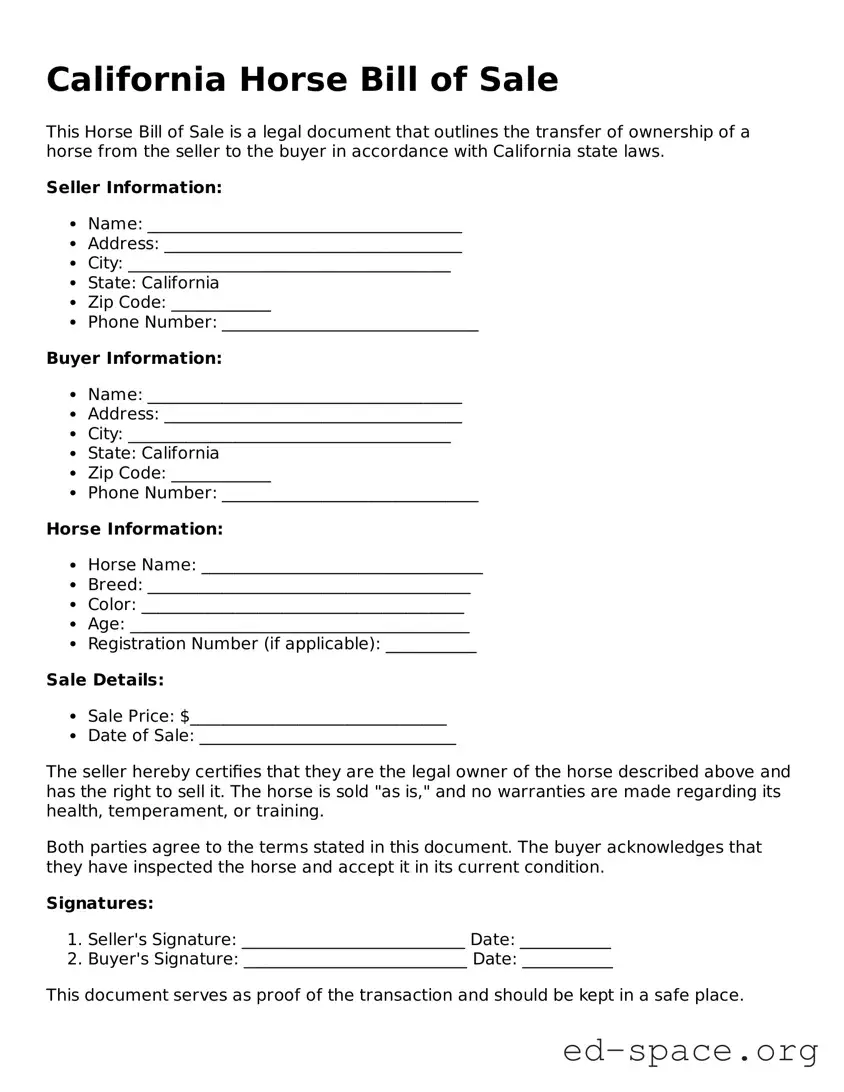
California Horse Bill of Sale

This Horse Bill of Sale is a legal document that outlines the transfer of ownership of a horse from the seller to the buyer in accordance with California state laws.

Seller Information:

  • Name: ______________________________________
  • Address: ____________________________________
  • City: _______________________________________
  • State: California
  • Zip Code: ____________
  • Phone Number: _______________________________

Buyer Information:

  • Name: ______________________________________
  • Address: ____________________________________
  • City: _______________________________________
  • State: California
  • Zip Code: ____________
  • Phone Number: _______________________________

Horse Information:

  • Horse Name: __________________________________
  • Breed: _______________________________________
  • Color: _______________________________________
  • Age: _________________________________________
  • Registration Number (if applicable): ___________

Sale Details:

  • Sale Price: $_______________________________
  • Date of Sale: _______________________________

The seller hereby certifies that they are the legal owner of the horse described above and has the right to sell it. The horse is sold "as is," and no warranties are made regarding its health, temperament, or training.

Both parties agree to the terms stated in this document. The buyer acknowledges that they have inspected the horse and accept it in its current condition.

Signatures:

  1. Seller's Signature: ___________________________ Date: ___________
  2. Buyer's Signature: ___________________________ Date: ___________

This document serves as proof of the transaction and should be kept in a safe place.

PDF Form Details

Fact Name Description
Purpose The California Horse Bill of Sale form serves as a legal document to transfer ownership of a horse from one party to another.
Governing Law This form is governed by the California Civil Code, specifically sections related to the sale of personal property.
Required Information Essential details include the names and addresses of both the buyer and seller, a description of the horse, and the sale price.
Signatures Both the buyer and seller must sign the form to validate the transaction, indicating their agreement to the terms outlined.
Record Keeping It is advisable for both parties to retain a copy of the completed Bill of Sale for their records, as it may be needed for future reference or disputes.

California Horse Bill of Sale: Usage Guidelines

When preparing to complete the California Horse Bill of Sale form, it's important to gather all necessary information about the horse and the transaction. This will ensure that the form is filled out accurately and completely, facilitating a smooth transfer of ownership.

  1. Begin by entering the date of the sale at the top of the form.
  2. Provide the seller's name and contact information. This should include the address, phone number, and email address.
  3. Next, fill in the buyer's name and contact information, mirroring the details provided for the seller.
  4. Describe the horse being sold. Include the horse's name, breed, age, color, and any identifying marks or registration numbers.
  5. Indicate the sale price of the horse. This should be a clear and accurate figure.
  6. Both the seller and buyer should sign and date the form to confirm the transaction.
  7. Finally, provide any additional notes or terms of the sale in the designated area, if necessary.

Your Questions, Answered

What is a California Horse Bill of Sale form?

The California Horse Bill of Sale form is a legal document used to record the sale of a horse in the state of California. This form provides essential details about the transaction, including the names and addresses of both the buyer and seller, a description of the horse, and the sale price. It serves as proof of ownership transfer and can be important for future reference, especially for registration or health records.

What information is required on the form?

When completing the California Horse Bill of Sale form, certain information is necessary. This includes the full names and addresses of both the seller and the buyer. A detailed description of the horse, including its breed, age, color, and any identifying marks, is also required. Additionally, the sale price must be clearly stated. Both parties should sign and date the form to validate the transaction.

Is the Horse Bill of Sale form legally binding?

Yes, the California Horse Bill of Sale form is a legally binding document once it is signed by both the buyer and the seller. It acts as evidence of the sale and the transfer of ownership. While it is not required to be notarized, having a witness or notary public can add an extra layer of credibility to the document, should any disputes arise in the future.

Do I need a Horse Bill of Sale if I am giving a horse as a gift?

Common mistakes

  1. Incomplete Information: One common mistake is not filling out all required fields. Buyers and sellers must provide complete details, including names, addresses, and contact information. Leaving any section blank can lead to confusion or disputes later on.

  2. Incorrect Horse Description: Providing an inaccurate description of the horse can cause issues. This includes details such as breed, age, color, and any identifying marks. A precise description is crucial for identifying the horse in question.

  3. Failure to Sign: Both parties must sign the bill of sale for it to be valid. A common oversight is forgetting to obtain signatures from both the buyer and seller. Without these signatures, the document may not hold up in case of a dispute.

  4. Not Including Sale Price: Omitting the sale price is another mistake. The bill of sale should clearly state the amount paid for the horse. This information is important for record-keeping and potential tax implications.

  5. Ignoring Additional Terms: Some buyers and sellers neglect to include any additional terms or conditions of the sale. If there are warranties, health guarantees, or payment plans, these should be clearly outlined in the document.

  6. Not Keeping Copies: After completing the bill of sale, it is essential to keep copies for both parties. Failing to do so can lead to issues if questions arise later regarding the transaction.

Documents used along the form

When engaging in the sale or purchase of a horse in California, several additional forms and documents may be necessary to ensure a smooth transaction. Each of these documents serves a specific purpose and can help protect the interests of both the buyer and seller.

  • Horse Health Certificate: This document certifies that the horse has been examined by a veterinarian and is free from contagious diseases. It is often required for transportation and can provide peace of mind to the buyer.
  • Equine Registration Papers: If the horse is registered with a breed association, these papers prove the horse's pedigree and can affect its value. Buyers may want to verify the registration status before completing the sale.
  • Bill of Sale for Equipment: If any equipment, such as saddles or trailers, is included in the sale, a separate bill of sale for these items can clarify ownership and terms of the sale.
  • Transfer of Ownership Form: This form is often required by breed registries to officially transfer ownership of the horse from the seller to the buyer. Completing this form is crucial for maintaining accurate records.
  • Liability Waiver: This document can protect the seller from liability for injuries or damages that may occur after the sale. It outlines the responsibilities of the buyer and can be an important legal safeguard.
  • Purchase Agreement: This contract outlines the terms of the sale, including price, payment method, and any contingencies. Having a written agreement helps prevent misunderstandings and provides a reference for both parties.

Using these documents in conjunction with the California Horse Bill of Sale can facilitate a more secure and legally sound transaction. It is advisable to ensure that all necessary paperwork is completed accurately to avoid potential disputes in the future.

Similar forms

  • Vehicle Bill of Sale: Similar to a Horse Bill of Sale, this document serves as proof of ownership transfer for vehicles. It includes details about the buyer, seller, and the vehicle itself.
  • Boat Bill of Sale: This document is used when transferring ownership of a boat. Like the Horse Bill of Sale, it outlines the specifics of the transaction and identifies the parties involved.
  • Real Estate Purchase Agreement: This legal document formalizes the sale of real property. It shares similarities with the Horse Bill of Sale in that both require clear identification of the property and terms of sale.
  • Pet Bill of Sale: When adopting or selling a pet, this document serves as proof of ownership transfer. It includes details about the pet and the transaction, much like the Horse Bill of Sale.
  • Equipment Bill of Sale: Used for the sale of equipment, this document outlines the specifics of the equipment and the terms of sale, paralleling the Horse Bill of Sale's purpose.
  • Motorcycle Bill of Sale: This document serves to transfer ownership of a motorcycle, including details about the buyer, seller, and the motorcycle, akin to the Horse Bill of Sale.
  • Business Asset Bill of Sale: When selling business assets, this document details the assets being sold and the terms of the sale, similar to how a Horse Bill of Sale functions.
  • Mobile Home Bill of Sale: This document is used to transfer ownership of a mobile home, including essential details about the home and the parties involved, much like the Horse Bill of Sale.
  • Art Bill of Sale: When art is sold, this document serves as proof of ownership transfer, detailing the artwork and terms, paralleling the Horse Bill of Sale in function.
  • Livestock Bill of Sale: This document is specifically for the sale of livestock, detailing the animals involved and the transaction terms, similar to the Horse Bill of Sale.

Dos and Don'ts

When filling out the California Horse Bill of Sale form, it’s important to ensure accuracy and clarity. Here are some guidelines to help you through the process:

  • Do provide accurate information about the horse, including its breed, age, and color.
  • Do include both the buyer's and seller's full names and contact information.
  • Do specify the sale price clearly to avoid any misunderstandings.
  • Do sign and date the form to make it legally binding.
  • Don't leave any sections blank. Complete all required fields.
  • Don't use vague descriptions. Be specific about the horse's condition and any known issues.
  • Don't forget to provide a copy of the completed form to both parties for their records.

Following these tips can help ensure a smooth transaction when buying or selling a horse in California.

Misconceptions

The California Horse Bill of Sale form is an important document for anyone involved in the buying or selling of horses. However, several misconceptions can lead to confusion. Here are ten common misconceptions explained:

  1. It is not necessary to have a Bill of Sale for a horse. Some people believe that a verbal agreement is enough. However, a written Bill of Sale provides legal proof of the transaction and protects both parties.
  2. The Bill of Sale must be notarized. While notarization can add an extra layer of security, it is not a legal requirement in California. A simple signed document suffices.
  3. The form is only for registered horses. This is incorrect. The Bill of Sale can be used for any horse, regardless of registration status.
  4. Only the seller needs to sign the Bill of Sale. Both the buyer and the seller should sign the document to ensure that both parties acknowledge the terms of the sale.
  5. The Bill of Sale does not need to include a description of the horse. In fact, a detailed description is crucial. It helps identify the horse and avoid disputes later on.
  6. Once signed, the Bill of Sale cannot be changed. If both parties agree, modifications can be made. It’s important to document any changes clearly.
  7. A Bill of Sale is only needed for high-value horses. Regardless of the horse's value, a Bill of Sale is recommended for all transactions to provide clarity and legal protection.
  8. The Bill of Sale is not needed if the horse is a gift. Even if the horse is given as a gift, a Bill of Sale can help clarify ownership and prevent future misunderstandings.
  9. The form is the same for all states. Each state has its own requirements. The California Horse Bill of Sale form is specific to California and may differ from those in other states.
  10. Once the Bill of Sale is completed, the transaction is final. While the Bill of Sale signifies the completion of the sale, it is wise to keep communication open in case issues arise after the transaction.

Understanding these misconceptions can help ensure a smooth transaction when buying or selling a horse in California. Always consult the appropriate resources or professionals if you have questions about the process.

Key takeaways

When dealing with the California Horse Bill of Sale form, it’s essential to understand the key components to ensure a smooth transaction. Here are some important takeaways:

  • Identification of the Horse: Clearly describe the horse being sold. Include details such as breed, age, color, and any identifying marks.
  • Seller and Buyer Information: Both parties must provide their full names and contact information. This ensures that both parties can be reached if needed.
  • Purchase Price: Clearly state the agreed-upon price for the horse. This prevents any misunderstandings later on.
  • Payment Terms: Specify how payment will be made. Will it be a lump sum, or are there installment payments? Clarity is key.
  • As-Is Clause: Typically, the bill of sale includes an as-is clause, indicating that the buyer accepts the horse in its current condition without warranties.
  • Signatures: Both the seller and buyer must sign the document. This makes the agreement legally binding.
  • Record Keeping: Keep a copy of the completed bill of sale for your records. This can be important for future reference or if any disputes arise.

Understanding these points can help ensure that the transaction is straightforward and legally sound.