Homepage Free Homeschool Letter of Intent Form for California
Content Overview

In California, families choosing to educate their children at home must navigate a variety of requirements, one of which is the Homeschool Letter of Intent form. This essential document serves as a formal notification to the local school district, indicating a family's decision to homeschool. By submitting this letter, parents affirm their commitment to providing a quality education outside of the traditional school setting. The form typically requires basic information such as the names and ages of the children being homeschooled, as well as the educational approach the family plans to implement. While the state does not mandate a specific curriculum, parents are encouraged to outline their educational philosophy and any resources they intend to use. Additionally, the submission of this letter is a critical step in ensuring compliance with California's homeschooling laws, as it establishes a clear record of intent that can be referenced in future interactions with school officials. Understanding the importance of this form can empower families to take charge of their children's education and navigate the homeschooling landscape with confidence.

Document Preview

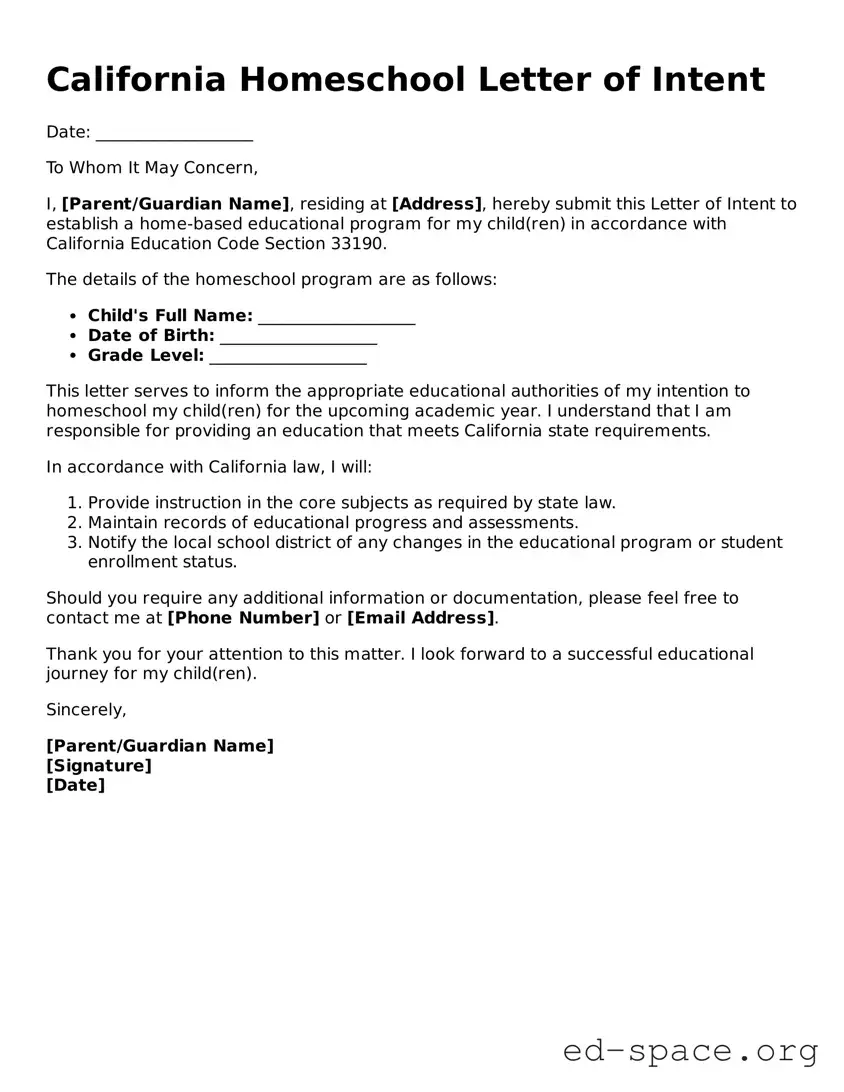
California Homeschool Letter of Intent

Date: ___________________

To Whom It May Concern,

I, [Parent/Guardian Name], residing at [Address], hereby submit this Letter of Intent to establish a home-based educational program for my child(ren) in accordance with California Education Code Section 33190.

The details of the homeschool program are as follows:

  • Child's Full Name: ___________________
  • Date of Birth: ___________________
  • Grade Level: ___________________

This letter serves to inform the appropriate educational authorities of my intention to homeschool my child(ren) for the upcoming academic year. I understand that I am responsible for providing an education that meets California state requirements.

In accordance with California law, I will:

  1. Provide instruction in the core subjects as required by state law.
  2. Maintain records of educational progress and assessments.
  3. Notify the local school district of any changes in the educational program or student enrollment status.

Should you require any additional information or documentation, please feel free to contact me at [Phone Number] or [Email Address].

Thank you for your attention to this matter. I look forward to a successful educational journey for my child(ren).

Sincerely,

[Parent/Guardian Name]
[Signature]
[Date]

PDF Form Details

Fact Name Description
Purpose The California Homeschool Letter of Intent form serves to notify the local school district of a parent's decision to homeschool their child.
Governing Law This form is governed by California Education Code Section 33190, which outlines the requirements for homeschooling in the state.
Submission Timeline Parents must submit the Letter of Intent within 10 days of starting the homeschooling process.
Information Required The form requires basic information, including the child's name, age, and the educational curriculum being used.

California Homeschool Letter of Intent: Usage Guidelines

After obtaining the California Homeschool Letter of Intent form, you are ready to begin the process of filling it out. This form is essential for notifying the state of your intent to homeschool your child. Ensure that you have all necessary information at hand before starting.

  1. Begin by downloading the California Homeschool Letter of Intent form from the California Department of Education website or obtaining a physical copy from your local school district.
  2. Fill in your name as the parent or guardian in the designated section at the top of the form.
  3. Provide your address, including city, state, and zip code, in the appropriate fields.
  4. Enter your phone number and email address to ensure the school district can contact you if needed.
  5. List the name and birthdate of each child you intend to homeschool. Make sure to include all relevant children.
  6. Indicate the grade level for each child listed. This information helps the district understand the educational needs of your family.
  7. Sign and date the form at the bottom to confirm that the information provided is accurate and complete.
  8. Submit the completed form to your local school district office. You may choose to do this in person or via mail, depending on your preference.

Once you have submitted the form, you will receive confirmation from your school district. This confirmation may take some time, so it is important to keep a record of your submission. Following this step, you will be able to proceed with your homeschooling plans.

Your Questions, Answered

What is the California Homeschool Letter of Intent?

The California Homeschool Letter of Intent is a formal document that parents or guardians submit to notify the local school district of their intention to homeschool their children. This letter is a crucial first step in the homeschooling process and establishes the family's commitment to provide education outside of the traditional school system.

Who needs to submit the Letter of Intent?

Any parent or guardian who chooses to homeschool their child in California must submit the Letter of Intent. This requirement applies to children who are between the ages of 6 and 18 and who are not enrolled in a public or private school. It is essential to complete this process to ensure compliance with state homeschooling laws.

When should the Letter of Intent be submitted?

The Letter of Intent should be submitted at the beginning of the homeschooling year or as soon as the decision to homeschool has been made. Ideally, it should be filed before the school year starts to avoid any potential legal issues. If a family decides to withdraw a child from a public or private school, the letter should be submitted promptly to the local school district.

What information is required on the Letter of Intent?

The Letter of Intent typically requires basic information such as the names and ages of the children being homeschooled, the address of the family, and the name of the parent or guardian overseeing the homeschooling. Some districts may request additional information, so it is advisable to check with the local school district for specific requirements.

Is there a specific format for the Letter of Intent?

What happens after submitting the Letter of Intent?

After the Letter of Intent is submitted, the local school district will acknowledge receipt of the letter. This acknowledgment does not imply approval or disapproval of the homeschooling plan. It is the parent's responsibility to ensure that they comply with all homeschooling laws and regulations, including maintaining educational records and providing instruction according to state guidelines.

Can the Letter of Intent be revoked or changed?

Yes, the Letter of Intent can be revoked or changed. If a family decides to stop homeschooling or enroll their child in a traditional school, they should inform the local school district. It is recommended to submit a written notice to clarify the change in educational status to avoid any misunderstandings or potential legal issues.

Common mistakes

  1. Not providing the full name of the child. Make sure to include the first, middle, and last name as it appears on the birth certificate.

  2. Forgetting to include the date of birth. This is crucial for identifying the child’s age and grade level.

  3. Failing to list the address of the homeschool. The form requires the physical address where the homeschooling will take place.

  4. Not signing the form. A signature is necessary to validate the intent to homeschool.

  5. Overlooking the submission deadline. Be aware of when the form needs to be filed, especially if you are starting mid-year.

  6. Neglecting to keep a copy of the submitted form. It’s important to have your own records in case of future inquiries.

Documents used along the form

When families decide to homeschool in California, they often need to prepare several important documents alongside the California Homeschool Letter of Intent form. These documents help ensure compliance with state regulations and provide necessary information for educational planning. Below is a list of commonly used forms and documents that complement the Homeschool Letter of Intent.

  • Curriculum Plan: This document outlines the educational materials and subjects that will be taught throughout the school year. It serves as a roadmap for the family's homeschooling journey.
  • Attendance Record: Keeping track of daily attendance is essential. This record helps demonstrate that the student is engaged in educational activities and can be useful for future assessments.
  • Assessment Plan: This plan details how the student’s progress will be evaluated. It may include standardized tests, portfolios, or other methods to measure learning outcomes.
  • Student Portfolio: A collection of the student's work, including assignments, projects, and assessments. This portfolio showcases the student's progress and achievements over the school year.
  • Emergency Contact Information: This document provides essential contact details for emergencies. It ensures that caregivers and educators have access to necessary information in case of an incident.
  • Health Records: Maintaining up-to-date health records is important for homeschooling families. These records can include immunization history and any medical conditions that may affect learning.
  • Field Trip Permission Slips: If the family plans to participate in group outings or educational trips, these slips may be necessary to ensure parental consent and safety.
  • Extracurricular Activity Agreements: For students participating in outside activities, such as sports or clubs, these agreements outline expectations and responsibilities.
  • Withdrawal Notice: If a child is transitioning from a public or private school to homeschooling, a withdrawal notice may be required to officially remove the student from the school’s roster.

By preparing these documents alongside the California Homeschool Letter of Intent, families can create a structured and organized approach to homeschooling. This preparation not only supports compliance with state laws but also enhances the educational experience for students.

Similar forms

  • Notice of Intent to Homeschool: This document serves a similar purpose as the Homeschool Letter of Intent. It formally notifies the school district of a parent's intention to educate their child at home. Both documents require basic information about the child and the educational plan.
  • Curriculum Plan: Like the Homeschool Letter of Intent, a curriculum plan outlines the educational approach and subjects to be taught. It provides a roadmap for learning and can be submitted to the school district to demonstrate educational intent.
  • Educational Philosophy Statement: This document explains the educational beliefs and values guiding a parent's homeschooling approach. Similar to the Homeschool Letter of Intent, it reflects a commitment to providing a structured learning environment.
  • Attendance Record: An attendance record tracks a child's educational progress and participation. While the Homeschool Letter of Intent initiates the homeschooling process, the attendance record serves as ongoing documentation of the child's learning journey.
  • Annual Assessment Report: This report evaluates a child's academic progress at the end of the school year. It is similar to the Homeschool Letter of Intent in that it demonstrates compliance with educational requirements and provides insight into the child's achievements.
  • Educational Portfolio: An educational portfolio showcases a child's work and progress over time. Like the Homeschool Letter of Intent, it serves as evidence of a structured educational experience and can be reviewed by the school district if necessary.
  • Withdrawal Letter: When a parent decides to withdraw a child from public or private school to homeschool, a withdrawal letter is often submitted. This document, like the Homeschool Letter of Intent, formally communicates a change in the child's educational status.
  • Homeschooling Agreement: This is a mutual understanding between parents and children regarding the homeschooling process. It is similar to the Homeschool Letter of Intent in that it establishes expectations and responsibilities for the educational experience.
  • Learning Objectives: A document outlining specific learning goals for a child during the homeschooling year. It shares similarities with the Homeschool Letter of Intent by detailing the educational intentions and aspirations for the child's learning.
  • State Compliance Forms: Many states require specific forms to ensure compliance with homeschooling laws. These forms, like the Homeschool Letter of Intent, are necessary for legal recognition of the homeschooling arrangement and ensure adherence to state regulations.

Dos and Don'ts

When filling out the California Homeschool Letter of Intent form, consider the following guidelines:

  • Do provide accurate information about your child, including their full name and date of birth.
  • Do include your address and contact information to ensure you can be reached if necessary.
  • Do sign and date the form to validate your intent to homeschool.
  • Do keep a copy of the completed form for your records.
  • Don't leave any required fields blank; all sections must be completed.
  • Don't submit the form late; adhere to the deadlines set by the state.
  • Don't provide false information; accuracy is crucial for compliance.

Misconceptions

Many people have misunderstandings about the California Homeschool Letter of Intent form. Here are five common misconceptions:

  • It is mandatory for all homeschoolers to file a Letter of Intent. Some believe that every homeschooling family must submit this form. However, only those who choose to operate as a private school or under certain legal exemptions need to file.
  • The Letter of Intent must be filed every year. Many think that they need to submit a new Letter of Intent annually. In reality, once the form is filed, it remains valid until there is a change in the homeschooling status or if the family decides to stop homeschooling.
  • Filing the Letter of Intent guarantees approval from the state. Some individuals assume that submitting this form automatically means they have state approval to homeschool. The truth is that the form simply notifies the state of the family's intent to homeschool; it does not require or provide approval.
  • All information on the form is public. There is a belief that personal information provided in the Letter of Intent is accessible to the public. In fact, the information is kept confidential and is only used for administrative purposes by the state.
  • Homeschooling families are not required to keep records. Some think that once they file the Letter of Intent, they do not need to maintain any records. However, families are encouraged to keep educational records and documentation to support their homeschooling activities, especially if they choose to apply for college or other educational opportunities later.

Key takeaways

Filling out the California Homeschool Letter of Intent form is an important step for parents who choose to homeschool their children. Here are some key takeaways to consider:

  • Complete the Form Accurately: Ensure that all information is filled out correctly. This includes the names of the children being homeschooled and the address of the homeschooling location.
  • Submit on Time: The form must be submitted within the required timeframe. Typically, this means submitting it within 30 days of starting your homeschool program.
  • Keep a Copy: Always keep a copy of the submitted form for your records. This can be helpful for future reference or in case of any inquiries.
  • Understand Your Responsibilities: Submitting the form is just the beginning. Parents must also ensure they comply with California's homeschooling laws and regulations.

By following these guidelines, you can navigate the process smoothly and focus on providing a quality education for your children.