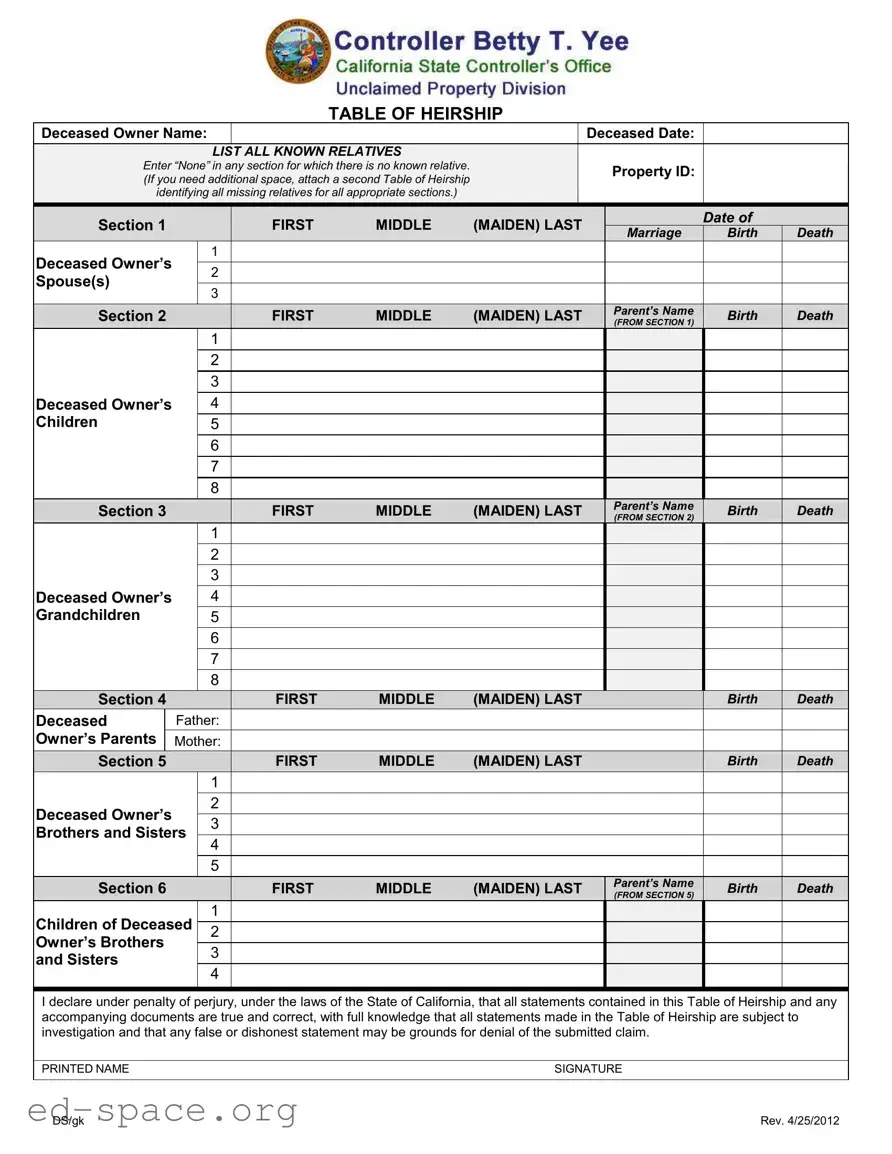
The California Heirship form serves as a crucial document for individuals seeking to claim property belonging to a deceased person. This form meticulously outlines the relationships between the deceased owner and their known relatives, ensuring that all potential heirs are accounted for in the claim process. It requires detailed information, including the names, birth dates, and, if applicable, death dates of the deceased owner's spouse, children, grandchildren, parents, and siblings. Each section of the form is designed to capture specific familial connections, making it easier for the claimant to establish their right to the property. In addition to personal details, the form includes a declaration under penalty of perjury, emphasizing the importance of accuracy and honesty in the information provided. Claimants must also attach certified death certificates for all deceased relatives listed, reinforcing the need for thorough documentation. By following the instructions carefully and filling out each section completely, individuals can navigate the complexities of property claims in California more effectively.

|
|
|
|
|
|
|
TABLE OF HEIRSHIP |
|
|
|
|
|
|
|
||
Deceased Owner Name: |
|
|
|
|
|
|
Deceased Date: |
|
|
|
|
|||||
|
|
|
|
|
|
|
|
|
|
|
|
|
|
|
|
|
|
|
|
|
LIST ALL KNOWN RELATIVES |
|
|
|
|
|
|
|
|
|
|||
Enter “None” in any section for which there is no known relative. |
|
|
|
Property ID: |
|
|
|
|
||||||||
(If you need additional space, attach a second Table of Heirship |
|
|
|
|
|
|
|
|||||||||
|
|
|
|
|
|
|
|
|
||||||||
identifying all missing relatives for all appropriate sections.) |
|
|
|
|
|
|
|
|
|
|||||||
|
|
|
|
|
|
|
|
|
||||||||
|
|
|
|
|
|
|
|
|
|
|
|
|
|
|
|
|
Section 1 |
|
|
|
|
FIRST |
MIDDLE |
(MAIDEN) LAST |
|
|
|
Date of |
|
|
|||
|
|
|
|
|
|
Marriage |
|
Birth |
|
Death |
||||||
|
|
|
|
|
|
|
|
|
|
|
|
|
|
|||
Deceased Owner’s |
|
|
1 |
|
|
|
|
|
|
|
|
|
|
|
|
|
|
|
|
|
|
|
|
|
|
|
|
|
|
|
|
||
|
|
2 |
|
|
|
|
|
|
|
|
|
|
|
|
||
Spouse(s) |
|
|
|
|
|
|
|
|
|
|
|
|
|
|
||
|
|
|
|
|
|
|
|
|
|
|
|
|
|
|
||
|
|
3 |
|
|
|
|
|
|
|
|
|
|
|
|
||
|
|
|
|
|
|
|
|
|
|
|
|
|
|
|
|
|
|
|
|
|
|
|
|
|
|
|
|
|
|
|
|
|
|
Section 2 |
|
|
|
|
FIRST |
MIDDLE |
(MAIDEN) LAST |
|
|
Parent’s Name |
|
Birth |
|
Death |
||
|
|
|
|
|
|
(FROM SECTION 1) |
|
|
||||||||
|
|
|
|
1 |
|
|
|
|
|
|
|
|
|
|
|
|
|
|
|
|
2 |
|
|
|
|
|
|
|
|
|
|
|
|
|
|
|
|
3 |
|
|
|
|
|
|
|
|
|
|
|
|
Deceased Owner’s |
|
|
4 |
|
|
|
|
|
|
|
|
|
|
|
|
|
Children |
|
|
5 |
|
|
|
|
|
|
|
|
|
|
|
|
|
|
|
|
|
6 |
|
|
|
|
|
|
|
|
|
|
|
|
|
|
|
|
7 |
|
|
|
|
|
|
|
|
|
|
|
|
|
|
|
|
8 |
|
|
|
|
|
|
|
|
|
|
|
|
Section 3 |
|
|
|
|
FIRST |
MIDDLE |
(MAIDEN) LAST |
|
|
Parent’s Name |
|
Birth |
|
Death |
||
|
|
|
|
|
|
(FROM SECTION 2) |
|
|
||||||||
|
|
|
|
1 |
|
|
|
|
|
|
|
|
|
|
|
|
|
|
|
|
2 |
|
|
|
|
|
|
|
|
|
|
|
|
|
|
|
|
3 |
|
|
|
|
|
|
|
|
|
|
|
|
Deceased Owner’s |
|
|
4 |
|
|
|
|
|
|
|
|
|
|
|
|
|
Grandchildren |
|
|
5 |
|
|
|
|
|
|
|
|
|
|
|
|
|
|
|
|
|
6 |
|
|
|
|
|
|
|
|
|
|
|
|
|
|
|
|
7 |
|
|
|
|
|
|
|
|
|
|
|
|
|
|
|
|
8 |
|
|
|
|
|
|
|
|
|
|
|
|
Section 4 |
|
|
|
|
FIRST |
MIDDLE |
(MAIDEN) LAST |
|
|
|
|
Birth |
|
Death |
||
Deceased |
|
Father: |
|
|
|
|
|
|
|
|
|
|
|
|||
Owner’s Parents |
|
Mother: |
|
|
|
|
|
|
|
|
|
|
|
|||
Section 5 |
|
|
|
|
FIRST |
MIDDLE |
(MAIDEN) LAST |
|
|
|
|
Birth |
|
Death |
||
|
|
|
|
1 |
|
|
|
|
|
|
|
|
|
|
|
|
Deceased Owner’s |
|
|
2 |
|
|
|
|
|
|
|
|
|
|
|
|
|
|
|
3 |
|
|
|
|
|
|
|
|
|
|
|
|
||
Brothers and Sisters |
|
|
|
|
|
|
|
|
|
|
|
|
|
|||
|
4 |
|
|
|
|
|
|
|
|
|
|
|
|
|||
|
|
|
|
|
|
|
|
|
|
|
|
|
|
|
|
|
|
|
|
|
5 |
|
|
|
|
|
|
|
|
|
|
|
|
|
|
|
|
|
|
|
|
|
|
|
|
|
|
|
|
|
Section 6 |
|
|
|
|
FIRST |
MIDDLE |
(MAIDEN) LAST |
|
|
Parent’s Name |
|
Birth |
|
Death |
||
|
|
|
|
|
|
(FROM SECTION 5) |
|
|
||||||||
Children of Deceased |
|
1 |
|
|
|
|
|
|
|
|
|
|
|
|
||
|
2 |
|
|
|
|
|
|
|
|
|
|
|
|
|||
Owner’s Brothers |
|
|
|
|
|
|
|
|
|
|
|
|
|
|
|
|
|
|
3 |
|
|
|
|
|
|
|
|
|
|
|
|
||
and Sisters |
|
|
|
|
|
|
|
|
|
|
|
|
|
|
||
|
|
4 |
|
|
|
|
|
|
|
|
|
|
|
|
||
|
|
|
|
|
|
|
|
|
|
|
|
|
|
|
|
|
|
|
|
|
|
|
|
|
|
|
|
|
|
|
|
|
|
I declare under penalty of perjury, under the laws of the State of California, that all statements contained in this Table of Heirship and any accompanying documents are true and correct, with full knowledge that all statements made in the Table of Heirship are subject to investigation and that any false or dishonest statement may be grounds for denial of the submitted claim.
PRINTED NAME |
SIGNATURE |
|
|
DS/gk |
Rev. 4/25/2012 |
|
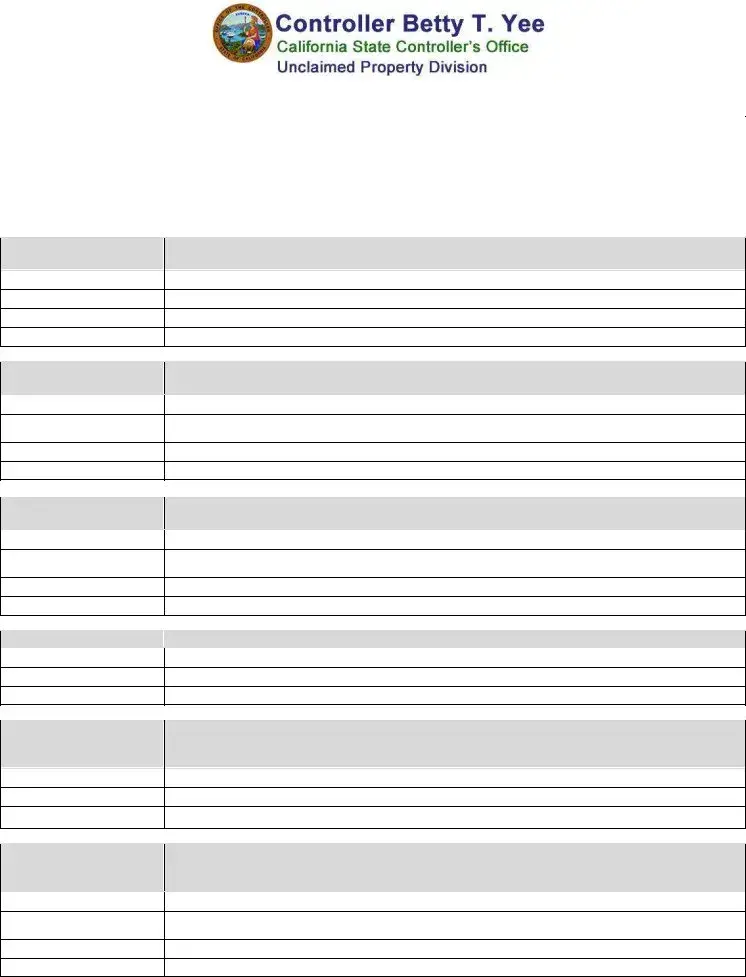
TABLE OF HEIRSHIP |
|
INSTRUCTIONS |
Deceased Owner Name |
Enter the name of the deceased person whose property you are claiming. |
|
|
Deceased Date |
Enter the date the deceased property owner died. |
|
|
Property ID |
Enter the Property ID found on the claim details page printed with your claim form. |
|
|
To ensure you receive the funds to which you are entitled, enter the requested information for yourself and all of the deceased property owner’s known relatives, both living and dead. In addition, provide a copy of all pages of the certified death certificate for all deceased relatives listed in all Sections above your name to whom you are directly related (such as, your grandmother/grandfather, mother/father, and/or son/daughter).
Include in this section all of the deceased property owner’s current or former spouses. Enter one spouse per line (living or dead). If the deceased owner never married, enter “None.”
Enter the spouse’s first, middle, (maiden name, if applicable) and last name.
Enter the spouse’s date of marriage to the deceased property owner.
Enter the spouse’s date of birth.
If the spouse is deceased, enter the spouse’s date of death.
Include in this section all of the deceased property owner’s children. Enter one child per line (living or dead). If the deceased owner did not have any children, enter “None.”
Enter the child’s first, middle, (maiden name, if applicable) and last name.
Enter the first name of the child’s parent, as listed in Section 1.
Enter the child’s date of birth.
If the child is deceased, enter the child’s date of death.
Include in this section all of the deceased property owner’s grandchildren. Enter one grandchild per line (living or dead). If the deceased owner did not have any grandchildren, enter “None.”
Enter the grandchild’s first, middle, (maiden name, if applicable) and last name.
Enter the first name of grandchild’s parent, as listed in Section 2.
Enter the grandchild’s date of birth.
If the grandchild is deceased, enter the grandchild’s date of death.
Include in this section both of the deceased property owner’s parents (living or dead).
Enter the parent’s first, middle, (maiden name, if applicable) and last name.
Enter the parent’s date of birth.
If the parent is deceased, enter the parent’s date of death.
Include in this section all of the deceased property owner’s brothers and sisters. Enter one brother or sister per line (living or dead). If the deceased owner did not have any brothers or sisters, enter “None.”
Enter the brother or sister’s first, middle, (maiden name, if applicable) and last name.
Enter the brother or sister’s date of birth.
If the brother or sister is deceased, enter the brother or sister’s date of death.
Include in this section all of the deceased property owner’s nieces and nephews. Enter one niece or nephew per line (living or dead). If the deceased owner did not have any nieces or nephews, enter “None.”
Enter the niece or nephew’s first, middle, (maiden name, if applicable) and last name.
Enter the first name of the niece or nephew’s parent, as listed in Section 5.
Enter the niece or nephew’s date of birth.
If the niece or nephew is deceased, enter the niece or nephew’s date of death.
DS/gk |
Rev. 4/25/2012 |
| Fact Name | Details |
|---|---|
| Purpose | The California Heirship form is used to identify the heirs of a deceased property owner for the purpose of claiming property. |
| Governing Law | This form is governed by California Probate Code Section 6400 and related statutes. |
| Required Information | Applicants must provide the names, birth dates, and death dates of all known relatives, including spouses, children, and parents. |
| Affidavit Requirement | The form includes a declaration under penalty of perjury, affirming the truthfulness of the provided information. |
| Attachments | A certified death certificate for each deceased relative listed must accompany the form to validate claims. |
| Submission Process | The completed form should be submitted to the relevant authority along with any necessary documentation to process the claim. |
Filling out the California Heirship form is an important step in claiming property after a loved one has passed away. After completing the form, it will need to be submitted along with any required documentation, such as death certificates, to ensure the claim is processed correctly.
What is the California Heirship form?
The California Heirship form is a document used to identify the heirs of a deceased property owner. It lists all known relatives of the deceased, including spouses, children, grandchildren, parents, siblings, and other relatives. This form is essential for claiming property or assets that belonged to the deceased.
Who should fill out the California Heirship form?
The form should be filled out by individuals who are claiming property or assets of a deceased person. This could be a spouse, child, or any other relative who is entitled to inherit from the deceased. It’s important to provide accurate information about the deceased and all known relatives.
What information is required on the form?
You will need to provide the deceased owner's name, date of death, and property ID. Additionally, you must list all known relatives, including their names, dates of birth, and dates of death if applicable. This includes spouses, children, grandchildren, parents, and siblings. If any section does not apply, you can simply write “None.”
What if I don’t know all the relatives of the deceased?
If you are unsure about some relatives, it’s best to include as much information as you can. You can also attach a second Table of Heirship if you need more space to identify missing relatives. However, providing complete and accurate information is crucial for the processing of your claim.
Do I need to provide death certificates?
Yes, you will need to provide copies of the certified death certificates for all deceased relatives listed in the form above your name. This includes parents, siblings, and any other direct relatives. This helps verify the information provided and ensures that your claim is processed smoothly.
What happens if I provide false information on the form?
Providing false or misleading information can lead to serious consequences, including the denial of your claim. The form includes a declaration stating that all information is true and correct, and any dishonesty may be grounds for legal action. It’s essential to be truthful and thorough when completing the form.
Can I submit the form if the deceased had no known relatives?
If the deceased had no known relatives, you can still submit the form. In such cases, you would enter “None” in all applicable sections. However, it’s advisable to seek legal guidance to understand how to proceed with the claim in the absence of heirs.
Is there a deadline for submitting the California Heirship form?
While there isn’t a specific deadline for submitting the Heirship form, it’s important to act promptly. Delays in filing may complicate the claims process or result in the loss of rights to the property. It’s best to submit the form as soon as you have gathered all necessary information.
Where do I submit the completed California Heirship form?
The completed form should be submitted to the appropriate court or agency handling the estate of the deceased. This could vary depending on the specific circumstances, so it’s advisable to check with local authorities or consult with a legal professional for guidance on where to file.
Can I get help with filling out the California Heirship form?
Absolutely! If you find the form confusing or need assistance, consider reaching out to a legal professional. They can provide guidance on how to fill out the form correctly and help ensure that all necessary information is included. You can also find resources online that offer step-by-step instructions.
Incomplete Information: Failing to provide complete names, dates of birth, or dates of death for the deceased and their relatives can lead to delays or denials.
Missing Sections: Omitting entire sections, such as not listing all known relatives or failing to indicate "None" where applicable, can cause confusion.
Incorrect Spelling: Misspelling names, especially of relatives, can complicate the verification process and may result in rejection of the claim.
Failure to Attach Required Documents: Not including certified death certificates for deceased relatives listed in the form can lead to issues with processing the claim.
Using Outdated Forms: Submitting an old version of the Table of Heirship may not comply with current requirements, resulting in delays.
Neglecting to Sign: Forgetting to sign the form can invalidate the submission and cause unnecessary delays in processing.
Incorrect Property ID: Providing an incorrect Property ID can lead to confusion and potential denial of the claim.
Inconsistent Information: Providing conflicting information across different sections can raise red flags and complicate the review process.
Ignoring Instructions: Not following the specific instructions for each section can lead to incomplete submissions and subsequent delays.
The California Heirship form is an essential document for identifying the heirs of a deceased property owner. When filing this form, several other documents may be required to support your claim. Here’s a list of common forms and documents that are often used alongside the California Heirship form.
Gathering these documents can help ensure a smooth process when filing the California Heirship form. Each document plays a role in establishing the legitimacy of the claim and the rightful heirs to the deceased's estate.
When filling out the California Heirship form, it is important to follow specific guidelines to ensure accuracy and compliance. Below is a list of things to do and avoid during this process.
Following these guidelines will help ensure that the form is completed correctly and submitted successfully.
Misconceptions about the California Heirship form can lead to confusion and errors in the claims process. Here are ten common misconceptions, along with clarifications to help ensure accurate completion of the form.
Understanding these misconceptions can help individuals navigate the California Heirship form more effectively, ensuring a smoother claims process.
When filling out the California Heirship form, it’s essential to pay attention to detail. Here are some key takeaways to help guide you through the process:
By following these guidelines, you can ensure that the California Heirship form is completed accurately, helping to facilitate the claims process effectively.