The California Gypsy Moth Checklist form is an essential tool for anyone planning to move from a gypsy moth quarantine area to a non-quarantine area. This form outlines the legal requirements for inspecting outdoor household items to prevent the spread of this invasive pest. Before moving, individuals must check their belongings for any life stages of the gypsy moth, which can cause significant damage to various trees and shrubs. Failure to comply with this inspection requirement can result in penalties. The checklist provides a straightforward process for self-inspection, allowing individuals to examine items such as patio furniture, lawn equipment, and recreational vehicles for gypsy moth egg masses. If preferred, a qualified certified applicator can perform the inspection. The completed checklist serves as an official certificate, which must be kept on hand during the move. It is also advisable to retain a copy for future reference. For those unsure whether they reside in a quarantine area, the form directs users to a helpful website that provides this information. Additionally, resources are available for further assistance, including contact details for state agricultural departments and the USDA. Understanding and utilizing this checklist can help protect new neighborhoods from the gypsy moth's destructive impact.
|
|
|
OK F |
|
|
|
|
|
|
LO |
OR |
|
|
|
|
|
O |
|
|
|
|
|
|
T |
T |
|
|
|
|
|
|
|
|
|
|
|
|
|
|
A |
|
|
|
|
|
|
|
H |
|
|
|
|
|
|
S |
W |
|
|
|
|
|
|
E |
|
|
|
|
|
|
|
S |
|
|
|
|
|
|
|
S |
|
|
|
|
|
|
|
A |
|
G |
|
|
|
G |
M |
|
|
Y |
|
|
G |
|
||
|
|
P |
E |
|
|
||
|
|
|
SY MOTH |
|
|
|
|
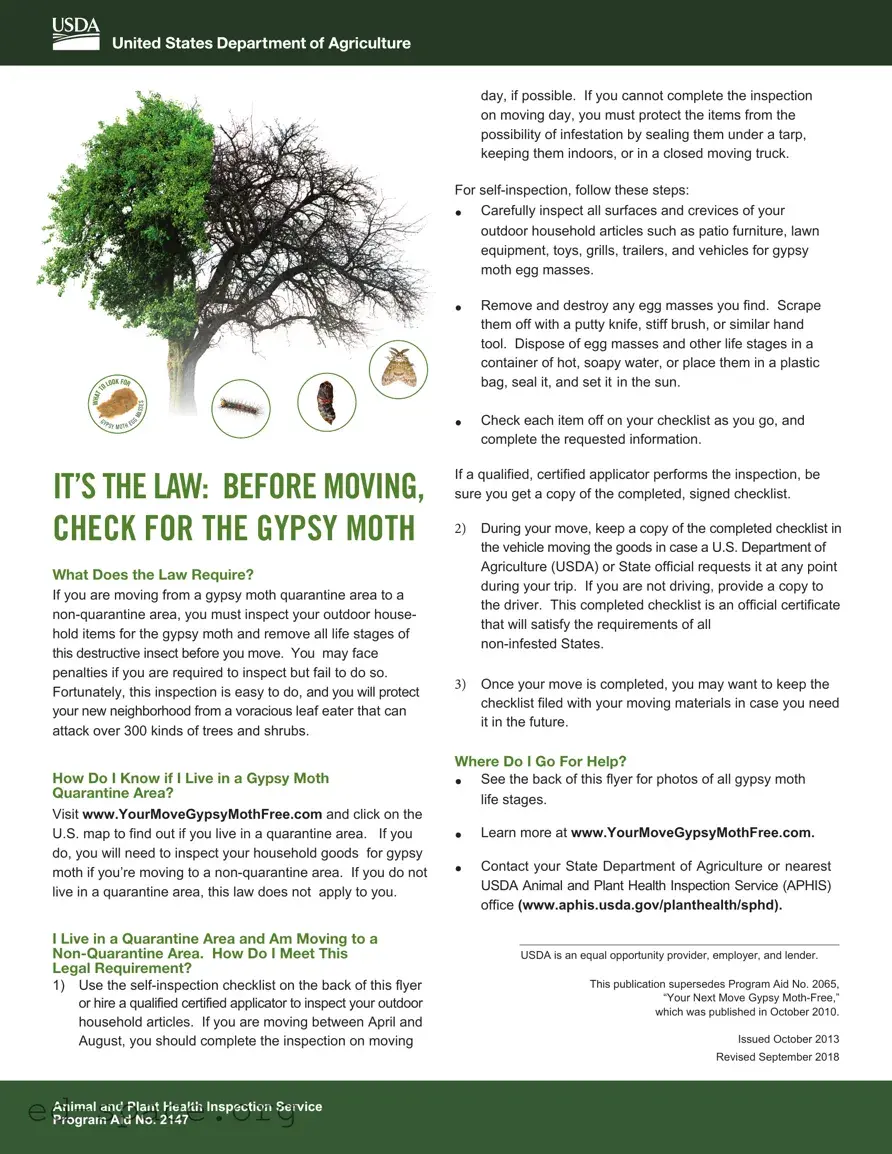
IT’S THE LAW: BEFORE MOVING, CHECK FOR THE GYPSY MOTH
What Does the Law Require?
If you are moving from a gypsy moth quarantine area to a
How Do I Know if I Live in a Gypsy Moth
Quarantine Area?
Visit www.YourMoveGypsyMothFree.com and click on the U.S. map to find out if you live in a quarantine area. If you do, you will need to inspect your household goods for gypsy moth if you’re moving to a
I Live in a Quarantine Area and Am Moving to a
1)Use the
household articles. If you are moving between April and August, you should complete the inspection on moving
day, if possible. If you cannot complete the inspection on moving day, you must protect the items from the possibility of infestation by sealing them under a tarp, keeping them indoors, or in a closed moving truck.
For
•Carefully inspect all surfaces and crevices of your outdoor household articles such as patio furniture, lawn equipment, toys, grills, trailers, and vehicles for gypsy moth egg masses.
•Remove and destroy any egg masses you find. Scrape them off with a putty knife, stiff brush, or similar hand tool. Dispose of egg masses and other life stages in a container of hot, soapy water, or place them in a plastic bag, seal it, and set it in the sun.
•Check each item off on your checklist as you go, and complete the requested information.
If a qualified, certified applicator performs the inspection, be sure you get a copy of the completed, signed checklist.
2)During your move, keep a copy of the completed checklist in the vehicle moving the goods in case a U.S. Department of Agriculture (USDA) or State official requests it at any point during your trip. If you are not driving, provide a copy to the driver. This completed checklist is an official certificate that will satisfy the requirements of all
3)Once your move is completed, you may want to keep the checklist filed with your moving materials in case you need it in the future.
Where Do I Go For Help?
•See the back of this flyer for photos of all gypsy moth life stages.
•Learn more at www.YourMoveGypsyMothFree.com.
•Contact your State Department of Agriculture or nearest USDA Animal and Plant Health Inspection Service (APHIS) office (www.aphis.usda.gov/planthealth/sphd).
USDA is an equal opportunity provider, employer, and lender.
This publication supersedes Program Aid No. 2065, “Your Next Move Gypsy
Issued October 2013
Revised September 2018
Animal and Plant Health Inspection Service Program Aid No. 2147
According to the Paperwork Reduction Act of 1995, an agency may not conduct or sponsor, and a person is not required to respond to, a collection of information unless it displays a valid OMB control number. The valid OMB control number for this information collection is
OMB APPROVED
EXP. DATE 09/30/2021
UNITED STATES DEPARTMENT OF AGRICULTURE ANIMAL AND PLANT HEALTH INSPECTION SERVICE PLANT PROTECTION AND QUARANTINE
GYPSY MOTH CHECKLIST AND
RECORD OF YOUR
Important: Make sure this checklist goes with your outdoor household items when you move
1. Originating Property Address |
|
|
2. Date |
|
|
|
|
|
|
3. Recreational or Camping Items |
|
|
|
|
Backpacks |
Ice Chests |
Tarps |
||
Basketball Backboards |
Motorcycles |
Tents |
||
Bicycles |
Motor Homes |
Waders or Boots |
||
Boats |
Recreational Vehicles |
Other: _____________________ |
||
Boat Trailers |
Snowmobiles |
None |
||
Campers |
Sports Equipment |
|
|
|
|
|
|
|
|
4. Household Items |
|
|
|
|
Air Conditioners |
Ladders |
Tanks for Propane and Oil |
||
Barrels |
Outdoor Doormats |
Television Antennas |
||
Cardboard and Wooden Boxes |
Outdoor Thermometers |
Trash Cans |
||
Clothesline Poles |
Refrigerators |
Washing Machines |
||
Clothespin Bags |
Sheets of Plastic |
Water Hoses |
||
Empty Plant Containers |
Shutters |
Weather Vanes |
||
Firewood* |
Storage Sheds |
Window Awnings |
||
House Plants (taken outside |
Storm/screen Doors and Windows |
Other: _____________________ |
||
during the summer) |
|
None |
||
|
|
|||
5. Building Materials |
|
|
|
|
Bricks |
Roofing Materials |
Welding Equipment |
||
Cement Mixing Tubs |
Sewer Pipes |
Workbenches |
||
Cinder Blocks |
Tools and Toolboxes |
Other: _____________________ |
||
Lumber |
Water Pipes |
None |
||
|
|
|
|
|
6. Yard and Garden Items |
|
|
|
|
Animal Houses (doghouses, |
Fertilizer Spreaders |
Storage Sheds |
||
rabbit hutches, etc.) |
||||
|
|
|
||
Barbecue Grills |
Flagpoles |
Swimming Pools |
||
Birdbaths |
Garden Tillers |
Tractors and Trailers |
||
Bird Feeders |
Garden Tools |
Trees, Shrubs, and Plants |
||
Bird Houses |
Lawnmowers |
Trellises |
||
Bug lights |
Mailboxes |
Wheelbarrows |
||
Carts |
Picnic Tables |
Yard Decorations |
||
Cold Frames |
Porch or Patio Furniture |
Other: _____________________ |
||
Driftwood |
Signs and Posts |
None |
||
Fencing |
|
|
||
|
|
|
|
|
7. Children’s Playthings |
|
Other Outside Toys (like trucks or |
||
Bicycles, tricycles |
Swing sets |
|||
sand molds) |
||||
Playhouses |
Tire Swings |
Other: _____________________ |
||
Sandboxes |
Wagons |
None |
||
Sleds, Toboggans |
|
|
|
|
|
|
|
|
|
8. Other Items |
|
|
|
|
Cars or Trucks |
Farm Implements |
None |
||
Car Parts |
Stored Tires (snow tires) |
|
|
|
Car Ramps |
Other: _____________________ |
|
|
|
|
|
|
|
|
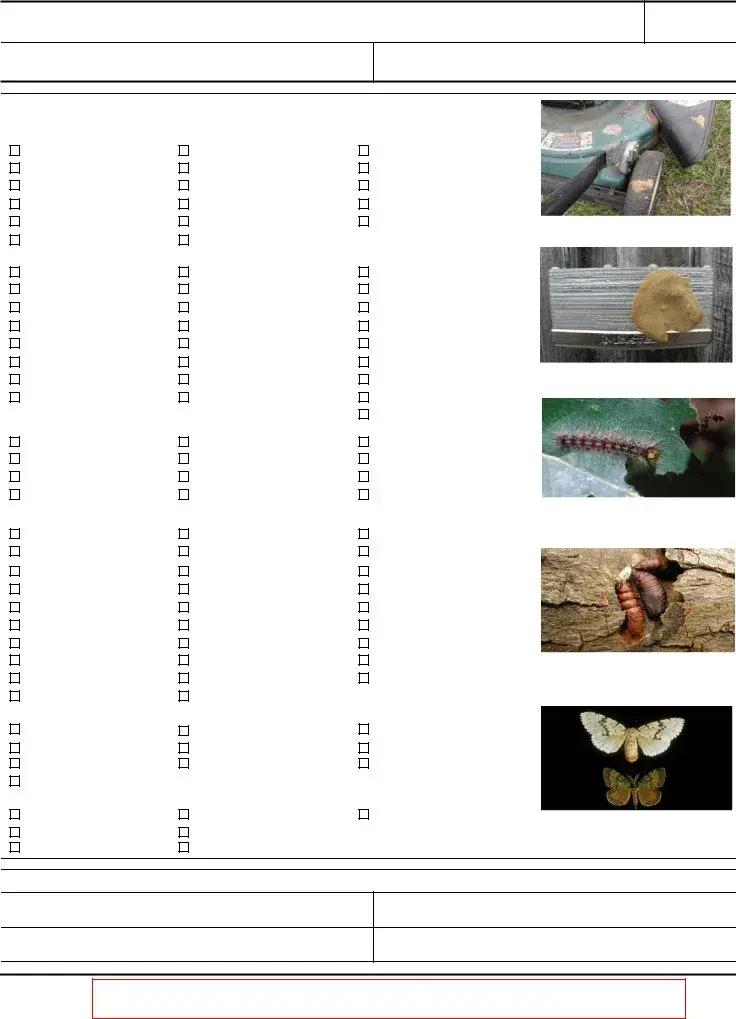
Gypsy moth egg masses on a lawn mower (USDA/APHIS, Susan Lane)
Gypsy moth egg mass on a padlock (USDA/APHIS, Susan Lane)
Gypsy moth caterpillar (larva)
(Daniel Herms, The Ohio State University, Bugwood.org)
Gypsy moth pupae
(Pennsylvania Department of Conservation
and Natural Resources, Forestry Archive,
Bugwood.org)
Female (top) and male adult gypsy moths (USDA APHIS PPQ Archive, USDA/APHIS/PPQ, Bugwood.org)
Inspect anything that was stored outside
By signing my name in block 9 below, I agree that I am legally signing this document and affirming that I have inspected all outdoor household articles, whether included on this checklist or not, for all life stages of gypsy moth in accordance with the procedures on this form, as required by Title 7, Code of Federal Regulations, Part
9.Signature and Date
11.Printed Name
10. Phone Number
12.Company Name (if applicable)
* To avoid spreading other tree pests, move only USDA- or
PPQ Form 377
SEP 2018
Note: The electronic signature function on this form works only if the user opens the file in Internet Explorer or Adobe Acrobat.
| Fact Name | Details |
|---|---|
| Legal Requirement | Individuals moving from a gypsy moth quarantine area to a non-quarantine area must inspect their outdoor household items for gypsy moth life stages. |
| Inspection Process | Inspectors can either self-inspect using a checklist or hire a certified applicator. The inspection should ideally be done on moving day. |
| Quarantine Area Identification | To determine if you live in a quarantine area, visit www.YourMoveGypsyMothFree.com and check the U.S. map provided. |
| Checklist Importance | The completed checklist serves as an official certificate. It must be kept accessible during the move in case of inspection by USDA or state officials. |
| Inspection Steps | Carefully inspect all surfaces of outdoor items for egg masses. Remove and destroy any found egg masses using appropriate tools. |
| Record Keeping | After the move, it is advisable to keep the checklist filed with moving materials for future reference. |
| Governing Law | This checklist is governed by Title 7, Code of Federal Regulations, Part 301.45-4(a). |
Filling out the California Gypsy Moth Checklist is an important step if you are moving from a gypsy moth quarantine area to a non-quarantine area. This form helps ensure that you have inspected your outdoor household items for any signs of the gypsy moth before your move. Completing the checklist accurately will not only help you comply with the law but also protect your new community from this invasive pest.
After completing the checklist, keep a copy in your vehicle during the move. This document may be requested by officials from the U.S. Department of Agriculture or State authorities. Once your move is finished, it’s a good idea to file the checklist with your moving materials for future reference.
What is the California Gypsy Moth Checklist form?
The California Gypsy Moth Checklist form is a document that individuals must complete when moving from a gypsy moth quarantine area to a non-quarantine area. This checklist helps ensure that all outdoor household items are inspected for gypsy moth life stages, which can harm trees and shrubs. Completing this checklist is not only a legal requirement but also a way to protect your new neighborhood from potential infestations.
Why is it important to inspect for gypsy moths?
Gypsy moths are known to be destructive pests that can damage over 300 types of trees and shrubs. Inspecting for these pests is crucial because they can easily spread to new areas if not properly managed. By conducting a thorough inspection and removing any egg masses or larvae, you help safeguard the environment and maintain the health of local flora.
How can I find out if I live in a gypsy moth quarantine area?
To determine if you reside in a gypsy moth quarantine area, visit www.YourMoveGypsyMothFree.com. There, you can click on a U.S. map that will guide you to the relevant information. If you find that you live in a quarantine area, you will need to follow the inspection requirements when moving to a non-quarantine area.
What steps should I take if I live in a quarantine area and am moving?
If you live in a quarantine area and are moving to a non-quarantine area, you have two options. You can either conduct a self-inspection using the checklist provided or hire a qualified certified applicator to perform the inspection. If you choose to do it yourself, inspect all surfaces and crevices of your outdoor items for gypsy moth egg masses, remove any you find, and complete the checklist. Ensure that you keep the checklist with you during your move as proof of compliance.
What should I do if I find gypsy moth egg masses?
If you discover gypsy moth egg masses during your inspection, it is important to remove and destroy them. You can scrape them off with a putty knife or stiff brush and dispose of them in a container of hot, soapy water. Alternatively, you can place them in a sealed plastic bag and leave it in the sun. Proper disposal helps prevent the spread of these pests.
Do I need to keep a copy of the checklist after my move?
Yes, it is advisable to keep a copy of the completed checklist with your moving materials even after your move is finished. This document serves as an official certificate that verifies you have complied with the inspection requirements. It may be useful for future reference or in case you need to provide proof of inspection later on.
What if I cannot complete the inspection on moving day?
If you are unable to complete the inspection on the day of your move, you must protect your items from potential infestation. This can be done by sealing them under a tarp, keeping them indoors, or storing them in a closed moving truck. It is essential to take these precautions to minimize the risk of transporting gypsy moths.
Where can I find more information about gypsy moths?
For additional information about gypsy moths, including their life stages and inspection procedures, you can visit www.YourMoveGypsyMothFree.com. You can also contact your State Department of Agriculture or the nearest USDA Animal and Plant Health Inspection Service (APHIS) office for assistance and guidance.
What happens if I fail to comply with the inspection requirements?
Failing to comply with the inspection requirements can lead to penalties. If you are moving from a quarantine area and do not conduct the necessary inspections, you may face legal repercussions. It is crucial to take this responsibility seriously to avoid potential fines and to protect the environment.
Failing to check if you live in a gypsy moth quarantine area. Always verify your status before moving.
Not inspecting all outdoor household items. Make sure to check every item that has been outside.
Forgetting to remove and destroy any egg masses found. It’s crucial to dispose of them properly.
Not using the self-inspection checklist correctly. Each item needs to be marked off as you inspect.
Failing to keep a copy of the completed checklist in the moving vehicle. This document is essential if requested by officials.
Not sealing items properly if the inspection cannot be done on moving day. Protect items from infestation.
Ignoring the need for a qualified applicator. If unsure, hiring a professional can save you from mistakes.
Not filing the checklist with moving materials after the move. It may be needed in the future.
Overlooking the importance of inspecting items like vehicles and outdoor furniture. All surfaces must be checked.
Neglecting to provide necessary information on the checklist, such as your name and contact details.
When preparing for a move from a gypsy moth quarantine area to a non-quarantine area in California, several forms and documents may be necessary to ensure compliance with the law. Understanding these additional documents can help streamline the process and avoid potential issues. Below is a list of commonly used forms that accompany the California Gypsy Moth Checklist form.
Being aware of these forms and documents can greatly ease the moving process. Proper preparation not only helps you comply with legal requirements but also protects your new community from potential infestations. Always keep these documents organized and accessible during your move to ensure a smooth transition.
The California Gypsy Moth Checklist form is similar to several other documents that serve similar purposes in ensuring compliance with regulations regarding pest control and inspections. Here are five documents that share similarities:
When filling out the California Gypsy Moth Checklist form, it is crucial to follow specific guidelines to ensure compliance with the law and protect your new neighborhood from this invasive pest. Below is a list of dos and don'ts to help you navigate this process effectively.
By adhering to these guidelines, you can ensure a smoother moving process while helping to prevent the spread of gypsy moths. Always remember that the responsibility of inspection lies with you, and taking these steps is essential for protecting both your belongings and the environment.
In reality, if you are moving from a gypsy moth quarantine area to a non-quarantine area, using the checklist is mandatory. Failing to do so can lead to penalties.
Every outdoor household item must be inspected. This includes patio furniture, toys, vehicles, and any other items stored outside.
It is best to conduct the inspection on the moving day, especially if you are moving between April and August. This timing helps ensure that any potential infestations are caught early.
Simply using insecticide is not sufficient. You must physically inspect and remove any gypsy moth life stages you find. This includes egg masses and caterpillars.
It is crucial to keep a copy of the completed checklist with you during the move. This document serves as proof of compliance and may be requested by officials.
Renters and anyone moving items from a quarantine area must also complete the checklist. The law applies to all individuals moving from affected areas.
Egg masses must be disposed of properly. Options include placing them in hot, soapy water or sealing them in a plastic bag and placing them in the sun.
The inspection process is straightforward. Following the checklist and guidelines will make it manageable and effective in preventing infestations.