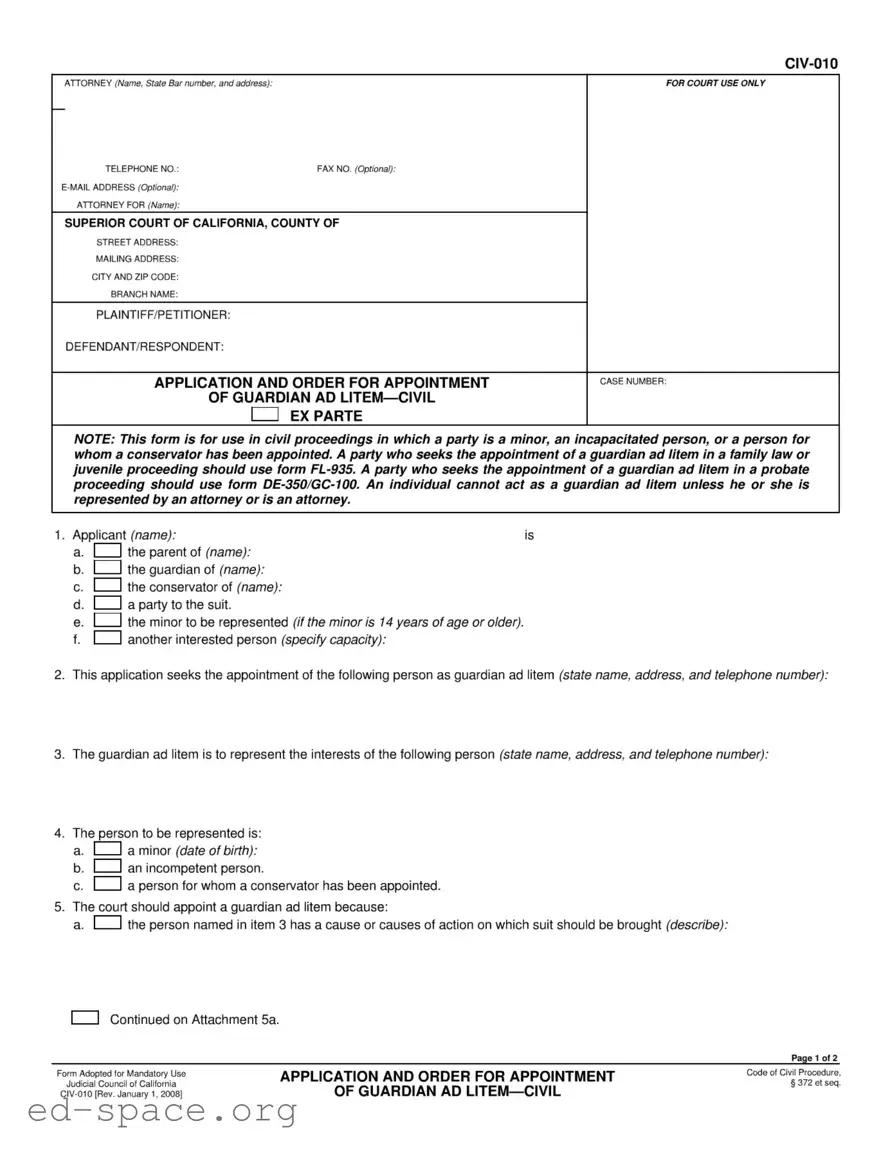
The California Guardian Ad Litem form, known as CIV-010, plays a crucial role in civil proceedings involving minors or individuals unable to represent themselves due to incapacity. This form is specifically designed for situations where a party needs a guardian ad litem—someone who can act on behalf of a minor, an incapacitated person, or a person under conservatorship. It is important to note that this form is distinct from others used in family law or juvenile proceedings, such as FL-935, and probate cases, like DE-350/GC-100. The application requires the applicant to identify their relationship to the person needing representation, whether they are a parent, guardian, conservator, or the individual themselves, if they are over 14 years old. Furthermore, the form outlines the reasons for seeking a guardian ad litem, which may include the need to pursue legal action or the absence of a current guardian. The proposed guardian must demonstrate their competence and lack of conflicting interests, ensuring they can adequately protect the rights of the person they represent. Ultimately, the form culminates in a court order that officially appoints the guardian ad litem, confirming the necessity of this appointment for the well-being of the individual involved.
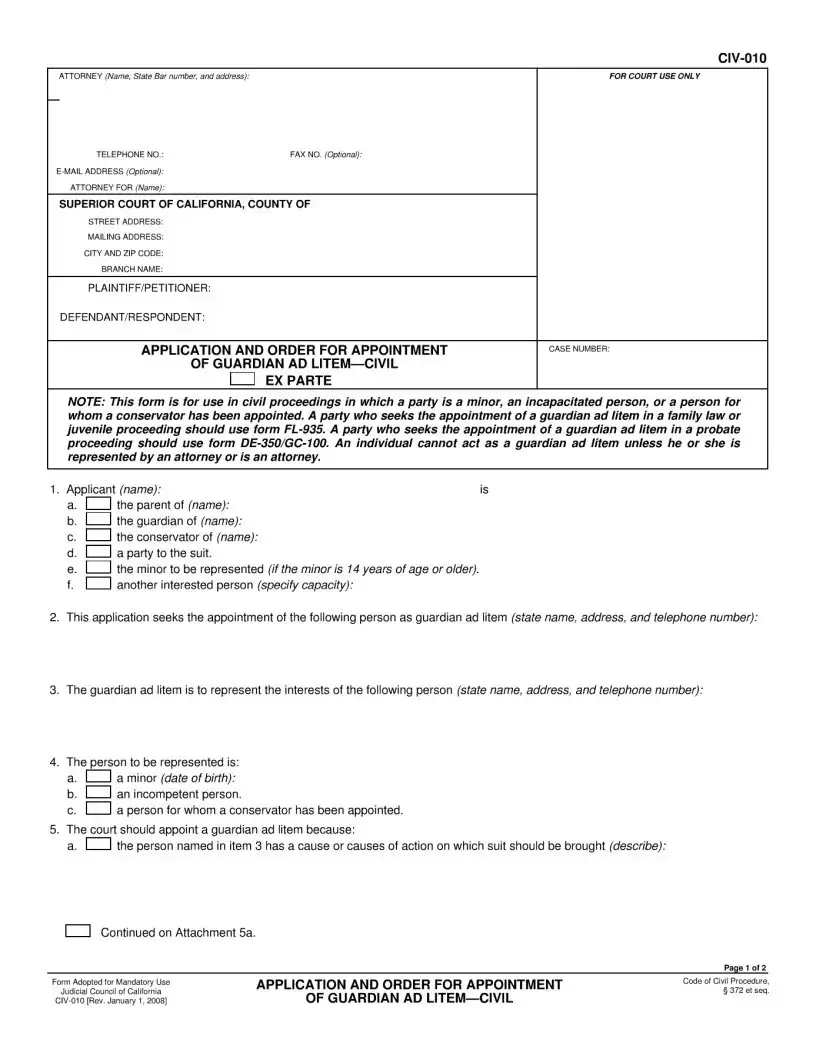
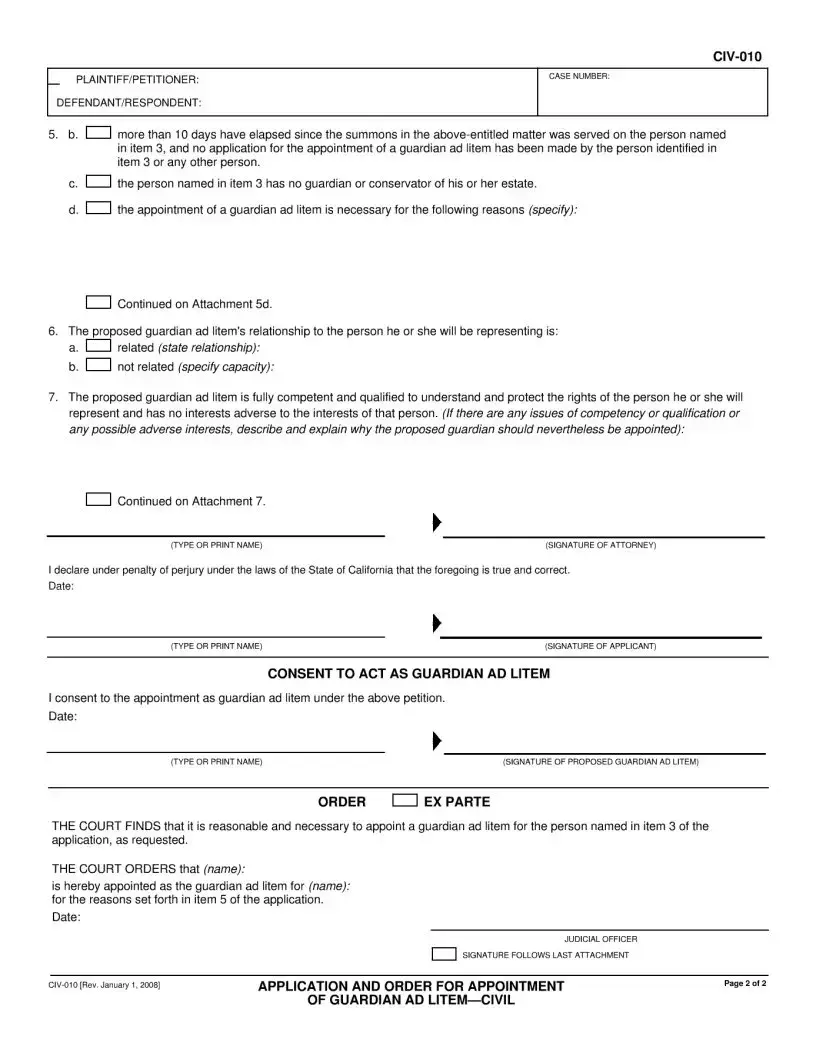
| Fact Name | Description |
|---|---|
| Form Title | The form is titled "Application and Order for Appointment of Guardian Ad Litem—Civil." |
| Governing Law | This form is governed by California Code of Civil Procedure § 372 et seq. |
| Purpose | The form is used to appoint a guardian ad litem for minors or incapacitated persons in civil cases. |
| Eligibility | Only individuals represented by an attorney or those who are attorneys themselves can act as guardians ad litem. |
| Related Forms | For family law or juvenile proceedings, use form FL-935. For probate proceedings, use forms DE-350/GC-100. |
| Application Process | The applicant must provide their relationship to the person being represented, such as parent or guardian. |
| Minor Representation | The form requires information about the minor’s date of birth if the person to be represented is a minor. |
| Consent Requirement | The proposed guardian must consent to act as guardian ad litem by signing the form. |
| Ex Parte Nature | This application can be filed ex parte, meaning it may be submitted without notifying other parties in certain circumstances. |
| Judicial Officer's Role | The court must find it reasonable and necessary to appoint a guardian ad litem before granting the request. |
Filling out the California Guardian ad Litem form requires careful attention to detail. Each section must be completed accurately to ensure the court has the necessary information to make an informed decision. Below are the steps to guide you through the process.
After completing the form, ensure that all information is accurate and legible. Once submitted, the court will review the application and make a determination regarding the appointment of the guardian ad litem.
What is the purpose of the California Guardian Ad Litem form?
The California Guardian Ad Litem form is used to request the appointment of a guardian ad litem in civil proceedings. This is particularly important when a party involved is a minor, an incapacitated person, or someone under a conservatorship. The guardian ad litem will represent the interests of that individual in court.
Who can file this form?
The form can be filed by various individuals, including a parent, guardian, conservator, or even the minor themselves if they are 14 years or older. Additionally, another interested person may file the form, specifying their capacity in relation to the case.
What information is required on the form?
Applicants must provide details such as their relationship to the individual needing representation, the name and contact information of the proposed guardian ad litem, and the reasons for the appointment. It is essential to clearly state the interests of the person to be represented.
What types of cases require this form?
This form is specifically for civil cases. For family law or juvenile proceedings, a different form (FL-935) should be used. Similarly, probate proceedings require a separate form (DE-350/GC-100). Understanding which form to use is crucial for proper legal representation.
What happens after submitting the form?
Once the form is submitted, the court will review the application. If the court finds it reasonable and necessary, it will issue an order appointing the guardian ad litem. This order will specify the individual appointed and the reasons for the appointment.
Can the proposed guardian ad litem have any conflicts of interest?
The proposed guardian ad litem must be fully competent and qualified to protect the rights of the person they will represent. They should not have any interests that conflict with those of the individual. If there are any potential conflicts, these must be disclosed in the application.
Is an attorney required to file this form?
Yes, an individual cannot act as a guardian ad litem unless they are represented by an attorney or are an attorney themselves. This requirement ensures that the legal process is navigated correctly and that the rights of the person being represented are adequately protected.
What if the person needing representation does not have a guardian or conservator?
If the individual does not have a guardian or conservator, the application can still be filed. The court may appoint a guardian ad litem to ensure that the person's interests are represented in the legal proceedings.
How long does the process take?
The timeline for the appointment of a guardian ad litem can vary. Generally, the court will act promptly, especially if the application is marked as "ex parte." However, it is advisable to check with the court for specific timelines related to your case.
Where can I find the California Guardian Ad Litem form?
The form can typically be obtained from the California Judicial Council's website or directly from the local Superior Court. It is important to ensure that you are using the most current version of the form to avoid any issues during the application process.
Incomplete Information: Failing to provide all necessary details, such as names, addresses, and contact information, can delay the process.
Incorrect Applicant Status: Misidentifying oneself as the applicant can lead to confusion. Ensure you accurately select whether you are a parent, guardian, or another interested party.
Missing Signatures: Omitting signatures from either the applicant or the proposed guardian ad litem will render the application invalid.
Failure to Specify Relationship: Not clearly stating the relationship between the proposed guardian and the person being represented may raise questions during review.
Neglecting to Address Competency: Not providing information about the proposed guardian's competency and qualifications can hinder approval.
Ignoring Deadline Requirements: Submitting the application after the specified time frame can result in rejection. Always check for deadlines.
Inadequate Justification: Failing to clearly explain why a guardian ad litem is necessary may lead to denial of the application.
Not Using the Correct Form: Using the wrong form for the type of proceeding can cause significant delays. Ensure you are using the CIV-010 form specifically for civil cases.
Ignoring Court Instructions: Not following any specific instructions or notes provided by the court can lead to complications. Always read the form and any accompanying materials carefully.
The California Guardian Ad Litem form is essential for appointing a representative for individuals who cannot represent themselves in civil cases. When utilizing this form, several other documents may also be necessary to ensure proper legal proceedings. Below is a list of forms that are often used in conjunction with the Guardian Ad Litem form.
Utilizing these forms alongside the California Guardian Ad Litem form can help streamline the legal process and ensure that the rights of those unable to represent themselves are adequately protected. It is important to carefully complete each document to facilitate a smooth court experience.
The California Guardian Ad Litem form is a crucial document used in legal proceedings involving minors or incapacitated individuals. There are several other documents that share similarities with this form, each serving specific purposes in different legal contexts. Here’s a breakdown of seven documents that are similar to the California Guardian Ad Litem form:
Each of these documents plays a vital role in ensuring that vulnerable individuals receive the necessary legal representation and protection in various contexts. Understanding their similarities helps clarify the legal landscape surrounding guardianship and representation in California.
When filling out the California Guardian Ad Litem form, there are important guidelines to follow. Here’s a list of what you should and shouldn’t do:
Understanding the California Guardian Litem form can be challenging. Here are six common misconceptions about this important document.
In reality, any interested person can apply. This includes guardians, conservators, or even the minor themselves if they are 14 years or older.
While the proposed guardian must be represented by an attorney or be an attorney themselves, the guardian ad litem does not have to be a lawyer.
This form is specifically for civil cases involving minors or incapacitated persons. Different forms are required for family law or probate proceedings.
In some situations, the process can be expedited. An ex parte application allows for a quicker appointment if necessary.
The guardian ad litem represents the interests of the minor or incapacitated person but does not have parental rights. Their role is to advocate for the best interests of the person they represent.
The proposed guardian's relationship to the person they represent is significant. The form requires disclosure of this relationship to ensure that the guardian can effectively advocate for the individual’s interests.
When filling out the California Guardian Ad Litem form, consider these key takeaways:
Following these guidelines will help streamline the process and increase the chances of a successful application.