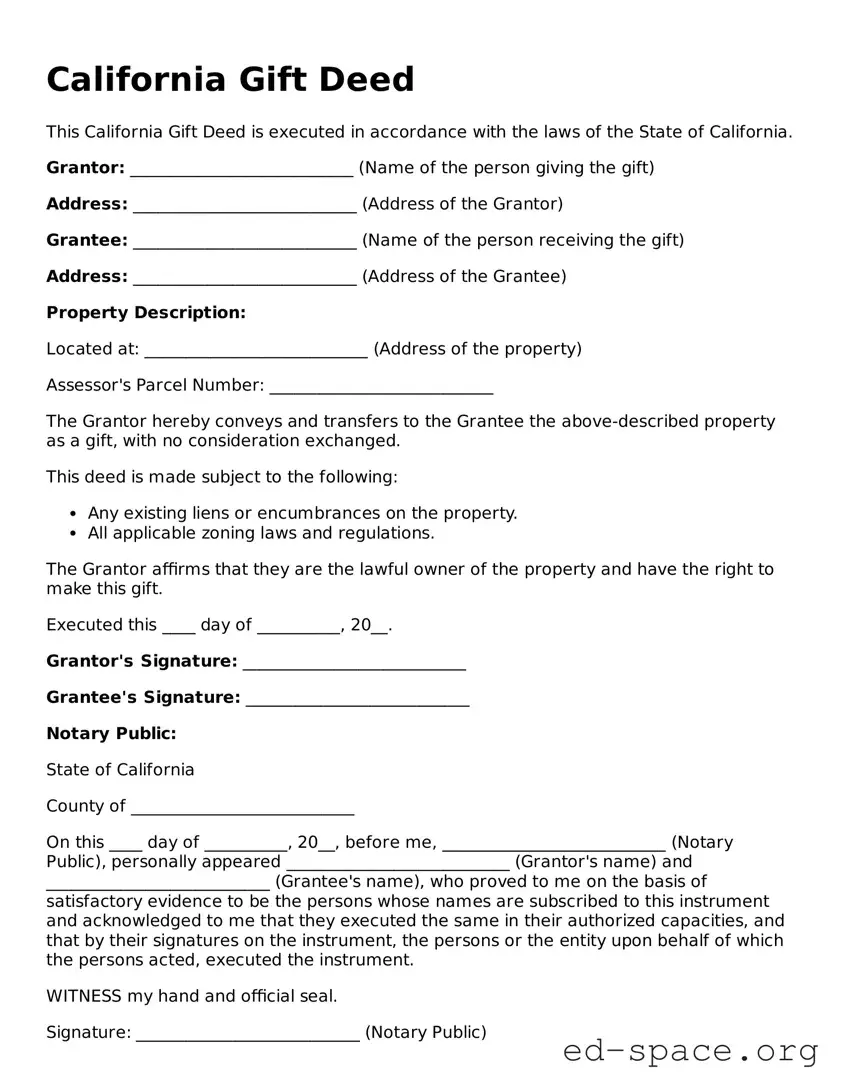
The California Gift Deed form serves as a crucial legal document for individuals wishing to transfer property without any exchange of money. This form allows the donor to convey ownership of real estate to a recipient, known as the grantee, as a gift. It is essential to note that the Gift Deed must be executed voluntarily and without any expectation of compensation. The document typically includes details such as the names of both parties, a description of the property being gifted, and the date of the transfer. To ensure validity, the form requires notarization, which adds a layer of authenticity to the transaction. Additionally, understanding the tax implications associated with gifting property is vital, as the donor may need to file a gift tax return depending on the property's value. Overall, the California Gift Deed form simplifies the process of property transfer between individuals, making it a valuable tool for estate planning and personal transactions.
California Gift Deed
This California Gift Deed is executed in accordance with the laws of the State of California.
Grantor: ___________________________ (Name of the person giving the gift)
Address: ___________________________ (Address of the Grantor)
Grantee: ___________________________ (Name of the person receiving the gift)
Address: ___________________________ (Address of the Grantee)
Property Description:
Located at: ___________________________ (Address of the property)
Assessor's Parcel Number: ___________________________
The Grantor hereby conveys and transfers to the Grantee the above-described property as a gift, with no consideration exchanged.
This deed is made subject to the following:
The Grantor affirms that they are the lawful owner of the property and have the right to make this gift.
Executed this ____ day of __________, 20__.
Grantor's Signature: ___________________________
Grantee's Signature: ___________________________
Notary Public:
State of California
County of ___________________________
On this ____ day of __________, 20__, before me, ___________________________ (Notary Public), personally appeared ___________________________ (Grantor's name) and ___________________________ (Grantee's name), who proved to me on the basis of satisfactory evidence to be the persons whose names are subscribed to this instrument and acknowledged to me that they executed the same in their authorized capacities, and that by their signatures on the instrument, the persons or the entity upon behalf of which the persons acted, executed the instrument.
WITNESS my hand and official seal.
Signature: ___________________________ (Notary Public)
| Fact Name | Description |
|---|---|
| Definition | A California Gift Deed is a legal document used to transfer property ownership as a gift without any exchange of money. |
| Governing Law | The California Gift Deed is governed by California Civil Code Section 11911. |
| Requirements | The deed must be in writing, signed by the donor (the person giving the gift), and must be notarized. |
| Consideration | Unlike other property transfers, a Gift Deed does not require consideration (payment) to be valid. |
| Tax Implications | Gift deeds may have tax implications for both the donor and the recipient, including potential gift tax obligations. |
| Revocation | A Gift Deed is generally irrevocable once executed, meaning the donor cannot take back the gift. |
| Recording | To ensure the transfer is recognized legally, the Gift Deed should be recorded with the county recorder's office where the property is located. |
Once you have your California Gift Deed form ready, you can begin filling it out. This process involves providing accurate information about the property and the parties involved. Make sure you have all the necessary details at hand to ensure a smooth completion.
What is a California Gift Deed?
A California Gift Deed is a legal document used to transfer ownership of real property from one individual to another without any exchange of money. This type of deed is often utilized when a property owner wishes to give their property to a family member or friend as a gift. The deed outlines the details of the transfer, including the names of the giver (grantor) and the recipient (grantee), as well as a description of the property being transferred. It is important to note that while the transfer is made without consideration, the grantee may still be responsible for property taxes and other obligations associated with ownership.
Do I need to use a specific form for the Gift Deed?
Yes, California has specific requirements for a Gift Deed. While there is no official state form mandated, it is advisable to use a template that includes all necessary elements to ensure that the deed is legally binding. This typically includes the names and addresses of both the grantor and grantee, a legal description of the property, and a statement indicating that the property is being given as a gift. Additionally, the document must be signed by the grantor and notarized to be valid. Using a well-structured template can help avoid potential issues in the future.
Are there tax implications when using a Gift Deed in California?
Yes, there can be tax implications associated with transferring property through a Gift Deed. While the recipient does not pay taxes at the time of the gift, the transfer may be subject to gift tax regulations. The IRS allows individuals to give a certain amount each year to another individual without incurring gift tax. However, if the value of the property exceeds this annual exclusion amount, the grantor may need to file a gift tax return. Additionally, when the grantee eventually sells the property, they may face capital gains taxes based on the property's appreciated value. It is wise to consult with a tax professional to understand these implications fully.
Can I revoke a Gift Deed after it has been executed?
Once a Gift Deed has been executed and recorded, it generally cannot be revoked or undone. The act of gifting is considered a completed transaction, and the property is legally transferred to the grantee. However, if the grantor wishes to retain some control over the property, they may consider other options, such as placing the property in a trust. If the grantor is concerned about future needs or changes in circumstances, discussing these options with a legal professional can provide clarity and guidance on how to protect their interests.
How do I record a Gift Deed in California?
To officially record a Gift Deed in California, the completed and signed document must be submitted to the county recorder's office in the county where the property is located. There may be a small fee associated with the recording process. It is crucial to ensure that the deed is properly notarized before submission, as this adds a layer of authenticity. Once recorded, the Gift Deed becomes a matter of public record, which helps to protect the grantee's ownership rights and provides notice to any future buyers or lenders regarding the property's status.
Incorrect Property Description: Failing to provide a clear and accurate description of the property can lead to confusion. It's essential to include the correct address and legal description to avoid disputes.
Missing Signatures: Both the donor and the recipient must sign the form. Omitting one of these signatures can invalidate the deed.
Not Notarizing the Document: A Gift Deed typically requires notarization. Neglecting this step can result in the deed not being recognized by the county.
Improper Completion of the Date: The date on which the gift is made should be clearly indicated. An incorrect or missing date can create legal complications.
Failure to Consider Tax Implications: Not being aware of potential gift tax consequences can lead to unexpected financial burdens. It's advisable to consult with a tax professional.
Neglecting to File with the County: After completing the Gift Deed, it must be filed with the appropriate county office. Failing to do so can result in challenges to the transfer of ownership.
When preparing a California Gift Deed, several other forms and documents may also be necessary to ensure a smooth transfer of property. These documents help clarify the intentions of the parties involved and provide legal protection. Below are some commonly used forms that complement the Gift Deed.
Each of these documents plays a vital role in the property transfer process. Properly completing and submitting them can help prevent potential legal issues and ensure that the gift is recognized by relevant authorities.
A Gift Deed is a legal document that transfers ownership of property or assets from one person to another without any exchange of money. Several other documents serve similar purposes in property and asset transfer. Here are eight documents that share similarities with a Gift Deed:
When filling out the California Gift Deed form, attention to detail is crucial. Here are some essential dos and don'ts to keep in mind:
Understanding the California Gift Deed form is essential for anyone considering transferring property as a gift. However, several misconceptions can lead to confusion. Here are eight common misconceptions:
Filling out and using the California Gift Deed form involves several important considerations. Here are key takeaways to keep in mind: