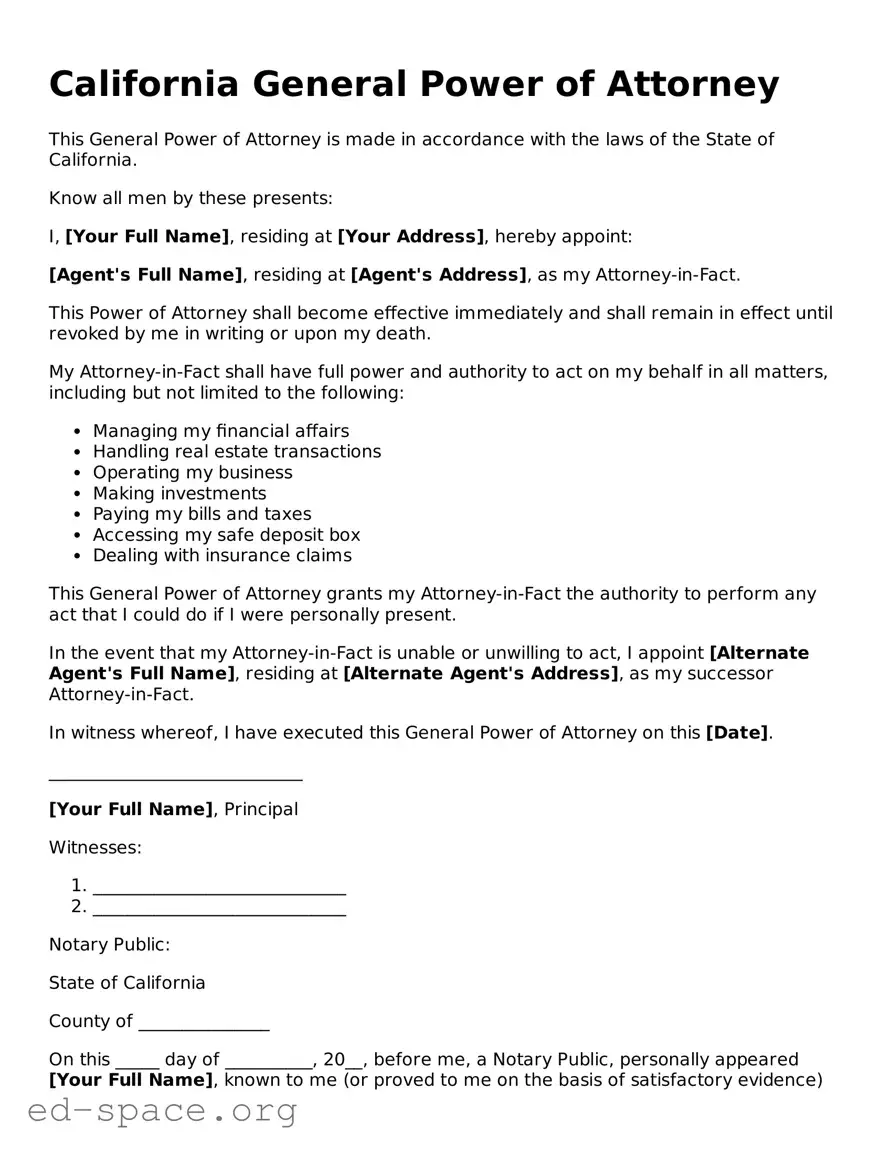
The California General Power of Attorney form is a crucial legal document that allows individuals to appoint someone they trust to handle their financial and legal matters on their behalf. This form grants broad authority to the designated agent, enabling them to manage tasks such as paying bills, managing investments, and handling real estate transactions. It is particularly useful in situations where the principal may be unable to make decisions due to illness, absence, or incapacity. The form must be completed with careful attention to detail, ensuring that the powers granted align with the principal's wishes. Additionally, the General Power of Attorney can be tailored to be effective immediately or to take effect only upon the principal's incapacitation. Understanding the implications of this form is essential, as it can significantly impact the management of one’s affairs and the authority given to the agent. Proper execution and notarization of the document are also necessary to ensure its validity and enforceability under California law.
California General Power of Attorney
This General Power of Attorney is made in accordance with the laws of the State of California.
Know all men by these presents:
I, [Your Full Name], residing at [Your Address], hereby appoint:
[Agent's Full Name], residing at [Agent's Address], as my Attorney-in-Fact.
This Power of Attorney shall become effective immediately and shall remain in effect until revoked by me in writing or upon my death.
My Attorney-in-Fact shall have full power and authority to act on my behalf in all matters, including but not limited to the following:
This General Power of Attorney grants my Attorney-in-Fact the authority to perform any act that I could do if I were personally present.
In the event that my Attorney-in-Fact is unable or unwilling to act, I appoint [Alternate Agent's Full Name], residing at [Alternate Agent's Address], as my successor Attorney-in-Fact.
In witness whereof, I have executed this General Power of Attorney on this [Date].
_____________________________
[Your Full Name], Principal
Witnesses:
Notary Public:
State of California
County of _______________
On this _____ day of __________, 20__, before me, a Notary Public, personally appeared [Your Full Name], known to me (or proved to me on the basis of satisfactory evidence) to be the person whose name is subscribed to the within instrument, and acknowledged that he/she executed the same.
_____________________________
Notary Public Signature
My Commission Expires: ________________
| Fact Name | Description |
|---|---|
| Definition | A California General Power of Attorney allows an individual to designate another person to act on their behalf in financial matters. |
| Governing Law | This form is governed by the California Probate Code, specifically Sections 4000 to 4545. |
| Principal | The person granting authority is referred to as the principal. |
| Agent | The individual receiving authority is known as the agent or attorney-in-fact. |
| Durability | The power of attorney can be durable, meaning it remains effective even if the principal becomes incapacitated. |
| Revocation | The principal can revoke the power of attorney at any time, as long as they are competent to do so. |
| Notarization | Although notarization is not mandatory, it is highly recommended to prevent disputes regarding the document's validity. |
| Limitations | The agent cannot make healthcare decisions unless specifically granted authority in a separate healthcare power of attorney. |
| Filing Requirement | There is no requirement to file the power of attorney with any court; however, it should be kept in a safe place. |
After obtaining the California General Power of Attorney form, you will need to fill it out carefully. This document allows someone to act on your behalf in various matters. Follow the steps below to complete the form accurately.
Once completed, keep a copy for your records and provide a copy to your agent. You may also want to share it with relevant institutions or individuals who may need to recognize the authority of your agent.
What is a General Power of Attorney in California?
A General Power of Attorney (GPOA) in California is a legal document that allows one person, known as the agent or attorney-in-fact, to act on behalf of another person, called the principal. This authority can cover a wide range of financial and legal decisions, including managing bank accounts, signing contracts, and handling real estate transactions.
Who can create a General Power of Attorney in California?
Any adult who is mentally competent can create a General Power of Attorney in California. This means that the person must understand the nature and consequences of the document they are signing. It is important that the principal is not under duress or undue influence when creating the GPOA.
What powers can be granted in a General Power of Attorney?
The powers granted in a General Power of Attorney can be quite broad. They may include the ability to manage financial affairs, make healthcare decisions, handle real estate transactions, and conduct business operations. However, it is essential for the principal to specify the powers they wish to grant to their agent clearly.
Does a General Power of Attorney need to be notarized in California?
Yes, in California, a General Power of Attorney must be notarized to be legally valid. This means that the principal must sign the document in the presence of a notary public, who will then add their seal. This step helps ensure that the document is authentic and that the principal was not coerced into signing.
Can I revoke a General Power of Attorney once it is created?
Yes, the principal can revoke a General Power of Attorney at any time as long as they are mentally competent. To revoke the GPOA, the principal should create a written revocation and notify the agent and any institutions or individuals who may have relied on the original document. It is advisable to keep a copy of the revocation for personal records.
What happens if the principal becomes incapacitated?
If the principal becomes incapacitated, the General Power of Attorney typically remains in effect unless it is specifically stated that it becomes void upon incapacity. However, many people choose to create a Durable Power of Attorney, which remains valid even if the principal can no longer make decisions for themselves.
Can I appoint more than one agent in a General Power of Attorney?
Yes, you can appoint more than one agent in a General Power of Attorney. You can specify whether they must act together or if they can act independently. Having multiple agents can provide a system of checks and balances, but it can also lead to confusion if the agents do not agree on decisions.
Is a General Power of Attorney effective immediately?
Yes, a General Power of Attorney is typically effective immediately upon signing, unless the principal specifies a different effective date. This means that the agent can start making decisions on behalf of the principal right away. If the principal prefers, they can create a springing power of attorney that only becomes effective under certain conditions, such as incapacitation.
What should I consider before creating a General Power of Attorney?
Before creating a General Power of Attorney, consider the level of trust you have in the person you are appointing as your agent. It is crucial to choose someone who will act in your best interest. Additionally, think about the specific powers you want to grant and ensure that the document is drafted clearly to avoid any misunderstandings.
Where can I obtain a General Power of Attorney form in California?
You can obtain a General Power of Attorney form from various sources, including legal stationery stores, online legal service providers, or through a lawyer. It is important to ensure that the form complies with California state laws. Consulting with a legal professional can provide guidance tailored to your specific situation.
Failing to specify the powers granted: Many individuals overlook the importance of clearly stating the specific powers they wish to grant to their agent. This can lead to confusion and potential disputes later on.
Not signing the form in front of a notary: A common mistake is neglecting to have the document notarized. In California, the General Power of Attorney must be signed in the presence of a notary public to be considered valid.
Inadequate identification of the agent: It is crucial to provide complete and accurate information about the agent, including their full name and address. Missing details can render the document ineffective.
Using outdated forms: People sometimes use older versions of the General Power of Attorney form, which may not comply with current laws. Always ensure that the most recent version is being utilized.
Overlooking the revocation of previous powers of attorney: If there are existing powers of attorney, failing to revoke them can create conflicts. It is essential to indicate that previous documents are no longer valid when executing a new one.
The California General Power of Attorney form serves as a vital legal document that allows one person to appoint another to act on their behalf in various matters. However, it is often used alongside several other forms and documents to ensure comprehensive management of personal, financial, and health-related decisions. Below is a list of commonly associated documents that complement the General Power of Attorney.
Understanding these documents and their purposes can significantly enhance the effectiveness of a General Power of Attorney. Each serves a unique function, and together they create a robust framework for managing personal and financial affairs, ensuring that individuals’ wishes are honored even in challenging circumstances.
The General Power of Attorney (GPOA) form allows an individual, known as the principal, to grant authority to another person, called the agent, to act on their behalf in a variety of matters. This document is similar to several other legal forms, each serving a specific purpose but sharing the common theme of delegating authority. Below are ten documents that are similar to the General Power of Attorney form:
Each of these documents serves a unique purpose but shares the fundamental idea of empowering someone to act on behalf of another. Understanding these similarities can help individuals choose the right document for their specific needs.
When filling out the California General Power of Attorney form, it’s important to follow certain guidelines to ensure everything is completed correctly. Here are some dos and don'ts to keep in mind:
Following these guidelines will help ensure that your General Power of Attorney form is valid and effective.
When it comes to the California General Power of Attorney (GPOA) form, many people harbor misconceptions that can lead to confusion or even legal issues. Here are five common misunderstandings:
Many believe that a GPOA is solely for financial matters. While it does allow an agent to handle financial transactions, it can also include decisions about health care, property management, and other personal affairs, depending on how it is drafted.
This is a frequent misconception. A standard GPOA typically becomes invalid if the principal becomes incapacitated. To ensure that your agent can act on your behalf during such times, you would need a durable power of attorney.
While notarization is highly recommended to avoid disputes, it is not strictly required for a GPOA to be legally valid in California. However, having it notarized can provide an extra layer of protection and credibility.
While you can choose almost anyone to be your agent, they must be at least 18 years old and mentally competent. It’s also wise to select someone you trust implicitly, as they will have significant control over your affairs.
This is simply not true. A GPOA can be revoked or modified at any time, as long as the principal is competent. It’s important to regularly review and update your documents to reflect your current wishes.
Understanding these misconceptions can help you make informed decisions about your legal documents and ensure that your intentions are carried out effectively.
Filling out and using the California General Power of Attorney form can be a straightforward process if you keep a few key points in mind. Here are some essential takeaways: