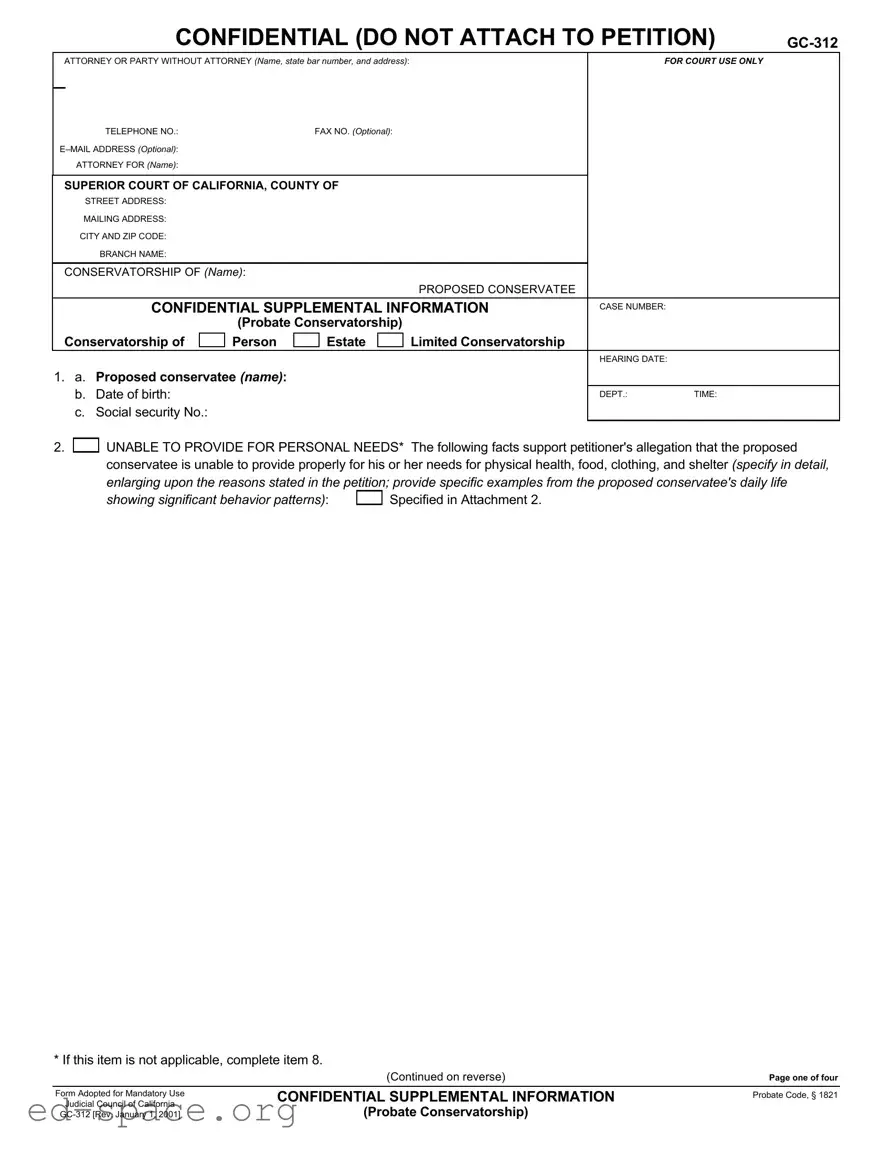
The California GC-312 form serves as a vital document in the context of conservatorship proceedings, specifically designed to provide confidential supplemental information about a proposed conservatee. This form is not attached to the main petition but is crucial for the court's understanding of the individual's needs and circumstances. It includes sections that detail the proposed conservatee's inability to provide for personal needs and manage financial resources, offering specific examples from their daily life to illustrate significant behavior patterns. Furthermore, the form requires information about the proposed conservatee's residence, outlining whether they can continue living there or if a move is necessary upon the appointment of a conservator. Alternatives to conservatorship must also be considered, with the petitioner required to explain why such options are unsuitable or unavailable. The form emphasizes the importance of documenting any health and social services provided to the proposed conservatee in the year prior to filing the petition. Additionally, the petitioner must affirm the accuracy of the information provided through declarations and affidavits, ensuring the court has a comprehensive view of the situation at hand. Each section is designed to gather essential details that aid the court in making informed decisions regarding the conservatorship, ultimately prioritizing the well-being of the proposed conservatee.

CONFIDENTIAL (DO NOT ATTACH TO PETITION)
ATTORNEY OR PARTY WITHOUT ATTORNEY (Name, state bar number, and address): |
FOR COURT USE ONLY |
TELEPHONE NO.: |
FAX NO. (Optional): |
|
|
ATTORNEY FOR (Name): |
|
SUPERIOR COURT OF CALIFORNIA, COUNTY OF |
|
|
|||||
STREET ADDRESS: |
|
|
|
|
|
|
|
MAILING ADDRESS: |
|
|
|
|
|
|
|
CITY AND ZIP CODE: |
|
|
|
|
|
|
|
BRANCH NAME: |
|
|
|
|
|
|
|
|
|
|
|
|
|
||
CONSERVATORSHIP OF (Name): |
|
|
|
|
|
||
|
|
|
|
|
|
PROPOSED CONSERVATEE |
|
CONFIDENTIAL SUPPLEMENTAL INFORMATION |
CASE NUMBER: |
||||||
|
|
(Probate Conservatorship) |
|
|
|||
Conservatorship of |
|
Person |
|
Estate |
|
Limited Conservatorship |
|
|
|
|
|
||||
|
|
|
|
|
|
|
|
|
|
|
|
|
|
|
HEARING DATE: |
1.a. Proposed conservatee (name):
b. Date of birth: |
DEPT.: |
TIME: |
c.Social security No.:
2. UNABLE TO PROVIDE FOR PERSONAL NEEDS* The following facts support petitioner's allegation that the proposed conservatee is unable to provide properly for his or her needs for physical health, food, clothing, and shelter (specify in detail,
enlarging upon the reasons stated in the petition; provide specific examples from the proposed conservatee's daily life
showing significant behavior patterns): |
|
Specified in Attachment 2. |
* If this item is not applicable, complete item 8.
|
(Continued on reverse) |
Page one of four |
|
|
|
Form Adopted for Mandatory Use |
CONFIDENTIAL SUPPLEMENTAL INFORMATION |
Probate Code, § 1821 |
Judicial Council of California |
|
|
(Probate Conservatorship) |
|
|
|

CONFIDENTIAL
CONSERVATORSHIP OF (Name):
PROPOSED CONSERVATEE
CASE NUMBER:
3. |
|
UNABLE TO MANAGE FINANCIAL RESOURCES* The following facts support petitioner's allegation that the proposed |
||
|
|
conservatee is substantially unable to manage his or her financial resources or to resist fraud or undue influence (specify in |
||
|
|
detail, enlarging upon the reasons stated in the petition; provide specific examples from the proposed conservatee's daily life |
||
|
|
showing significant behavior patterns): |
|
Specified in Attachment 3. |
4.RESIDENCE ("Residence" means the place usually described as "home"; for example, owned real property or
b. The proposed conservatee's residence is* |
|
the address in item 4a |
|
other (street address, city, state): |
c.Ability to live in residence* The proposed conservatee is
(1) |
|
living in his or her residence and |
||
|
|
(a) |
|
will continue to live there unless circumstances change. |
|
|
|
||
(b) will need to be moved after a conservator is appointed (specify supporting facts below in item 4c(3)).
(c) other (specify and give supporting facts below in item 4c(3)).
* If this item is not applicable, complete item 8.
(Continued on page three)
CONFIDENTIAL SUPPLEMENTAL INFORMATION |
Page two of four
(Probate Conservatorship)

CONFIDENTIAL
CONSERVATORSHIP OF (Name):
PROPOSED CONSERVATEE
CASE NUMBER:
4.c. (continued)
(2) |
|
not living in his or her residence and |
|
|
||
|
|
(a) |
|
will return by (date): |
|
(specify supporting facts below in item 4c(3)). |
|
|
|
|
|||
|
|
|
|
|
|
|
|
|
(b) |
|
will not return to live there (specify supporting facts below in item 4c(3)). |
||
|
|
|
|
|
|
|
|
|
(c) |
|
other (specify and give supporting facts below in item 4c(3)). |
||
(3) |
|
Supporting facts (specify if required): |
|
Specified in Attachment 4c. |
||
|
|
|||||
5.ALTERNATIVES TO CONSERVATORSHIP* Petitioner has considered the following alternatives to conservatorship and found them to be unsuitable or unavailable to the proposed conservatee (specify the alternatives considered and the reason or reasons
each is unsuitable or unavailable): |
|
Reasons specified in Attachment 5. |
a.Voluntary acceptance of informal or formal assistance (give reason this is unsuitable or unavailable):
b.Special or limited power of attorney (give reason this is unsuitable or unavailable):
c.General power of attorney (give reason this is unsuitable or unavailable):
d. Durable power of attorney for |
|
health care |
|
estate management (give reason this is unsuitable or unavailable): |
e.Trust (give reason this is unsuitable or unavailable):
f.Other alternatives considered (specify and give reason each is unsuitable or unavailable):
6.SERVICES PROVIDED* (complete a or b, or both a and b)
a. During the year before this petition was filed,
(1) health services |
|
were provided |
|
were not provided |
to the proposed conservatee (explain): |
||
|
|
Explained in Attachment 6a(1). |
|
|
|
||
|
|
|
|
|
|||
(2) social services |
|
were provided |
Explained in Attachment 6a(2).
were not provided |
to the proposed conservatee (explain): |
* If this item is not applicable, complete item 8.
(Continued on page four)
CONFIDENTIAL SUPPLEMENTAL INFORMATION |
Page three of four
(Probate Conservatorship)

CONFIDENTIAL
CONSERVATORSHIP OF (Name):
PROPOSED CONSERVATEE
CASE NUMBER:
6. a. (continued) |
|
|||
(3) estate management assistance |
|
was provided |
||
|
conservatee (explain): |
|
||
|
|
Explained in Attachment 6a(3). |
|
|
|
|
|
||
was not provided to the proposed
b. |
|
Petitioner has no knowledge of what |
|
social services |
|
health services |
|
estate management |
assistance was provided to the proposed conservatee during the year before this petition was filed. Petitioner has no reasonable means of determining what services were provided.
7. |
SUPPORTING FACTS (AFFIDAVITS) The information provided above is stated |
||||||||||||||||
|
a. |
Item 1: |
|
|
|
on petitioner's own knowledge |
|
|
in an affidavit (declaration) by another person attached as Attachment 1a. |
||||||||
|
|
|
|
|
|
|
|
|
|
|
|
|
|
|
|
|
|
|
b. |
Item 2: |
|
|
|
on petitioner's own knowledge |
|
|
in an affidavit (declaration) by another person attached as Attachment 2a. |
||||||||
|
|
|
|
|
|
|
|
|
|
|
|
|
|
|
|
|
|
|
c. |
Item 3: |
|
|
|
on petitioner's own knowledge |
|
|
in an affidavit (declaration) by another person attached as Attachment 3a. |
||||||||
|
|
|
|
|
|
|
|
|
|
|
|
|
|
|
|
|
|
|
d. |
Item 4: |
|
|
|
on petitioner's own knowledge |
|
|
in an affidavit (declaration) by another person attached as Attachment 4a. |
||||||||
|
|
|
|
|
|
|
|
|
|
|
|
|
|
|
|
|
|
|
e. |
Item 5: |
|
|
|
on petitioner's own knowledge |
|
|
in an affidavit (declaration) by another person attached as Attachment 5a. |
||||||||
|
|
|
|
|
|
|
|
|
|
|
|
|
|
|
|
|
|
8. |
f. |
Item 6: |
|
|
|
on petitioner's own knowledge |
|
|
in an affidavit (declaration) by another person attached as Attachment 6a. |
||||||||
ITEMS NOT APPLICABLE |
The following items on this form were not applicable to the proposed conservatee: |
||||||||||||||||
|
|
|
2 |
|
|
3 |
|
|
4b |
|
4c |
|
5 |
|
|
6 (specify reasons each item is not applicable): |
|
|
|
|
Reasons specified in Attachment 8. |
|
|
|
|
|
|||||||||
|
|
|
|
|
|
|
|
||||||||||
9. Number of pages attached: _____
DECLARATION
I declare under penalty of perjury under the laws of the State of California that the foregoing is true and correct.
Date:
(TYPE OR PRINT NAME) |
(SIGNATURE OF PETITIONER) |
CONFIDENTIAL SUPPLEMENTAL INFORMATION |
Page four of four
(Probate Conservatorship)
| Fact Name | Details |
|---|---|
| Purpose | The GC-312 form is used in California for providing confidential supplemental information in conservatorship cases. |
| Governing Law | This form is governed by the California Probate Code, specifically section 1821. |
| Confidentiality | Information provided on the GC-312 is confidential and should not be attached to the petition. |
| Use Cases | It is utilized to demonstrate a proposed conservatee's inability to provide for personal needs or manage financial resources. |
| Attachments | The form allows for attachments to provide detailed explanations and supporting facts for the claims made. |
Completing the California GC-312 form is a crucial step in the conservatorship process. This form requires detailed information about the proposed conservatee and the reasons for seeking conservatorship. Accurate and thorough completion is essential to ensure that the court has all the necessary information to make an informed decision.
What is the purpose of the California GC 312 form?
The California GC 312 form is used in probate conservatorship cases. It provides confidential supplemental information about a proposed conservatee, who is an individual that may need assistance managing personal and financial matters. This form is crucial for the court to assess the need for a conservatorship and to understand the specific needs and circumstances of the proposed conservatee.
Who needs to fill out the GC 312 form?
The form must be completed by the petitioner, who is typically the person seeking the conservatorship. This may include family members or other interested parties who believe that the proposed conservatee cannot manage their own personal or financial affairs. The petitioner must provide detailed information to support their request for conservatorship.
What information is required on the GC 312 form?
The GC 312 form requires several key pieces of information. It includes details about the proposed conservatee, such as their name, date of birth, and social security number. The petitioner must also describe the proposed conservatee's inability to provide for their personal needs and manage financial resources. Additionally, the form asks for information about the proposed conservatee's residence, alternatives to conservatorship that were considered, and any services provided to them in the past year.
What happens if certain items on the form are not applicable?
If any items on the GC 312 form do not apply to the proposed conservatee, the petitioner must indicate this in the designated section. They should specify the reasons why each item is not applicable, which helps the court understand the context and ensures that the information provided is accurate and relevant to the case.
Are there any attachments required with the GC 312 form?
Yes, the GC 312 form may require attachments to provide further detail and support for the statements made. The petitioner must reference these attachments in the appropriate sections of the form. For example, if the petitioner discusses specific examples of the proposed conservatee's behavior patterns, they should include those details in the designated attachment.
Is the information on the GC 312 form public?
No, the information provided on the GC 312 form is confidential. It is important that this form is not attached to the petition filed with the court. This confidentiality is intended to protect the privacy of the proposed conservatee and ensure sensitive information is not publicly disclosed.
What is the declaration at the end of the GC 312 form?
The declaration at the end of the GC 312 form is a statement made by the petitioner affirming that the information provided is true and correct to the best of their knowledge. This declaration is made under penalty of perjury, emphasizing the importance of honesty and accuracy in the information submitted to the court.
Not providing complete information about the proposed conservatee. This includes failing to include the full name, date of birth, and social security number.
Overlooking the requirement to specify details in attachments. Each section that requires elaboration must have supporting facts detailed in the appropriate attachments.
Failing to consider alternatives to conservatorship. Applicants must list all alternatives that were considered and explain why they are unsuitable or unavailable.
Leaving out the address of the proposed conservatee's residence. This information is crucial and must be accurate to avoid delays in processing the form.
Not attaching necessary affidavits or declarations. Each item that relies on another person's knowledge must be supported by an affidavit attached to the form.
Ignoring the declaration section. The petitioner must sign and date the form, confirming that the information provided is true and correct.
The California GC-312 form is an important document used in the conservatorship process, particularly for providing supplemental information about a proposed conservatee. When filing this form, several other documents are often required to support the petition. Below is a list of commonly used forms that accompany the GC-312.
Each of these forms plays a crucial role in the conservatorship process, helping to protect the rights and well-being of the proposed conservatee. Proper completion and submission of these documents can facilitate a smoother legal process.
The California GC-312 form is a crucial document used in conservatorship proceedings, specifically for providing confidential supplemental information about a proposed conservatee. Several other documents share similarities with the GC-312 form in terms of purpose, structure, or the information they gather. Here’s a list of seven documents that are comparable to the GC-312 form:
Each of these documents plays a vital role in the conservatorship process, ensuring that the needs and rights of the proposed conservatee are thoroughly considered and protected.
When filling out the California GC-312 form, it is essential to approach the task with care and attention to detail. Here are some important dos and don'ts to consider:
By following these guidelines, you can help ensure that the process runs smoothly and that the needs of the proposed conservatee are adequately addressed.
Understanding the California GC 312 form can be challenging, and several misconceptions can lead to confusion. Here are seven common misunderstandings about this form:
By clarifying these misconceptions, individuals can approach the GC 312 form with a better understanding, ensuring a smoother process in conservatorship matters.
The California GC-312 form is crucial for initiating a conservatorship case. It provides the court with detailed information about the proposed conservatee's needs and circumstances.
This form must be filled out with care, as it requires specific examples and detailed explanations of the proposed conservatee's inability to manage personal and financial needs.
Confidentiality is key. Ensure that this form is not attached to the petition when submitted, as it contains sensitive information.
Supporting facts are essential. Each claim made in the form should be backed by affidavits or declarations from knowledgeable individuals, which should be attached as specified.
Consider alternatives to conservatorship. The form requires you to outline any alternatives that were evaluated and explain why they were deemed unsuitable.
Pay attention to the residence section. Clearly state where the proposed conservatee currently resides and any relevant details about their living situation.
Finally, ensure all attachments are numbered correctly. The form allows for additional pages, and keeping them organized will help streamline the process for the court.