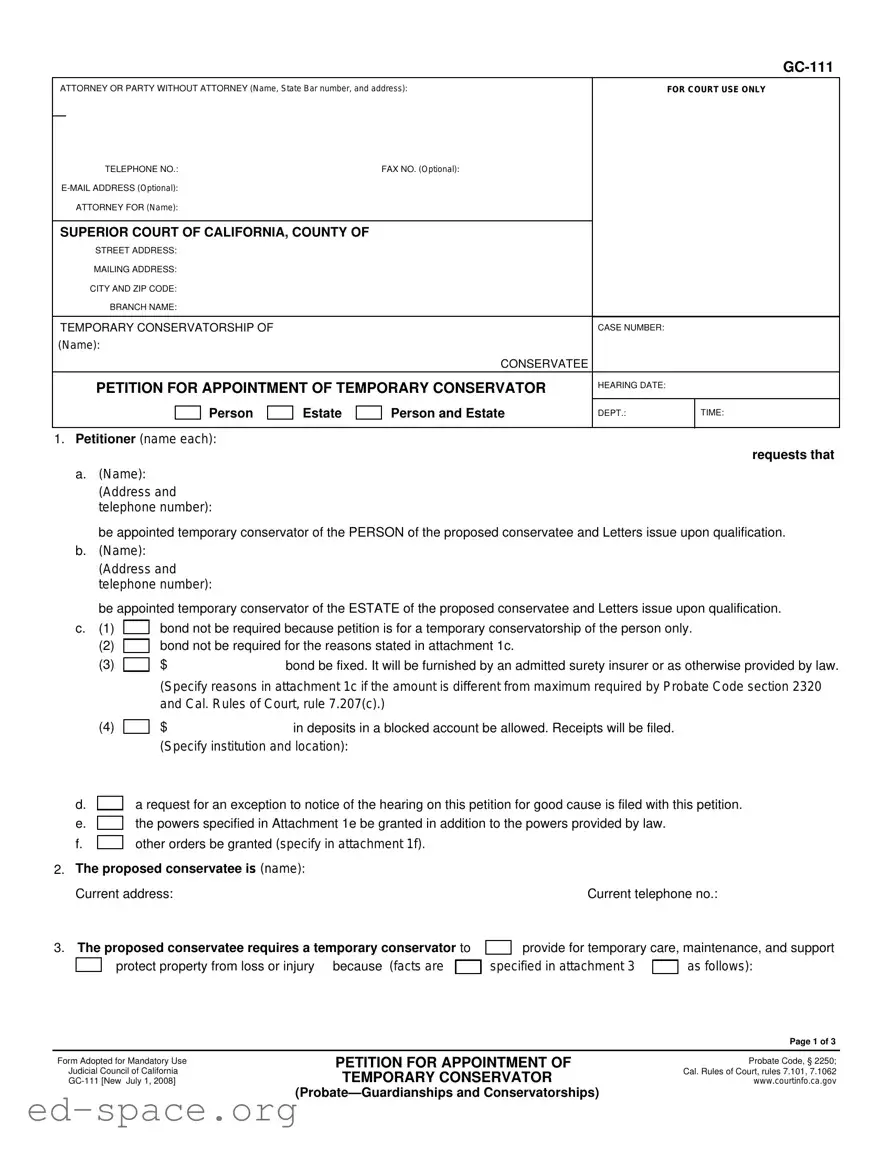
The California GC-111 form plays a crucial role in the legal process of establishing a temporary conservatorship, which is often necessary when an individual is unable to manage their own affairs due to incapacity. This form is designed for use in the Superior Court of California and outlines the petitioner's request for the appointment of a temporary conservator to protect the personal and/or estate interests of a proposed conservatee. Key aspects of the GC-111 include identifying the proposed conservatee, detailing the reasons for requiring a temporary conservator, and specifying the powers and responsibilities that the conservator will assume. The form also allows for requests regarding bond requirements, changes to the conservatee's residence, and the necessity of notifying relevant parties about the hearing. By completing this form, petitioners can initiate the legal process to ensure that vulnerable individuals receive the care and protection they need during times of uncertainty.

ATTORNEY OR PARTY WITHOUT ATTORNEY (Name, State Bar number, and address): |
FOR COURT USE ONLY |
|
|
|
|
TELEPHONE NO.: |
FAX NO. (Optional): |
|
|
ATTORNEY FOR (Name): |
|
SUPERIOR COURT OF CALIFORNIA, COUNTY OF |
|
|
|
|
|||||
STREET ADDRESS: |
|
|
|
|
|
|
|||
MAILING ADDRESS: |
|
|
|
|
|
|
|||
CITY AND ZIP CODE: |
|
|
|
|
|
|
|||
BRANCH NAME: |
|
|
|
|
|
|
|||
|
|
|
|
|
|
|
|
|
|
TEMPORARY CONSERVATORSHIP OF |
|
|
|
|
CASE NUMBER: |
|
|||
(Name): |
|
|
|
|
|
|
|||
|
|
|
|
|
|
CONSERVATEE |
|
|
|
PETITION FOR APPOINTMENT OF TEMPORARY CONSERVATOR |
HEARING DATE: |
|
|||||||
|
|
||||||||
|
|
|
|
|
|
|
|
|
|
|
|
Person |
|
Estate |
|
Person and Estate |
DEPT.: |
TIME: |
|
|
|
|
|
||||||
|
|
|
|
|
|
|
|
|
|
1. Petitioner (name each): |
|
|
|
|
|
|
|||
requests that
a.(Name):
(Address and telephone number):
be appointed temporary conservator of the PERSON of the proposed conservatee and Letters issue upon qualification.
b.(Name):
(Address and telephone number):
be appointed temporary conservator of the ESTATE of the proposed conservatee and Letters issue upon qualification.
c. (1) |
|
|
bond not be required because petition is for a temporary conservatorship of the person only. |
|
(2) |
|
|
bond not be required for the reasons stated in attachment 1c. |
|
|
|
|||
(3) |
|
|
|
|
|
$ |
bond be fixed. It will be furnished by an admitted surety insurer or as otherwise provided by law. |
||
|
|
|
(Specify reasons in attachment 1c if the amount is different from maximum required by Probate Code section 2320 |
|
|
|
|
and Cal. Rules of Court, rule 7.207(c).) |
|
(4) |
|
|
|
|
|
$ |
in deposits in a blocked account be allowed. Receipts will be filed. |
||
(Specify institution and location):
a request for an exception to notice of the hearing on this petition for good cause is filed with this petition. the powers specified in Attachment 1e be granted in addition to the powers provided by law.
other orders be granted (specify in attachment 1f).
2. |
The proposed conservatee is (name): |
|
|
|
|
|
|
|
||
|
Current address: |
|
|
|
|
Current telephone no.: |
||||
3. |
|
The proposed conservatee requires a temporary conservator to |
|
provide for temporary care, maintenance, and support |
||||||
|
|
|||||||||
|
|
|
protect property from loss or injury |
because (facts are |
|
|
specified in attachment 3 |
|
as follows): |
|
|
|
|
|
|
|
|||||
|
|
|
|
|
|
|
|
|
|
Page 1 of 3 |
|
|
|
|
|
|
|
|
|
|
|
|
|
|
|
|
|
|
||||
Form Adopted for Mandatory Use |
PETITION FOR APPOINTMENT OF |
|
Probate Code, § 2250; |
|||||||
|
|
|
|
|
|
|||||
|
Judicial Council of California |
TEMPORARY CONSERVATOR |
|
Cal. Rules of Court, rules 7.101, 7.1062 |
||||||
|
|
www.courtinfo.ca.gov |
||||||||

TEMPORARY CONSERVATORSHIP OF
(Name):
CONSERVATEE
CASE NUMBER:
4.Temporary conservatorship is required
5.
a. |
|
|
|
|
pending the hearing on the petition for appointment of a general conservator. |
|
|
|
|
||||
|
|
|
|
|
|
|
b. |
|
|
|
|
pending the appeal under Probate Code section 1301. |
|
|
|
|
|
|
||
c. |
|
|
|
|
during the suspension of powers of the conservator. |
|
|
|
|
|
|
||
|
|
|
Character and estimated value of the property of the estate (complete if a temporary conservatorship of the estate or the |
|||
|
|
|
||||
|
|
|
person and estate is requested): |
|
||
a. |
|
Personal property: |
$ |
|||
b. Annual gross income from all sources, including real and |
|
|||||
|
|
personal property, wages, pensions, and public benefits: |
$ |
|||
c.Additional amount for cost of recovery on the bond, calculated as
required under Cal. Rules of Court, rule 7.207(c): |
$ |
|
d.
6.
a.
b.
Total: |
$ |
Petitioner requests authority to change the proposed conservatee's residence during the temporary conservatorship
Petitioner proposes to change the residence of the proposed conservatee to (address):
The proposed conservatee will suffer irreparable harm if his or her residence is not changed as requested and no means less restrictive of the proposed conservatee's liberty will suffice to prevent the harm because (reasons are
specified in attachment 6a |
|
as follows): |
The proposed conservatee must be removed from the State of California to permit the performance of the following nonpsychiatric medical treatment essential to the proposed conservatee's physical survival. The proposed conservatee
consents to this medical treatment. (Facts and place of treatment are |
|
specified in attachment 6b |
|
as follows): |
7.
|
Petitioner is a professional fiduciary |
|
|
a. |
Petitioner holds license no. (specify): |
from the Professional Fiduciaries Bureau of the Department |
|
|
of Consumer Affairs issued or last renewed on (specify later date of initial issuance or renewal): |
. |
|
b. |
Petitioner was requested to file this petition by (name): |
|
. |
c.The circumstances leading to petitioner's engagement to file this petition are described in attachment 7c.
d. |
Petitioner had: (1) |
|
No relationship to the proposed conservatee, his or her family, or his or her friends before |
|
|||
|
|
|
engagement to file this petition. |
|
|
|
|
|
(2) |
|
A relationship to the proposed conservatee, his or her family, or his or her friends before |
|
|||
|
|
|
|||||
|
|
|
engagement to file this petition. That relationship is described in |
|
attachment 7d. |
|
the |
|
|
|
|
|
|||
|
|
|
|
|
|
|
|
Petition for Appointment of Probate Conservator (form
PETITION FOR APPOINTMENT OF
TEMPORARY CONSERVATOR
Page 2 of 3

TEMPORARY CONSERVATORSHIP OF
(Name):
CONSERVATEE
CASE NUMBER:
8.Petitioner's contact with persons named in Petition for Appointment of Probate Conservator
a.
b.
c.
Petitioner is the proposed conservatee. (If this item is selected, go to item 9.)
Petitioner is not the proposed conservatee. All persons other than the proposed conservatee named in the Petition for Appointment of Probate Conservator filed with this petition:
(1) |
|
Have been found and contacted. All will be given notice of the hearing on this petition. |
(2) |
|
Have not been found or have not been contacted. Efforts to find the persons who have not been found and |
|
||
|
|
the reasons why any person cannot be contacted are described in one or more declarations under penalty of |
|
|
perjury attached to this petition as attachment 8b. (Attachment 8b is not a request for a good cause exception |
|
|
to notice. See Prob. Code, § 2250(e) and rule 7.1062 of the Cal. Rules of Court.) |
Petitioner is not the proposed conservatee. Facts showing the preferences of the proposed conservatee concerning the appointment of any temporary conservator, and the appointment of the temporary conservator proposed in this petition, or why it was not feasible to ascertain those preferences, are specified in one or more declarations attached to this petition as attachment 8c.
9.Petitioner is informed and believes that the proposed conservatee
|
a. |
|
|
will attend the hearing. |
|
|||
|
|
|
|
|
|
|
|
|
|
b. |
|
|
is able but unwilling to attend the hearing, does not wish to contest the establishment of a conservatorship, does not |
||||
|
|
|
|
|
object to the proposed conservator, and does not prefer that another person act as conservator. |
|
||
|
|
|
|
|
|
|
|
|
|
c. |
|
|
is unable to attend the hearing because of medical inability. An affidavit or certificate of a licensed medical |
|
|||
|
|
|
|
|
practitioner or an accredited religious practitioner is affixed as attachment 9c. |
|
||
|
|
|
|
|
|
|
|
|
|
d. |
|
|
is not the petitioner, is out of state, and will not attend the hearing. |
|
|||
10. |
|
|
|
Filed with this petition is a proposed Order Appointing Court Investigator (form |
|
|||
|
|
|
|
|||||
11. |
|
All attachments to this form are incorporated by this reference as though placed here in this form. There are |
|
|
pages |
|||
|
|
attached to this form. |
|
|||||
Date:
(SIGNATURE OF ATTORNEY*)
* (Signature of all petitioners also required (Prob. Code, § 1020).)
I declare under penalty of perjury under the laws of the State of California that the foregoing is true and correct. Date:
(TYPE OR PRINT NAME)
(SIGNATURE OF PETITIONER)
(TYPE OR PRINT NAME) |
(SIGNATURE OF PETITIONER) |
PETITION FOR APPOINTMENT OF
TEMPORARY CONSERVATOR
Page 3 of 3
| Fact Name | Description |
|---|---|
| Form Purpose | The GC-111 form is used to request the appointment of a temporary conservator for a person who is unable to manage their own affairs. |
| Governing Laws | This form is governed by the California Probate Code, specifically sections 2250 and 1301, as well as the California Rules of Court, rules 7.101 and 7.1062. |
| Eligibility | Any individual who believes that a person needs temporary assistance in managing their personal or financial matters can file this petition. |
| Required Information | The form requires details about the proposed conservatee, including their current address, and the reasons for requesting the conservatorship. |
| Temporary Nature | The conservatorship granted through this form is temporary, pending a hearing for a general conservatorship appointment. |
| Attachments | Various attachments may be required, such as declarations explaining the necessity for the conservatorship and the proposed conservatee's preferences. |
Filling out the California GC-111 form is an essential step in the process of petitioning for a temporary conservatorship. Once the form is completed, it will need to be filed with the appropriate court. Following submission, a hearing will be scheduled to review the petition and make a determination regarding the appointment of a temporary conservator.
What is the purpose of the California GC 111 form?
The California GC 111 form is used to petition for the appointment of a temporary conservator for an individual, referred to as the proposed conservatee. This form allows a petitioner to request the court to appoint someone to manage the personal or estate affairs of the proposed conservatee when immediate action is necessary to protect their interests.
Who can file a GC 111 form?
Any interested person, such as a family member, friend, or professional fiduciary, can file a GC 111 form. The petitioner must demonstrate a legitimate concern for the proposed conservatee's well-being and provide adequate reasons for needing a temporary conservatorship.
What information is required on the GC 111 form?
The form requires detailed information, including the names and contact information of the petitioner and proposed conservatee, the reasons for seeking a temporary conservatorship, and any relevant attachments that support the petition. Additionally, it asks for details about the proposed conservatee's property and any necessary medical treatment.
Is a bond required when filing the GC 111 form?
Whether a bond is required depends on the specific circumstances of the case. The petitioner can request that no bond be required if the petition is solely for the conservatorship of the person. If a bond is necessary, the petitioner must specify the amount and provide reasons for that amount in the form.
What happens after the GC 111 form is filed?
Once the GC 111 form is filed, the court will schedule a hearing. The petitioner must notify all relevant parties about the hearing date. During the hearing, the court will evaluate the petition and determine whether to grant the temporary conservatorship.
Can the proposed conservatee attend the hearing?
The proposed conservatee may attend the hearing unless they are unable due to medical reasons. The petitioner must indicate the proposed conservatee's ability to attend on the form, and if they cannot attend, appropriate documentation must be provided to the court.
What is included in the attachments to the GC 111 form?
Attachments may include declarations that provide additional information about the proposed conservatee’s preferences, medical conditions, or efforts made to contact other interested parties. These attachments help support the petition and provide the court with necessary context.
How long does a temporary conservatorship last?
A temporary conservatorship typically lasts until the court makes a decision regarding the appointment of a general conservator or until the circumstances that necessitated the temporary conservatorship change. The duration is determined by the court based on the specifics of each case.
What is the significance of the proposed Order Appointing Court Investigator?
The proposed Order Appointing Court Investigator, which is filed alongside the GC 111 form, is significant because it allows for an investigation into the circumstances of the proposed conservatorship. This investigation helps ensure that the proposed conservatee's rights and needs are adequately considered before any decisions are made.
Can the GC 111 form be amended after filing?
Yes, the GC 111 form can be amended after filing if new information arises or if corrections are needed. It is essential to inform the court of any changes promptly to ensure that all parties have the most current information regarding the petition.
Incomplete Information: One of the most common mistakes is failing to provide all necessary details. Ensure that every section is filled out completely, including the names, addresses, and contact information of all parties involved.
Incorrect Case Number: Entering the wrong case number can lead to significant delays. Always double-check the case number to ensure it matches the one assigned by the court.
Missing Signatures: Signatures from all petitioners are required. Omitting a signature can result in the petition being rejected. Review the form carefully to confirm that all necessary signatures are present.
Failure to Attach Required Documents: Attachments play a crucial role in supporting your petition. Failing to include necessary attachments, such as declarations or proof of contact with interested parties, can weaken your case.
Inaccurate Financial Information: Providing incorrect financial details about the proposed conservatee can lead to complications. Ensure that all financial figures, such as property value and income, are accurate and well-documented.
Ignoring Notice Requirements: Not properly notifying all interested parties about the hearing can create legal challenges. It is essential to follow the notice requirements outlined in the Probate Code to avoid potential objections.
The California GC-111 form is used to petition for the appointment of a temporary conservator. In addition to this form, several other documents are commonly utilized in conjunction with it to ensure a smooth legal process. Below is a list of these forms, each serving a specific purpose in the conservatorship proceedings.
These forms and documents play crucial roles in the conservatorship process, helping to protect the rights and interests of the proposed conservatee while ensuring that legal procedures are followed. Understanding each document's purpose is essential for those involved in these proceedings.
The California GC-111 form is primarily used for the appointment of a temporary conservator. There are several other legal documents that serve similar purposes within the realm of conservatorships and guardianships. Here’s a list of nine documents that are comparable to the GC-111 form:
Each of these documents plays a vital role in the legal processes surrounding conservatorships and guardianships, ensuring that the rights and needs of individuals are protected.
When filling out the California GC-111 form, it is important to follow certain guidelines to ensure the process goes smoothly. Below is a list of things to do and avoid.
Misconception 1: The GC-111 form is only for individuals who are incapacitated.
In reality, the GC-111 form is applicable to individuals who may not be fully incapacitated but still require temporary assistance to manage their personal or financial affairs. This can include those facing temporary challenges due to medical issues or other life events.
Misconception 2: Filing the GC-111 form guarantees the appointment of a temporary conservator.
Submitting this form does not automatically ensure that a temporary conservator will be appointed. A hearing will be held to assess the necessity of the conservatorship and to consider any objections from interested parties.
Misconception 3: The proposed conservatee must attend the hearing.
While it is preferred for the proposed conservatee to attend, there are provisions for situations where attendance is not possible. Medical documentation may be required to confirm their inability to attend.
Misconception 4: A bond is always required when filing the GC-111 form.
In some cases, a bond may not be necessary, especially if the petition is solely for the temporary conservatorship of the person. The petitioner can request an exemption and provide reasons for this in the application.
Misconception 5: The GC-111 form can be filled out without any prior legal advice.
While individuals can complete the form on their own, seeking legal advice is highly recommended. The process can be complex, and professional guidance can help ensure that all necessary information is accurately provided.
Misconception 6: The GC-111 form only deals with financial matters.
This form addresses both personal and financial aspects of a conservatorship. It allows for the appointment of a temporary conservator to manage the proposed conservatee's personal care as well as their estate.
Misconception 7: Once a temporary conservator is appointed, they have unlimited authority.
The authority of a temporary conservator is limited and defined by the court. They must operate within the parameters set by the court order, and any significant decisions may require further court approval.
Here are some key takeaways about filling out and using the California GC-111 form: