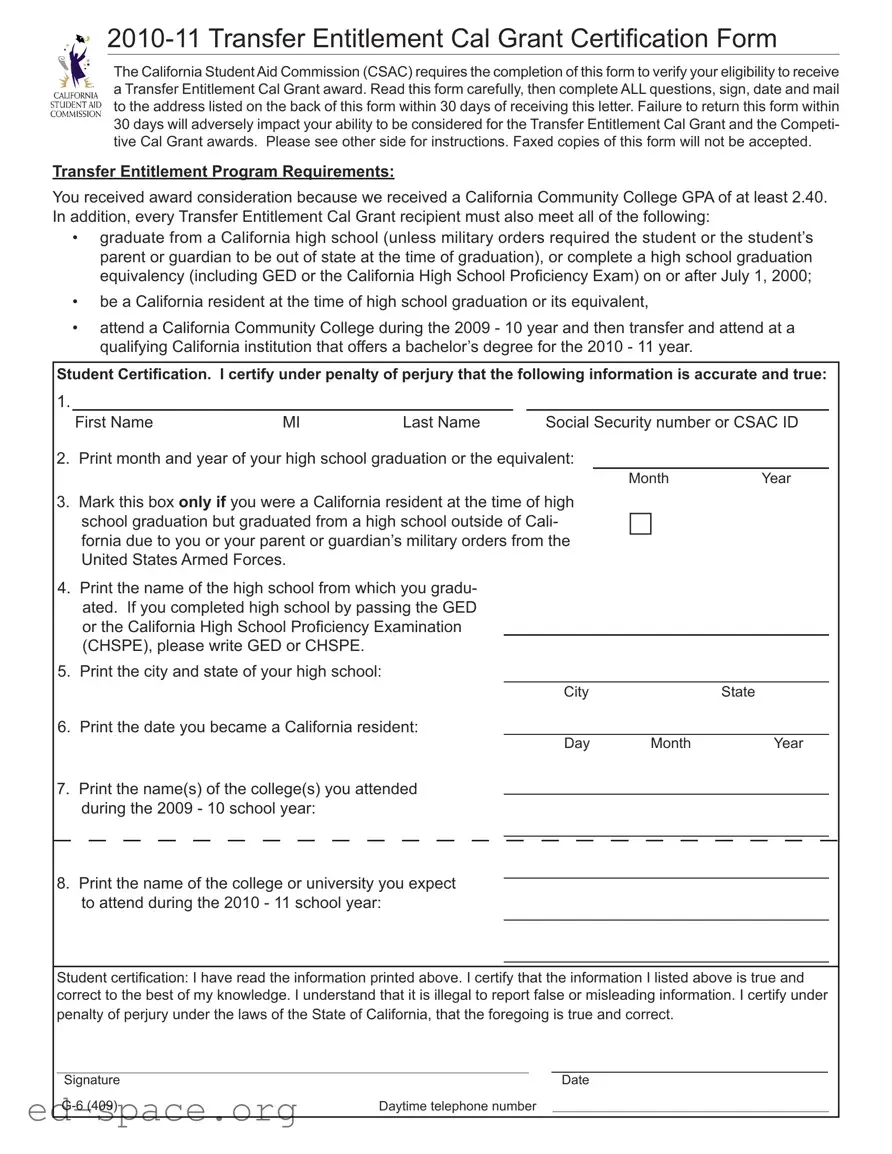
The California G 6 form is an essential document for students seeking financial assistance through the Transfer Entitlement Cal Grant program. This form serves to confirm your eligibility for the award, which is available to those who have completed certain educational milestones. To qualify, students must have a California Community College GPA of at least 2.40 and meet specific residency and graduation criteria. For instance, applicants must either graduate from a California high school or achieve a high school equivalency, such as a GED, after July 1, 2000. Furthermore, students need to have attended a California Community College during the 2009-10 academic year and plan to transfer to a qualifying institution for the 2010-11 year. Completing the G 6 form accurately is crucial; it requires personal information, including your name, Social Security number, and details about your educational history. Remember, all questions must be answered, and the form must be submitted within 30 days of receipt to ensure consideration for the award. Failure to do so could hinder your chances of receiving financial support, including the Competitive Cal Grant awards. Always ensure that you sign and date the form, as this certification affirms the truthfulness of the information provided.

The California Student Aid Commission (CSAC) requires the completion of this form to verify your eligibility to receive
a Transfer Entitlement Cal Grant award. Read this form carefully, then complete ALL questions, sign, date and mail to the address listed on the back of this form within 30 days of receiving this letter. Failure to return this form within
30 days will adversely impact your ability to be considered for the Transfer Entitlement Cal Grant and the Competi-
tive Cal Grant awards. Please see other side for instructions. Faxed copies of this form will not be accepted.
Transfer Entitlement Program Requirements:
You received award consideration because we received a California Community College GPA of at least 2.40.
In addition, every Transfer Entitlement Cal Grant recipient must also meet all of the following:
•graduate from a California high school (unless military orders required the student or the student’s
parent or guardian to be out of state at the time of graduation), or complete a high school graduation equivalency (including GED or the California High School Proiciency Exam) on or after July 1, 2000;
•be a California resident at the time of high school graduation or its equivalent,
•attend a California Community College during the 2009 - 10 year and then transfer and attend at a qualifying California institution that offers a bachelor’s degree for the 2010 - 11 year.
Student Certiication. I certify under penalty of perjury that the following information is accurate and true:
1.
First Name |
MI |
Last Name |
|
Social Security number or CSAC ID |
2. Print month and year of your high school graduation or the equivalent:
MonthYear
3.Mark this box only if you were a California resident at the time of high
|
school graduation but graduated from a high school outside of Cali- |
|
|
|
fornia due to you or your parent or guardian’s military orders from the |
|
|
|
United States Armed Forces. |
|
|
4. |
Print the name of the high school from which you gradu- |
|
|
|
ated. If you completed high school by passing the GED |
|
|
|
or the California High School Proiciency Examination |
|
|
|
(CHSPE), please write GED or CHSPE. |
|
|
5. |
Print the city and state of your high school: |
|
|
|
|
City |
State |
6. Print the date you became a California resident:
Day |
Month |
Year |
7.Print the name(s) of the college(s) you attended during the 2009 - 10 school year:
8.Print the name of the college or university you expect to attend during the 2010 - 11 school year:
Student certiication: I have read the information printed above. I certify that the information I listed above is true and correct to the best of my knowledge. I understand that it is illegal to report false or misleading information. I certify under
penalty of perjury under the laws of the State of California, that the foregoing is true and correct.
Signature |
|
Date |
Daytime telephone number |
|

In order to receive further consideration for a Cal Grant award, you must complete all questions, sign and return this form to CSAC within 30 days of the date of your letter. If you are not eligible
for a Cal Grant Transfer Entitlement award, you may be considered for a Competitive Cal Grant award, but only if you complete and return this form within 30 days. Faxed copies of the completed form will not be accepted. DO NOT LEAVE ANY QUESTION BLANK.
Instructions for illing out the Student Certiication section:
When completing this form, please print clearly using black ink only.
Answer each question by illing in the response or checking the appropriate box as it applies to your situation.
1.Print your name as it appears on your Social Security card. Enter your irst name, middle initial and last name. Print your Social Security number as it appears on your Social Security card or your CSAC ID as it appears on your CSAC notiication letter.
2.Print the month and year you graduated from high school or achieved the equivalent by passing the GED or
California High School Proiciency Examination. For example: June 2006.
3.Mark this box only if you were a California resident at the time of high school graduation but graduated from
a high school outside of California due to you or your parent or guardian’s military orders from the United
States Armed Forces. If you graduated from a California high school, leave this box empty.
4.Print the name of the high school from which you graduated. If you completed high school by passing the GED or the California High School Proiciency Examination, please write in “GED” or “CHSPE.”
5.If you graduated high school, list the city and state of the high school.
6.Print the date you became a California resident. If you have resided in California since your birth, please put your date of birth.
7.Print the name of the colleges you attended during the 2009 - 10 year. For example: College of the Red- woods.
8.Print the name of the college or university you expect to attend during the 2010
Signature: By signing this form, you certify that you have read the instructions and the information you provided
is correct. It is illegal to report false or misleading information on this form and in doing so, may result in any
Cal Grant award being revoked and CSAC potentially seeking repayment of any grant amount that is obtained
based on the submission of inaccurate information.
For more information on filling out this form or for questions on Cal Grant eligibility, contact CSAC at
(888)
Faxed copies of this completed form will not be accepted.
Mail completed forms to:
California Student Aid Commission
Cal Grant Operations Branch
PO Box 419028
Rancho Cordova, CA
| Fact Name | Description |
|---|---|
| Purpose of the Form | The California G 6 form is required by the California Student Aid Commission (CSAC) to verify eligibility for the Transfer Entitlement Cal Grant award. |
| Submission Deadline | Applicants must complete and mail the form within 30 days of receiving the notification letter. Failure to do so may impact eligibility for the grant. |
| Eligibility Requirements | To qualify, students must have a California Community College GPA of at least 2.40 and meet additional criteria, such as being a California resident at high school graduation. |
| Governing Law | This form is governed by California Education Code Sections 69430-69437, which outline the requirements for Cal Grant programs. |
Completing the California G 6 form is essential for verifying eligibility for a Transfer Entitlement Cal Grant award. The form must be filled out accurately and returned within 30 days to ensure consideration for the award. Below are the steps to complete the form.
What is the purpose of the California G 6 form?
The California G 6 form is used to verify a student's eligibility for the Transfer Entitlement Cal Grant award. This form is required by the California Student Aid Commission (CSAC) and must be completed and submitted within 30 days of receiving it. Failing to return the form on time can affect your chances of receiving financial aid.
Who is eligible to fill out the California G 6 form?
To be eligible, you must have graduated from a California high school or completed a high school equivalency test after July 1, 2000. Additionally, you need to be a California resident at the time of your high school graduation. You must also have attended a California Community College during the 2009-10 academic year and plan to transfer to a qualifying institution for the 2010-11 academic year.
What happens if I do not return the California G 6 form within 30 days?
If you do not return the form within the specified 30 days, you may lose your eligibility for the Transfer Entitlement Cal Grant and potentially the Competitive Cal Grant awards as well. Timely submission is crucial for maintaining your consideration for these financial aid options.
Can I submit a faxed copy of the California G 6 form?
No, faxed copies of the California G 6 form will not be accepted. You must mail the completed form to the address provided on the back of the form. Ensure that you send the original document to avoid any issues with your application.
What information do I need to provide on the California G 6 form?
You will need to provide personal details such as your name, Social Security number or CSAC ID, and the date of your high school graduation. Additionally, you must list the college(s) you attended during the 2009-10 school year and the institution you plan to attend in the 2010-11 school year. Make sure to complete all questions without leaving any blank.
How can I contact CSAC if I have questions about the California G 6 form?
If you have questions regarding the California G 6 form or need assistance with Cal Grant eligibility, you can contact the California Student Aid Commission at (888) 224-7268. You can also reach out via email at [email protected] for further guidance.
Leaving Questions Blank: Many individuals forget to answer all questions. Each section must be completed. Leaving any question unanswered can lead to delays or disqualification.
Incorrect Name Format: Some people do not print their names exactly as they appear on their Social Security card. This can cause confusion and may result in processing issues.
Using Ink Other Than Black: The form must be filled out in black ink only. Using any other color can make the form difficult to read and may lead to rejection.
Not Signing the Form: Failing to sign the form is a common mistake. Without a signature, the application cannot be processed.
Incorrect Dates: Some applicants mistakenly enter the wrong dates for graduation or residency. Double-checking these details is crucial for eligibility.
Missing Deadline: The requirement to return the form within 30 days is often overlooked. Missing this deadline can adversely affect eligibility for the Cal Grant.
Faxing the Form: Many people believe they can fax the completed form. However, faxed copies are not accepted. Always mail the original document.
The California G 6 form is an essential document for students seeking a Transfer Entitlement Cal Grant award. However, several other forms and documents are often used in conjunction with it to ensure a smooth application process. Below is a list of these important documents.
Understanding these documents and their purposes can significantly enhance the application process for financial aid. Each plays a vital role in ensuring that students have access to the resources they need to pursue their education.
The California G 6 form is an important document for students seeking financial aid. It shares similarities with several other forms used in the educational and financial aid process. Here are four documents that are similar to the California G 6 form:
When filling out the California G 6 form, it is essential to follow specific guidelines to ensure your application is processed smoothly. Below are some key things to do and avoid.
By adhering to these guidelines, you enhance your chances of a successful application for the Transfer Entitlement Cal Grant.
Misconceptions about the California G 6 form can lead to confusion and potential issues with financial aid eligibility. Here are eight common misconceptions along with clarifications:
This is incorrect. Faxed copies of the California G 6 form are not accepted. The completed form must be mailed to the specified address.
While many applicants do graduate from California high schools, students who graduated out of state due to military orders can still apply, provided they were California residents at the time of graduation.
The form must be returned within 30 days of receipt. Failing to meet this deadline can negatively impact eligibility for the Transfer Entitlement Cal Grant and other awards.
In addition to a high school diploma, students can also use a GED or the California High School Proficiency Exam (CHSPE) as proof of graduation.
All questions on the form must be answered. Leaving any question blank can result in delays or denial of the application.
While completing the form is necessary for consideration, it does not guarantee that a Cal Grant will be awarded. Eligibility criteria must still be met.
While students can list more than one college they expect to attend, it is important to ensure that the colleges meet the eligibility requirements for the Cal Grant program.
This form is specifically for students transferring from a California Community College to a qualifying institution. It is not limited to first-time college students.
Here are key takeaways for filling out and using the California G 6 form:
Ensure that every section is completed accurately to support your eligibility for financial aid.