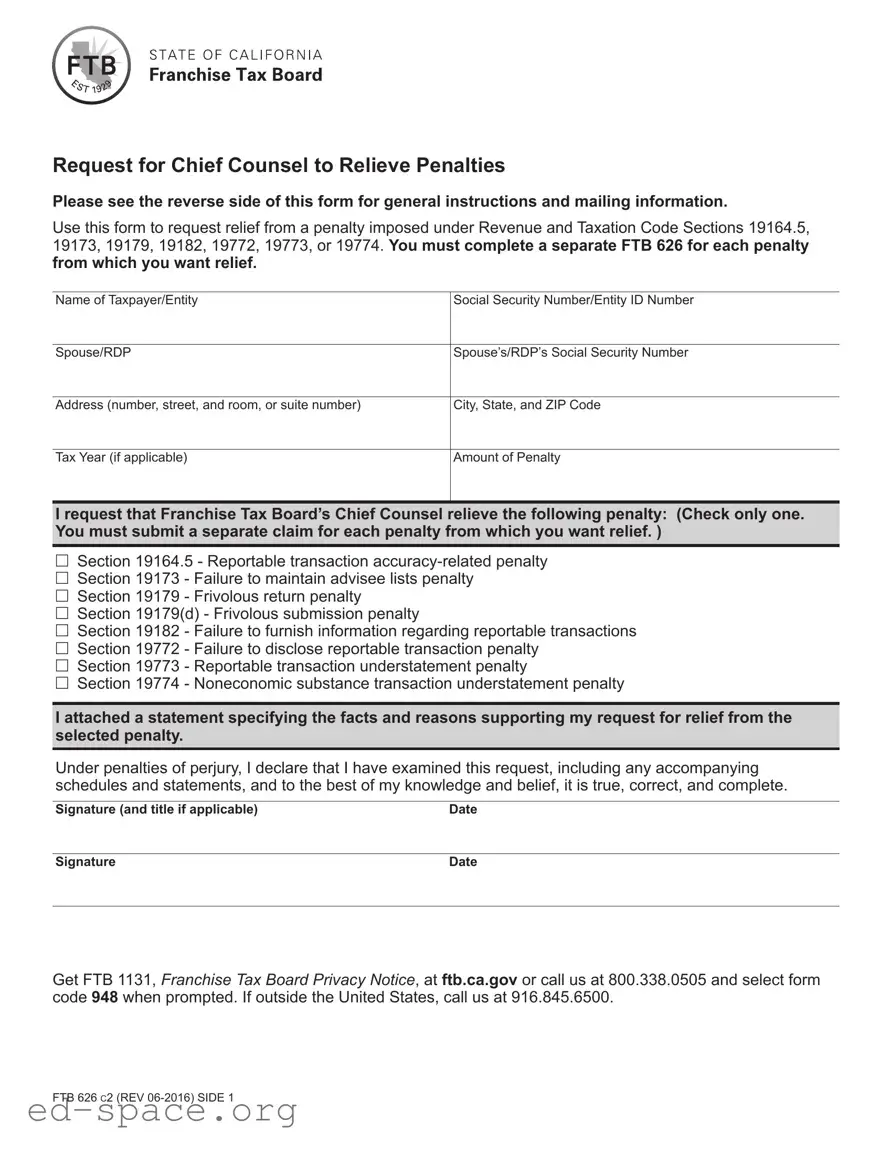
The California FTB 626 form serves as a critical tool for taxpayers seeking relief from specific penalties imposed by the Franchise Tax Board (FTB). This form allows individuals and entities to formally request the Chief Counsel to reconsider penalties outlined in various sections of the Revenue and Taxation Code, such as those related to reportable transactions and frivolous returns. Each request must be submitted on a separate FTB 626 for each penalty, ensuring clarity and specificity in the appeal process. Taxpayers need to provide essential information, including their Social Security or Entity Identification Number, as well as details about the penalty in question. A statement justifying the request must accompany the form, detailing the facts and reasons for seeking relief. The process is designed to be straightforward, allowing taxpayers to navigate the complexities of penalty relief with relative ease. Understanding the requirements and instructions outlined on the form is crucial for a successful submission, as it ensures compliance with the FTB's guidelines and facilitates the review process.
Request for Chief Counsel to Relieve Penalties
Please see the reverse side of this form for general instructions and mailing information.
Use this form to request relief from a penalty imposed under Revenue and Taxation Code Sections 19164.5, 19173, 19179, 19182, 19772, 19773, or 19774. You must complete a separate FTB 626 for each penalty from which you want relief.
Name of Taxpayer/Entity
Social Security Number/Entity ID Number
Spouse/RDP
Spouse’s/RDP’s Social Security Number
Address (number, street, and room, or suite number)
City, State, and ZIP Code
Tax Year (if applicable)
Amount of Penalty
I request that Franchise Tax Board’s Chief Counsel relieve the following penalty: (Check only one. You must submit a separate claim for each penalty from which you want relief. )
Section 19164.5 - Reportable transaction
Section 19173 - Failure to maintain advisee lists penalty
Section 19179 - Frivolous return penalty
Section 19179(d) - Frivolous submission penalty
Section 19182 - Failure to furnish information regarding reportable transactions
Section 19772 - Failure to disclose reportable transaction penalty
Section 19773 - Reportable transaction understatement penalty
Section 19774 - Noneconomic substance transaction understatement penalty
I attached a statement specifying the facts and reasons supporting my request for relief from the selected penalty.
Under penalties of perjury, I declare that I have examined this request, including any accompanying schedules and statements, and to the best of my knowledge and belief, it is true, correct, and complete.
Signature (and title if applicable) |
Date |
|
|
Signature |
Date |
|
|
Get FTB 1131, Franchise Tax Board Privacy Notice, at ftb.ca.gov or call us at 800.338.0505 and select form code 948 when prompted. If outside the United States, call us at 916.845.6500.
FTB 626 C2 (REV

Instructions for FTB 626
Request for Chief Counsel to Relieve Penalties
Purpose of FTB 626
You can use FTB 626 to request that Franchise Tax Board’s Chief Counsel relieve certain penalties. The law provides the Chief Counsel with discretion to relieve all or part of these penalties. You can only request relief from penalties listed on the front of FTB 626.
You must complete an FTB 626 for each penalty from which you are seeking relief and attach a copy of the notice on which we imposed the penalty. We impose penalties on Notices of Proposed Assessment or billing notices.
Speciic Instructions
Social Security Number – Individuals: If your request for penalty relief is related to a joint return, enter social security numbers for both you and your spouse/RDP.
Entity Identiication Number: If your request for penalty relief is for a corporation, partnership, estate, trust,
LLC or other business entity, enter the entity identiication number.
Signature – Individuals: If you iled a joint return, and you and your spouse/RDP are both requesting relief, both spouses/RDPs should sign the request.
Signature – Business Entities: An authorized individual must sign requests iled by business entities, and the signature must be accompanied by the individual’s title.
Your authorized representative may ile FTB 626 for you. A copy of the original Power of Attorney must be attached to FTB 626.
Statement: You must attach a statement specifying the facts and reasons supporting your request for relief from the penalty.
Mail your completed request and supporting statement to:
CHIEF COUNSEL LEGAL DIVISION MS A 260
FRANCHISE TAX BOARD
PO BOX 1720
RANCHO CORDOVA CA
For additional penalty information, go to ftb.ca.gov and search for penalty. You can also contact us at 800.852.5711.
Connect With Us
Web: ftb.ca.gov |
Phone: |
800.852.5711 |
|
7 a.m. to 5 p.m. weekdays, except state holidays |
|
|
916.845.6500 |
|
from outside the United States |
|
|
|
||
|
TTY/TDD: |
800.822.6268 |
|
for persons with hearing or speech impairments |
|
|
FTB 626 C2 (REV
| Fact Name | Details |
|---|---|
| Purpose | The FTB 626 form is used to request relief from specific penalties imposed by the California Franchise Tax Board. |
| Governing Laws | This form pertains to penalties under Revenue and Taxation Code Sections 19164.5, 19173, 19179, 19182, 19772, 19773, and 19774. |
| Separate Requests | A separate FTB 626 must be completed for each penalty from which relief is sought. |
| Supporting Statement | Taxpayers must attach a statement detailing the facts and reasons for the request for relief. |
| Signature Requirements | Both spouses or registered domestic partners must sign if filing a joint return. An authorized individual must sign for business entities. |
| Mailing Instructions | Completed forms and supporting statements should be mailed to the Chief Counsel, Legal Division, Franchise Tax Board, Rancho Cordova, CA. |
After gathering the necessary information, you can proceed to fill out the California FTB 626 form. This form is used to request relief from specific penalties imposed by the Franchise Tax Board. It is important to ensure that all required sections are completed accurately to avoid delays in processing your request.
Once the form is completed, mail it along with your supporting statement to the address provided on the form. This ensures that your request is directed to the appropriate department for review.
What is the purpose of the California FTB 626 form?
The California FTB 626 form is designed for individuals or entities seeking relief from certain penalties imposed by the Franchise Tax Board (FTB). These penalties may arise from various tax-related issues, such as failure to maintain proper records or frivolous submissions. By completing this form, taxpayers can formally request that the Chief Counsel of the FTB consider relieving them of these penalties.
Who should use the FTB 626 form?
Anyone who has received a penalty notice from the FTB can use the FTB 626 form to seek relief. This includes individuals filing joint returns, as well as business entities like corporations and partnerships. Each penalty requires a separate FTB 626 submission, ensuring that the request is clear and specific to the penalty in question.
What information is required to complete the FTB 626 form?
To complete the FTB 626 form, you will need to provide personal information such as your name, Social Security Number (or Entity Identification Number for businesses), and address. Additionally, you must specify the tax year and the amount of the penalty. It's essential to check the specific penalty section you are requesting relief from and attach a statement detailing the facts and reasons supporting your request.
How do I submit the FTB 626 form?
Once you have filled out the FTB 626 form and attached the necessary supporting statement, mail it to the Chief Counsel at the address provided on the form. The complete mailing address is: Chief Counsel, Legal Division, MS A 260, Franchise Tax Board, PO Box 1720, Rancho Cordova, CA 95741-1720. Ensure that you send it to the correct address to avoid any delays in processing your request.
Can I have someone else submit the FTB 626 form on my behalf?
Yes, you can authorize someone else, such as a tax professional or attorney, to submit the FTB 626 form on your behalf. However, you must attach a copy of the original Power of Attorney to the form. This ensures that the FTB recognizes the authorized individual as your representative in this matter.
What happens after I submit the FTB 626 form?
After submitting your FTB 626 form, the Chief Counsel will review your request for penalty relief. The law grants the Chief Counsel discretion to either fully or partially relieve the penalties. You will receive a response regarding the outcome of your request, which may take some time, so patience is key. If you have any questions during this process, you can contact the FTB directly for assistance.
Not Completing a Separate Form for Each Penalty: Individuals often make the mistake of trying to address multiple penalties on a single FTB 626 form. Each penalty requires its own form for the request to be valid.
Missing Supporting Statement: A common error is failing to attach a statement that outlines the facts and reasons for seeking relief. This statement is crucial for the Chief Counsel to evaluate the request.
Incorrect Social Security Numbers: Providing incorrect or incomplete social security numbers can lead to delays or rejections of the request. Ensure that both taxpayer and spouse/RDP numbers are accurate, especially for joint returns.
Omitting Signatures: Individuals sometimes forget to sign the form. If filing jointly, both spouses/RDPs must sign. For business entities, an authorized individual must sign and include their title.
Failing to Mail to the Correct Address: Sending the completed form to the wrong address can result in processing delays. Always verify that you are mailing it to the correct location specified in the instructions.
The California FTB 626 form serves as a formal request to the Franchise Tax Board's Chief Counsel for relief from specific penalties. When navigating the complexities of tax penalties, several other forms and documents may be necessary to support your case or provide additional information. Below is a list of documents commonly used alongside the FTB 626 form.
Understanding the various forms and documents that complement the FTB 626 can facilitate a smoother process when seeking penalty relief. Each document plays a role in clarifying your situation and supporting your request, ultimately contributing to a more favorable outcome.
The California FTB 626 form is designed to help taxpayers request relief from specific penalties. Here are five other documents that share similarities with the FTB 626 form:
When filling out the California FTB 626 form, it is important to follow certain guidelines to ensure your request for penalty relief is processed smoothly. Here is a list of things you should and shouldn't do:
Many taxpayers have misunderstandings about the California FTB 626 form. Here are five common misconceptions:
Understanding these misconceptions can help ensure that your request for penalty relief is handled correctly and efficiently.
Key Takeaways for Filling Out and Using the California FTB 626 Form: