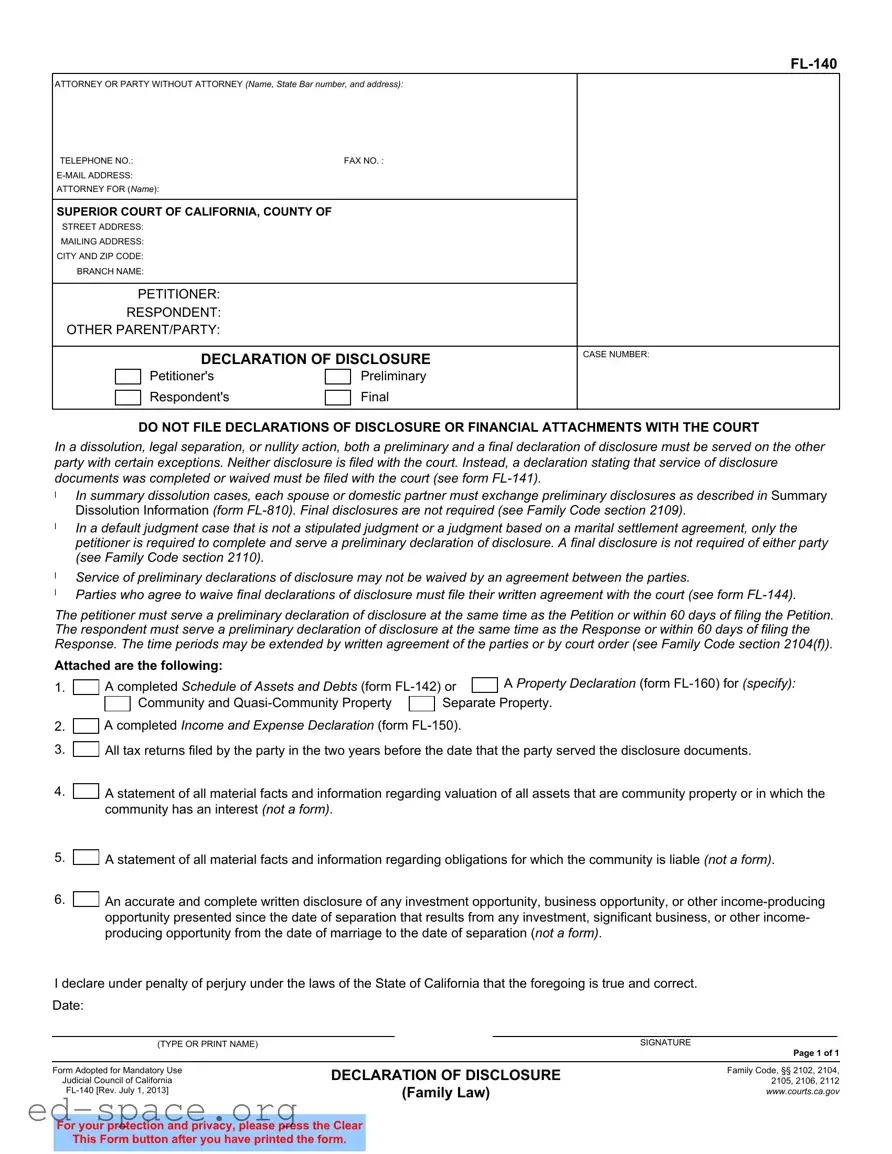
The California FL-140 form plays a crucial role in family law proceedings, particularly during the processes of dissolution, legal separation, or nullity. This form is designed to facilitate the exchange of financial information between parties involved in a case. It requires both the petitioner and the respondent to provide detailed disclosures, ensuring transparency in financial matters. Importantly, while the preliminary and final declarations of disclosure must be served to the other party, they are not filed with the court. Instead, a separate declaration confirming that these disclosures have been served or waived must be submitted using form FL-141. For cases involving summary dissolution, the requirements differ slightly, as only preliminary disclosures are necessary. Furthermore, in default judgment cases, only the petitioner is responsible for serving a preliminary declaration. The form also outlines specific timelines for serving these disclosures, emphasizing the importance of adhering to deadlines to avoid complications. Along with the FL-140, additional documents such as the Schedule of Assets and Debts, Income and Expense Declaration, and relevant tax returns are often required to provide a comprehensive view of each party's financial situation. Understanding the nuances of the FL-140 form is essential for anyone navigating the complexities of family law in California.
ATTORNEY OR PARTY WITHOUT ATTORNEY (Name, State Bar number, and address):
TELEPHONE NO.: |
FAX NO. : |
|
|
ATTORNEY FOR (Name): |
|
SUPERIOR COURT OF CALIFORNIA, COUNTY OF
STREET ADDRESS:
MAILING ADDRESS:
CITY AND ZIP CODE:
BRANCH NAME:
|
PETITIONER: |
|
|
|
|
|
RESPONDENT: |
|
|
|
|
OTHER PARENT/PARTY: |
|
|
|
||
|
|
|
|
|
|
|
|
DECLARATION OF DISCLOSURE |
CASE NUMBER: |
||
|
|
|
|||
|
|
Petitioner's |
|
Preliminary |
|
|
|
|
|
||
|
|
Respondent's |
|
Final |
|
|
|
|
|
||
DO NOT FILE DECLARATIONS OF DISCLOSURE OR FINANCIAL ATTACHMENTS WITH THE COURT
In a dissolution, legal separation, or nullity action, both a preliminary and a final declaration of disclosure must be served on the other party with certain exceptions. Neither disclosure is filed with the court. Instead, a declaration stating that service of disclosure documents was completed or waived must be filed with the court (see form
lIn summary dissolution cases, each spouse or domestic partner must exchange preliminary disclosures as described in Summary Dissolution Information (form
lIn a default judgment case that is not a stipulated judgment or a judgment based on a marital settlement agreement, only the petitioner is required to complete and serve a preliminary declaration of disclosure. A final disclosure is not required of either party (see Family Code section 2110).
lService of preliminary declarations of disclosure may not be waived by an agreement between the parties.
lParties who agree to waive final declarations of disclosure must file their written agreement with the court (see form
The petitioner must serve a preliminary declaration of disclosure at the same time as the Petition or within 60 days of filing the Petition. The respondent must serve a preliminary declaration of disclosure at the same time as the Response or within 60 days of filing the Response. The time periods may be extended by written agreement of the parties or by court order (see Family Code section 2104(f)).
Attached are the following:
1.
2.
3.
4.
5.
6.
A completed Schedule of Assets and Debts (form |
|
A Property Declaration (form |
||||
|
Community and |
|
|
Separate Property. |
||
|
|
|||||
A completed Income and Expense Declaration (form
All tax returns filed by the party in the two years before the date that the party served the disclosure documents.
A statement of all material facts and information regarding valuation of all assets that are community property or in which the community has an interest (not a form).
A statement of all material facts and information regarding obligations for which the community is liable (not a form).
An accurate and complete written disclosure of any investment opportunity, business opportunity, or other
I declare under penalty of perjury under the laws of the State of California that the foregoing is true and correct. Date:
(TYPE OR PRINT NAME) |
|
SIGNATURE |
|
|
|
Page 1 of 1 |
|
|
|
|
|
Form Adopted for Mandatory Use |
DECLARATION OF DISCLOSURE |
Family Code, §§ 2102, 2104, |
|
Judicial Council of California |
2105, 2106, 2112 |
||
|
|||
(Family Law) |
www.courts.ca.gov |
For your protection and privacy, please press the Clear
This Form button after you have printed the form.
| Fact Name | Fact Description |
|---|---|
| Form Purpose | The FL-140 form is used for the Declaration of Disclosure in California family law cases. |
| Governing Laws | This form is governed by the California Family Code, specifically sections 2102, 2104, 2105, 2106, and 2112. |
| Required Parties | Both the petitioner and respondent must complete and serve preliminary disclosures, with certain exceptions. |
| Filing Instructions | Declarations of Disclosure are not filed with the court; instead, a declaration of service must be filed. |
| Preliminary Disclosure Timing | The petitioner must serve a preliminary declaration at the same time as the Petition or within 60 days of filing. |
| Final Disclosure Requirements | A final declaration of disclosure is not required in default judgment cases. |
| Waiving Final Disclosures | Parties can agree to waive final disclosures, but must file their agreement with the court. |
| Attachments Required | Specific attachments, like the Income and Expense Declaration (form FL-150), are required with the FL-140. |
| Privacy Notice | For privacy, users are advised to clear the form after printing. |
Filling out the California FL-140 form is an essential step in the process of providing financial disclosures during a legal separation, divorce, or nullity case. This form requires you to provide specific information about yourself and your financial situation. Once completed, it should not be filed with the court but rather served to the other party involved in the case.
After completing the FL-140 form, ensure that you serve it along with the necessary financial disclosures to the other party. Remember to keep copies for your records, as they may be important for future reference in your case.
What is the purpose of the California FL-140 form?
The California FL-140 form is a Declaration of Disclosure used in family law cases, specifically during dissolution, legal separation, or nullity actions. Its primary purpose is to ensure that both parties provide full financial disclosure to each other. This transparency helps in equitable division of assets and debts, and it is a crucial step in the legal process.
Who needs to file the FL-140 form?
In most cases, both the petitioner and the respondent must complete and serve a preliminary declaration of disclosure. The petitioner serves this document at the same time as filing the Petition, while the respondent must serve theirs with the Response. However, in default judgment cases, only the petitioner is required to provide a preliminary declaration.
Are there any exceptions to filing the FL-140?
Yes, there are specific exceptions. In summary dissolution cases, each spouse or domestic partner must exchange preliminary disclosures, but final disclosures are not necessary. Additionally, parties can agree to waive final declarations of disclosure, but this agreement must be filed with the court using form FL-144.
What documents must accompany the FL-140 form?
When filing the FL-140, you should attach several documents, including a completed Schedule of Assets and Debts (form FL-142) or a Property Declaration (form FL-160), an Income and Expense Declaration (form FL-150), and any tax returns filed in the last two years. You must also include statements detailing material facts regarding community property and liabilities.
Can the time periods for serving the FL-140 be extended?
Yes, the time periods for serving the preliminary declarations of disclosure can be extended. This extension can occur through a written agreement between the parties or by obtaining a court order. It's essential to ensure that any extensions are documented properly to avoid complications.
What happens if I do not serve the FL-140 on time?
Failing to serve the FL-140 on time can lead to delays in your case and may negatively impact your legal standing. The court may impose penalties or require additional disclosures, which can complicate the process. Timely service is crucial for a smooth resolution.
Do I need to file the FL-140 with the court?
No, the FL-140 form itself is not filed with the court. Instead, you must file a declaration stating that you have served the disclosure documents, which is done using form FL-141. This ensures that the court is aware that both parties have received the necessary financial disclosures.
What is the penalty for providing false information on the FL-140?
Providing false information on the FL-140 form can lead to serious legal consequences, including penalties for perjury. The declaration includes a statement that you are declaring under penalty of perjury, which emphasizes the importance of honesty in your disclosures. Courts take financial disclosures seriously, and any discrepancies can affect your case outcome.
How can I ensure my privacy when completing the FL-140?
To protect your privacy, it’s advisable to handle the FL-140 form carefully. After printing the form, use the “Clear This Form” button to remove any sensitive information from the system. Additionally, be cautious about how you share the form with the other party to maintain confidentiality.
Failing to include all required contact information. This includes the attorney's name, state bar number, address, and contact details.
Not specifying the correct case number. Each case has a unique identifier, and omitting it can lead to confusion and delays.
Overlooking the need for both preliminary and final declarations of disclosure. Both must be served to the other party unless exceptions apply.
Not filing the required declaration stating that disclosures were served or waived. This is necessary even though the disclosures themselves are not filed with the court.
Missing deadlines for serving disclosures. The petitioner must serve the preliminary disclosure with the Petition or within 60 days, while the respondent has similar obligations.
Failing to attach the necessary financial documents. This includes the Schedule of Assets and Debts or the Property Declaration.
Neglecting to provide a complete Income and Expense Declaration. Incomplete information can lead to complications in the case.
Not including all tax returns filed in the past two years. This documentation is crucial for a full financial disclosure.
Omitting material facts regarding community property and liabilities. Full transparency is required to ensure fair proceedings.
Failing to declare any investment or business opportunities since separation. This information is important for evaluating the financial situation of both parties.
When navigating the complexities of family law in California, understanding the various forms and documents that accompany the FL-140 form is essential. Each document serves a specific purpose in ensuring transparency and fairness during legal proceedings related to dissolution, legal separation, or nullity. Below is a list of commonly used forms that you may encounter alongside the FL-140.
Being familiar with these documents can significantly streamline the process of legal separation or divorce. Each form plays a crucial role in promoting transparency and ensuring that both parties fulfill their legal obligations. Understanding these requirements can help you navigate your case more effectively.
The California FL-140 form, known as the Declaration of Disclosure, shares similarities with several other legal documents. Below is a list of eight documents that are comparable to the FL-140 form, highlighting their similarities:
When filling out the California FL-140 form, it is essential to follow specific guidelines to ensure accuracy and compliance. Below is a list of ten important do's and don'ts to consider.
Understanding the FL-140 form in California can be challenging, and several misconceptions often arise. Here are five common misunderstandings about this important document:
Being aware of these misconceptions can help individuals navigate the complexities of family law in California more effectively. Understanding the requirements and processes associated with the FL-140 form is essential for ensuring compliance and protecting one's interests.
Filling out the California FL-140 form, also known as the Declaration of Disclosure, is an essential step in family law cases such as divorce or legal separation. Here are some key takeaways to keep in mind:
Being aware of these points can help streamline the process and ensure compliance with California family law requirements. Properly filling out and using the FL-140 form can significantly impact the outcome of your case.