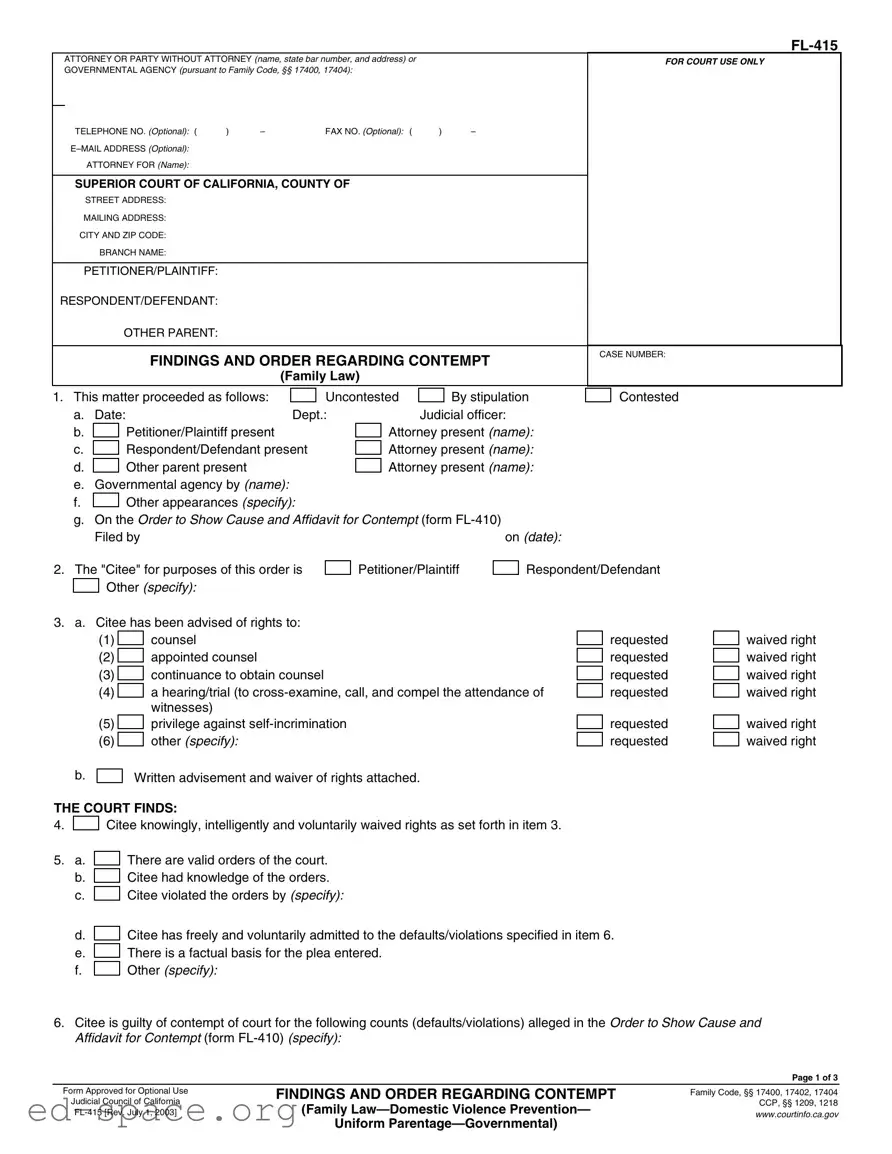
The California FL 415 form plays a crucial role in family law, particularly in cases involving contempt of court. This form is utilized by the Superior Court of California to document findings and orders regarding contempt proceedings. It captures essential information about the parties involved, including the petitioner, respondent, and any other parents, ensuring that all relevant individuals are identified. The form outlines the court's findings, detailing whether the citee has violated existing court orders and whether they have been informed of their rights, such as the right to counsel and the privilege against self-incrimination. Furthermore, the FL 415 form specifies the consequences of contempt, which may include community service, fines, or even jail time, depending on the severity of the violation. It emphasizes the importance of compliance with court orders and outlines the necessary steps the citee must take to rectify their situation. Additionally, the form mandates that the citee report on their employment status and any changes in their circumstances, thereby reinforcing accountability. Understanding the nuances of this form is essential for all parties involved in family law cases to navigate the complexities of contempt proceedings effectively.
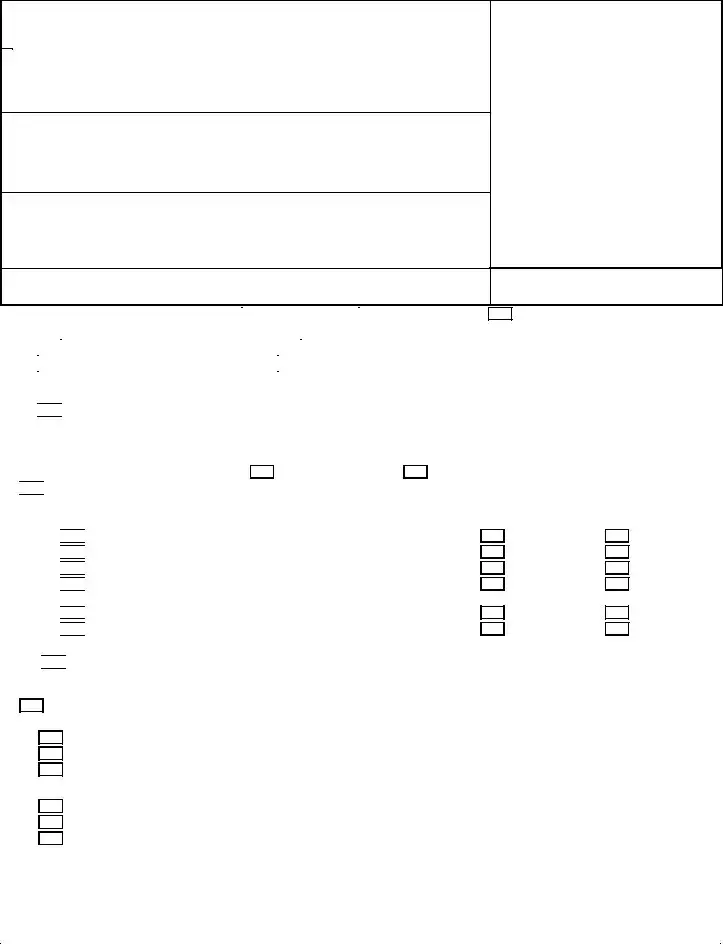
ATTORNEY OR PARTY WITHOUT ATTORNEY (name, state bar number, and address) or
GOVERNMENTAL AGENCY (pursuant to Family Code, §§ 17400, 17404):
TELEPHONE NO. (Optional): ( |
) |
– |
FAX NO. (Optional): ( |
) |
– |
ATTORNEY FOR (Name):
SUPERIOR COURT OF CALIFORNIA, COUNTY OF
STREET ADDRESS:
MAILING ADDRESS:
CITY AND ZIP CODE:
BRANCH NAME:
PETITIONER/PLAINTIFF:
RESPONDENT/DEFENDANT:
OTHER PARENT:
FINDINGS AND ORDER REGARDING CONTEMPT
(Family Law)
1. This matter proceeded as follows: |
|
Uncontested |
|
By stipulation |
||||
a. |
Date: |
Dept.: |
|
|
Judicial officer: |
|||
b. |
|
Petitioner/Plaintiff present |
|
|
|
Attorney present (name): |
||
|
|
|
|
|
||||
c. |
|
Respondent/Defendant present |
|
Attorney present (name): |
||||
|
|
|
|
|
|
|
||
d. |
|
Other parent present |
|
|
|
Attorney present (name): |
||
e.Governmental agency by (name):
f. Other appearances (specify):
g.On the Order to Show Cause and Affidavit for Contempt (form
Filed by |
on (date): |
FOR COURT USE ONLY
CASE NUMBER:
Contested
2.The "Citee" for purposes of this order is Other (specify):
Petitioner/Plaintiff
Respondent/Defendant
3.a. Citee has been advised of rights to:
(1) counsel
(2) appointed counsel
(3) continuance to obtain counsel
(4) a hearing/trial (to
(5) privilege against
(6) other (specify):
b. Written advisement and waiver of rights attached.
requested requested requested requested
requested requested
waived right waived right waived right waived right
waived right waived right
THE COURT FINDS:
4.
Citee knowingly, intelligently and voluntarily waived rights as set forth in item 3.
5.a.
b.
c.
d.
e.
f.
There are valid orders of the court.
Citee had knowledge of the orders.
Citee violated the orders by (specify):
Citee has freely and voluntarily admitted to the defaults/violations specified in item 6. There is a factual basis for the plea entered.
Other (specify):
6.Citee is guilty of contempt of court for the following counts (defaults/violations) alleged in the Order to Show Cause and Affidavit for Contempt (form
|
|
Page 1 of 3 |
|
Form Approved for Optional Use |
FINDINGS AND ORDER REGARDING CONTEMPT |
Family Code, §§ 17400, 17402, 17404 |
|
Judicial Council of California |
CCP, §§ 1209, 1218 |
||
(Family |
|||
www.courtinfo.ca.gov |
|||
|
Uniform |
||
|
|

PETITIONER/PLAINTIFF:
RESPONDENT/DEFENDANT: OTHER PARENT:
CASE NUMBER:
7.a.
b.
8.
9.
10.
11.
Citee is not guilty of contempt of court for the following counts (defaults/violations) alleged in the Order to Show Cause and Affidavit for Contempt (form
Citee has a previous finding of contempt (specify):
Citee waived time for sentencing.
Citee waived time for trial.
Citee failed to appear as ordered.
Other (specify):
THE COURT ORDERS
12.a.
b.
13.
|
|
That the following counts alleged in the Order to Show Cause and Affidavit for Contempt (form |
|||||||
|
|
are dismissed |
|
with prejudice |
|
|
|
without prejudice. |
|
|
|
|
|
|
|
||||
|
|
That the request to dismiss the following counts alleged in the Order to Show Cause and Affidavit for Contempt (form |
|||||||
|
|
||||||||
|
|
|
|
|
|
|
is denied. |
||
Citee must perform |
|
hours of community service for counts (specify): |
|||||||
a. |
|
To commence on (date): |
|
|
|
to be completed by (date): |
|||
|
|
|
Citee must report to (specify): |
|
|
|
|
||
|
|
|
on (date): |
|
|
|
|
|
at (time): |
|
|
|
|
|
|
|
|
|
|
b. |
|
Citee must pay an administrative fee |
|
|
|
of $ |
|||
|
|
|
|
|
|
|
|
|
as determined by the community service agency |
|
|
|
|
|
|
|
|
|
|
14.
15.
16.a.
b.
17.
Citee must serve
To commence on (date): |
to be completed by (date): |
Citee must report to (specify): |
|
on (date): |
at (time): |
Citee must pay: |
|
||
a. |
|
attorney fees in the total amount of $ |
payable to (specify name): |
|
|||
|
|
|
|
b. |
|
fines in the total amount of $ |
|
The contempt proceedings are suspended on condition that citee comply with all terms and conditions of this order. Imposition of sentence is suspended on condition that citee comply with all terms and conditions of this order.
Execution of sentence for |
|
hours of community service |
|
|
hours in county jail |
||
will be suspended for a period of |
and citee is placed on court probation on condition that citee |
||||||
comply with all terms and conditions of this order, and |
|
||||||
a. |
|
Comply with current support order. |
|
||||
|
|
|
|
||||
b. |
|
Pay at least $ |
per month on current support order, payable to (specify name): |
||||
|
|
|
|
commencing (date): |
|
||
c. |
|
Pay at least $ |
per month on arrears commencing (date): |
|
|||
d. |
|
Serve any remaining hours not suspended as specified in items 13 and 14. |
|
||||
|
|
||||||
18.
Citee must seek and maintain employment and must keep written records, copies of which must be forwarded by the 5th day
of each month as follows to the |
|
Local Child Support Agency |
|
court |
|
|
other (specify): |
|
|
|
|
|
|
|
|
|
|
a.Records of efforts to gain employment must include the name, address, and telephone numbers of individuals and firms contacted regarding employment, the dates of such contact and the anticipated results.
b.Records of all actual employment must include the name of the employer, dates, and hours worked and the gross and net amounts of income from each employer.
FINDINGS AND ORDER REGARDING CONTEMPT |
|
|
Page 2 of 3
(Family
Uniform
PETITIONER/PLAINTIFF:
RESPONDENT/DEFENDANT: OTHER PARENT:
CASE NUMBER:
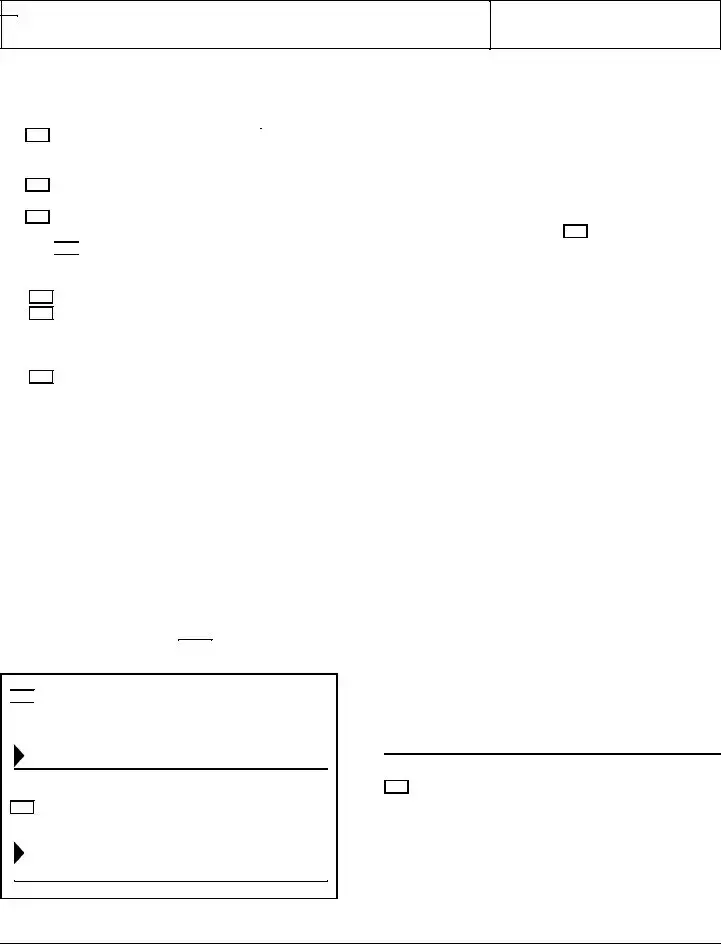
19.Orders for payments required to be made as conditions of probation or suspension of sentence in this order do not modify a court ordered support obligation.
20.Citee must provide written notification to the superior court clerk of any change in residence and to
the local child support agency |
|
the other party |
of any change of residence, income, or employment within 10 days of the change.
21.
22.
23.
24.
A wage and earnings assignment will issue.
This matter is continued to (date): |
|
at (specify time): |
in court department (specify): |
room (specify): |
of this court for |
compliance review. Citee is ordered to personally appear in court on that date and time. WARNING: Failure to appear may result in issuance of a bench warrant for citee's arrest.
A Warrant of Attachment will issue for citee's arrest. Bail is set in the sum of: $
Execution of the Warrant of Attachment is stayed until (date): at (specify court name):
Other (specify):
further hearing
25.Number of pages attached:
Approved as conforming to court order and findings: Date:
(SIGNATURE OF ATTORNEY FOR CITEE)
The citee agrees to the above terms:
Date:
Date:
(JUDICIAL OFFICER OF THE SUPERIOR COURT)
Signature follows last attachment
(SIGNATURE OF CITEE)
FINDINGS AND ORDER REGARDING CONTEMPT
Page 3 of 3
(Family
Uniform
| Fact Name | Details |
|---|---|
| Purpose | The FL-415 form is used in California to document findings and orders regarding contempt in family law cases. |
| Governing Laws | This form is governed by Family Code sections 17400, 17402, and 17404, as well as California Code of Civil Procedure sections 1209 and 1218. |
| Parties Involved | The form must include information about the petitioner/plaintiff, respondent/defendant, and any other relevant parties, including attorneys if present. |
| Rights Advisement | Citee must be advised of their rights, including the right to counsel and the right to a hearing, as part of the contempt proceedings. |
| Consequences of Contempt | If found guilty of contempt, the citee may face penalties such as community service, fines, or even jail time, depending on the circumstances. |
Filling out the California FL-415 form is an essential step in addressing matters related to contempt in family law cases. This form requires careful attention to detail to ensure that all necessary information is accurately provided. Below are the steps to guide you through the process of completing the form.
After completing the form, review it thoroughly to ensure accuracy. Once confirmed, submit it to the appropriate court. Keep a copy for your records, as this will be important for future reference or compliance with court orders.
What is the purpose of the California FL-415 form?
The California FL-415 form is used to document findings and orders regarding contempt in family law cases. It is typically filed after a court has determined that a party has violated a court order. The form outlines the court's findings, any admissions made by the citee, and the resulting orders. These orders may include community service, fines, or other conditions aimed at ensuring compliance with court orders.
Who needs to fill out the FL-415 form?
The FL-415 form is generally filled out by the court or the attorney representing a party involved in a contempt proceeding. This includes the petitioner, respondent, or any other parent involved in the case. It is important that the information provided is accurate and complete, as it will affect the court's orders and the parties' obligations moving forward.
What happens if the citee does not comply with the orders outlined in the FL-415 form?
If the citee fails to comply with the orders specified in the FL-415 form, they may face serious consequences. This could include additional fines, further contempt proceedings, or even jail time. The court may issue a bench warrant for the citee's arrest if they do not appear as required. Compliance is crucial to avoid escalating legal issues.
How can one contest the findings or orders made in the FL-415 form?
If a party wishes to contest the findings or orders in the FL-415 form, they must do so by appearing in court on the specified date. They can present evidence, call witnesses, and argue their case before the judge. It is advisable to seek legal representation to navigate this process effectively and to ensure that all rights are protected.
Incorrect Identification of Parties: Failing to accurately list the names of the petitioner, respondent, and other parent can lead to confusion and delays.
Missing Case Number: Not including the case number can result in the form being misplaced or not processed correctly by the court.
Inaccurate Dates: Entering wrong dates for hearings or filings can jeopardize the case and lead to missed deadlines.
Omitting Contact Information: Not providing complete contact details, such as phone numbers and email addresses, may hinder communication with the court.
Improperly Filling Out Rights Waiver: Failing to correctly indicate whether the citee waived their rights can invalidate the proceedings.
Neglecting to Attach Required Documents: Forgetting to include necessary attachments, like the advisement and waiver of rights, can delay the process.
Failure to Specify Violations: Not clearly outlining the specific counts of contempt can lead to misunderstandings in court.
Ignoring Signature Requirements: Not signing the form or having the required parties sign can render the form invalid.
Not Keeping Copies: Failing to make copies of the completed form for personal records can create issues later if questions arise.
The California FL-415 form, known as the Findings and Order Regarding Contempt, is an essential document used in family law cases. It outlines the court's findings related to contempt proceedings, including any violations of court orders. When navigating the family law system, several other forms may be necessary to complement the FL-415. Below is a list of commonly used documents alongside brief descriptions of each.
Understanding these forms and their purposes can significantly aid in navigating the complexities of family law. Each document plays a vital role in ensuring that the court has the necessary information to make informed decisions regarding family matters.
When filling out the California FL-415 form, it's essential to follow certain guidelines to ensure accuracy and compliance. Here are four things to do and not do:
Misconception 1: The FL-415 form is only for attorneys.
Many people believe that only attorneys can fill out the FL-415 form. In reality, this form can also be completed by individuals who are representing themselves in court. It is designed for both parties involved in a contempt case, whether they have legal representation or not.
Misconception 2: The FL-415 form is only used in contested cases.
Some assume that the FL-415 is only relevant when a case is contested. However, this form is applicable in both contested and uncontested situations. It serves to document findings and orders regarding contempt, regardless of how the case proceeds.
Misconception 3: Submitting the FL-415 form guarantees a favorable outcome.
There is a common belief that simply submitting the FL-415 form will lead to a favorable judgment. This is not true. The form is a tool for the court to assess the situation, but the final decision will depend on the evidence presented and the court's findings.
Misconception 4: The FL-415 form is the only document needed for contempt proceedings.
Some individuals think that the FL-415 form is the sole requirement for contempt proceedings. In fact, other documents, such as the Order to Show Cause and Affidavit for Contempt (form FL-410), are also necessary. It's crucial to ensure all required paperwork is submitted to avoid delays in the process.
Here are some important points to consider when filling out and using the California FL-415 form:
Be thorough and accurate when filling out this form. Every detail matters. Ensure that all required sections are completed to avoid delays in your case.