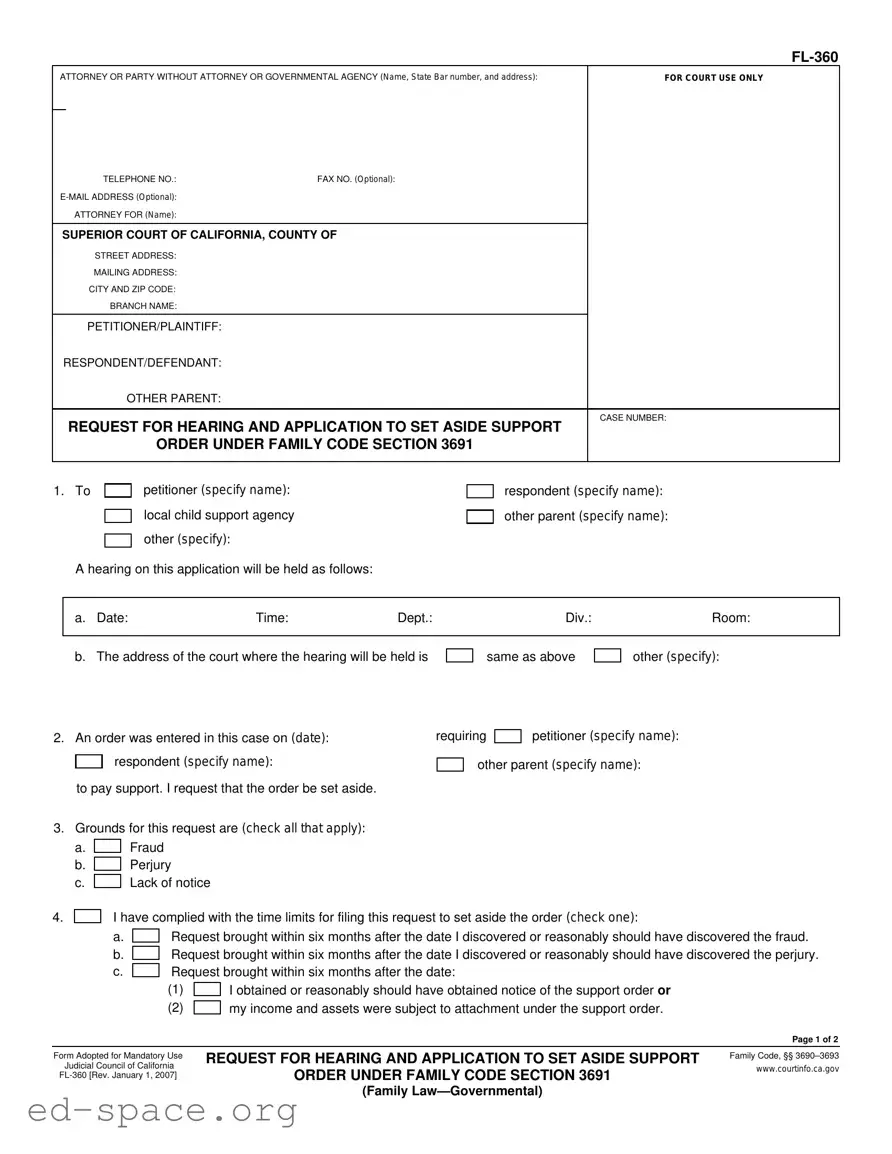
The California FL-360 form serves as a crucial tool for individuals seeking to challenge or set aside a support order previously established by the court. This form is primarily utilized within the context of family law, particularly under Family Code Section 3691. It requires the petitioner to provide essential information, including the names of the parties involved, the case number, and the specifics of the hearing request. The form outlines the grounds for requesting the modification, which may include fraud, perjury, or lack of notice regarding the original support order. It is imperative that the petitioner indicates compliance with the time limits for filing this request, as the law stipulates a six-month window from the discovery of the alleged issues. Additionally, the form emphasizes the importance of providing supporting facts, which must be detailed in an attached declaration. It is also worth noting that cases involving local child support agencies may be referred to a court commissioner, who can make recommendations but lacks the authority to issue final orders unless acting as a temporary judge. Understanding these aspects of the FL-360 form is essential for navigating the complexities of family law in California.
ATTORNEY OR PARTY WITHOUT ATTORNEY OR GOVERNMENTAL AGENCY (Name, State Bar number, and address): |
FOR COURT USE ONLY |
TELEPHONE NO.: |
FAX NO. (Optional): |
|
|
ATTORNEY FOR (Name): |
|
SUPERIOR COURT OF CALIFORNIA, COUNTY OF
STREET ADDRESS:
MAILING ADDRESS:
CITY AND ZIP CODE:
BRANCH NAME:
PETITIONER/PLAINTIFF:
RESPONDENT/DEFENDANT:
OTHER PARENT:
CASE NUMBER:
REQUEST FOR HEARING AND APPLICATION TO SET ASIDE SUPPORT
ORDER UNDER FAMILY CODE SECTION 3691
1. To
petitioner (specify name):
local child support agency
other (specify):
respondent (specify name):
other parent (specify name):
A hearing on this application will be held as follows:
a. Date: |
Time: |
Dept.: |
Div.: |
Room: |
|
|
|
|
|
b. The address of the court where the hearing will be held is
same as above
other (specify):
2. An order was entered in this case on (date):
respondent (specify name):
to pay support. I request that the order be set aside.
3. Grounds for this request are (check all that apply):
a. |
|
Fraud |
|
|
|
b. |
|
Perjury |
c. |
|
Lack of notice |
|
requiring |
|
petitioner (specify name): |
other parent (specify name):
4.
I have complied with the time limits for filing this request to set aside the order (check one):
a. |
|
Request brought within six months after the date I discovered or reasonably should have discovered the fraud. |
||
b. |
|
Request brought within six months after the date I discovered or reasonably should have discovered the perjury. |
||
|
||||
c. |
|
Request brought within six months after the date: |
||
|
||||
|
(1) |
|
I obtained or reasonably should have obtained notice of the support order or |
|
|
|
|||
|
(2) |
|
my income and assets were subject to attachment under the support order. |
|
|
|
|||
|
|
Page 1 of 2 |
|
Form Adopted for Mandatory Use |
REQUEST FOR HEARING AND APPLICATION TO SET ASIDE SUPPORT |
Family Code, §§ |
|
Judicial Council of California |
www.courtinfo.ca.gov |
||
ORDER UNDER FAMILY CODE SECTION 3691 |
|||
|
(Family

PETITIONER/PLAINTIFF:
RESPONDENT/DEFENDANT:
OTHER PARENT:
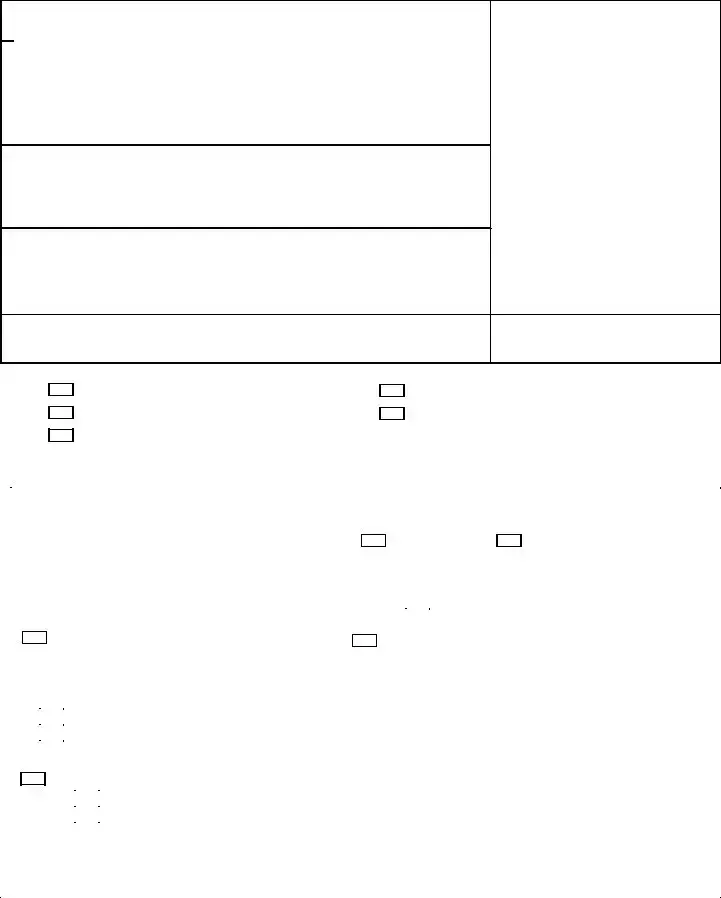
5. FACTS IN SUPPORT of relief requested are (specify):
CASE NUMBER:
Contained in the attached declaration.
I declare under penalty of perjury under the laws of the State of California that the foregoing is true and correct.
Date:
(TYPE OR PRINT NAME) |
(SIGNATURE OF DECLARANT) |
NOTICE FOR CASES INVOLVING A LOCAL CHILD SUPPORT AGENCY
This case may be referred to a court commissioner for hearing. By law, court commissioners do not have the authority to issue final orders and judgments in contested cases unless they are acting as temporary judges. The court commissioner in your case will act as a temporary judge unless, before the hearing, you or any other party objects to the commissioner acting as a temporary judge.
The court commissioner may still hear your case to make findings and a recommended order. If you do not like the recommended order, you must object to it within 10 court days; otherwise, the recommended order will become a final order of the court. If you object to the recommended order, a judge will make a temporary order and set a new hearing.
Request for Accommodations
Assistive listening systems,
REQUEST FOR HEARING AND APPLICATION
TO SET ASIDE SUPPORT ORDER
Page 2 of 2
(Family
| Fact Name | Description |
|---|---|
| Purpose of Form | The FL-360 form is used to request a hearing and apply to set aside a support order under California Family Code Section 3691. |
| Governing Law | This form is governed by California Family Code Sections 3690 to 3693, which outline the procedures for setting aside support orders. |
| Filing Time Limits | Requests to set aside a support order must be filed within six months of discovering fraud, perjury, or lack of notice regarding the support order. |
| Court Commissioner Role | In cases involving a local child support agency, a court commissioner may hear the case, but cannot issue final orders unless acting as a temporary judge. |
Filling out the California FL-360 form is an important step in addressing a support order issue. After completing the form, you will need to submit it to the court, where a hearing will be scheduled to review your request. Below are the steps to guide you through the process of filling out the form.
Once you have completed these steps, make sure to review your form for accuracy. After that, you can file it with the court and await your hearing date.
What is the purpose of the California FL 360 form?
The California FL 360 form is used to request a hearing and apply to set aside a support order under Family Code Section 3691. This form is typically filed by a party involved in a family law case who believes that the support order should be overturned due to specific grounds such as fraud, perjury, or lack of notice.
Who can file the FL 360 form?
The form can be filed by the petitioner, respondent, or other parent involved in the case. It can also be submitted by an attorney representing any of these parties. If a local child support agency is involved, they may also participate in the process.
What information is required on the FL 360 form?
The form requires details such as the names of the parties involved, the case number, and the grounds for requesting to set aside the support order. It also asks for a declaration of facts supporting the request. This information helps the court understand the basis for the application.
What are the grounds for requesting to set aside a support order?
Grounds for this request include fraud, perjury, and lack of notice. The party filing the form must check all applicable grounds to indicate why they believe the support order should be set aside.
What are the time limits for filing the FL 360 form?
The request must be filed within six months of discovering the fraud or perjury, or within six months of obtaining notice of the support order. It is essential to comply with these time limits to ensure that the request is considered by the court.
What happens after the FL 360 form is filed?
Once the form is filed, a hearing will be scheduled. The date, time, and location of the hearing will be specified on the form. It is crucial for all parties involved to attend the hearing, as the court will review the application and make a determination based on the evidence presented.
Can a court commissioner hear my case?
Yes, in cases involving a local child support agency, a court commissioner may hear your case. However, court commissioners cannot issue final orders in contested cases unless they are acting as temporary judges. If you have concerns about this, you can object before the hearing.
What if I disagree with the recommended order from the court commissioner?
If you disagree with the recommended order, you must file an objection within 10 court days. If you do not object, the recommended order will become a final order of the court. If you do object, a judge will make a temporary order and set a new hearing.
What accommodations are available for individuals with disabilities?
Assistive listening systems, computer-assisted real-time captioning, and sign language interpreter services are available upon request. It is important to ask for these accommodations at least five days before the proceeding to ensure they can be provided.
Incomplete Information: Failing to fill out all required fields can lead to delays. Ensure that all sections, including names and case numbers, are complete.
Incorrect Dates: Entering the wrong date for the support order or the discovery of fraud can invalidate the request. Double-check all dates for accuracy.
Not Specifying Grounds: Omitting to check the appropriate grounds for requesting to set aside the support order can result in rejection. Clearly indicate whether it is fraud, perjury, or lack of notice.
Failure to Meet Deadlines: Not adhering to the six-month time limit for filing the request can lead to dismissal. Be aware of the timeline and file promptly.
Missing Signature: Neglecting to sign the form can cause it to be deemed incomplete. Always sign and date the declaration to validate your request.
Ignoring Notification Requirements: Not understanding the implications of a court commissioner’s role can lead to confusion. Be aware of the process and your rights regarding objections to recommended orders.
The California FL-360 form is a crucial document used in family law cases, specifically for requesting a hearing to set aside a support order. It serves as a formal application to challenge an existing support order based on specific grounds such as fraud or lack of notice. Alongside the FL-360 form, several other documents may be required to support the application or to provide additional information to the court. Below is a list of commonly used forms and documents that often accompany the FL-360.
These documents collectively contribute to the legal process surrounding family law cases in California. Each form serves a specific purpose, ensuring that the court has all the necessary information to make informed decisions regarding support and related issues. Understanding these forms can greatly assist individuals navigating the complexities of family law.
The California FL-360 form is essential for individuals seeking to set aside a support order. It shares similarities with several other legal documents. Here’s a list of seven documents that are comparable to the FL-360 form, along with how they relate:
Understanding these documents can help you navigate the complexities of family law in California. Each serves a specific purpose but shares the common goal of addressing support issues in family law cases.
When filling out the California FL-360 form, it is crucial to follow specific guidelines to ensure your application is processed smoothly. Here are eight important dos and don'ts:
Following these guidelines can help ensure that your request is considered promptly and fairly. Take the time to prepare your application correctly to avoid unnecessary complications.
Understanding the California FL-360 form is crucial for anyone involved in family law matters. However, several misconceptions can lead to confusion. Here are five common misunderstandings:
Being aware of these misconceptions can help individuals navigate the process more effectively and make informed decisions regarding their family law matters.
Filling out and using the California FL 360 form requires attention to detail and understanding of the process. Here are key takeaways to keep in mind:
Completing the form accurately and timely is crucial for a successful outcome in your case.