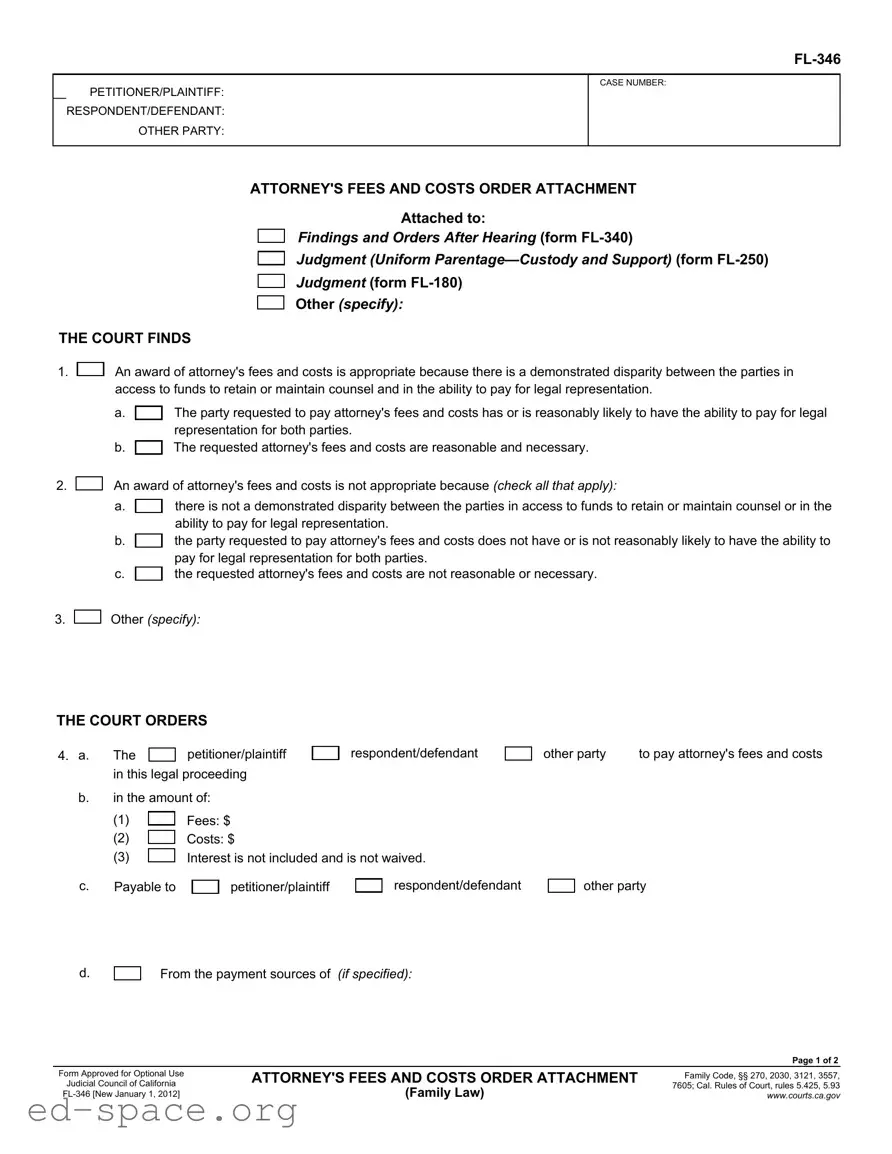
The California FL-346 form plays a crucial role in family law proceedings, particularly when it comes to addressing the financial aspects of legal representation. This form is specifically designed to facilitate the request for attorney's fees and costs, ensuring that both parties have fair access to legal counsel. When filling out the FL-346, the petitioner or plaintiff, along with the respondent or defendant, must provide essential information, including case numbers and the specific amounts requested for fees and costs. The form also requires the court to assess whether there is a significant disparity between the parties regarding their ability to pay for legal representation. If such a disparity exists, the court can order one party to pay a portion of the other party's attorney's fees and costs. Additionally, the FL-346 outlines the payment schedule and terms, including potential interest on overdue amounts, which is currently set at 10 percent per year. It is important for individuals involved in family law cases to understand how this form operates and the implications it carries for their financial responsibilities during legal proceedings.

—PETITIONER/PLAINTIFF:
RESPONDENT/DEFENDANT: OTHER PARTY:
CASE NUMBER:
ATTORNEY'S FEES AND COSTS ORDER ATTACHMENT
Attached to:
Findings and Orders After Hearing (form
Judgment (Uniform
Judgment (form
Other (specify):
THE COURT FINDS
1. |
|
|
An award of attorney's fees and costs is appropriate because there is a demonstrated disparity between the parties in |
||
|
|||||
|
|
|
access to funds to retain or maintain counsel and in the ability to pay for legal representation. |
||
|
|
|
a. |
|
The party requested to pay attorney's fees and costs has or is reasonably likely to have the ability to pay for legal |
|
|
|
|
||
|
|
|
|
|
representation for both parties. |
|
|
|
|
|
The requested attorney's fees and costs are reasonable and necessary. |
|
|
|
b. |
|
|
2. |
|
|
An award of attorney's fees and costs is not appropriate because (check all that apply): |
||
|
|
||||
|
|
||||
|
|
|
|
|
there is not a demonstrated disparity between the parties in access to funds to retain or maintain counsel or in the |
|
|
|
a. |
|
|
|
|
|
|
|
ability to pay for legal representation. |
|
|
|
|
|
the party requested to pay attorney's fees and costs does not have or is not reasonably likely to have the ability to |
|
|
|
b. |
|
|
|
|
|
|
|
pay for legal representation for both parties. |
|
|
|
|
|
the requested attorney's fees and costs are not reasonable or necessary. |
|
|
|
c. |
|
|
3. Other (specify):
THE COURT ORDERS
4. a. |
The |
|
petitioner/plaintiff |
|
respondent/defendant |
|
in this legal proceeding |
|
|
||
b.in the amount of:
(1) Fees: $
(2) Costs: $
|
(3) |
|
|
Interest is not included and is not waived. |
||||
|
|
|
||||||
c. |
Payable to |
|
|
petitioner/plaintiff |
|
respondent/defendant |
||
|
|
|
||||||
other party |
to pay attorney's fees and costs |
other party
d.
From the payment sources of (if specified):
|
|
Page 1 of 2 |
|
Form Approved for Optional Use |
ATTORNEY'S FEES AND COSTS ORDER ATTACHMENT |
Family Code, §§ 270, 2030, 3121, 3557, |
|
Judicial Council of California |
|||
7605; Cal. Rules of Court, rules 5.425, 5.93 |
|||
(Family Law) |
|||
www.courts.ca.gov |
—PETITIONER/PLAINTIFF:
RESPONDENT/DEFENDANT: OTHER PARTY:
CASE NUMBER:
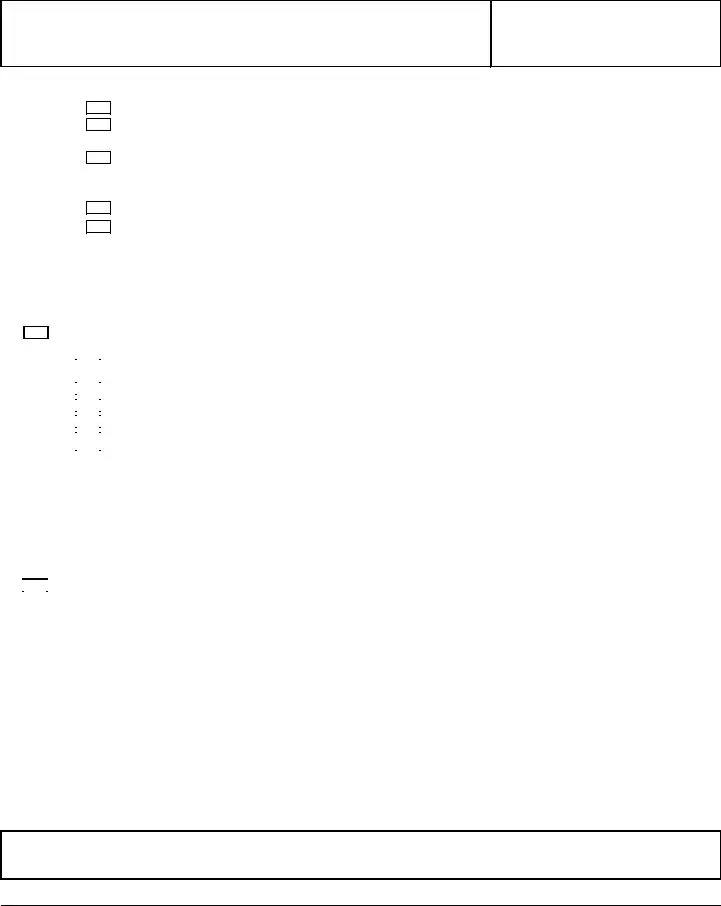
4. e. With a payment schedule of (specify):
(1)
(2)
(3)
(4)
(5)
Due in full, on or before (date): |
|
|
|
|
Due in installments, with monthly payments of (specify): $ |
, on the (specify): |
day of each month, |
||
beginning (date): |
until paid in full. |
|
|
|
If any payment is not timely made and more than |
days overdue, the entire unpaid balance will |
|||
immediately become due with interest at the legal rate, which is currently 10 percent per year, from the date of default to the date payment is finally made.
No interest will accrue as long as payments are timely made. Other (specify):
5.
This amount includes (check all that apply): |
|
||
a. |
|
a fee in the amount of (specify) $ |
to hire an attorney in a timely manner before the proceedings in the |
|
|||
|
|
matter go forward. |
|
|
|
|
|
b. |
|
attorney's fees and costs incurred to date in the amount of (specify): $ |
|
|
|
|
|
c. |
|
estimated attorney's fees and costs in the amount of (specify): $ |
|
|
|
|
|
d. |
|
attorney's fees and costs for limited scope representation in the amount of (specify): $ |
|
|
|
|
|
e. |
|
any amounts previously ordered that have not yet been paid (specify): $ |
|
f. |
|
Other (specify): |
|
|
|
||
6. Other orders (specify):
NOTICE: Any party required to pay attorney's fees and costs must pay interest on overdue amounts at the legal rate, which is currently 10 percent per year.
ATTORNEY'S FEES AND COSTS ORDER ATTACHMENT
Page 2 of 2
(Family Law)
| Fact Name | Details |
|---|---|
| Purpose of FL-346 | The FL-346 form is used to request an order for attorney's fees and costs in family law cases, ensuring that parties have equitable access to legal representation. |
| Governing Laws | This form is governed by California Family Code sections 270, 2030, 3121, and 3557, as well as California Rules of Court rules 5.425 and 5.93. |
| Payment Terms | The form outlines specific payment terms, including the total amount due, payment schedules, and consequences for late payments, such as accruing interest at a legal rate of 10 percent per year. |
| Attachments | FL-346 may be attached to various court documents, including Findings and Orders After Hearing (FL-340) and Judgments (FL-180, FL-250), to provide context for the request for fees. |
Filling out the California FL-346 form requires attention to detail and accuracy. This form is used in family law cases to address attorney's fees and costs. Once completed, it will be submitted to the court as part of your legal proceedings.
What is the purpose of the California FL-346 form?
The California FL-346 form is used to request an order for attorney's fees and costs in family law cases. This form is typically attached to other court documents, such as the Findings and Orders After Hearing (FL-340) or Judgments (FL-250, FL-180). It helps ensure that parties who may have a financial disadvantage in securing legal representation can obtain the necessary funds to hire an attorney.
Who can request attorney's fees and costs using the FL-346 form?
Any party involved in a family law case can request attorney's fees and costs by using the FL-346 form. This includes petitioners, respondents, or other parties in the case. The form serves to highlight any disparities in financial resources between the parties, which may justify the need for one party to assist the other in covering legal expenses.
What factors does the court consider when deciding on attorney's fees and costs?
The court will consider several factors when deciding whether to grant a request for attorney's fees and costs. Key considerations include the financial disparity between the parties, the ability of the party requested to pay the fees, and whether the requested amounts are reasonable and necessary. If the court finds that one party has sufficient funds to cover legal representation for both parties, it may grant the request.
What happens if the ordered payments are not made on time?
If a party fails to make the ordered payments on time, the entire unpaid balance may become due immediately. This includes interest at the legal rate, which is currently 10 percent per year, from the date of default until the payment is made. However, if payments are made on time, no interest will accrue. It’s essential to adhere to the payment schedule outlined in the order to avoid additional financial penalties.
Can the FL-346 form include additional orders or specifications?
Yes, the FL-346 form allows for additional orders or specifications to be included. Parties can specify details such as payment schedules, amounts for different types of attorney's fees, and any previously ordered amounts that remain unpaid. This flexibility helps tailor the order to the specific needs and circumstances of the case.
Inaccurate Information: One common mistake is providing incorrect or incomplete information about the parties involved. This includes misidentifying the petitioner, respondent, or other parties. Ensure that names and roles are accurately filled out to avoid delays in processing.
Missing Required Attachments: Failing to attach necessary documents can hinder the application process. For example, if the FL-346 form is being used with findings and orders after hearing, it must be attached to the FL-340 form. Always double-check that all required attachments are included.
Ignoring Payment Details: Some individuals overlook the specifics regarding attorney’s fees and costs. It’s essential to provide clear amounts for fees, costs, and any payment schedules. If these details are vague or missing, it could lead to confusion and potential disputes later on.
Not Checking Disparity Criteria: When indicating whether an award of attorney’s fees and costs is appropriate, individuals may forget to check all applicable boxes. This can result in an incomplete assessment of financial disparities between the parties, affecting the court's decision.
Neglecting to Specify Payment Sources: It's important to clearly outline where the payment for attorney's fees and costs will come from. Omitting this information can complicate the court’s understanding of financial arrangements and obligations.
The California FL-346 form, also known as the Attorney's Fees and Costs Order Attachment, is a document used in family law cases to request or respond to an order for attorney's fees and costs. This form is typically submitted alongside other related documents to ensure a comprehensive approach to legal representation costs. Below is a list of additional forms and documents often used in conjunction with the FL-346.
These forms collectively help to create a clear legal framework for addressing attorney's fees and costs in family law proceedings. Proper completion and submission of these documents can significantly impact the outcome of a case.
The California FL-346 form is primarily used in family law cases to address the issue of attorney's fees and costs. Several other documents serve similar purposes in different contexts or legal scenarios. Here’s a list of ten documents that share similarities with the FL-346 form:
When filling out the California FL-346 form, it’s important to approach the task with care. Here’s a helpful list of dos and don’ts to guide you through the process.
By following these guidelines, you can help ensure that your FL-346 form is completed correctly and efficiently. Taking the time to double-check your work can save you from potential complications down the line.
Here are some common misconceptions about the California FL-346 form:
This form is designed to address the financial disparity between parties, regardless of their income levels. It allows the court to assess whether one party needs assistance in covering attorney's fees and costs.
Filing the FL-346 does not automatically result in an award of fees. The court evaluates the circumstances and may decide that fees are not appropriate based on the financial situation of both parties.
This form can be used in various family law matters, including custody and support cases. Its purpose is to address attorney's fees in any situation where financial disparity exists.
The FL-346 allows for flexible payment arrangements. The court can establish a payment schedule, which may include monthly installments, depending on the circumstances.
Filling out and using the California FL-346 form is an important step in legal proceedings related to attorney's fees and costs. Here are key takeaways to keep in mind: