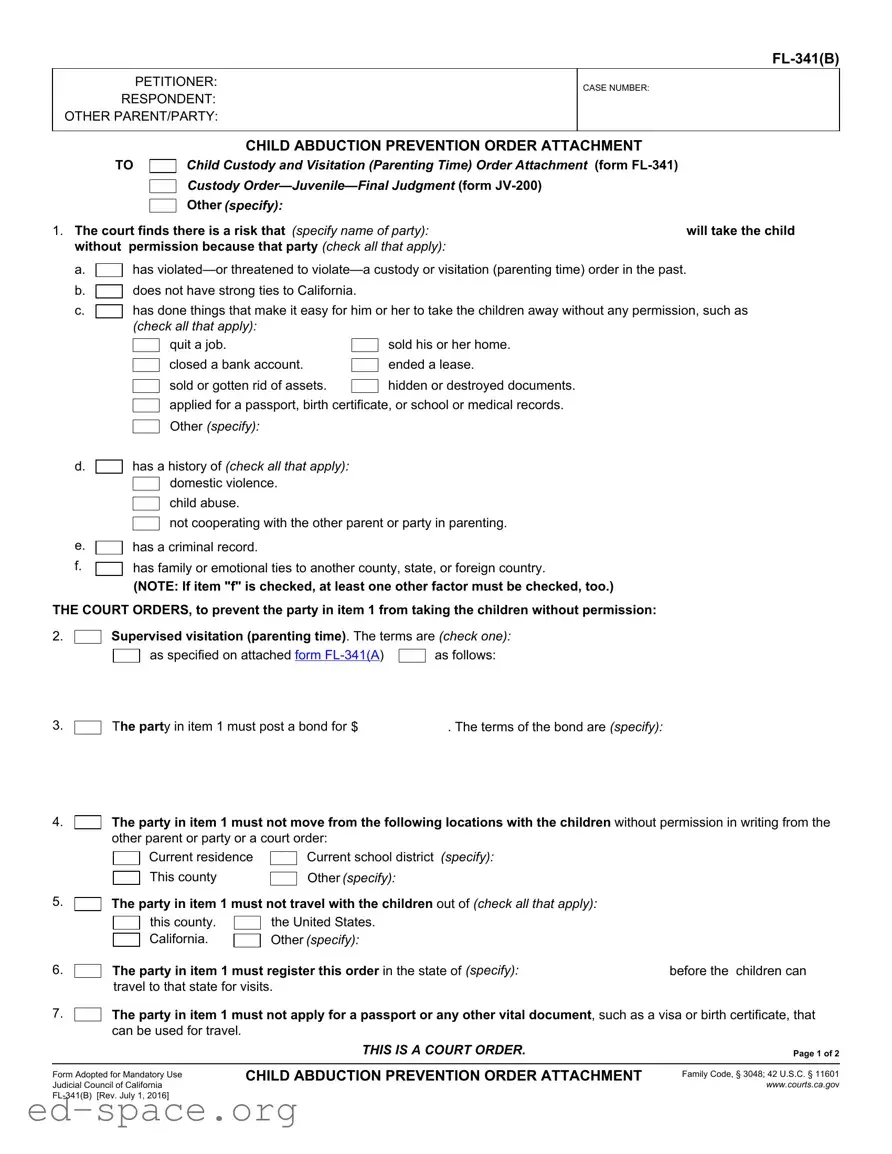
The California FL-341(B) form serves as a critical tool in the realm of child custody and visitation, particularly when there is a concern about the potential abduction of a child by a parent or guardian. This form is an attachment to the Child Abduction Prevention Order, which outlines specific findings that may indicate a risk of abduction. The court assesses various factors, such as past violations of custody orders, lack of ties to California, and any history of domestic violence or child abuse. It is designed to impose restrictions on the party deemed at risk of taking the child without permission, including supervised visitation and requirements for posting a bond. Additionally, the form mandates that certain vital documents, like passports, be surrendered and outlines the necessary notifications to be made to embassies or consulates. By establishing these guidelines, the FL-341(B) form aims to protect the child’s welfare while ensuring that both parents are aware of their rights and responsibilities. Understanding this form is essential for any parent navigating the complexities of custody arrangements in California.

PETITIONER:
RESPONDENT: OTHER PARENT/PARTY:
CASE NUMBER:
TO
CHILD ABDUCTION PREVENTION ORDER ATTACHMENT
Child Custody and Visitation (Parenting Time) Order Attachment (form
Custody
Other (specify):
1. The court finds there is a risk that (specify name of party): |
will take the child |
||||||
without permission because that party (check all that apply): |
|
||||||
a. |
|
has |
|||||
|
|||||||
b. |
|
|
does not have strong ties to California. |
|
|
||
|
|
|
|
||||
c. |
|
|
has done things that make it easy for him or her to take the children away without any permission, such as |
||||
|
|
||||||
|
|
|
(check all that apply): |
|
|
||
|
|
|
|
quit a job. |
|
sold his or her home. |
|
|
|
|
|
|
|
||
|
|
|
|
closed a bank account. |
|
ended a lease. |
|
|
|
|
|
|
|
||
|
|
|
|
sold or gotten rid of assets. |
|
hidden or destroyed documents. |
|
|
|
|
|
|
|
||
|
|
|
|
applied for a passport, birth certificate, or school or medical records. |
|
||
|
|
|
|
|
|||
Other (specify):
d.
has a history of (check all that apply):
domestic violence. child abuse.
not cooperating with the other parent or party in parenting.
e.
f.
has a criminal record.
has family or emotional ties to another county, state, or foreign country.
(NOTE: If item "f" is checked, at least one other factor must be checked, too.)
THE COURT ORDERS, to prevent the party in item 1 from taking the children without permission:
2. |
|
Supervised visitation (parenting time). The terms are (check one): |
||||
|
|
|
|
as specified on attached form |
|
as follows: |
|
|
|
|
|
||
3.
The party in item 1 must post a bond for $ |
. The terms of the bond are (specify): |
4.
5.
The party in item 1 must not move from the following locations with the children without permission in writing from the other parent or party or a court order:
Current residence |
|
Current school district (specify): |
This county |
|
Other (specify): |
|
The party in item 1 must not travel with the children out of (check all that apply):
this county. |
|
the United States. |
|
|
|
California. |
|
Other (specify): |
6.
7.
The party in item 1 must register this order in the state of (specify): |
before the children can |
travel to that state for visits. |
|
The party in item 1 must not apply for a passport or any other vital document, such as a visa or birth certificate, that can be used for travel.
THIS IS A COURT ORDER.
Page 1 of 2
Form Adopted for Mandatory Use Judicial Council of California
CHILD ABDUCTION PREVENTION ORDER ATTACHMENT
Family Code, § 3048; 42 U.S.C. § 11601
www.courts.ca.gov

PETITIONER:
RESPONDENT: OTHER PARENT/PARTY:
CASE NUMBER:
8.
9.
10.
The party in item 1 must turn in all the children's passports and other vital documents in the party's possession or control as specified below (List the documents that must be turned in. Include the details for turning in the documents to the court, one of the attorneys, the other party, or another person):
The party in item 1 must give the other parent or party the following before traveling with the children:
The children's travel itinerary
Copies of
Addresses and telephone numbers where the children can be reached at all times
An open airline ticket for the other parent in case the children are not returned
Other (specify):
The party in item 1 must notify the embassy or consulate of (specify country): |
about |
this order and provide the court with proof of that notification within (specify number): |
days. |
11. |
|
The party in item 1 must get a custody and visitation (parenting time) order equivalent to the most recent U.S. order |
|
|
before the children may travel to that country for visits. The court recognizes that foreign orders may be changed or enforced |
|
|
according to the laws of that country. |
12. Enforcing the order. The court authorizes any law enforcement officer to enforce this order. In this county, contact the Child Abduction Unit of the Office of the District Attorney at (phone number and address):
13. |
|
Other orders (specify): |
14. This order is valid in other states and in any country that has signed the Hague Convention on Child Abduction.
NOTICE TO AUTHORITIES IN OTHER STATES AND COUNTRIES
This court has jurisdiction to make child custody orders under California's Uniform Child Custody Jurisdiction and Enforcement Act (Fam. Code, § 3400 et seq.) and the Hague Convention on Civil Aspects of International Child Abduction (42 U.S.C.
§11601 et seq.). If jurisdiction is based on other factors, they are listed above in item 13.
Date:
JUDICIAL OFFICER
THIS IS A COURT ORDER.
CHILD ABDUCTION PREVENTION ORDER ATTACHMENT
Page 2 of 2
| Fact Name | Fact Description |
|---|---|
| Purpose | The FL-341(B) form is used to create a Child Abduction Prevention Order, aimed at protecting children from being taken without permission by a parent or guardian. |
| Governing Laws | This form is governed by California Family Code § 3048 and 42 U.S.C. § 11601, ensuring compliance with both state and federal regulations regarding child custody. |
| Risk Assessment | The court assesses risks that a parent may take a child without consent, considering past violations of custody orders and other concerning behaviors. |
| Supervised Visitation | If deemed necessary, the court may order supervised visitation, specifying the terms either on the form itself or via an attached document (FL-341(A)). |
| Bond Requirement | The court may require the parent identified as a risk to post a bond, ensuring compliance with the order and safeguarding the child's welfare. |
| Travel Restrictions | Parents may be restricted from traveling with the child outside of California or specific counties without written permission or a court order. |
| Passport Control | The order prohibits the parent from applying for or holding onto the child's passport or other vital documents that could facilitate unauthorized travel. |
| Notification Requirement | Parents must notify the relevant embassy or consulate about the order, providing proof of this notification within a specified timeframe. |
| Enforcement Authority | The order is enforceable by law enforcement officers, and specific local authorities, such as the Child Abduction Unit, are designated to assist in enforcement. |
Filling out the California FL-341 B form is an important step in ensuring the safety and well-being of children involved in custody disputes. After completing this form, it will be submitted to the court as part of the child abduction prevention order process. Follow these steps carefully to ensure that all necessary information is accurately provided.
What is the purpose of the California FL-341(B) form?
The California FL-341(B) form is designed to help prevent child abduction in custody cases. When a court believes there is a risk that one parent may take a child without permission, this form outlines specific conditions and restrictions to safeguard the child's welfare. It includes measures like supervised visitation, bond requirements, and limitations on travel, all aimed at ensuring that both parents have a say in the child's movements and that the child remains safe.
Who should file the FL-341(B) form?
The FL-341(B) form should be filed by a parent or legal guardian who has concerns about the other parent's potential to abduct their child. If there is evidence suggesting that the other parent may not return the child after visitation or has a history of violating custody agreements, this form becomes essential. It serves as a protective measure, allowing the concerned parent to present their case to the court and seek necessary orders to prevent abduction.
What kind of restrictions can be included in the FL-341(B) form?
The FL-341(B) form allows the court to impose various restrictions to prevent potential abduction. These may include supervised visitation, requirements for posting a bond, and restrictions on moving or traveling with the child. For instance, the form may specify that the parent cannot leave the county or state without written permission. Additionally, the court can order the surrender of passports and other vital documents, ensuring that the child cannot be taken out of the country without consent.
How does the FL-341(B) form enforce its orders?
The orders outlined in the FL-341(B) form are legally binding. Law enforcement officers are authorized to enforce these orders, ensuring compliance. If a parent violates the terms set forth in the form, the other parent can seek assistance from local authorities, such as the Child Abduction Unit. This enforcement mechanism is crucial for maintaining the safety and security of the child, as it allows for immediate action if a violation occurs.
Incomplete Information: Failing to fill in all required fields, such as the names of the parties or the case number, can lead to delays or rejection of the form.
Incorrect Checkmarks: Users often forget to check all applicable boxes. This can result in missing critical information that the court needs to assess the risk of child abduction.
Not Specifying Details: When listing actions that make it easy for a party to take children without permission, individuals may not provide enough detail. Specific examples strengthen the case.
Ignoring Additional Factors: If a party has a criminal record, it’s essential to check at least one other factor. Neglecting this requirement can invalidate parts of the form.
Missing Bond Information: Forgetting to specify the bond amount or its terms can lead to complications. This information is crucial for enforcing the order.
Failure to List Vital Documents: Not detailing which documents must be turned in, such as passports, may result in confusion and potential legal issues.
Neglecting Notification Requirements: Failing to notify the appropriate embassy or consulate about the order can lead to complications, especially when traveling internationally.
Not Understanding Enforcement: Many individuals do not realize that law enforcement can enforce this order. Understanding this can help in ensuring compliance.
The California FL-341 B form is part of the legal framework designed to prevent child abduction in custody cases. Several other forms and documents may accompany this form to address various aspects of child custody and visitation. Below is a list of these documents, each serving a specific purpose in the legal process.
Each of these documents plays a vital role in the legal process surrounding child custody and visitation. Properly completing and submitting them can significantly impact the outcome of custody arrangements and help ensure that the best interests of the child are prioritized.
The California FL-341(B) form, which addresses child abduction prevention, shares similarities with several other legal documents. Each of these documents serves a specific purpose in family law, particularly in matters of custody and visitation. Below is a list of documents that are similar to the FL-341(B) form, along with an explanation of their similarities:
Understanding these documents is essential for parents navigating the complexities of custody and visitation issues. Each form plays a role in ensuring the safety and well-being of children in potentially volatile situations. Familiarity with these documents can empower parents to take informed steps in protecting their rights and their children's futures.
When filling out the California FL-341 B form, there are several important guidelines to follow. Here’s a list of things you should and shouldn’t do to ensure that your submission is complete and accurate.
Misconception 1: The FL-341(B) form is only for cases involving international abduction.
This form is actually used to prevent any form of child abduction, whether it's domestic or international. It addresses various risks, including those posed by a parent who may not have strong ties to California or has a history of violating custody orders.
Misconception 2: Completing the FL-341(B) form guarantees that the court will issue a child abduction prevention order.
While submitting this form is an important step, it does not automatically lead to an order. The court must evaluate the specific circumstances and evidence presented before making a decision.
Misconception 3: The FL-341(B) form can only be filled out by lawyers.
Anyone involved in a custody case can complete this form. It is designed to be user-friendly, allowing parents or guardians to express their concerns about potential abduction risks without needing legal representation.
Misconception 4: Once the order is issued, it cannot be changed or revoked.
In fact, the order can be modified if circumstances change. If new evidence arises or if the situation evolves, either party can request a review of the order to ensure it remains relevant and appropriate.
Filling out the California FL-341(B) form, which is essential for establishing a Child Abduction Prevention Order, requires careful attention to detail. Here are some key takeaways to guide you through the process:
Completing this form accurately is crucial for protecting the child's welfare and ensuring that legal measures are in place to prevent abduction.