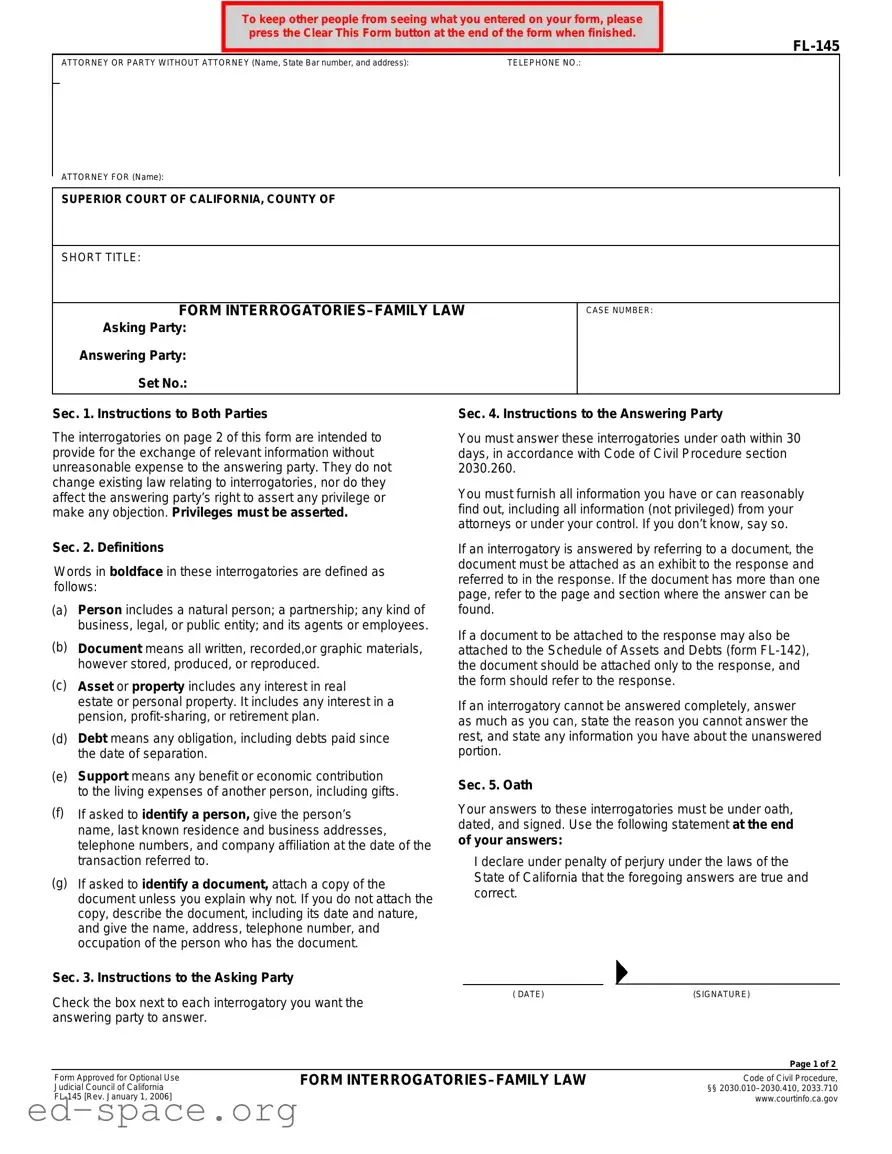
The California FL-145 form plays a crucial role in family law proceedings, serving as a tool for parties to exchange vital information. This form, known as the Form Interrogatories, facilitates the sharing of relevant details without imposing excessive burdens on the answering party. It includes specific instructions for both the asking and answering parties, ensuring clarity and compliance with legal standards. The interrogatories cover a range of topics, from personal history and financial disclosures to agreements between spouses or domestic partners. Each question is designed to elicit important information that can impact asset division, support obligations, and other critical aspects of a family law case. Notably, the form emphasizes the need for truthful responses under oath, reinforcing the importance of honesty in legal proceedings. By understanding the structure and requirements of the FL-145, individuals can navigate their family law cases more effectively and protect their interests.

To keep other people from seeing what you entered on your form, please press the Clear This Form button at the end of the form when finished.
ATTORNEY OR PARTY WITHOUT ATTORNEY (Name, State Bar number, and address): |
TELEPHONE NO.: |
ATTORNEY FOR (Name):
SUPERIOR COURT OF CALIFORNIA, COUNTY OF
SHORT TITLE:
FORM |
CASE NUMBER: |
|
Asking Party: |
|
|
Answering Party: |
|
|
Set No.: |
|
|
Sec. 1. Instructions to Both Parties |
Sec. 4. Instructions to the Answering Party |
|
The interrogatories on page 2 of this form are intended to |
You must answer these interrogatories under oath within 30 |
|
provide for the exchange of relevant information without |
days, in accordance with Code of Civil Procedure section |
|
unreasonable expense to the answering party. They do not |
2030.260. |
|
change existing law relating to interrogatories, nor do they |
You must furnish all information you have or can reasonably |
|
affect the answering party’s right to assert any privilege or |
||
make any objection. Privileges must be asserted. |
find out, including all information (not privileged) from your |
|
|
attorneys or under your control. If you don’t know, say so. |
|
Sec. 2. Definitions
Words in boldface in these interrogatories are defined as follows:
(a)Person includes a natural person; a partnership; any kind of business, legal, or public entity; and its agents or employees.
(b)Document means all written, recorded,or graphic materials, however stored, produced, or reproduced.
(c)Asset or property includes any interest in real
estate or personal property. It includes any interest in a pension,
(d)Debt means any obligation, including debts paid since the date of separation.
(e)Support means any benefit or economic contribution to the living expenses of another person, including gifts.
If an interrogatory is answered by referring to a document, the document must be attached as an exhibit to the response and referred to in the response. If the document has more than one page, refer to the page and section where the answer can be found.
If a document to be attached to the response may also be attached to the Schedule of Assets and Debts (form
If an interrogatory cannot be answered completely, answer as much as you can, state the reason you cannot answer the rest, and state any information you have about the unanswered portion.
Sec. 5. Oath
(f)If asked to identify a person, give the person’s name, last known residence and business addresses, telephone numbers, and company affiliation at the date of the transaction referred to.
(g)If asked to identify a document, attach a copy of the document unless you explain why not. If you do not attach the copy, describe the document, including its date and nature, and give the name, address, telephone number, and occupation of the person who has the document.
Sec. 3. Instructions to the Asking Party
Check the box next to each interrogatory you want the answering party to answer.
Your answers to these interrogatories must be under oath, dated, and signed. Use the following statement at the end of your answers:
I declare under penalty of perjury under the laws of the State of California that the foregoing answers are true and correct.
( DATE) |
(SIGNATURE) |
Page 1 of 2
Form Approved for Optional Use Judicial Council of California
FORM
Code of Civil Procedure,
§§

1.Personal history. State your full name, current residence address and work address, social security number, any other names you have used, and the dates between which you used each name.
2.Agreements. Are there any agreements between you and your spouse or domestic partner, made before or during your marriage or domestic partnership or after your separation, that affect the disposition of assets, debts, or support in this proceeding? If your answer is yes, for each agreement state the date made and whether it was written or oral, and attach a copy of the agreement or describe its contents.
3.Legal actions. Are you a party or do you anticipate being a party to any legal or administrative proceeding other than this action? If your answer is yes, state your role and the name, jurisdiction, case number, and a brief description of each proceeding.
4.Persons sharing residence. State the name, age, and relationship to you of each person at your present address.
5.Support provided others. State the name, age, address, and relationship to you of each person for whom you have provided support during the past 12 months and the amount provided per month for each.
6.Support received for others. State the name, age, address, and relationship to you of each person for whom you have received support during the past 12 months and the amount received per month for each.
7.Current income. List all income you received during
the past 12 months, its source, the basis for its computation, and the total amount received from each. Attach your last three paycheck stubs.
8.Other income. During the past three years, have you received cash or other property from any source not identified in item 7? If so, list the source, the date, and the nature and value of the property.
9.Tax returns. Attach copies of all tax returns and tax schedules filed by or for you in any jurisdiction for the past three calendar years.
10.Schedule of assets and debts. Complete the Schedule of Assets and Debts (form
11.Separate property contentions. State the facts that support your contention that an asset or debt is separate property.
12.Property valuations. During the past 12 months, have you received written offers to purchase or had written appraisals of any of the assets listed on your completed Schedule of Assets and Debts? If your answer is yes, identify the document.
13.Property held by others. Is there any property
held by any third party in which you have any interest or over which you have any control? If your answer is yes, indicate whether the property is shown on the Schedule of Assets and Debts completed by you. If it is not, describe and identify each such asset, state its present value and the basis for your valuation, and identify the person holding the asset.
14.Retirement and other benefits. Do you have an interest in any disability, retirement,
15.Claims of reimbursement. Do you claim the legal right to be reimbursed for any expenditures of your separate or community property? If your answer is yes, state all supporting facts.
16.Credits. Have you claimed reimbursement credits for payments of community debts since the date of separation? If your answer is yes, identify the source of payment, the creditor, the date paid, and the amount paid. State whether you have added to the debt since the separation.
17.Insurance. Identify each health, life, automobile, and disability insurance policy or plan that you now own or that covers you, your children, or your assets. State the policy type, policy number, and name of the company. Identify the agent and give the address.
18.Health. Is there any physical or emotional condition that limits your ability to work? If your answer is yes, state each fact on which you base your answer.
19.Children’s needs. Do you contend that any of your children have any special needs? If so, identify the child with the need, the reason for the need, its cost, and its expected duration.
20.Attorney fees. State the total amount of attorney fees and costs incurred by you in this proceeding, the amount paid, and the source of the money paid. Describe the billing arrangements.
21.Gifts. List any gifts you have made without the
consent of your spouse or domestic partner in the past 24 months, their values, and the recipients.
FORM |
|||||
|
|
|
|
|
|
|
|
|
|
|
|
For your protection and privacy, please press the Clear This Form |
|
|
|
|
|
|
Save This Form |
|
Print This Form |
||
button after you have printed the form. |
|
|
|
||
|
|
|
|
|
|
Page 2 of 2
Clear This Form
| Fact Name | Details |
|---|---|
| Purpose | The FL-145 form is designed to facilitate the exchange of relevant information between parties in a family law case without incurring unreasonable expenses. |
| Response Timeframe | Parties must respond to the interrogatories under oath within 30 days, as mandated by California Code of Civil Procedure section 2030.260. |
| Definitions | Key terms such as "Person," "Document," and "Asset" are clearly defined within the form to ensure clarity in responses. |
| Governing Laws | The FL-145 form is governed by California Code of Civil Procedure sections 2030.010–2030.410 and 2033.710. |
Completing the California FL-145 form is an important step in your family law case. After filling out this form, you will need to submit it according to the court's instructions. Make sure to keep a copy for your records.
What is the purpose of the California FL 145 form?
The California FL 145 form is used in family law cases to facilitate the exchange of important information between parties. It contains a series of questions, known as interrogatories, that require parties to provide details about their personal history, financial situation, and any agreements relevant to the case. This form aims to ensure that both parties have access to the necessary information to resolve issues related to assets, debts, and support without incurring excessive costs.
How long do I have to respond to the interrogatories on the FL 145 form?
You are required to respond to the interrogatories within 30 days of receiving the form. This timeframe is set by the California Code of Civil Procedure section 2030.260. It is essential to answer all questions under oath and ensure that your responses are accurate and complete. If you cannot answer a question fully, provide as much information as possible and explain the reason for any incomplete responses.
What happens if I do not respond to the FL 145 form?
Failing to respond to the FL 145 form can have significant consequences. The court may interpret your lack of response as a failure to comply with legal obligations, which could result in penalties. This may include sanctions or adverse inferences drawn against you in the case. It is crucial to adhere to the deadlines and provide the required information to avoid complications in your proceedings.
Can I attach documents to my responses on the FL 145 form?
Yes, you can and should attach relevant documents to your responses. If a question requires you to refer to a document, you must provide a copy of that document as an exhibit to your response. Ensure that you clearly identify the document and include any necessary details, such as the date and nature of the document. If the document is lengthy, indicate the specific page and section where the answer can be found.
What should I do if I do not know the answer to a question on the FL 145 form?
If you do not know the answer to a question, it is important to state that clearly in your response. You should provide as much information as you can and explain why you are unable to answer the question completely. Honesty and transparency in your responses are vital, as they contribute to the integrity of the information exchanged during the legal process.
Incomplete Personal Information: Failing to provide your full name, current residence, and work address can lead to confusion and delays. Ensure that all personal details are accurately filled out.
Missing Signatures: Not signing the form or forgetting to include the declaration statement under penalty of perjury can invalidate your responses. Always double-check for your signature at the end.
Neglecting to Attach Required Documents: If an interrogatory refers to a document, it is crucial to attach it. Omitting necessary documents can result in incomplete responses and possible penalties.
Vague Responses: Providing unclear or ambiguous answers can lead to misunderstandings. Be specific and detailed in your responses to avoid further inquiries.
Ignoring Deadlines: The form requires responses within 30 days. Missing this deadline can have serious consequences, including potential legal ramifications.
Failure to Assert Privileges: If there are any privileges that apply to your information, make sure to assert them. Not doing so may waive your rights to confidentiality.
Inaccurate Financial Reporting: Listing incorrect income, assets, or debts can lead to legal issues. Ensure that all financial information is accurate and up-to-date to avoid complications.
The California FL-145 form, known as the Form Interrogatories for Family Law, is an essential document used during family law proceedings. It facilitates the exchange of information between parties involved in a case, helping to clarify various aspects related to assets, debts, and support. Alongside this form, several other documents are often utilized to ensure a comprehensive understanding of the issues at hand. Below are four key forms that are frequently used in conjunction with the FL-145.
Understanding these forms and how they interconnect with the FL-145 is vital for individuals navigating family law cases. Each document plays a significant role in ensuring that all relevant information is shared, promoting fairness and clarity throughout the legal process.
The California FL 145 form is similar to several other documents used in family law cases. Each serves a specific purpose in gathering information and facilitating communication between parties. Here are six documents that share similarities with the FL 145 form:
When filling out the California FL-145 form, it’s important to follow specific guidelines to ensure accuracy and compliance. Here’s a list of things you should and shouldn’t do:
Understanding the California FL-145 form is essential for anyone involved in family law cases. However, there are several misconceptions surrounding this form. Here are four common misunderstandings:
Being informed about these misconceptions can help individuals navigate the family law process more effectively. Understanding the requirements and implications of the FL-145 form is crucial for ensuring a smooth legal experience.
Filling out the California FL-145 form can be a crucial step in family law cases. Here are some key takeaways to keep in mind:
By following these guidelines, you can navigate the FL-145 form more effectively and ensure that you are providing the necessary information in your family law case.