Homepage Blank California Executive Clemency PDF Form
Article Guide

The California Executive Clemency form serves as a vital tool for individuals seeking relief from the consequences of their past convictions. This application allows a person to request various forms of clemency, including a commutation of sentence, a traditional pardon, or a reduction in conviction level or sentence. It also provides options for release from prison, discharge from parole, and even a declaration of innocence. Completing the form requires personal details such as the applicant's name, date of birth, and social security number, along with specific information about their conviction, including the arresting agency, trial details, and the sentence imposed. Applicants must also disclose their rehabilitation efforts, prison record, and the reasons for their request. Additionally, the form includes questions about prior applications for clemency and any appeals that may have been filed. To ensure the application is processed, it must be notarized and accompanied by a Notice of Intention to Apply for Executive Clemency, which must be sent to the district attorneys in each county where the applicant has felony convictions. This comprehensive approach aims to provide a fair opportunity for individuals to move forward in their lives while acknowledging the seriousness of their past actions.
Document Preview

Form Specifications

Fact Name Description
Governing Law The California Executive Clemency form is governed by Penal Code Section 4800.
Application Requirements Applicants must provide personal information, conviction details, and rehabilitation efforts.
Submission Process A Notice of Intention to Apply for Executive Clemency must be mailed to each District Attorney in relevant counties before the Governor acts on the request.
Notarization Requirement The application must be signed by the applicant and notarized to be considered valid.

California Executive Clemency: Usage Guidelines

Completing the California Executive Clemency form is a detailed process that requires careful attention to the information being provided. After submitting the form, it will be reviewed, and the next steps will depend on the specifics of your application and the Governor's decision-making process.

  1. Obtain the California Executive Clemency form. Ensure you have the most recent version available.
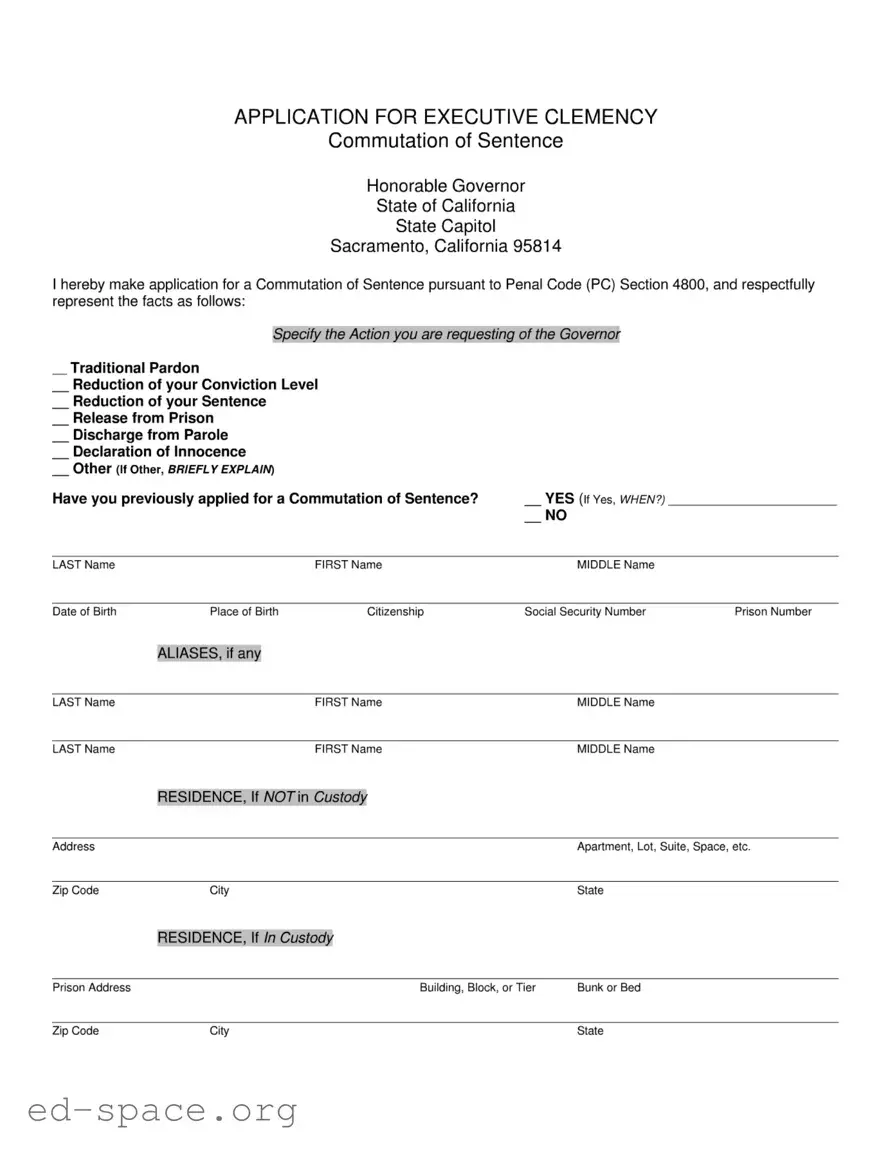
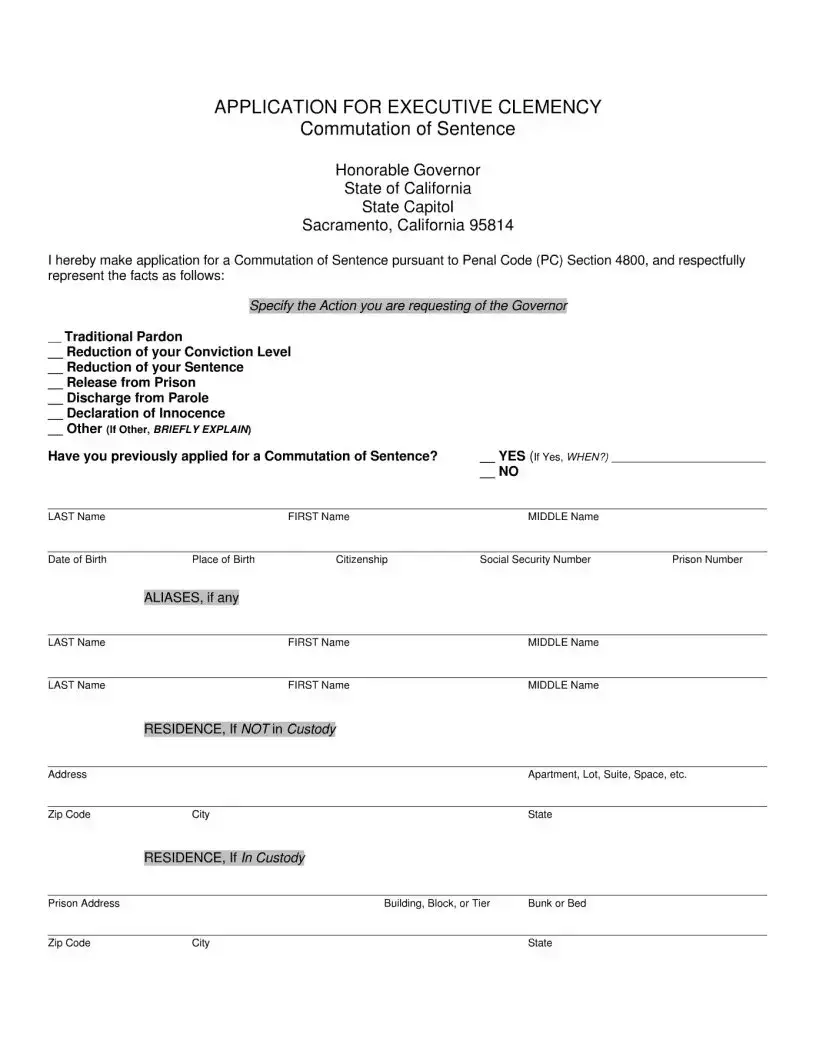
  2. Begin by filling out your personal information, including your last name, first name, middle name, date of birth, place of birth, citizenship, social security number, and prison number if applicable.
  3. Indicate the action you are requesting from the Governor. Options include a traditional pardon, reduction of your conviction level, reduction of your sentence, release from prison, discharge from parole, declaration of innocence, or other. If selecting "other," provide a brief explanation.
  4. Answer whether you have previously applied for a commutation of sentence. If yes, include the date of your last application.
  5. Provide your residence information. If not in custody, include your address, city, state, and zip code. If in custody, provide your prison address.
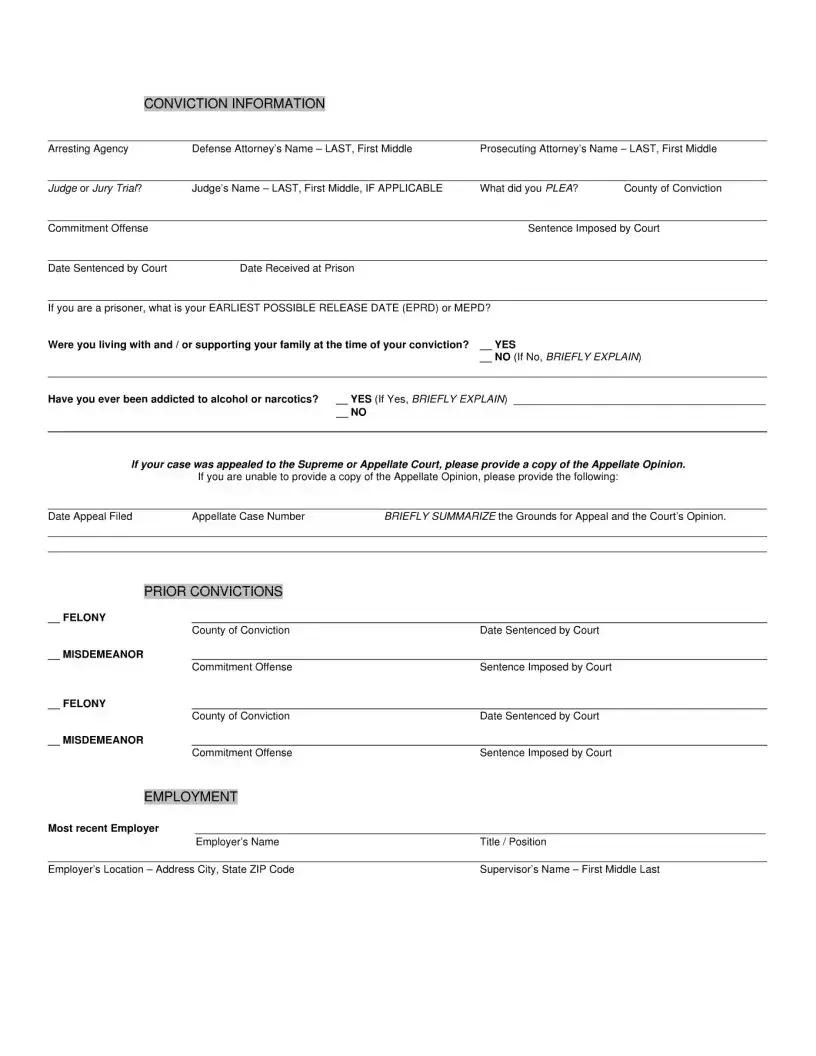
  6. Fill out the conviction information section. This includes details about the arresting agency, whether your case went to judge or jury trial, commitment offense, sentencing details, and names of involved attorneys.
  7. Indicate your plea and provide the county of conviction along with the sentence imposed by the court and the date you were received at prison.
  8. If applicable, state your earliest possible release date (EPRD) or minimum eligible parole date (MEPD).
  9. Answer questions regarding your living situation at the time of conviction and any history of addiction to alcohol or narcotics.
  10. If your case was appealed, provide the appellate case number, date filed, and a brief summary of the grounds for appeal and the court's opinion.
  11. List any prior convictions, including details about the offenses and sentences.
  12. Provide employment information, including your most recent employer's name, address, job title, and supervisor's name.
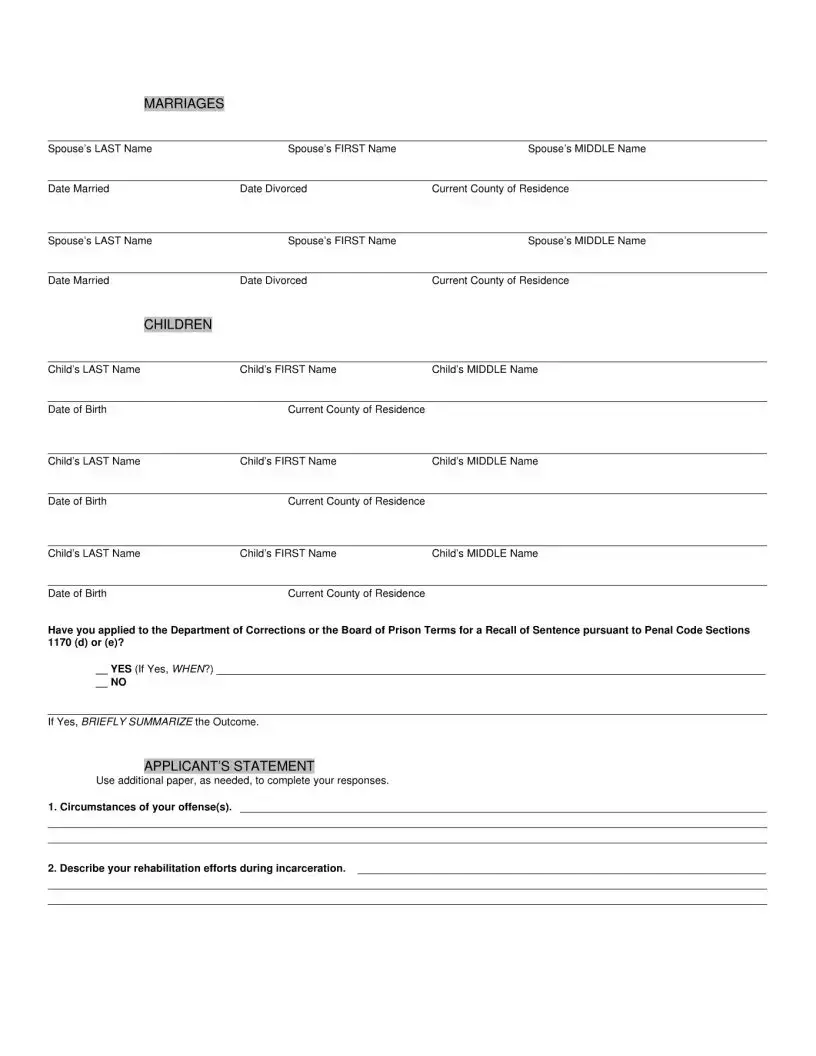
  13. Fill out the marriage and children sections, including names, dates of marriage, and dates of birth for children.
  14. Answer whether you have applied to the Department of Corrections or the Board of Prison Terms for a recall of sentence, and summarize the outcome if applicable.
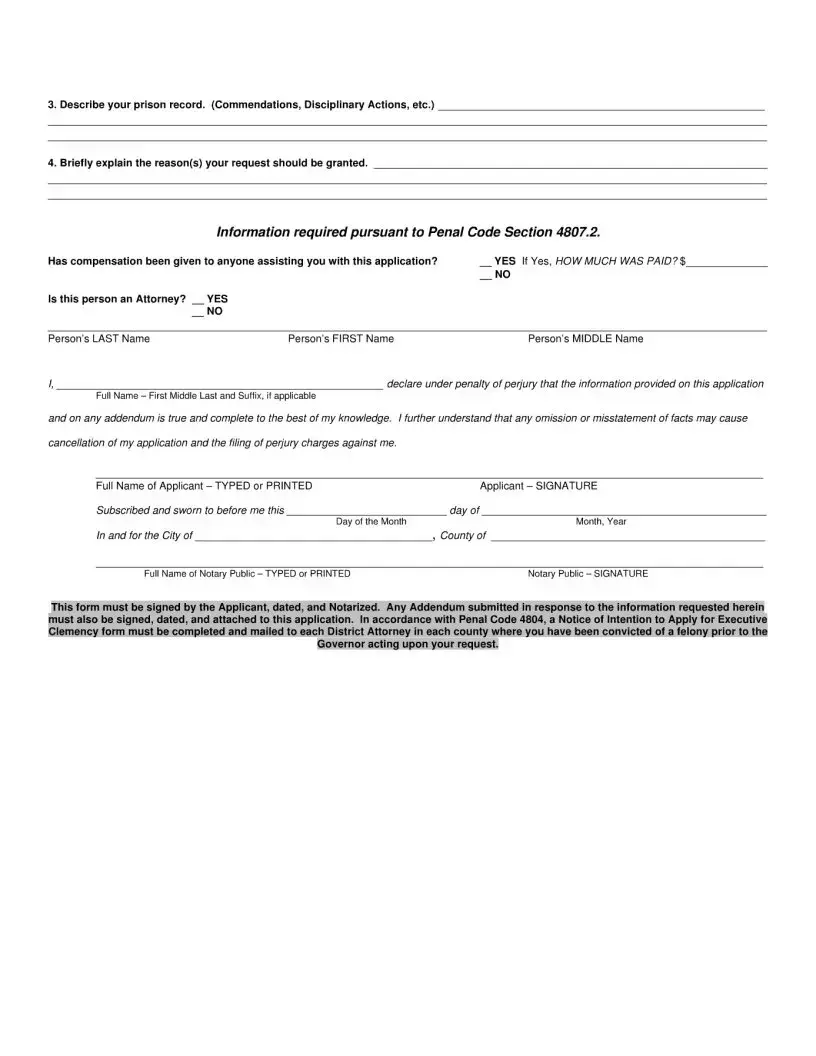
  15. Complete the applicant's statement section. Describe the circumstances of your offenses, your rehabilitation efforts during incarceration, your prison record, and reasons your request should be granted.
  16. Disclose any compensation given to anyone assisting with your application and whether that person is an attorney.
  17. Sign and date the application. Ensure it is notarized. The form must be signed by you, and any additional pages must also be signed and attached.
  18. Complete and mail a Notice of Intention to Apply for Executive Clemency form to each District Attorney in each county where you have been convicted of a felony.

Your Questions, Answered

What is the purpose of the California Executive Clemency form?

The California Executive Clemency form is used to apply for a commutation of sentence. Individuals can request a reduction of their conviction level, sentence, or even seek a traditional pardon. This form allows applicants to present their case to the Governor of California for consideration.

Who is eligible to apply for clemency?

Individuals who have been convicted of a felony in California may apply for clemency. Eligibility can depend on various factors, including the nature of the offense, the time served, and evidence of rehabilitation. It is essential to meet the criteria outlined in the application to be considered.

What information is required on the application?

The application requires personal information, such as the applicant's name, date of birth, and social security number. Additionally, details about the conviction, plea, sentencing, and any prior convictions must be included. Applicants must also describe their rehabilitation efforts and circumstances surrounding their offense.

Is there a fee associated with submitting the clemency application?

No, there is no fee required to submit the California Executive Clemency application. However, applicants are responsible for any costs associated with obtaining necessary documentation, such as court records or legal representation.

What happens after the application is submitted?

Once the application is submitted, it will be reviewed by the Governor's office. The review process may involve a thorough examination of the applicant's criminal history, rehabilitation efforts, and any supporting documentation. The Governor will ultimately decide whether to grant or deny the request for clemency.

Can I apply for clemency if I have previously applied and was denied?

Yes, individuals can reapply for clemency even if their previous application was denied. It is advisable to include new information or demonstrate additional rehabilitation efforts that may support the new application.

Do I need legal representation to complete the application?

While legal representation is not required to complete the clemency application, it can be beneficial. An attorney experienced in clemency cases can provide guidance, help gather necessary documentation, and strengthen the application by presenting a compelling case.

What is the role of the District Attorney in the clemency process?

Before the Governor acts on a clemency request, applicants must submit a Notice of Intention to Apply for Executive Clemency form to each District Attorney in the counties where they were convicted. This gives the District Attorneys an opportunity to review the application and provide their input, which may influence the Governor's decision.

Common mistakes

  1. Incomplete Information: Many applicants fail to provide all necessary details, such as their full name, date of birth, or prison number. Omitting this information can delay the processing of the application.

  2. Incorrect Action Requested: Applicants sometimes do not specify the correct action they are requesting from the Governor. It is crucial to clearly indicate whether seeking a traditional pardon, reduction of conviction level, or another option.

  3. Failure to Summarize Grounds for Appeal: If applicable, a brief summary of the grounds for appeal and the court's opinion is required. Neglecting this section can weaken the application.

  4. Not Providing Rehabilitation Efforts: Applicants often overlook the importance of detailing their rehabilitation efforts during incarceration. This information is vital for demonstrating personal growth and change.

  5. Missing Signatures and Notarization: The application must be signed, dated, and notarized. Failing to complete these steps can lead to immediate rejection of the application.

Documents used along the form

The process of applying for executive clemency in California involves several key documents that support the main application. Each of these documents serves a specific purpose and provides critical information to the Governor's office as they consider the request. Below is a list of commonly used forms and documents that accompany the California Executive Clemency form.

  • Notice of Intention to Apply for Executive Clemency: This form must be completed and submitted to each District Attorney in every county where the applicant has been convicted of a felony. It serves as a formal notification of the applicant's intention to seek clemency.
  • Appellate Opinion: If the applicant's case was appealed, a copy of the appellate court's opinion is often required. This document outlines the grounds for the appeal and the court's decision, providing context for the clemency request.
  • Personal Statement: This is a narrative written by the applicant that details the circumstances surrounding the offense, rehabilitation efforts, and reasons for requesting clemency. It allows the applicant to present their case in a personal and compelling manner.
  • Employment Verification: Documentation from the applicant's most recent employer may be included to demonstrate stability and responsibility. This can help illustrate the applicant's efforts to reintegrate into society.
  • Character References: Letters from individuals who can attest to the applicant's character and rehabilitation may be submitted. These references can provide insight into the applicant's journey and support the clemency request.

Each of these documents plays a vital role in the clemency application process. Together, they create a comprehensive picture of the applicant's circumstances and efforts toward rehabilitation. It is essential to prepare these documents carefully, as they significantly influence the Governor's decision.

Similar forms

The California Executive Clemency form shares similarities with several other legal documents that facilitate various forms of relief or modification of criminal sentences. Below is a list detailing these documents and their corresponding similarities:

  • Pardon Application: Like the clemency form, a pardon application requests forgiveness for a past crime, aiming to restore rights and clear a person's record.
  • Application for Post-Conviction Relief: This document allows individuals to challenge their convictions or sentences based on new evidence or legal errors, similar to how clemency seeks to address the consequences of a conviction.
  • Request for Sentence Modification: This request is made to a court to alter the terms of a sentence. It parallels the clemency application in seeking a reduction or change in sentencing conditions.
  • Application for Parole: Individuals seeking early release from prison submit this application. It is similar to clemency in that both processes involve seeking relief from incarceration.
  • Compassionate Release Request: This document is used to request release from prison due to severe medical conditions. Like clemency, it considers the individual's circumstances and the impact of continued incarceration.
  • Application for Expungement: This process allows individuals to have their criminal records sealed or erased. It is akin to clemency as both aim to alleviate the long-term consequences of a criminal conviction.
  • Application for a Certificate of Rehabilitation: This document is a formal request to demonstrate rehabilitation after a conviction. It is similar to clemency in that both affirm an individual's reformation and readiness to reintegrate into society.
  • Application for a Recall of Sentence: This application seeks to reduce a sentence based on specific criteria. It shares a common goal with clemency in that both aim to reassess the appropriateness of the original sentence.

Each of these documents serves a unique purpose but ultimately reflects the broader legal principle of providing individuals with opportunities for redemption and relief from past mistakes.

Dos and Don'ts

When filling out the California Executive Clemency form, it’s important to follow certain guidelines to ensure your application is complete and effective. Here’s a list of things you should and shouldn’t do:

  • Do read the entire application carefully before starting.
  • Do provide accurate and complete information in all sections.
  • Do explain any "yes" answers briefly and clearly.
  • Do include any relevant documents, such as appellate opinions, if applicable.
  • Do have your application notarized before submission.
  • Don’t leave any sections blank; fill in all required fields.
  • Don’t exaggerate or provide misleading information.
  • Don’t forget to sign and date the application.
  • Don’t submit your application without mailing the Notice of Intention to Apply for Executive Clemency to the relevant District Attorneys.

Following these guidelines will help you present a thorough and credible application for clemency. Good luck!

Misconceptions

Here are some common misconceptions about the California Executive Clemency form:

  • It guarantees a pardon or sentence reduction. Many believe that submitting the form will automatically result in a favorable outcome. However, the decision is at the Governor's discretion.
  • Only serious crimes can be considered. Some think that only violent felonies are eligible for clemency. In reality, individuals convicted of various offenses can apply.
  • You must have served your full sentence. It's a common belief that you need to complete your sentence before applying. You can seek clemency even if you are still incarcerated.
  • All applications are reviewed equally. Not every application receives the same level of attention. Factors like the nature of the crime and rehabilitation efforts play a significant role.
  • You cannot apply if you have prior convictions. Some people think that a history of previous convictions disqualifies them. However, prior convictions do not automatically prevent you from applying.
  • Legal representation is mandatory. While having an attorney can be helpful, it is not a requirement to submit the clemency application.
  • The process is quick and straightforward. Many assume that clemency applications are processed quickly. In reality, the review process can take a considerable amount of time.
  • Once submitted, you cannot make changes. Some believe that the application is final once submitted. In fact, you can provide additional information or corrections if needed.

Key takeaways

When filling out the California Executive Clemency form, there are several important points to keep in mind. Understanding these key takeaways can help streamline the process and increase the likelihood of a successful application.

  • Be Clear About Your Request: Specify the exact action you are seeking from the Governor, such as a pardon or reduction of your sentence. Clarity will help the review process.
  • Provide Complete Personal Information: Ensure that all personal details, including your full name, date of birth, and social security number, are accurately filled out. This helps avoid delays.
  • Detail Your Conviction: Include comprehensive information about your conviction, including the arresting agency, trial details, and the sentence imposed. This context is crucial for the review.
  • Summarize Rehabilitation Efforts: Use the applicant's statement section to describe your rehabilitation efforts during incarceration. Highlight any programs completed or positive changes made.
  • Include Prior Convictions: If applicable, list any prior convictions, including details about the offenses and sentences. This transparency is important for the evaluation.
  • Notarization is Essential: Remember that the application must be signed, dated, and notarized. Failure to do so can result in rejection of your application.
  • Notify Relevant District Attorneys: Before submitting your application, complete and send a Notice of Intention to Apply for Executive Clemency to each District Attorney in counties where you have felony convictions. This step is necessary for the Governor to consider your request.

By focusing on these key aspects, you can enhance your application and navigate the clemency process with confidence.